What Is PPC? The Brutally Honest Guide That Actually Makes You Money
Let me ask you something uncomfortable.
You've probably seen the acronym PPC thrown around in every marketing blog, agency pitch deck, and LinkedIn post since 2005. You nodded along. You maybe even used it in a sentence.
But do you actually know what PPC is — not just the textbook definition, but the mechanics, the psychology, the traps, and the moments where it prints money like a broken ATM?
Probably not. And that's okay. Because most people writing about PPC are either trying to sell you something or explaining it like you're in a certification exam.
This isn't that.
This is the real thing.
The One-Sentence Answer Nobody Gives You
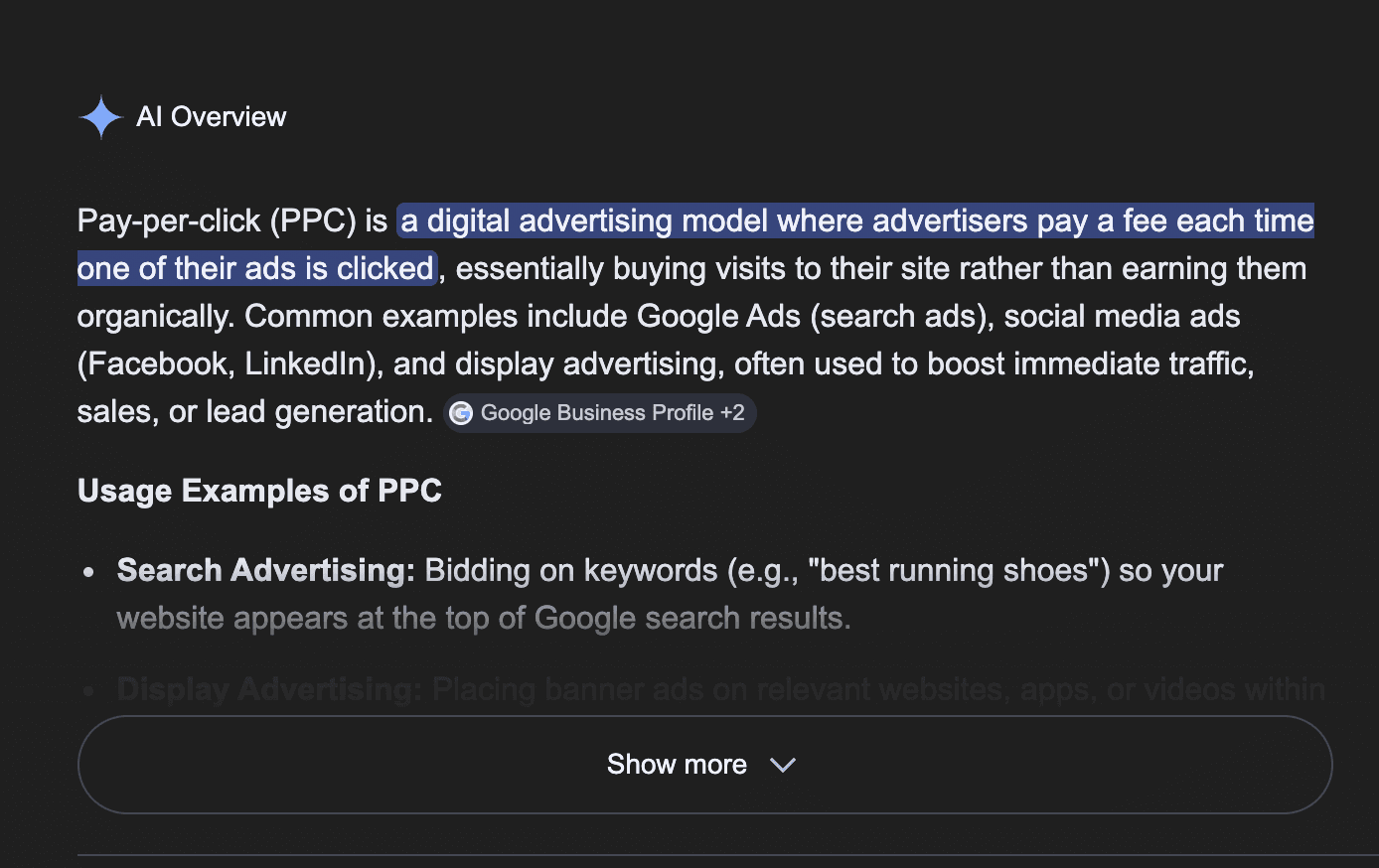
PPC — Pay-Per-Click — is an online advertising model where you pay only when someone actually clicks your ad.
That's it. That's the whole thing.
Except, of course, it isn't. Because that simple sentence hides an entire ecosystem of auctions, psychology, data, bidding wars, Quality Scores, landing page science, and conversion voodoo that can either make your business or quietly drain your bank account while you sleep.
So let's go deeper.
What PPC Actually Is (Beyond the Definition)
Here's what most articles won't tell you: PPC isn't really an advertising model. It's a demand harvesting engine.
Think about it. When someone types "emergency plumber London" into Google at 11pm on a Sunday, they are not browsing. They are not casually scrolling. They are in pain, they have intent, and they have their credit card one arm's reach away.
PPC lets you intercept that person at the exact moment they've decided they want something.
That's not advertising. That's fishing with a net at the precise moment the fish are jumping.
Compare that to a billboard. You put your message in front of thousands of people hoping that, statistically speaking, one of them might vaguely sort of be interested. That's not targeting. That's praying.
PPC flips the model entirely. Instead of chasing eyeballs, you position yourself in front of hands already reaching into their wallet.
The Core Mechanics: How PPC Actually Works
Let's walk through the engine room.
The Auction Nobody Told You About
Every time someone searches a keyword, an auction happens. Not a slow, hand-raising auction. A lightning-fast computational auction that resolves in milliseconds while the search page loads.
Hundreds of advertisers can be bidding on the same search query simultaneously. Google (or Bing, or whoever) runs the numbers and decides who shows up, in what order, and how much each click costs.
Here's the part that blows people's minds: the highest bidder doesn't always win.
Google uses something called the Ad Rank formula:
Ad Rank = Bid × Quality Score × Expected Impact of Ad Extensions
Quality Score is Google's way of asking, "Is this ad actually useful to the person searching?" It factors in:
Click-through rate (CTR) — do people actually click your ad?
Ad relevance — does your ad match what the person searched?
Landing page experience — when people land on your page, do they find what they came for?
This means a highly relevant ad with a $2 bid can beat a sloppy ad with a $10 bid. Google isn't a charity — they want to show the best result because happy searchers come back. So the system rewards advertisers who actually respect their audience.
This is the single most important thing to understand about PPC: it rewards relevance, not just money.
The CPC Calculation (And Why You're Probably Overpaying)
Once the auction runs, the actual cost per click (CPC) is calculated using the formula:
Your CPC = (Ad Rank of person below you ÷ Your Quality Score) + $0.01
You only pay one cent more than what it would take to beat the next competitor. This is called a second-price auction.
What this means practically: improving your Quality Score doesn't just improve your ad position. It literally lowers what you pay per click. A jump from a Quality Score of 5 to 8 on the same keyword can cut your costs by 30–50% while simultaneously pushing you higher in the results.
That's leverage. Real, measurable, compounding leverage.
The PPC Ecosystem: It's Bigger Than Google
When most people say PPC, they mean Google Ads. And yes, Google dominates — the Google Search Network processes over 8.5 billion searches per day, and Google Ads has roughly 29% of the entire global digital advertising market.
But PPC lives across a sprawling ecosystem.
Search PPC: Google Ads and Microsoft Advertising (Bing). Text-based ads that appear when someone types a query. Highest intent traffic you'll find anywhere.
Social PPC: Facebook Ads, Instagram Ads, LinkedIn Ads, TikTok Ads, Pinterest Ads, X (formerly Twitter) Ads. You're not catching people mid-search — you're interrupting their scroll. Lower purchase intent but unmatched demographic targeting. Want to reach CFOs at SaaS companies with 200-500 employees in the Midwest? LinkedIn can do that.
Display PPC: Banner and visual ads across the Google Display Network — over 2 million websites. Useful for brand awareness and retargeting. Terrible for direct conversion if you're not strategic.
Shopping PPC: Google Shopping and Microsoft Shopping. Product image ads that appear at the top of search results for product queries. E-commerce gold. If you're selling physical products and you're not running Shopping campaigns, you're leaving money in the road.
Video PPC: YouTube ads (which are managed through Google Ads). Pre-roll, mid-roll, bumper ads. The most underpriced attention in digital advertising right now. A 30-second non-skippable ad on a competitor keyword for $0.03 a view? Yes, that exists.
Amazon PPC: Sponsored Products, Sponsored Brands, Sponsored Display. If you sell on Amazon, this is its own universe with its own rules. Ignore it at your peril.
Programmatic PPC: Automated buying and selling of ad inventory in real time. Platforms like The Trade Desk, DV360, and others use machine learning to place ads across thousands of publisher sites simultaneously.
Each channel has a different audience state of mind, different cost structure, and different strategy. The mistake most businesses make? Treating them all the same.
Why PPC Works: The Psychology Underneath the Technology
There's a reason PPC has remained the dominant digital advertising model for over 25 years. It's not just the technology. It's the psychology.
Intent is everything. A person searching "buy running shoes size 10" is psychologically miles ahead of a person who just saw a shoe ad on Instagram. They've already decided they want the thing. Your job isn't to convince — it's to intercept and remove friction.
The Paradox of Choice — Applied. When someone searches for something specific, they want a specific answer. PPC lets you be that answer with near-surgical precision. The more specifically your ad matches the user's query, the more it feels like the universe just read their mind.
Urgency loops. Ads with time-sensitive language, availability scarcity, or pricing transparency consistently outperform generic ads. Why? Because they match the user's emotional state. A person searching at 11pm is in a different headspace than one searching at 2pm on a Tuesday. The best PPC practitioners think like behavioral economists, not just media buyers.
Priming. Seeing your brand in a search result — even if no click happens — increases brand recall and likelihood of future conversion. Studies consistently show that organic click-through rates go up when a brand is simultaneously running paid search ads, even if the searcher doesn't click the paid ad. The presence alone does something to the brain.
The Components of a PPC Campaign (And What Most People Mess Up)
Keywords: The Entire Foundation
Your keywords are the bridge between what you want to sell and what people are actually looking for. Getting this wrong is the #1 reason PPC campaigns fail.
Match types matter more than most beginners realize:
Broad Match: Your ad can show for loosely related searches. Cast a wide net, but you'll catch junk. "Running shoes" broad match might trigger for "shoes for running away from responsibilities." Use carefully.
Phrase Match: Your ad shows for searches that include your keyword phrase in order. More precise. Better signal-to-noise ratio.
Exact Match: Your ad only shows when someone searches that exact term (with minor variations for plurals/typos). Highest intent. Usually most expensive. Worth it for your money keywords.
Negative keywords are where the real money is. Adding negative keywords — terms you don't want to trigger your ads — is often more impactful than optimizing bids. If you sell premium leather bags, "cheap leather bags" as a negative keyword alone could save you thousands in wasted clicks.
Ad Copy: The Make-or-Break Moment
You have about 2 seconds and 90 characters of headline to convince a stranger to click your link instead of six competitors. No pressure.
The formula isn't complicated. The execution is.
Great PPC ad copy does three things:
Mirrors the query — the searcher should feel like the ad was written specifically for their search
Differentiates immediately — price, offer, USP, social proof
Creates micro-urgency — limited time, availability, or outcome language
The worst PPC ads are generic. "Quality Products. Great Service. Call Us Today." Every competitor has written this exact ad. You are invisible.
The best PPC ads are almost aggressively specific. "Same-Day Repair. iPhone 14 Screen $79. 50k+ Repairs Done." That's not an ad. That's a conversation.
Landing Pages: Where Money Is Made or Murdered
Here's the uncomfortable truth most PPC guides skip: your landing page is more important than your ads.
An incredible ad with a terrible landing page is just expensive disappointment.
Landing page fundamentals for PPC:
Message match. If your ad says "Free 30-Day Trial," your landing page headline should also say "Free 30-Day Trial." Not "Welcome to Our Platform." Not "Start Growing Today." The exact same offer, echoed back. Every step of mismatch between ad and landing page is a drop in conversion rate.
Single focused CTA. PPC landing pages are not websites. They are conversion machines. One goal. One button. Everything else is noise. The navigation menu? Remove it. The footer links? Gone. A person who clicked a specific ad should only have one place to go.
Speed. A one-second delay in landing page load time can reduce conversions by 7%. Mobile users are worse — Google data shows 53% of mobile visitors will abandon a page that takes longer than 3 seconds to load. Page speed is conversion rate.
Social proof above the fold. Testimonials, review counts, trust badges, client logos. Not buried at the bottom. Right there, visible without scrolling. People make decisions fast. Give them reasons to trust you before they can second-guess.

The Metrics You Actually Need to Understand
PPC has a reputation for being data-heavy and intimidating. Here are the metrics that actually matter, explained plainly.
CTR (Click-Through Rate): The percentage of people who see your ad and click it. Industry average hovers around 2–5% for search, much lower for display. High CTR means your ad resonates. Low CTR means you're either irrelevant or invisible.
CPC (Cost Per Click): What you pay each time someone clicks. Can range from $0.30 in some niches to $50+ in competitive sectors like legal or finance. CPC is a cost metric — it tells you nothing about profitability without pairing it with conversion data.
Conversion Rate: The percentage of clicks that turn into actions (purchases, form fills, calls). The most important lever in PPC. Doubling your conversion rate has the same financial impact as cutting your CPC in half — but conversion rate optimization is often cheaper than bidding higher.
CPA (Cost Per Acquisition): What you pay to get one customer. CPA = CPC ÷ Conversion Rate. This is your profitability metric. If your product makes $200 in gross margin and your CPA is $180, you need to either increase conversion rates, increase average order value, or optimize bids. If CPA is $40, you scale aggressively.
ROAS (Return on Ad Spend): For e-commerce, this is the king metric. ROAS = Revenue Generated ÷ Ad Spend. A 400% ROAS means every $1 spent generates $4 in revenue. Minimum viable ROAS depends on your margins, but 300–500% is often the range serious e-commerce operators target.
Quality Score: Google's 1–10 rating of your keyword-ad-landing page relevance. Not a direct KPI to chase, but a diagnostic tool. A score below 5 signals something is broken. Above 8 means you've got a machine.
Impression Share: The percentage of eligible auctions where your ad actually showed. Lost impression share due to budget means you're profitable but capped. Lost impression share due to rank means your bids or Quality Score need work.
The Unconventional PPC Strategies That Actually Move the Needle
Enough fundamentals. Here's where it gets interesting.
Bid on Competitor Brand Names (Yes, Really)
Bidding on your competitor's brand name is legal, common, and often devastatingly effective. When someone searches "[CompetitorName] alternatives" or "[CompetitorName] pricing," showing your ad positions you as a direct alternative at the exact moment someone is already questioning whether to stay with the competition.
Your CPC will be high. Your conversion rate will also be high if your offer is compelling. The math often works.
Retargeting Is Not Creepy — It's Continuity
Someone visited your website, looked at your pricing page, and left without converting. You can show that specific person display or social ads as they browse other websites. This is retargeting.
The average customer needs 7–13 touchpoints before converting. Retargeting is how you manufacture those touchpoints cost-efficiently. Conversion rates for retargeted ads are 10x higher than standard display ads. Not because the ad is better — because the audience is pre-qualified.
Create different retargeting audiences: people who visited but didn't click CTA, people who started checkout but abandoned, people who read your blog. Each segment gets different ad creative and different messaging. This is personalization that actually converts.
Day-Parting and Location Bidding: Hidden Multipliers
Not all clicks are equal. A click at 9am on a Tuesday from a desktop in Manhattan is worth more than a click at 2am on a Sunday from a mobile in a low-income market — for most B2B services, anyway.
Ad scheduling (day-parting) lets you increase bids during your highest-converting hours and reduce or eliminate spending during low-conversion windows. Most accounts have identifiable patterns: run the data, find the windows, adjust the multipliers.
Location bid adjustments work the same way. If you've got historical data showing that clicks from specific cities convert at 3x the average rate, bid 30-50% higher in those locations. Let the data tell you where to spend more.
The "Bottom Funnel Only" Strategy
Counterintuitive, but hear it out. Some businesses — particularly those with long sales cycles — should run PPC only for bottom-funnel, high-intent terms.
Instead of bidding on "what is project management software" (educational, top funnel, expensive, low conversion), focus entirely on "project management software for construction companies free trial" (specific, commercial, ready to buy).
Yes, the volume is lower. Yes, the CPA is dramatically better. For lean teams with limited budgets, bottom-funnel-only PPC is often the highest-ROI strategy available.

Using PPC to Test Before You Invest
Here's a PPC use case that almost nobody talks about: using it as a market research tool.
Want to know if there's genuine demand for a new product before you build it? Run a PPC campaign. Create a landing page with a "coming soon" waitlist. Spend $500 in ads. Measure click-through rate on the ad, landing page conversion rate, and email signups.
You've just done primary market research in a week for a few hundred dollars. No focus groups. No surveys. Real humans voting with their attention.
Some of the most successful product launches have been validated this way before a single line of code was written.
The PPC Mistakes That Are Quietly Burning Your Budget
Not using negative keywords from day one. The absence of negative keywords is the single most common reason PPC campaigns underperform. Run the search terms report weekly. Add negatives obsessively.
Sending paid traffic to your homepage. Your homepage is designed for everyone. PPC traffic is specifically someone who searched something specific. Build or use dedicated landing pages. Always.
Set-it-and-forget-it campaigns. PPC is not passive income. The market changes. Competitors change bids. Search behavior shifts with seasons, news, trends. Accounts that aren't actively managed month-over-month steadily decay.
Optimizing for clicks instead of conversions. A 10% CTR sounds great until you realize none of those clicks are buying. Optimize for CPA and ROAS, not vanity metrics.
Spreading budget too thin. Running 15 campaigns with $20/day each teaches the algorithm nothing and produces no single campaign with enough data to optimize. Concentrate spend. Let Google's machine learning get the data it needs to work.
Ignoring mobile vs. desktop performance. Mobile and desktop users convert at wildly different rates for most businesses. Check device data. Adjust bids. Don't treat them the same.
Is PPC Right for Your Business?
PPC is not a universal solution. Here's the honest breakdown.
PPC works brilliantly when:
There's identifiable search demand for your product or service
Your customer lifetime value is high enough to justify cost-per-click economics
You need results fast (PPC can drive traffic the same day you launch)
You want precise control over who sees your message and when
You're operating in a market where organic SEO would take 12–24 months to build
PPC is a slow drain when:
Your margins are too thin to absorb cost-per-click costs
There's no meaningful search volume for your solution
Your landing page and conversion funnel aren't optimized (you're paying to highlight your own weakness)
You need it to "pay for itself" in week one (PPC has a learning curve)
The honest truth? Most businesses with average order values above $150 and some search demand for what they sell can make PPC work profitably. The ones who fail usually failed at landing pages or gave up too early.
The Bigger Picture: PPC in the Modern Marketing Stack
PPC doesn't exist in isolation.
The most sophisticated growth teams use PPC as part of an integrated system. PPC captures demand that content marketing and SEO create. Retargeting ads close the leads that email sequences warm. Brand PPC protects organic real estate that competitors try to poach.
Think of PPC as the spike in your marketing volleyball team — it gets the point at the right moment, but the whole system needs to be working for the spike to land.
Search engine optimization builds the organic foundation. Content creates trust and demand. Social media builds community and brand. Email marketing nurtures and retains. PPC harvests, accelerates, and amplifies all of it.
Businesses that treat PPC as their entire marketing strategy are vulnerable — a Google algorithm change, a competitor with deeper pockets, or a Quality Score penalty can cut their traffic overnight.
Businesses that treat PPC as one powerful tool in a well-built stack are resilient, scalable, and consistently growing.
Where PPC Is Heading: The Next Wave
A few trends reshaping PPC that aren't getting enough attention yet.
AI-driven bidding is becoming table stakes. Smart Bidding, Performance Max, automated bidding strategies — Google is pushing advertisers toward machine learning-managed campaigns. The debate over manual vs. automated bidding is largely over. Automation wins, if you feed it good data and set the right constraints.
The death of the keyword? Google's Performance Max campaigns don't require keyword targeting at all. You give it assets (headlines, images, videos, descriptions) and audience signals, and the algorithm figures out where and when to show them. This is a philosophical shift in how PPC works — from keyword auctions to audience-and-intent modeling.
First-party data is now the competitive moat. With third-party cookies dying and privacy regulations tightening, advertisers who have strong first-party data (their own email lists, purchase histories, CRM data) will have a massive advantage in audience targeting and retargeting. The time to build that data asset is now.
Video PPC is criminally underpriced. YouTube and connected TV advertising are still dramatically cheaper per engaged impression than search or social. As streaming continues to grow and TV ad spend shifts to digital, early movers will lock in audiences at fractions of what they'll cost in five years.
The Bottom Line
PPC is the fastest, most measurable, most controllable form of advertising ever invented.
You set the budget. You choose the audience. You control the message. You see the results, click by click, penny by penny, conversion by conversion — in real time.
No other advertising medium gives you that level of accountability.
But it's not magic. It's not passive. It's not a plug-and-play machine you set up and forget. It's a system that rewards understanding, continuous optimization, and respect for the human on the other side of the click.
Get the fundamentals right — keywords, ads, landing pages, bidding, conversion tracking. Layer in the advanced strategies. Feed it data. Give it time to learn.
Do that, and PPC stops being a cost center and starts being the engine that scales your business.
The people who say "PPC doesn't work" are almost always people who didn't work PPC correctly.
The people who say "PPC changed my business" usually mean it quite literally.
Now you know the difference.
Keywords: what is PPC, PPC advertising, pay per click, PPC marketing, PPC campaigns, Google Ads, PPC strategy, how does PPC work, PPC meaning, PPC for beginners, PPC management, paid search advertising, PPC metrics, PPC vs SEO, cost per click
Blogs
More Blogs
From keyword goldmines to AI-driven content hacks—expert insights to help your blog posts dominate the first page.