TL;DR
Internet marketing is promoting your business through channels that require an internet connection: search, social, email, video, content, and paid ads. It differs from traditional marketing in three ways: it's measurable, targeted, and adjustable in real time.
The 7 channels and their numbers:
SEO: drives 40-53% of all traffic, 8x long-term ROI, the #1 ROI channel per HubSpot 2026. Takes 3-6 months. Now includes GEO (showing up in AI answers)
Content marketing: feeds every other channel. AI saturated the market, so human-centered, original content is the new differentiator
Email: the ROI king at $36-$42 per $1, up to $50-$70 with segmentation and automation. You own the list, no algorithm in the way
Social media: 77% more likely to buy from brands they follow, but Facebook organic reach is under 3%. Short-form video is the top ROI format (49% of marketers). Pick 1-2 platforms, post consistently
Paid ads (PPC): $2+ per $1, instant traffic, but 70% of people ignore ads. Best for high-intent searches and retargeting
Video: 93% of businesses use it. Phone + good lighting is enough. YouTube doubles as a search engine
Emerging: podcasts (81% of listeners pay attention to ads), messaging apps (3B users), and AI optimization (small traffic now, higher intent, cheap to claim early)
Budgets: Most small businesses spend $500-$3,000/month. The rule: 5-10% of revenue to marketing, 40-60% of that to internet channels. SEO, email, organic social, and Google Business Profile can all start nearly free.
Channel matching: Service businesses → local SEO + Google Ads. E-commerce → email + social. B2B → LinkedIn + content. Local → Google Business Profile first.
The #1 mistake: spreading thin across all seven channels. Winners pick 2-3, execute consistently for months, measure honestly, and let compounding work.
——————————————————————————————————————————-
What Is Internet Marketing? The Complete Practical Guide for 2026
Over 5.5 billion people are online right now. That is roughly 68% of every human on Earth.
Your customers are among them. They are searching Google, scrolling social feeds, checking email, watching videos, and asking AI assistants for recommendations. The question is not whether your business should market on the internet. The question is whether you are doing it deliberately or accidentally.
This guide explains what internet marketing actually is, the seven channels that matter, what each one costs and returns, how to pick the right mix for your business, and what changed in 2026 that most guides have not caught up with yet.
No fluff. Real numbers. Practical steps. Let's go.
What Internet Marketing Is (And How It Differs From Digital Marketing)
Internet marketing (also called online marketing or web marketing) is the promotion of products, services, or brands through channels that require an active internet connection.
That includes search engines, websites, social media, email, online video, content marketing, and paid digital advertising.
People often use "internet marketing" and "digital marketing" interchangeably. There is a technical difference. Digital marketing is the umbrella term covering all marketing on digital devices, whether or not they require the internet. A digital billboard in Times Square and an SMS blast are digital marketing but not internet marketing. If your campaign runs through a web browser, social media app, or email client, it is internet marketing.
For most businesses in 2026, the distinction barely matters because the vast majority of marketing spend is internet-based. Digital advertising now commands 73% of total global media spend, with global digital ad spend reaching $740 billion in 2026, up 11.4% year over year.
What makes internet marketing fundamentally different from traditional marketing comes down to three things:
It is measurable. You know exactly how many people saw your message, clicked it, and bought because of it. A newspaper ad cannot tell you that. Google Analytics can.
It is targeted. Instead of broadcasting to everyone and hoping your customers are watching, you reach the specific people searching for what you sell, at the moment they are searching for it.
It is adjustable in real time. A TV commercial that flops wasted its whole budget. An online campaign that underperforms can be paused, changed, and relaunched the same afternoon.
The Seven Channels of Internet Marketing
Every internet marketing strategy is built from some combination of seven core channels. Here is each one: what it is, what the numbers say, and when it makes sense.
1. Search Engine Optimization (SEO)
SEO is the practice of optimizing your website and content to rank higher in the unpaid search results on Google and other search engines.
The numbers make the case by themselves. Organic search drives 40 to 53% of all website traffic, more than any other source. Website, blog, and SEO efforts are the number one ROI-generating channel according to marketers in HubSpot's 2026 State of Marketing Report. And SEO delivers roughly 8x return on investment long term, versus about 4x for paid search.
SEO has three parts. On-page SEO covers your title tags, headings, keyword placement, and internal links. Off-page SEO covers backlinks and brand mentions from other websites. Technical SEO covers site speed, mobile-friendliness, and making sure Google can crawl and index your pages.
The catch is time. SEO typically takes 3 to 6 months to show meaningful results, and longer for new websites in competitive markets. It is the channel you plant now to harvest for years.
The 2026 evolution: SEO now extends into GEO (Generative Engine Optimization), which is about showing up in AI-generated answers on Google's AI Overviews and tools like Perplexity and ChatGPT. AI Overviews already cover 13 to 15% of searches and keep growing. The same fundamentals apply: authoritative, well-structured content that directly answers real questions.
Best for: Every business with a website and a 6+ month time horizon. Non-negotiable for long-term growth.
2. Content Marketing
Content marketing means creating genuinely useful content (articles, guides, videos, tools) that attracts your ideal customers by answering the questions they are already asking online.
It feeds every other channel. Your blog posts fuel your SEO. Your videos fuel your social media. Your guides fuel your email campaigns. A blog post written today can still rank and drive leads two years from now if it is genuinely useful and well-optimized.
The data: companies that blog consistently generate far more leads than those that do not, and small businesses are 23% more likely than average to see ROI from blog posts. Blog posts remain among the top five content formats marketers plan to invest in for 2026, alongside short-form video, live video, long-form video, and user-generated content.
The 2026 twist: AI flooded the market. About 94% of marketers plan to use AI in content creation, and 71% say AI makes it easier to produce more content. But 53% admit the market is now so saturated that standing out is a struggle, and 63% say they need human-centered, unique content to make an impact. The bar moved: generic content is free to produce and worth exactly that. Original data, real experience, and genuine expertise are what cut through.
Best for: Businesses selling anything with a research phase before purchase. Essential for B2B and considered purchases.
3. Email Marketing
Email is the highest-ROI channel in all of internet marketing, and it is not close.
Email generates $36 to $42 for every $1 spent. And that is just the average. Businesses with segmented lists and automated sequences routinely see $50 to $70 returns per dollar. Email drives conversions at 2.8% for B2C brands and 2.4% for B2B, ahead of nearly every other channel.
The strategic reason email matters goes beyond ROI: you own your list. Social platforms change their algorithms. Google updates its rankings. But your email list reaches your subscribers directly, with no intermediary deciding who sees your message.
The workhorses of email marketing are automated sequences: welcome series for new subscribers, nurture campaigns that educate prospects, cart abandonment emails that recover lost sales, and re-engagement campaigns for inactive subscribers. Automation is where the outsized returns live, because these sequences run continuously with no ongoing labor.
Best for: Literally every business. If you do only two things from this guide, do SEO and email.
4. Social Media Marketing
Social media marketing covers both organic posting and community building on platforms like Instagram, TikTok, LinkedIn, Facebook, and YouTube.
The influence numbers are real: 77% of consumers say they are more likely to buy from a brand they follow on social media. And social has become a direct sales channel, not just an awareness channel. Social commerce is projected to exceed $20 billion on TikTok Shop alone in 2026.
The honest picture, though: organic reach on most platforms has declined sharply. Facebook organic reach for business pages is below 3%. Instagram's algorithm favors paid distribution. TikTok remains the strongest organic reach opportunity in 2026, but it requires consistent short-form video.
The format data is unambiguous: the top three ROI-driving content formats are all video. Short-form video leads at 49% of marketers citing it as a top ROI driver, followed by long-form video at 29% and live-streaming at 25%. Short-form video under 60 seconds generates 2.5 times more engagement than long-form content on social platforms.
The winning approach: pick one or two platforms where your customers actually are, and post consistently. Three to five times per week on two platforms beats sporadic posting on six. LinkedIn for B2B. Instagram and TikTok for consumer brands. Facebook for local and community businesses.
Best for: Consumer brands, local businesses, and any company where visual proof or personality drives purchases.
5. Paid Advertising (PPC)
Pay-per-click advertising means paying to appear at the top of search results or in social feeds. Google Ads and Meta Ads dominate, with Meta forecast to reach $243 billion in ad revenue in 2026, overtaking Google for the first time.
PPC returns $2 for every $1 spent on average, though top-performing campaigns reach $8 or more per dollar. Its unique advantage is speed: you can launch a campaign today and have traffic today. No other channel offers that.
The honest limitations: 70% of people actively ignore paid digital ads, 25% of US consumers use ad blockers, and 41% say they are annoyed by internet advertising. Paid ads work best when they reach people with active intent (search ads for "emergency plumber near me") or retarget people who already visited your site.
The smart play is pairing PPC with SEO: use paid ads for immediate traffic and to test which keywords convert, then build organic rankings for the proven winners. Paid delivers now. Organic compounds later.
Best for: Businesses that need immediate results, are testing new offers, or compete for high-intent transactional searches.
6. Video Marketing
Video stopped being optional. 93% of businesses now use video as a marketing tool, and 87% of video marketers say video has directly increased traffic to their websites.
Video works across every other channel: YouTube videos rank in Google search, short clips power social media, embedded videos lift landing page conversions, and video in email increases click rates.
YouTube deserves special mention because it is both a social platform and the world's second-largest search engine. A helpful YouTube video answering a common customer question keeps generating views, subscribers, and website traffic for years, working more like SEO than like social media.
You do not need a production studio. A phone, decent lighting, and clear audio are enough for the talking-head videos, tutorials, and behind-the-scenes content that consistently perform. Authenticity outperforms polish on nearly every platform.
Best for: Every business in 2026. The only question is format: tutorials, demos, testimonials, or entertainment.
7. Emerging Channels: Podcasts, Messaging, and AI Optimization
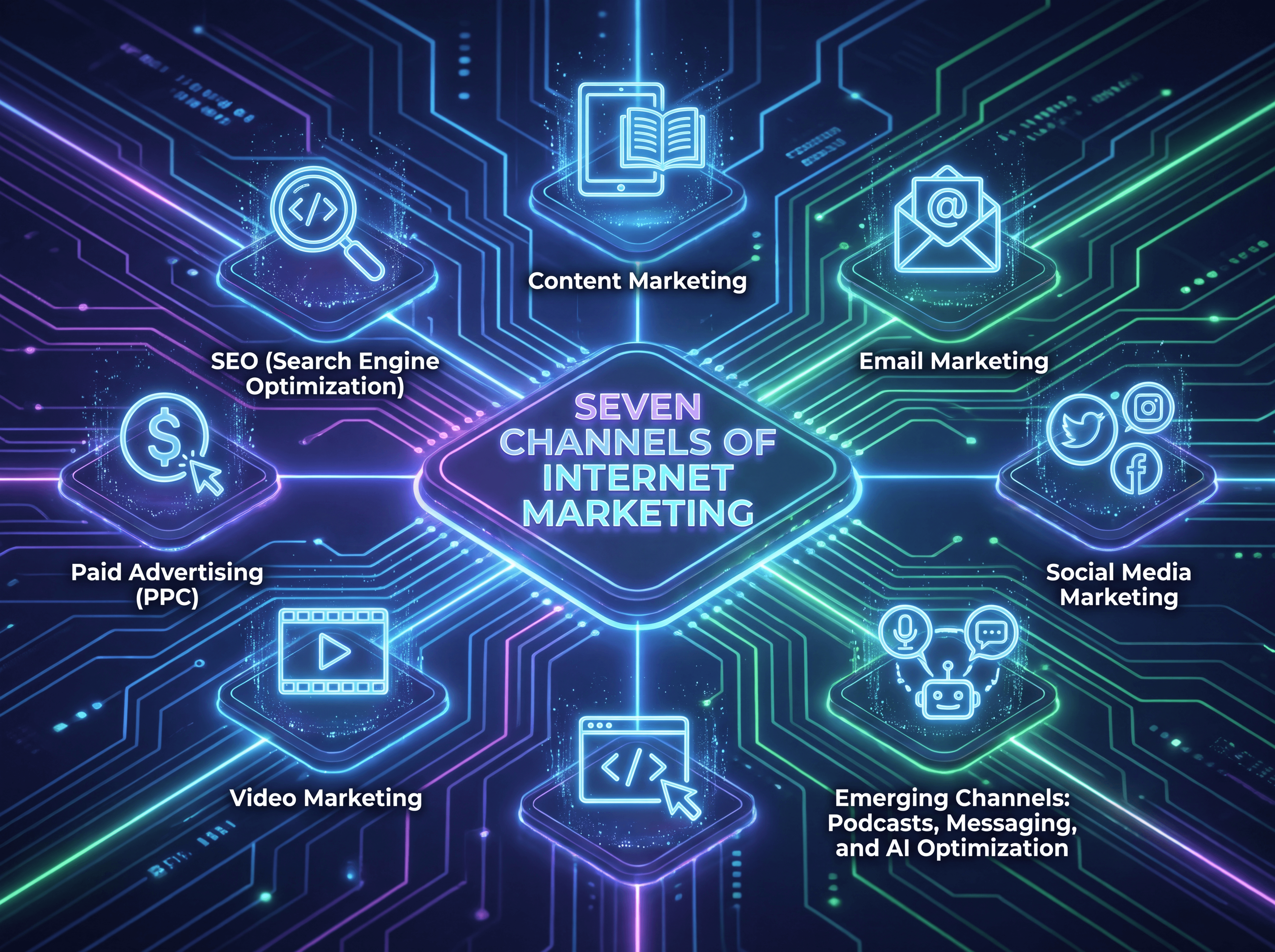
Three channels are growing fast enough to deserve attention.
Podcasting quietly became one of the most effective channels. 619 million people listen to podcasts worldwide in 2026. 81% of podcast listeners actively pay attention to ads, and 95% have taken action after hearing one. No other ad format comes close to those attention numbers. For most businesses, guesting on established podcasts in your industry is the low-cost entry point: you reach an engaged audience and almost always earn a backlink.
Messaging apps reach over 3 billion active users worldwide. Nearly 75% of marketers plan to increase or maintain investment in messaging (SMS, WhatsApp, Messenger) in 2026. Open rates dwarf email, though the channel demands restraint: message fatigue kills it fast.
AI optimization (GEO/AEO) is the newest discipline: making sure your business appears when people ask AI assistants for recommendations. AI referral traffic is still small (0.26% of website traffic versus 40.65% from organic search), but it behaves differently: AI-referred visitors show higher intent. 66% of consumers estimate AI will overtake traditional search within five years. Early positioning here is cheap. Late catch-up will not be.
Best for: Businesses ready to expand beyond the core channels, or those whose audiences skew early-adopter.
How Much Internet Marketing Costs (Real Budgets)
Here is the practical money question answered with real benchmarks.
The general rule: allocate 5 to 10% of total revenue to marketing. New businesses in aggressive growth mode may invest 12 to 20%. The US Small Business Administration recommends 7 to 8% of gross revenue for businesses under $5 million.
In practice: most successful small businesses spend $500 to $3,000 per month on internet marketing, depending on growth stage and competitive intensity. Of your total marketing budget, 40 to 60% should go to internet channels in 2026.
What you can do with almost no money: SEO and blogging require time more than cash, and a well-optimized post can generate traffic for years. Email platforms like Mailchimp are free up to 500 contacts. Organic social costs nothing but consistency. Google Business Profile provides free local visibility, which matters because 97% of consumers use the internet to find local businesses.
Timelines to expect: Email marketing shows results in days to weeks. Paid ads need 2 to 4 weeks to gather meaningful data. Social media takes 3 to 6 months to build a real following. SEO takes 3 to 6 months minimum, longer in competitive markets.
The budget mistake to avoid: spreading a small budget across all seven channels. Most small businesses spread themselves too thin across every channel and see weak results across all of them. The businesses that win pick two or three channels, execute consistently, and build compounding returns.
Which Channels Fit Your Business
There is no single best channel. The most effective mix depends on your business model. Here is the honest matching guide.
Service businesses (plumbers, lawyers, dentists, consultants): Local SEO and Google Ads drive the most revenue. People search with immediate intent ("emergency plumber near me") and hire from the results. Add a Google Business Profile, reviews, and an email list for repeat business.
E-commerce brands: Email and social lead. Email recovers abandoned carts and drives repeat purchases (multi-channel recovery combining email and retargeting reclaims about 28% of abandoned carts). Social provides discovery, especially Instagram and TikTok for visual products. Add SEO for product and category pages.
B2B companies: LinkedIn and content marketing dominate. B2B buyers research heavily before ever talking to sales, so the content that educates them wins the deal. The top B2B ROI channels are website/blog/SEO, paid social, and social media shopping tools.
Local brick-and-mortar: Google Business Profile first (it is free and it is how people find you), then local SEO, then Facebook for community presence, then email for repeat visits.
Creators and personal brands: One social platform done exceptionally well, plus an email list to own the audience relationship, plus a simple website as the home base.
The Five-Step Internet Marketing Plan
Marketing activity is not marketing strategy. Posting on Instagram, running the occasional ad, and sending emails when someone remembers is activity. A strategy defines goals, audience, channels, and measurement before any campaign goes live. Here is the five-step version.
Step 1: Set one specific goal. Not "get more customers." Something measurable: "Generate 30 qualified leads per month from organic search by December." Specific goals make every later decision easier because you can ask: does this serve the goal?
Step 2: Define your audience by behavior, not demographics. "Women 25 to 45" is not an audience definition. "First-time home buyers who research mortgage options on YouTube and Reddit before contacting anyone" is. Behavior tells you which channels to pick and what content to make.
Step 3: Pick two or three channels that match. Use the matching guide above. Resist the urge to be everywhere. Depth beats breadth every time in internet marketing.
Step 4: Build your measurement before you launch. Install Google Analytics 4. Set up conversion tracking. Add UTM parameters to links so you know which channel drives which results. If you cannot measure it, you cannot improve it, and you will not know what is working.
Step 5: Execute consistently, review monthly, adjust quarterly. An internet marketing strategy is not a document you write in January and open again in December. It is a working framework that gets tested against real numbers, adjusted when something stops working, and doubled down on when something outperforms.
What Changed in 2026: The Three Shifts That Matter
AI saturated content, which made human content more valuable. With 94% of marketers using AI for content and more than half saying differentiation is now a struggle, the winning move flipped: real experience, original data, and human perspective are the new scarcity. Use AI for speed. Use humanity for standing out.
Search fragmented beyond Google. People now discover businesses through TikTok search, AI assistants, Reddit threads, and YouTube, alongside traditional Google. Organic search still drives 40%+ of traffic while AI referrals are tiny, but the trendline matters: half of marketers report search traffic drops alongside AI traffic increases, and the AI traffic converts better. Optimize for answers, not just rankings.
Channels merged into journeys. The 2026 consumer discovers on social, researches on Google and YouTube, verifies with reviews, and buys through whatever channel is most convenient, sometimes inside the social app itself. 75% of marketers now use more than five distinct channels because the customer journey crosses all of them. Your channels need to work as a system, not as silos: social builds awareness, SEO captures research, email closes and retains.
The Bottom Line
Internet marketing is not a mystery and it is not a gamble. It is a set of seven channels with known costs, known returns, and known timelines.
Email returns $36 to $42 per dollar. SEO drives more traffic than any other source and compounds for years. Video is table stakes with 93% of businesses using it. Paid ads deliver speed at $2+ per dollar. Social influences 77% of purchase decisions. Podcasts hold attention like nothing else. And AI optimization is the cheap land grab of the moment.
The businesses that win online do not do everything. They pick the two or three channels that match their customers, execute consistently for months, measure honestly, and let compounding do the rest.
Over 5.5 billion people are online. Your customers are among them, searching for what you sell right now. Build the machine that lets them find you.
Blogs
More Blogs
From keyword goldmines to AI-driven content hacks—expert insights to help your blog posts dominate the first page.