What Is Content Marketing? The Practical Guide With 2026 Numbers
Here is a question that exposes how most companies market themselves.
When a potential customer searches for something you offer, what do they find? An ad asking them to buy? Or something genuinely useful?
If the answer is an ad, you are doing traditional marketing. If the answer is helpful content that earns their trust before asking for anything, you are doing content marketing.
These two approaches produce very different results. And the data from 2026 makes the gap unmistakably clear.
Content marketing generates 3 times more leads than outbound marketing at 62% less cost per lead. The average content marketing program returns $7.65 for every $1 spent. Companies that prioritize blogging are 13 times more likely to see positive ROI than those that do not. And the content marketing industry is now worth $524 billion globally, growing at 13.5% per year toward nearly $1 trillion by 2030.
This is not a trend. This is how the most effective businesses in the world grow.
This guide explains what content marketing actually is, why it works, what the best formats are, how to build a strategy that produces results, and what changed in 2026 that every marketer needs to know.
What Content Marketing Actually Means
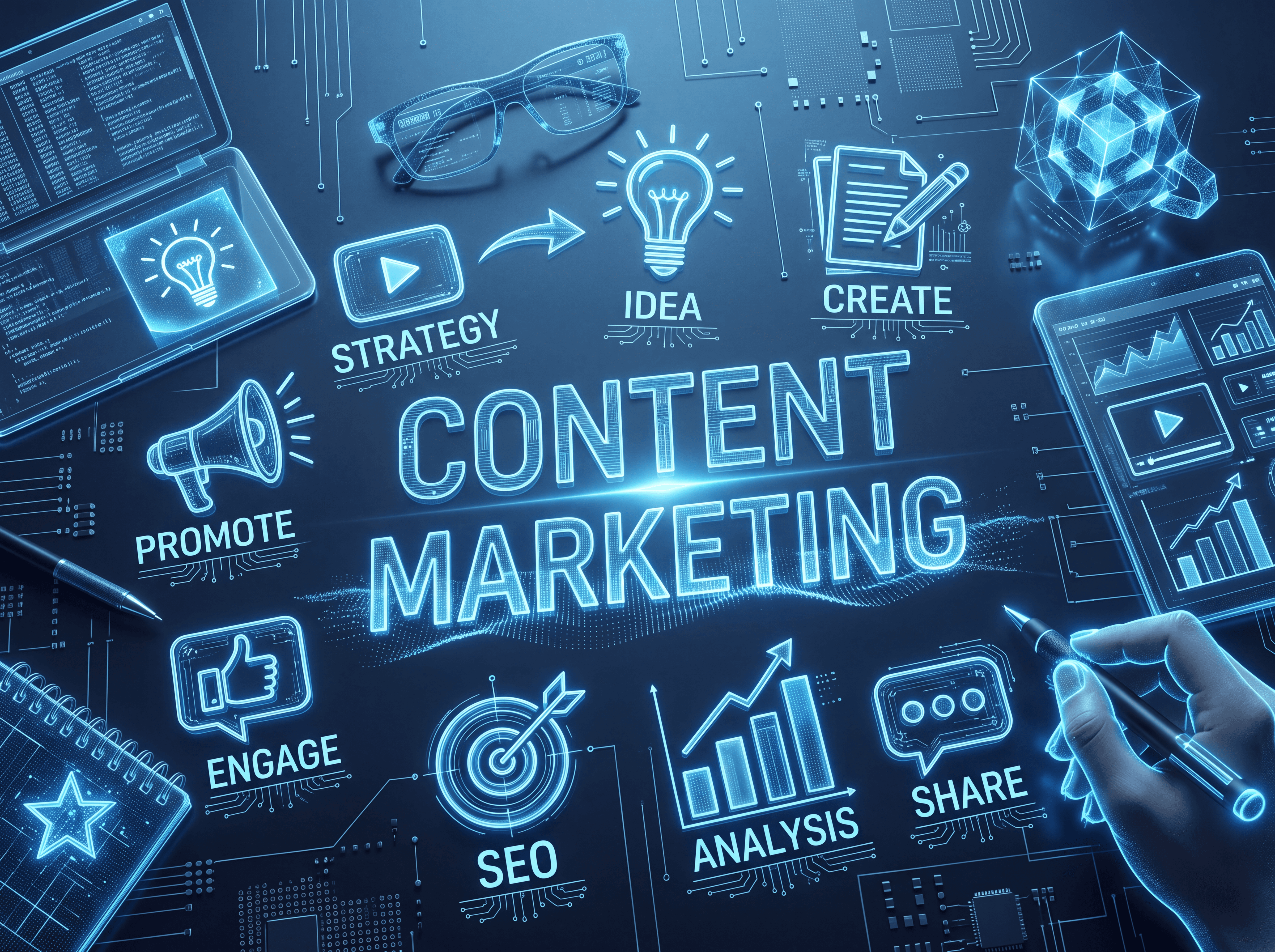
Content marketing is the practice of creating and distributing useful, relevant content to attract and keep a clearly defined audience, with the goal of eventually driving profitable customer action.
Three words in that definition matter most: useful, relevant, and eventually.
Useful. The content has to genuinely help someone. It answers a question. Solves a problem. Teaches something. Entertains. If your content does not deliver real value to the reader, viewer, or listener, it is not content marketing. It is noise.
Relevant. The content has to be relevant to both your audience and your business. A car dealership writing about personal finance might create useful content, but it is not relevant to their business. Relevant means your content sits at the intersection of what your audience cares about and what you sell.
Eventually. This is the part that trips people up. Content marketing does not ask for the sale immediately. It builds trust first. It educates. It demonstrates expertise. The sale comes later, as a natural result of the relationship the content created.
This is fundamentally different from traditional advertising. An ad says "buy this now." Content marketing says "here is something useful, and when you are ready to buy, you will think of us."
Why Content Marketing Outperforms Traditional Advertising
The shift toward content marketing is not just a preference. The economics are dramatically better.
Traditional advertising stops the moment you stop paying. You run an ad, you get traffic, you stop running it, the traffic disappears. You own nothing. Every dollar produces returns only while the tap is open.
Content marketing works the opposite way. Content you create today can attract customers three years from now without any additional spend. A well-written blog post, a well-produced video, a genuinely useful guide: these assets compound over time. They earn links, search rankings, and trust that grow rather than decay.
The numbers show this clearly:
SEO-focused content has a median ROI of 748% over three years. B2B SaaS content marketing averages 844% ROI over the same period. Companies with active blogs have 434% more indexed pages and 97% more inbound links than companies that do not blog. Active blogs generate 55% more website traffic and 67% more monthly leads.
Meanwhile, 73% of B2B marketers and 70% of B2C marketers now have a documented content marketing strategy, up from a small minority just five years ago. The organizations with documented strategies generate 3 times more leads per dollar than those without a formal plan.
Content marketing has crossed from "interesting experiment" to "core business function." The question is no longer whether to do it. It is whether you are doing it well.
The Seven Most Effective Content Marketing Formats
Not all content is equally effective for all purposes. Here is what the data shows about each major format in 2026.
1. Blog Posts and Long-Form Articles
Blog posts remain the cornerstone of most content marketing programs. 79% of marketers actively maintain a blog. And despite the explosion of video and audio content, blog content is still a top-five ROI-driving format according to HubSpot's 2026 State of Marketing Report.
Why do blogs still work? Because search engines still send the majority of web traffic to text-based content. And 53% of all website traffic comes from organic search. A well-written, keyword-targeted blog post can bring in visitors every month for years.
But not all blog posts work equally well. The research is clear about what drives results.
Longer posts outperform shorter ones. The optimal length for competing in search results is 1,890 to 2,500 words. Posts exceeding 3,000 words show the strongest overall performance for backlinks and rankings. The average blog post has shrunk to around 1,350 words in 2025, which means longer, more thorough posts stand out more than ever.
Posts with original data convert better. Marketers who publish original research see 64% higher conversion rates and 61% stronger SEO performance than those who do not. Original data is one of the most defensible content assets in 2026.
Structured formats get cited more. List posts and Q&A format articles are cited by AI tools at a 25% rate, compared to just 11% for traditional narrative content. If you want your content to appear in AI Overviews and AI-generated answers, structure matters enormously.
Visual content gets shared more. Blog posts with seven or more images generate 55% more backlinks than posts without images.
2. Video Content
Video has become the dominant format in content marketing and shows no signs of slowing down.
91% of businesses now use video as a marketing tool. 93% say it is an important part of their strategy. 82% report video delivers good ROI. And the top three ROI-driving content formats, according to HubSpot's 2026 State of Marketing Report, are all video: short-form video (49% of marketers cite it as their top ROI driver), long-form video (29%), and live-streaming (25%).
Short-form video is the single most leveraged media format among marketers today. TikTok, Instagram Reels, and YouTube Shorts have trained audiences to consume and engage with short video faster than any other format.
But longer video still earns its place. YouTube is the most widely used video marketing platform with 82% of video marketers using it. Tutorial videos, in-depth product explanations, and long-form educational content all continue to drive traffic and leads, particularly in B2B.
What makes video particularly powerful: it delivers ROI 49% faster than text-based content. For businesses that need results quickly, video is the highest-velocity format available.
3. Email Marketing
Email is the highest-ROI channel in digital marketing, full stop.
Email marketing returns $36 to $42 for every $1 spent. Top-performing programs exceed $70 per $1. Automated and triggered emails generate 320% more revenue than non-automated campaigns.
Most people think of email as a distribution channel for content. That is partially right. But email is also itself a content format. The best email marketers send newsletters, tips, case studies, and original insights that subscribers genuinely look forward to receiving.
The most important things to understand about email content marketing:
You own your email list. Social platforms can change their algorithm overnight. Google can update its rankings. But your email list belongs to you and reaches subscribers directly without any intermediary deciding who sees it.
Segmented emails dramatically outperform mass sends. Emails tailored to specific audience segments based on behavior and purchase history generate significantly higher open rates, click rates, and conversions than generic blasts.
Automated sequences are where the real money is. A well-built welcome sequence, a cart abandonment flow, a re-engagement campaign: these run automatically and produce revenue continuously with no ongoing labor. They account for 77% of total email marketing ROI.
4. Social Media Content
Social media is not one channel. It is seven to twelve different platforms, each with its own audience, algorithm, and content culture.
90% of marketers use social media to distribute content. But the most common mistake is treating social media as a broadcast channel: pushing out the same content everywhere and hoping for results.
What actually works: content built natively for each platform. Short videos for TikTok and Instagram Reels. Long-form text and thought leadership on LinkedIn. Conversation-starting questions on Threads. Community discussions in Facebook Groups.
Social media content's primary role in most content marketing strategies is top-of-funnel: awareness, discovery, and relationship-building. It is rarely where direct conversions happen. Its value is in starting the journey that eventually leads to a purchase.
For B2C brands in 2026, social media and community building is the top investment priority. For B2B brands, LinkedIn content and social proof (case studies, testimonials, thought leadership) are the highest-value uses of social platforms.
5. Podcasting
Podcasting continues to grow as both a content format and a marketing channel.
Global podcast listenership reached 584 million in 2025, up 6.8% from the previous year. 81% of podcast listeners pay more attention to podcast ads than to radio, TV, outdoor, or social media ads. Branded podcasts increase brand favorability by 14%. And 38% of listeners have purchased products based on a podcast ad.
Podcasting works for content marketing in two ways: you can host your own show or appear as a guest on others.
Hosting your own podcast builds a loyal, highly engaged audience. It positions you as an authority. It creates a large library of content that can be repurposed into blog posts, social clips, email newsletters, and YouTube videos.
Appearing as a guest on established podcasts in your industry generates awareness with targeted audiences and almost always produces a link in the show notes. This is one of the most underused link-building and audience-building tactics in content marketing.
6. Infographics and Visual Content
Infographics transform complex data or processes into images that are easy to understand and easy to share.
Content that includes visuals has a 650% higher engagement rate than text-only content. Infographics can increase website traffic by 12% when promoted correctly. Posts with images on LinkedIn have a 98% higher comment rate than text-only posts.
Infographics work particularly well as link bait: other bloggers and journalists use them in their own content and link back to yours as the source. An original data visualization based on proprietary research can earn dozens of links naturally.
The catch: bad infographics exist in enormous quantities. An infographic that is visually cluttered, factually thin, or not based on genuinely interesting data will not perform. The design and the underlying data both need to be strong.
7. Case Studies and Original Research
Case studies prove your product or service actually delivers results. They are among the most powerful pieces of content for B2B companies.
75% of B2B marketers use case studies. 64% of B2B marketers say they are the most effective content type for moving leads through the funnel, because they provide social proof at exactly the moment a buyer is deciding whether to trust you.
A strong case study follows a simple structure: here is the problem a real customer had, here is what we did, here are the measurable results. Specificity is everything. "Increased revenue by 34% in six months" is dramatically more persuasive than "improved business outcomes."
Original research reports follow similar logic but serve top-of-funnel as well as bottom-of-funnel. When you publish research that generates new insights your industry does not already have, other marketers, journalists, and researchers cite you. The result is natural links, brand awareness, and positioning as a thought leader.
How to Build a Content Marketing Strategy That Actually Works
Most content marketing fails for one reason: it is created without a clear strategy. A brand publishes things because it feels like it should, not because it has a plan connecting content to business outcomes.
Here is a six-step framework that produces real results.
Step 1: Define Your Goal Before You Create Anything
Content marketing can accomplish different things: brand awareness, lead generation, customer retention, SEO traffic, sales enablement. These require different types of content, different distribution channels, and different success metrics.
Before you create a single piece of content, write down the specific business goal you are trying to achieve. "We want more traffic" is not a goal. "We want to generate 50 qualified leads per month from organic search by Q4" is a goal. The specificity determines everything that follows.
Step 2: Know Who You Are Trying to Reach
A vague audience produces vague content. Vague content ranks for nothing, converts nobody, and gets shared with no one.
Define your ideal customer in detail. What do they search for when they have the problem your product solves? What language do they use? What keeps them up at night? What do they already know versus what do they need to learn?
Talk to your best existing customers. Read the language they use in reviews, Reddit communities, and social posts. That language is your keyword and content strategy.
Step 3: Do Your Keyword Research First
Content marketing and SEO are inseparable for any business that relies on organic traffic.
Before you write anything, find out what your audience is actually searching for. Use Google's free Keyword Planner, Google Autocomplete, and the "People Also Ask" section on search results pages. Find keywords with meaningful search volume that you can realistically rank for given your domain's current authority.
Create content built around those keywords. Not keyword-stuffed content, but content that genuinely answers what the person searching that phrase is looking for.
Step 4: Build Topic Clusters Instead of Random Posts
Individual, disconnected blog posts produce modest results. Interconnected topic clusters, where a central pillar page covers a broad topic and multiple cluster posts go deep on each subtopic, build topical authority that compounds over time.
For example: a company that sells project management software might build a topic cluster around "project management." The pillar page covers the broad topic. Cluster posts cover specific subtopics: "how to run a sprint planning meeting," "project management for remote teams," "how to choose project management software." Each post links back to the pillar and to other cluster posts.
This structure signals to Google that your site has deep expertise on a topic. It improves rankings for all pages in the cluster simultaneously.
Step 5: Choose Your Distribution Channels Deliberately
Creating great content is only half the work. Getting it seen is the other half.
96.55% of web pages receive zero organic traffic from Google. Publication without distribution is nearly worthless.
Pick your distribution channels based on where your audience actually spends time, not where you personally prefer to be. Distribute every major piece of content through multiple channels: promote it via email to your list, share it on relevant social platforms, repurpose it into different formats (a blog post becomes a short video, a social thread, an email newsletter section), and build internal links from other pages on your site to each new piece.
Step 6: Measure What Actually Matters
87% of content teams track traffic. Only 31% track revenue attribution. This is a dangerous gap.
Traffic is a vanity metric on its own. The metrics that connect content to business outcomes include: conversion rate from organic visitors, number of qualified leads generated from content, cost per lead compared to other channels, and revenue influenced by content at each stage of the funnel.
Teams that can prove ROI to leadership receive 3.1 times higher budget increases than those that cannot. Build your measurement framework before you start creating content, not after.
What Changed in Content Marketing in 2026

The fundamentals of content marketing have not changed. Create useful content, distribute it well, build relationships with your audience. But several significant shifts are reshaping how the best teams execute.
AI has changed the production economics. 94% of B2B marketers plan to use AI for content creation in 2026. AI-assisted content production costs 4.7 times less than high-end human-only content. 68% of businesses report increased content marketing ROI as a direct result of using AI. But pure AI-generated content consistently underperforms: human-edited AI content outperforms unedited AI output by 34%. The winning approach is using AI for speed and scale while layering genuine human expertise on top.
AI search is reshaping what kinds of content get found. Google AI Overviews now appear in nearly half of all informational searches. 44% of consumers say AI is their primary search tool. This does not kill content marketing, but it changes what type of content wins. Content cited in AI answers tends to be structured (lists, Q&As), factually dense, and from authoritative sources. Generic content with no original insight is being filtered out faster than ever.
Original data has become the most defensible content asset. 86% of marketers plan to increase research budgets in 2026. The typical AI Overview-cited article covers 62% more facts than the typical non-cited article. Proprietary data, original surveys, and unique research that no AI can replicate are now among the highest-value investments in content marketing.
The middle of the market is collapsing. Generic, undifferentiated content that rehashes what already exists is losing ground at an accelerating rate. The gap between excellent content and average content has never been wider. High-quality, high-specificity, original content is performing better. Everything else is struggling.
Your Content Marketing Action Plan for the Next 30 Days
You do not need a huge team or a huge budget to start. Here is a realistic first month.
Week 1: Define your one primary content marketing goal for the next six months. Pull your baseline metrics: organic traffic, email subscribers, current conversion rate. Do keyword research for your five most important topics.
Week 2: Create your first piece of content. Make it thorough. Aim for at least 1,500 words if it is a blog post. Include real data. Answer the question better than anyone else on page one of Google. Publish it.
Week 3: Distribute that piece. Email it to your list. Share it on the social platforms where your audience is. Find two or three places you could get a link to it (relevant industry publications, directories, partners).
Week 4: Plan your next four pieces of content based on the topic cluster approach. Pick a central pillar topic and map out four to six cluster posts that support it. Schedule them.
Do that for three months consistently before drawing conclusions. Content marketing compounds slowly at first and then much faster. The businesses that quit at month two miss the results that show up at month six.
The Bottom Line
Content marketing is not a tactic. It is a business strategy built on the idea that helping people is the best way to build a business.
The economics are extraordinary. $7.65 return per dollar spent on average. Three times more leads at 62% less cost than outbound. 748% SEO ROI over three years. 434% more indexed pages for companies that blog consistently.
The businesses winning at content marketing right now are not winning because they found a shortcut. They are winning because they started earlier, they created more useful content than their competitors, they distributed it consistently, and they measured what mattered.
That is a game any business can play. Start this week.
Blogs
More Blogs
From keyword goldmines to AI-driven content hacks—expert insights to help your blog posts dominate the first page.