Backlink analysis is the deep dive into all the links pointing to your website from other places on the web. Think of it as a full-scale audit of your site's reputation online. Each of those backlinks is essentially a recommendation or a vote of confidence from another corner of the internet.
What Is Backlink Analysis Exactly
Let's use a real-world analogy. Imagine your website is a new restaurant in town. A backlink is like a well-known food critic mentioning you in a review. A glowing mention from a famous critic carries a lot more weight than a random comment on an unknown blog. Backlink analysis is the work you do to figure out who is reviewing you and what they're saying.
It’s never just a numbers game—it's not about how many links you have. The real story is in the quality, relevance, and authority of the sites sending those links your way. This whole process is about seeing your website the way search engines like Google see it.
A solid backlink analysis gives you answers to the make-or-break questions that guide your entire SEO strategy:
Who is linking to me? Are these sites respected authorities in my field, or are they irrelevant?
What kind of content gets links? Which of my pages are getting all the attention and earning these valuable recommendations?
Are any of these links toxic? Do I have spammy or low-quality links that might actually be tanking my rankings?
How do I stack up against the competition? What can I learn by looking at who links to them?
By digging into your backlink profile, you stop just passively collecting links and start strategically building a web of trust that search engines reward. It turns a messy, confusing part of SEO into a clear, actionable plan to boost your site’s authority.
Why Backlink Analysis Is Your Secret SEO Weapon
It’s one thing to know what backlink analysis is, but the real magic happens when you understand why it's so critical. This is what separates websites that stagnate from those that consistently climb the search rankings.
Think about it like this: your business builds its reputation on referrals. A single, rave recommendation from an industry titan is going to carry a lot more weight than a hundred generic shout-outs from strangers.
That's exactly how search engines like Google see backlinks. A link from a trusted, relevant website is a powerful vote of confidence. It tells Google your content is the real deal—valuable, credible, and worth showing to more people. Backlink analysis is simply the process of managing these digital "referrals" to make sure they're helping, not hurting, your online reputation.
This isn’t just some checkbox on an SEO to-do list; it’s a core part of your business strategy. When you dig into your backlink profile, you find strategic insights that can help you increase website traffic organically and build lasting authority.
Turn Data Into A Competitive Edge
Consistent analysis lets you transform a messy list of links into a clear roadmap for outmaneuvering your competition. You start to see patterns and opportunities that others miss.
Here are a few of the biggest wins:
Decode Your Competitors' Playbook: You can pinpoint exactly where your competitors get their best links. This reverse-engineers their content strategy, shows you their PR wins, and reveals key partnerships—giving you a blueprint to build upon.
Find Untapped Link Opportunities: Analysis uncovers high-authority sites in your niche that link to your rivals but not to you. Suddenly, you have a hot list of outreach targets who are already interested in what you have to offer.
Defend Your Hard-Earned Rankings: Not all links are created equal. Toxic, spammy backlinks can quietly tank your SEO progress. Regular analysis is your first line of defense, helping you find and disavow these harmful links before they do any damage.
By keeping a close eye on your backlinks, you're essentially auditing and strengthening your website's authority. It turns link building from a shot in the dark into a smart, data-driven strategy for earning trust with both search engines and your audience.
This focus on quality links also helps you connect with the right people. A solid link from a niche blog can send a stream of highly relevant visitors your way, much like well-executed long-tail keyword research attracts searchers with very specific needs.
Analyzing Your Competitive Backlink Landscape
If you only look at your own website, you're missing half the story. The real magic happens when you start analyzing your competitors' backlink profiles—it's like getting a copy of their winning playbook. You get to see exactly how they built their authority, one link at a time.
This whole process is about deconstructing their strategy to see what’s actually working in your industry. Think of it as scouting the competition to find out where their best links come from, what content of theirs keeps getting mentioned, and where you might find a weakness to exploit.
Reverse-Engineering Their Success
The idea isn’t to just copy every single link they have. That’s a losing game. Instead, you're looking for the patterns behind their wins. A deep dive into their profile helps answer some really important questions:
What kind of content is attracting their best links? Are they publishing original research? Massive "ultimate guides"? Or maybe free tools that everyone loves?
Which high-authority sites are sending them traffic? This is a goldmine. It points you to potential partners and publications that are already interested in what you do.
How quickly are they earning new links? This gives you a realistic benchmark for your own link-building efforts.
This visual from a backlink analytics tool is a perfect example of how you can stack your domain up against the competition.
The chart instantly shows you who's leading the pack with metrics like Authority Score and the total number of referring domains. No more guessing.
By turning their hard-earned success into your strategic intelligence, you uncover proven tactics you might have completely missed otherwise. This data-driven approach takes the guesswork out of link building and turns it into a clear plan for getting ahead. Once you've got this down, you can move on to more advanced tactics like Mastering Backlink Gap Analysis to find the opportunities everyone else is missing.
Competitive analysis isn't about imitation; it's about innovation. By identifying what works for others, you can create a superior strategy that builds on their successes while capitalizing on their oversights.
Most tools even let you see a competitor's backlink history, showing you their new and lost links over specific periods. This is incredibly useful. You can watch the impact of their latest product launch or PR campaign by seeing how their link momentum picks up. It's like watching their strategy unfold in real-time.
Decoding the Key Backlink Analysis Metrics
Diving into a backlink report for the first time can feel like you're trying to decipher a secret code. You're hit with a wall of acronyms and numbers, but figuring out what they all mean is how you uncover the really powerful insights. These metrics tell the complete story of a website's authority and its reputation online.
Think of it like sizing up a restaurant. You’d check its overall reputation in the city (Domain Authority), how popular a specific dish is (Page Authority), and who’s recommending it (Referring Domains). Backlink metrics do the exact same thing for a website.
This infographic breaks down how you can turn raw backlink data into a real, actionable strategy.
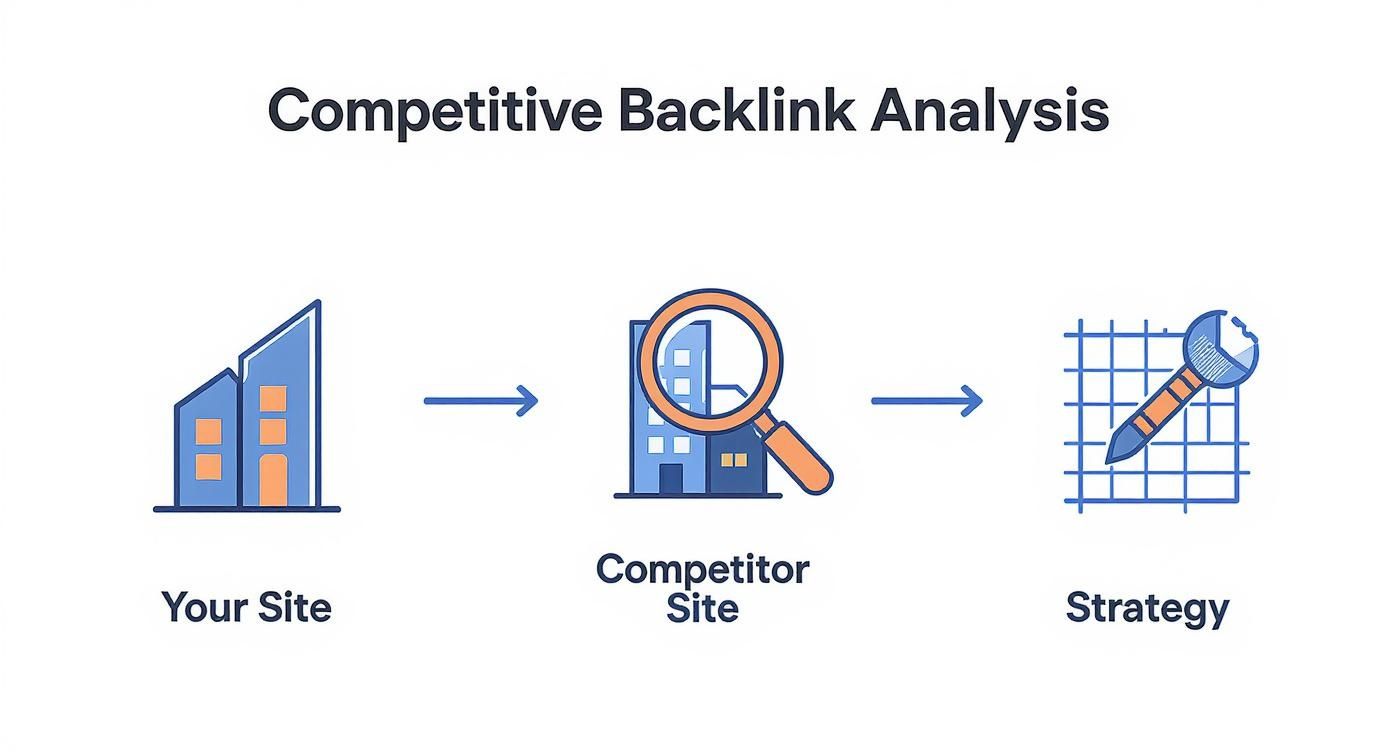
It shows a simple, logical path: start by analyzing your own site, then peek at what your competitors are doing, and finally, build a smart link-building plan based on that intelligence.
Understanding Authority Scores
The first metrics you'll almost always run into are authority scores. These aren't Google metrics; they're proprietary scores created by major SEO software companies to estimate a website's overall ranking strength.
Domain Authority (DA) or Authority Score (AS): This is the big one. It’s a score, typically from 1 to 100, that predicts how well an entire website is likely to rank in search results. A higher score points to a stronger, more trusted site.
Page Authority (PA): If DA is the whole restaurant's reputation, PA is the strength of a single dish on the menu. This metric tells you how authoritative a specific page is, which is crucial for understanding the value of a link from that page.
These scores are perfect for a quick gut check on a site's quality. If you want to get into the nitty-gritty, you can learn more in our guide on how to find domain authority and why it's so important for SEO.
A link from a page with high PA on a site with high DA is the gold standard. It’s a powerful signal to search engines that your content is being endorsed by a credible and authoritative source.
Core Link Profile Metrics
Beyond the top-level authority scores, a few other metrics give you the context you need to really understand a backlink profile.
Referring Domains: This is simply the number of unique websites linking to you. Getting 10 links from 10 different sites is almost always better than getting 10 links from the same site. It shows widespread approval.
Anchor Text: This is the clickable text in a hyperlink (the blue text you click on). It gives search engines a huge clue about what the linked page is about.
Total Backlinks: This is the grand total of every single link pointing to your site. While a bigger number seems impressive, the number of referring domains is a much better indicator of a healthy, diverse link profile.
To give you a sense of the scale we're talking about, the top SEO tools are constantly crawling the web to keep this data current. For instance, Semrush tracks an incredible 43 trillion backlinks to power its analytics, giving users a massive database to work with.
Core Backlink Metrics From Popular SEO Tools
Since each major SEO platform has its own way of crawling the web and calculating authority, their flagship metrics have different names. Here’s a quick breakdown of what to look for in the most popular tools.
Metric Type | Semrush | Ahrefs | Moz |
|---|---|---|---|
Domain-Level Authority | Authority Score (AS) | Domain Rating (DR) | Domain Authority (DA) |
Page-Level Authority | Page AS | URL Rating (UR) | Page Authority (PA) |
Spam/Toxicity Score | Toxicity Score | N/A (uses DR/UR context) | Spam Score |
While the names differ, they all aim to solve the same problem: quantifying a site's authority based on its backlink profile. Familiarizing yourself with these will help you navigate any tool you choose.
How to Conduct Your First Backlink Analysis
Alright, let's turn all this theory into real-world action. Getting your hands dirty with your first backlink analysis might sound intimidating, but it's a pretty straightforward process once you break it down. The key is to look for clear, actionable insights, not to drown in a sea of data.
Think of it like a first-time checkup for your website's health. You’re simply taking a snapshot to see where you’re strong, where you’re weak, and what your next steps should be. The goal here is to get a solid baseline of who's linking to you and how you stack up against the competition.
A Simple Four-Step Process
Your first analysis doesn't need to be overly complicated. Follow this simple, repeatable workflow to cover the essentials without getting bogged down in massive spreadsheets and confusing metrics.
Here’s a quick-start guide to get you rolling:
Choose Your Tool: Start with whatever fits your budget. Free tools like Google Search Console or Ahrefs' Free Backlink Checker are fantastic for looking at your own domain. If you're ready to peek at your competitors, a paid tool like Semrush or Moz is well worth the investment.
Analyze Your Own Profile: First, pull a list of your own backlinks and referring domains. Start looking for patterns. Which of your pages get the most links? Are the sites linking to you actually relevant to your niche? This initial step helps you figure out which of your pages are "linkable assets."
Benchmark Against a Top Competitor: Now, do the exact same thing for one of your main competitors. Seriously, just pick one to start. The goal is to spot their best links—where did they get them, and what kind of content earned them that link?
Identify Quick Wins and Red Flags: Put the two reports side-by-side. Are there high-authority sites linking to your competitor but not to you? Boom, that's your first outreach list. At the same time, keep an eye out for any obviously spammy or junky links pointing to your site; you might need to deal with those later.
This first analysis is the bedrock of your entire link-building strategy. It takes you from guessing what might work to knowing what is working in your niche, giving you a clear roadmap to follow.
A healthy backlink profile is all about diversity. We've seen that having over 800 referring domains is a strong sign of link authority that can really move the needle on your search rankings. For a great example of what a strong portfolio looks like, check out the one on DataForSEO's website.
And don't forget, building local signals with a targeted approach, as we cover in our local SEO checklist, is a fantastic way to attract high-quality, relevant links right from your own community.
Got Questions About Backlink Analysis? We've Got Answers.
Jumping into the world of backlink analysis always brings up a few questions. It's easy to get bogged down in the details, so let's tackle some of the most common ones head-on. This way, you can get started with a clear head and a solid plan.
Think of this as your quick-start guide. Nailing these fundamentals is the first step to building a backlink strategy that actually works.
How Often Should I Be Doing This?
For most sites, a deep-dive backlink analysis every quarter is the sweet spot. That's often enough to see what your competitors are up to and catch any potentially harmful links before they become a real problem, but it won't completely take over your schedule.
But what if you're in a super competitive market or right in the middle of a big link-building push? In that case, you’ll want to bump it up to a monthly check-in. This keeps you agile and ready to pivot your strategy based on the latest data.
Can I Do Backlink Analysis for Free?
You sure can. Tools like Google Search Console are a great starting point for seeing which sites are already linking to you. It gives you a good, albeit basic, snapshot of your own backlink profile.
The catch with free tools is that they don't give you the full picture, especially when it comes to your competitors. They're perfect for a self-audit, but you'll need a paid tool to really dig deep, reverse-engineer what's working for others, and find those game-changing link opportunities.
What Exactly Is a "Toxic" Backlink?
A toxic backlink is any link that can actively hurt your site's rankings. These usually come from shady places—think spammy websites, low-quality directories, private blog networks (PBNs), or sites that are completely irrelevant to what you do.
So, how do you spot one? Look for these classic red flags:
An authority score that’s scraping the bottom of the barrel (like a Domain Authority of 1).
Anchor text that looks spammy or has nothing to do with your page.
A sudden, unnatural flood of new links from sketchy-looking domains.
Luckily, you don't have to hunt for these manually. Most major SEO tools have a "Toxicity Score" or a similar feature that automatically flags these risky links, making it much easier to clean them up.
Ready to stop guessing and start building a winning content strategy? With Viral SEO, you can analyze your competitors' top pages in a single click and uncover the topics that truly drive traffic and authority. Get the insights you need to accelerate your organic growth.
Blogs
More Blogs
From keyword goldmines to AI-driven content hacks—expert insights to help your blog posts dominate the first page.