Blog

Blog

The Ultimate Local SEO Checklist: 8 Steps for 2025

The Ultimate Local SEO Checklist: 8 Steps for 2025

Blog

The Ultimate Local SEO Checklist: 8 Steps for 2025

In a world of global marketplaces, the most valuable customers are often right outside your door. Local Search Engine Optimization (SEO) is the art and science of making your business visible to these nearby customers at the exact moment they are searching for your products or services. From 'near me' queries on a smartphone to voice searches for the 'best coffee shop in downtown,' local intent drives immediate action and tangible revenue. Succeeding here means connecting with highly motivated buyers who are ready to make a purchase.

But navigating the nuances of Google's local algorithms requires a precise, repeatable strategy. Simply having a website is not enough; you must actively signal your geographic relevance and authority. This is where a detailed action plan becomes indispensable for capturing high-intent local traffic that bigger, non-local competitors cannot reach.

This comprehensive local SEO checklist breaks down the 8 fundamental pillars you must master to not only appear in local search results but to dominate them. We will move beyond the basics, providing a structured roadmap with actionable steps, expert tips, and clear examples to transform your local presence from invisible to unmissable.

We will cover critical tasks, including:

  • Optimizing your Google Business Profile for maximum impact.

  • Ensuring NAP (Name, Address, Phone Number) consistency.

  • Implementing local schema markup to speak Google’s language.

  • Building a powerful review generation and management system.

  • Creating location-specific content that attracts and converts.

Whether you are a single-location boutique or a multi-city service provider, this is your definitive guide to capturing your local market and driving measurable growth.

1. Optimize and Verify Google Business Profile

Your Google Business Profile (GBP) is the undisputed foundation of your local SEO strategy. This free tool from Google is what powers the information that appears in the Local Pack (the map with three business listings) and Google Maps search results. Think of it as your digital storefront on Google. A complete and verified profile not only provides potential customers with critical information but also signals to Google that your business is legitimate, active, and relevant to local search queries.

Verification is the crucial first step that proves you own the business, unlocking essential features like responding to reviews, publishing posts, and accessing performance insights. Without a verified profile, you're essentially invisible in the most valuable local search real estate. Businesses that fully optimize their profiles see tangible results. For example, a plumbing company in Austin increased its service calls by 45% after completing its profile with high-quality photos and detailed service descriptions.

How to Optimize Your Google Business Profile

A well-managed GBP is a powerful tool in any local seo checklist. To maximize its impact, focus on providing comprehensive and accurate information.

  • Choose the Right Categories: Select the most specific primary category that accurately describes your core business (e.g., "Family Law Attorney" instead of just "Lawyer"). Then, add secondary categories for all other relevant services you offer.

  • Upload High-Quality Photos: Visuals build trust. Upload at least 10 high-resolution photos showing your business exterior, interior, team members, and products or services in action. Aim to add new photos every few weeks to signal ongoing activity.

  • Write a Compelling Description: Naturally incorporate relevant keywords and location terms into your business description. Clearly state what you do, who you serve, and what makes you unique.

  • Enable All Relevant Features: Use features like Google Posts for weekly updates, Q&A to address common customer questions, and enable messaging if you have the resources to respond promptly. Fill out all applicable attributes (e.g., "wheelchair accessible," "free Wi-Fi") to appear in more filtered searches.

The GBP Verification Process

The verification process is straightforward but essential for gaining control over your listing. The following infographic outlines the simple three-step flow to get your profile set up and verified.
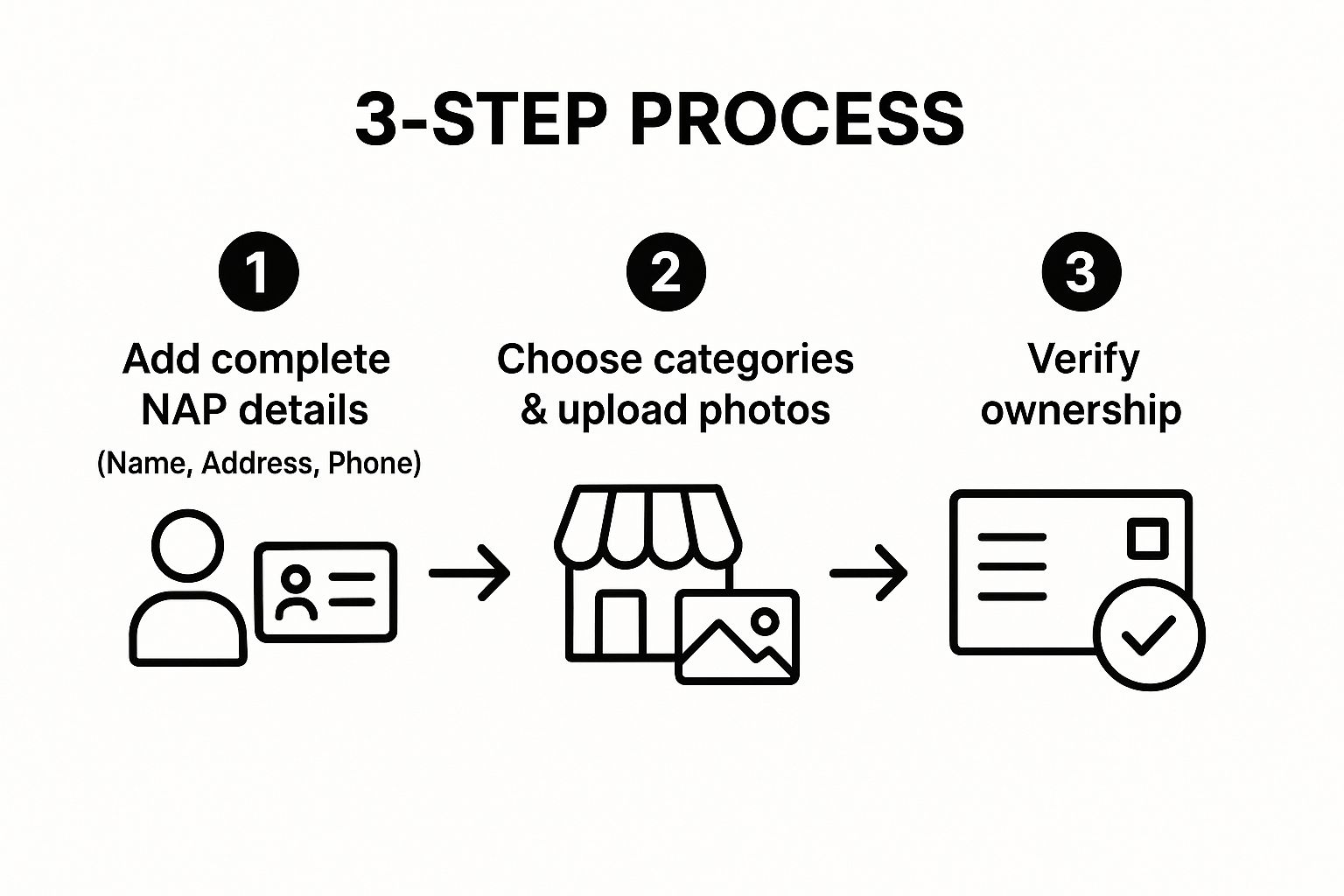
Infographic showing the 3-step process to set up a Google Business Profile: 1. Add complete NAP details, 2. Choose categories & upload photos, 3. Verify ownership.

This process ensures that your core business information is accurate before Google grants you full management access, protecting both your business and its potential customers.

For a more detailed walkthrough of setting up and optimizing your profile, this video provides excellent step-by-step guidance.

2. Build and Maintain NAP Consistency Across All Platforms

Your business's Name, Address, and Phone number (NAP) form its digital fingerprint online. NAP consistency is the practice of ensuring this core information is identical across every single platform where your business is mentioned, from major directories like Yelp to niche industry citations. Search engines like Google cross-reference this data to verify the legitimacy and location of your business. Inconsistent information creates confusion, erodes trust with search algorithms, and significantly dilutes your local authority, making it harder to rank.
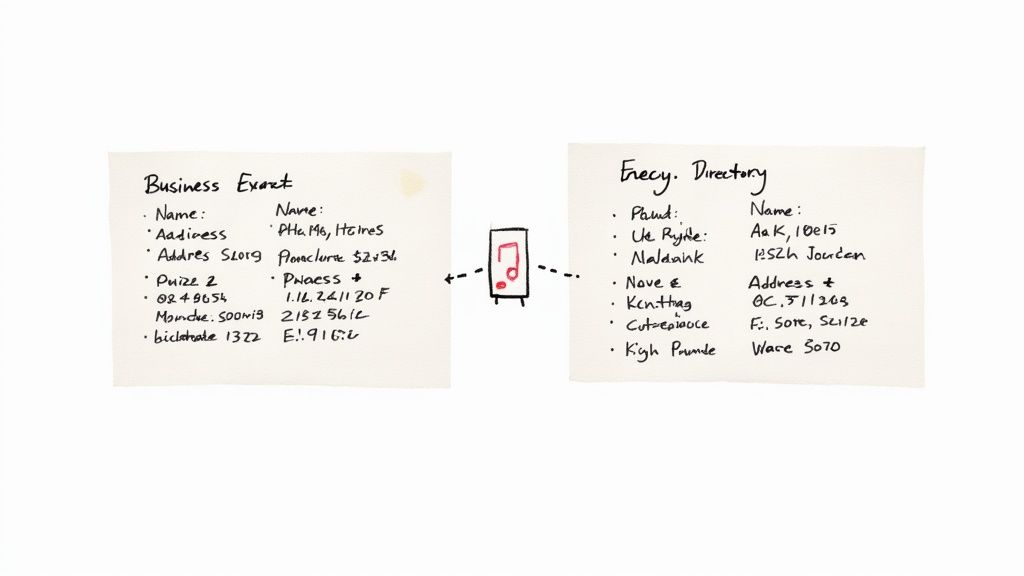
A graphic illustrating NAP (Name, Address, Phone) consistency across different online platforms, showing a central business icon connected to various directory logos with consistent data.

The impact of correcting these discrepancies is tangible and often swift. For example, a dental practice that moved to a new office but failed to update dozens of old citations saw its local visibility drop by 40% in just a few months. Once they conducted a thorough audit and corrected the outdated listings, they recovered their rankings and appointment bookings returned to normal levels. This underscores how critical clean, consistent data is for maintaining local search presence.

How to Achieve NAP Consistency

Achieving and maintaining perfect NAP consistency is a core task in any local seo checklist. This requires a systematic approach to auditing and managing your business information online.

  • Create a Master NAP Document: Establish a single source of truth for your business information. Document the exact formatting for your name (e.g., "Smith & Jones LLC" vs. "Smith and Jones"), address ("Street" vs. "St."), and phone number ("(555) 123-4567" vs. "555-123-4567").

  • Audit Your Existing Citations: Use tools like BrightLocal or Moz Local to scan the web and identify all existing mentions of your business. This will reveal inconsistencies, duplicates, and incorrect listings that need to be fixed.

  • Prioritize High-Authority Directories: Begin your cleanup process with the most influential platforms first. This includes your Google Business Profile, Yelp, Yellow Pages, Better Business Bureau, and top-tier industry-specific directories relevant to your niche.

  • Update and Claim Listings Manually: Systematically work through your audit list to claim and correct every incorrect citation. For businesses that have moved, it is crucial to find and update old listings rather than creating new ones, which can lead to duplicate profiles. Document every change you make in a spreadsheet for future reference.

3. Implement Local Schema Markup on Your Website

Local schema markup is structured data code added to your website that helps search engines like Google understand specific information about your business. This code communicates details like your business type, address, hours, services, and reviews in a language search engines can easily parse. By implementing schema, you make it simpler for Google to display your information accurately in rich results, such as star ratings, event listings, and Knowledge Panels.

Implement Local Schema Markup on Your Website

This direct communication is a critical advantage. When search engines don't have to guess, they are more confident in showing your business for relevant local queries. For instance, a restaurant chain that implemented review aggregate schema saw its click-through rate increase by 28% after star ratings began appearing directly in search results. This shows how schema can directly impact user engagement and drive more qualified traffic from local searches.

How to Implement Local Schema Markup

Adding schema markup is a technical but highly valuable step in any local seo checklist. To get started, focus on accurately representing your business details using the right schema types.

  • Choose the Most Specific Schema Type: Don't just use the generic LocalBusiness type. Be as specific as possible by using types like Dentist, Restaurant, or AutomotiveBusiness. This provides greater context to search engines.

  • Use JSON-LD: Implement your schema using the JSON-LD format. It's Google's preferred method and is easier to add to your site's <head> section without interfering with your existing HTML code.

  • Include Geo-Coordinates: In addition to your physical address, add geo schema with your latitude and longitude coordinates. This provides an unambiguous location signal to search engines.

  • Mark Up All Key Business Information: Ensure your schema includes your business name, address, phone number (NAP), opening hours (including special hours for holidays), and a link to your logo. Use sameAs schema to link to your official social media profiles.

  • Validate Your Code: Before deploying, always test your markup using Google's Rich Results Test tool. This will help you identify and fix any errors that could prevent your rich results from showing. Monitor Google Search Console for any schema-related warnings after implementation.

4. Generate and Optimize Customer Reviews

Customer reviews are one of the most powerful signals in local search, influencing both potential customers and search engine rankings. These reviews act as modern-day word-of-mouth marketing, providing crucial social proof that builds trust and credibility. For search engines like Google, a steady stream of positive reviews on your Google Business Profile, Yelp, or industry-specific sites indicates that your business is active, reputable, and provides a quality experience, directly impacting your position in the Local Pack.

A proactive review generation and management strategy is a non-negotiable part of any local seo checklist. This process involves not just collecting reviews but also engaging with them to show that you value customer feedback. For instance, a home services company that implemented automated review requests after each job saw its total reviews increase by 300% in six months, significantly boosting its local visibility and inbound leads.

Generate and Optimize Customer Reviews

How to Build a Powerful Review Strategy

An effective review strategy makes it easy for happy customers to share their feedback and demonstrates your commitment to customer service. The goal is to create a consistent flow of authentic reviews.

  • Make It Easy to Leave a Review: Timing is everything. Ask for a review immediately after a positive interaction or successful service completion. Provide a direct link to your review platform (e.g., your Google Business Profile review form) via email or SMS to remove any friction.

  • Respond to Every Single Review: Acknowledge all feedback, both positive and negative, ideally within 24-48 hours. Thank positive reviewers by name and address specific points from negative reviews professionally and non-defensively. This shows prospective customers that you care.

  • Leverage Reviews as Marketing Content: Feature your best reviews prominently on your website, especially on service or location pages. Use schema markup for reviews to help search engines understand and potentially display star ratings in search results.

  • Train Your Team: Empower your staff to identify satisfied customers and verbally encourage them to leave a review. This personal touch can be highly effective and makes customers feel valued.

The Impact of Review Management

Consistent review management does more than just boost rankings; it builds a strong brand reputation that drives conversions. It provides a direct line of communication with your customers, offering invaluable insights into what you're doing right and where you can improve.

Platforms like GatherUp and BirdEye have popularized systematic review management by providing tools to automate requests, monitor new reviews across multiple platforms, and streamline the response process. By actively managing your online reputation, you take control of your business's narrative and turn customer feedback into a tangible asset that fuels growth.

5. Create Location-Specific Website Pages and Content

Creating location-specific pages on your website is a powerful tactic for capturing geographically-focused search traffic. These are dedicated pages optimized for each city, neighborhood, or service area you target. By tailoring content to a specific locale, you signal strong relevance to Google for queries like "[service] in [city]," directly meeting the searcher's local intent and significantly improving your ranking potential in those areas.

This strategy is essential for both multi-location businesses and single-location businesses serving a wide area. It allows you to move beyond homepage optimization and build authority in multiple key markets. For example, a dental practice with multiple locations that gives each clinic its own page featuring unique team bios and local patient reviews can see dramatic growth. One such practice increased its organic traffic by 120% by implementing this exact approach, proving the value of hyper-local content.

How to Build Effective Location Pages

A key part of any local seo checklist is ensuring these pages are more than just duplicated templates. To be effective, each page must offer unique value and genuinely speak to the local audience.

  • Customize Content Heavily: While you can start with a template, ensure at least 60% of the content on each page is unique. Include 500-800 words covering your services from a local perspective.

  • Incorporate Local Flavor: Reference local landmarks, well-known streets, or nearby neighborhoods. This demonstrates a genuine connection to the area. For example, a plumber could mention, "We offer emergency services to homes near Central Park."

  • Use Local Social Proof: Feature testimonials and reviews from customers specifically within that city or neighborhood. This builds immense trust with new potential customers from the same area.

  • Add Location-Specific Details: Include a local phone number with the correct area code, an embedded Google Map, and driving directions from major local hubs. If applicable, mention location-specific promotions or events.

  • Optimize On-Page Elements: Use H1 tags that combine your service and location (e.g., "Expert Pest Control Services in Springfield"). Create a clean URL structure like /locations/springfield.

Showcasing Your Local Presence

Visuals and supporting content are crucial for making your location pages stand out and prove your local connection. Generic stock photos won't cut it; you need to show that you are truly part of the community you claim to serve.

Upload high-quality photos of your actual team working on local projects, your physical storefront in that area, or company vehicles parked near recognizable local landmarks. This visual evidence reinforces your claims of local service. Furthermore, you can create supporting blog content about local news or events and link back to your relevant location page. This builds topical authority and creates a powerful network of internal links that boosts the page's authority. By developing this hyper-local content ecosystem, you establish your business as the go-to provider in each target market.

For more strategies on developing compelling website content, you can learn more about creating location-specific website pages and content at GetViralSEO's articles.

6. Build Local Citations and Directory Listings

Local citations are online mentions of your business name, address, and phone number (NAP) on other websites. These mentions, found on business directories, social media profiles, and industry-specific platforms, act as powerful validation signals to search engines. Each consistent citation reinforces the legitimacy and location of your business, helping Google trust that you are who and where you say you are. A strong citation profile is a cornerstone of any local seo checklist, directly contributing to local search rankings and helping customers discover your business across the web.

The impact of a consistent citation-building campaign can be significant. For example, a local bakery that built 50 high-quality citations over six months moved from the third page of search results into the coveted Google Local Pack. Similarly, a specialized legal practice saw a 30% increase in new clients from directory referrals after ensuring their listings were accurate on all major legal directories. This strategy broadens your digital footprint and strengthens your local authority.

How to Build Local Citations and Directory Listings

The key to a successful citation strategy is consistency and quality over quantity. Ensuring your NAP is identical across every platform is non-negotiable, as inconsistencies can confuse search engines and harm your rankings.

  • Start with Data Aggregators: Submit your business information to the main data aggregators like Neustar/Localeze and Foursquare. These services feed data to hundreds of other online directories, which can automate and scale your initial citation-building efforts.

  • Prioritize High-Authority Directories: Focus on established, high-quality directories first. This includes platforms like Yelp, Bing Places, Apple Maps, and Facebook. A listing on a well-respected site carries more weight than dozens of listings on low-quality, spammy directories.

  • Find Niche and Hyperlocal Directories: Identify directories specific to your industry (e.g., Avvo for lawyers, Houzz for home contractors) and your geographic area (e.g., your local Chamber of Commerce website). These niche citations signal relevance to both search engines and potential customers.

  • Audit and Claim Existing Listings: Before building new citations, search for existing listings for your business and claim them. This allows you to correct any inaccurate information and gain control over your online presence. Use a spreadsheet to track all your listings, URLs, and login credentials.

  • Analyze Competitor Citations: Use tools like Whitespark or BrightLocal to find where your top-ranking local competitors are listed. This provides a clear roadmap of high-value directories you should also be on.

7. Optimize for Local Keywords and Search Intent

Targeting the right keywords is a core element of any successful local seo checklist, but local search requires a more nuanced approach. Local keyword optimization involves identifying and targeting terms that signal local intent, which includes both explicit geo-modified keywords like "plumber in Seattle" and implicit queries like "emergency dentist near me." Understanding and integrating these terms across your website and digital profiles is crucial for appearing in front of customers who are actively searching for services in your area.

Focusing on local search intent is incredibly effective because these queries often have high commercial value and a greater likelihood of conversion. When users search with location-specific terms, they are typically ready to take action. For example, a veterinary clinic that optimized its content for "emergency vet near me" and its location variants increased emergency calls by an impressive 78%, demonstrating the direct impact of aligning content with specific, urgent local needs.

How to Optimize for Local Keywords

To capture high-intent local traffic, you must go beyond basic service keywords and think like a local customer. This means targeting neighborhoods, landmarks, and common local phrasing.

  • Identify Local Search Queries: Use your Google Business Profile Insights to see the actual search terms people use to find you. Supplement this by typing "[your service] in [your city]" into Google and observing the autocomplete suggestions and "People Also Ask" sections for common variations.

  • Create Dedicated Location Pages: If you serve multiple distinct areas, create dedicated service pages for each one (e.g., "Roof Repair in Queen Anne," "Roof Repair in Ballard"). This allows you to create highly relevant content for users in those specific neighborhoods.

  • Integrate Keywords Naturally: Weave your primary local keywords into your page titles, H1 headings, meta descriptions, and the first 100 words of your body content. Also, include them in image alt text and file names (e.g., "best-roofer-in-denver-colorado.jpg").

  • Optimize for "Near Me" and Voice Search: Structure content to answer conversational questions that are common in voice searches, like "Who is the best dentist near me?" Create FAQ pages that directly address these types of queries. Knowing how many keywords to target on each page is key; you can learn more about keyword density and placement to avoid over-optimization while maximizing visibility.

  • Use Keyword Modifiers: Target long-tail keywords by adding modifiers like "best," "top," "affordable," or "emergency" to your primary service and location keywords to capture searchers at different stages of the buying cycle.

8. Acquire Local Backlinks and Build Community Relationships

Local backlinks are hyperlinks to your website from other websites within your geographic area. These links, from sources like local news outlets, community organizations, and nearby businesses, are powerful signals to search engines. They not only boost your domain authority but, more importantly, they confirm your geographic relevance and deep connection to the local community, a key factor in local search rankings.

Building these links is less about traditional outreach and more about genuine community involvement. It’s an authentic way to build your brand’s presence and earn trust, both online and offline. For example, a home services company that created a scholarship program for local high schools was featured on school websites and in local news, gaining over 25 high-quality local backlinks and a significant boost in local visibility. This approach transforms community engagement into tangible SEO results.

How to Acquire Local Backlinks

Earning quality local links is a core component of any effective local seo checklist. It requires a proactive and community-focused strategy.

  • Sponsor Local Events or Teams: Sponsoring a local youth sports team, a charity 5k run, or a community festival almost always results in a link from the event organizer’s website. This is a simple, high-impact way to get relevant links while supporting your community.

  • Host Community Workshops or Events: Offer your expertise by hosting a free workshop, seminar, or open house. A law firm offering free legal workshops at a community college can earn links from the college, local libraries, and community event calendars.

  • Create Valuable Local Resources: Develop a comprehensive guide, such as "The Ultimate Guide to Dog-Friendly Parks in [Your City]" or a report on local housing trends. This type of content naturally attracts links from local bloggers, tourism boards, and news sites. You can identify potential topics by researching local long-tail keywords. For more guidance on this, learn more about keyword research for valuable content.

  • Partner with Complementary Businesses: Build relationships with non-competing local businesses for cross-promotional opportunities. A wedding planner could guest post on a local photographer’s blog, with each business linking to the other as a preferred partner.

  • Engage with Local Media: Use platforms like HARO (Help A Reporter Out) to respond to queries from local journalists. By providing an expert quote or data, you can earn a powerful backlink from a reputable news source.

Local SEO Checklist: 8 Key Strategy Comparison

Item

Implementation Complexity 🔄

Resource Requirements ⚡

Expected Outcomes 📊

Ideal Use Cases 💡

Key Advantages ⭐

Optimize and Verify Google Business Profile

Moderate: Setup and ongoing maintenance needed

Low: Free tool, but regular updates required

High: Increased local visibility, engagement, insights

Local businesses seeking strong Google Search & Maps presence

Free, verified trust badge, direct customer interaction, analytics

Build and Maintain NAP Consistency Across All Platforms

High: Audits and widespread updates necessary

Moderate to High: Time and/or paid tools needed

High: Better search engine trust, local ranking gains

Businesses with multiple citations across directories

Strengthens local SEO foundation, reduces customer confusion

Implement Local Schema Markup on Your Website

High: Requires technical skill or developer help

Moderate: Time for coding, testing, validating

Medium to High: Rich snippets, knowledge panels, improved SERP display

Websites wanting enhanced search result appearance

Competitive edge, better search engine understanding

Generate and Optimize Customer Reviews

Moderate: Ongoing review requests and response

Moderate: Time-intensive monitoring and engagement

High: Trust, increased conversions, ranking signal

Service businesses dependent on reputation

Influences rankings, boosts trust and conversions

Create Location-Specific Website Pages and Content

High: Content creation and customization intense

High: Content resources and maintenance required

High: Improves local rankings and user experience

Multi-location or service-area businesses with many targets

Targets local search intent, differentiated presence

Build Local Citations and Directory Listings

Moderate: Manual building and management effort

Moderate: Time-intensive; may require tools or services

Medium to High: Enhanced local visibility and authority

Local businesses gaining presence on multiple platforms

Builds domain authority, increases referral traffic

Optimize for Local Keywords and Search Intent

Moderate: Keyword research and content tailoring

Moderate: Ongoing keyword research and optimization

High: Attracts relevant, high-intent local traffic

Businesses targeting geo-specific search queries

Higher conversion potential, aligns with actual user intent

Acquire Local Backlinks and Build Community Relationships

High: Requires relationship building and outreach

High: Significant time and possible financial investment

Medium to High: Local relevance, brand awareness, authority

Businesses investing in genuine local partnerships

Local authority, difficult for competitors to replicate

From Checklist to Competitive Edge

You’ve navigated through the essential components of a robust local marketing strategy, moving from foundational setups to advanced optimization tactics. Completing this comprehensive local seo checklist is far more than an academic exercise or a simple series of tasks to be ticked off. It's the blueprint for building a resilient, highly visible, and authoritative presence in the community you serve. Each item, from meticulously verifying your Google Business Profile to cultivating genuine community relationships for local backlinks, acts as a crucial gear in a much larger machine designed for sustainable growth.

The true power of this checklist isn't found in any single action but in the cumulative, compounding effect of consistent execution. Think of it as a flywheel. Initial efforts, like cleaning up NAP inconsistencies or implementing schema markup, require significant force to get started. But as you continue to generate positive reviews, create valuable location-specific content, and build local citations, the wheel begins to spin faster and with less effort, creating self-sustaining momentum that consistently attracts and converts local customers.

The Shift from Tactic to Strategy

It’s easy to view local SEO as a collection of isolated tasks. However, the most successful businesses understand that these actions are interconnected parts of a cohesive strategy.

  • Your Google Business Profile (GBP) is not just a listing; it's your digital storefront. The reviews you generate (Item #4) directly impact its authority and visibility.

  • Location-specific pages (Item #5) are amplified by the local keywords you research (Item #7) and the local backlinks you acquire (Item #6), creating a powerful signal to Google that you are the relevant authority for a specific geographic area.

  • NAP consistency (Item #2) and local schema (Item #3) work in tandem, providing search engines with unambiguous, structured data that verifies your physical location and services, building a foundation of trust that is critical for ranking in the local pack.

This synergy is where the magic happens. A well-optimized GBP with glowing reviews will drive more traffic to your location pages. Those pages, optimized with local keywords and supported by local links, will rank higher in organic search, further reinforcing your GBP’s authority. This virtuous cycle transforms your digital presence from a passive listing into an active, lead-generating asset.

Your Ongoing Commitment to Local Dominance

The digital landscape is never static. Competitors will emerge, search engine algorithms will evolve, and customer behaviors will shift. Therefore, this local seo checklist should not be treated as a one-and-done project. It is a living document, a guide to be revisited and refined on a quarterly or semi-annual basis.

Key Takeaway: Local SEO is not a set-it-and-forget-it activity. It's an ongoing commitment to serving your local audience and clearly communicating your value, relevance, and authority to search engines.

By systematically implementing and regularly auditing these strategies, you move beyond simply competing in the local market. You begin to define the local search landscape for your industry. You become the default choice, the name that appears consistently in the MapPack, and the business that customers in your neighborhood trust. The ultimate result is not just higher rankings; it's the creation of a predictable, scalable engine for growth fueled by the most valuable asset of any local business: its community.

Ready to turn this checklist into an actionable growth plan? The Viral SEO toolkit can supercharge your efforts by helping you identify high-impact local content opportunities your competitors are already ranking for. Use our Content Gap Analyzer to find proven, location-specific topics that will attract and convert customers right in your neighborhood. Start building your local authority today by visiting Viral SEO.

In a world of global marketplaces, the most valuable customers are often right outside your door. Local Search Engine Optimization (SEO) is the art and science of making your business visible to these nearby customers at the exact moment they are searching for your products or services. From 'near me' queries on a smartphone to voice searches for the 'best coffee shop in downtown,' local intent drives immediate action and tangible revenue. Succeeding here means connecting with highly motivated buyers who are ready to make a purchase.

But navigating the nuances of Google's local algorithms requires a precise, repeatable strategy. Simply having a website is not enough; you must actively signal your geographic relevance and authority. This is where a detailed action plan becomes indispensable for capturing high-intent local traffic that bigger, non-local competitors cannot reach.

This comprehensive local SEO checklist breaks down the 8 fundamental pillars you must master to not only appear in local search results but to dominate them. We will move beyond the basics, providing a structured roadmap with actionable steps, expert tips, and clear examples to transform your local presence from invisible to unmissable.

We will cover critical tasks, including:

  • Optimizing your Google Business Profile for maximum impact.

  • Ensuring NAP (Name, Address, Phone Number) consistency.

  • Implementing local schema markup to speak Google’s language.

  • Building a powerful review generation and management system.

  • Creating location-specific content that attracts and converts.

Whether you are a single-location boutique or a multi-city service provider, this is your definitive guide to capturing your local market and driving measurable growth.

1. Optimize and Verify Google Business Profile

Your Google Business Profile (GBP) is the undisputed foundation of your local SEO strategy. This free tool from Google is what powers the information that appears in the Local Pack (the map with three business listings) and Google Maps search results. Think of it as your digital storefront on Google. A complete and verified profile not only provides potential customers with critical information but also signals to Google that your business is legitimate, active, and relevant to local search queries.

Verification is the crucial first step that proves you own the business, unlocking essential features like responding to reviews, publishing posts, and accessing performance insights. Without a verified profile, you're essentially invisible in the most valuable local search real estate. Businesses that fully optimize their profiles see tangible results. For example, a plumbing company in Austin increased its service calls by 45% after completing its profile with high-quality photos and detailed service descriptions.

How to Optimize Your Google Business Profile

A well-managed GBP is a powerful tool in any local seo checklist. To maximize its impact, focus on providing comprehensive and accurate information.

  • Choose the Right Categories: Select the most specific primary category that accurately describes your core business (e.g., "Family Law Attorney" instead of just "Lawyer"). Then, add secondary categories for all other relevant services you offer.

  • Upload High-Quality Photos: Visuals build trust. Upload at least 10 high-resolution photos showing your business exterior, interior, team members, and products or services in action. Aim to add new photos every few weeks to signal ongoing activity.

  • Write a Compelling Description: Naturally incorporate relevant keywords and location terms into your business description. Clearly state what you do, who you serve, and what makes you unique.

  • Enable All Relevant Features: Use features like Google Posts for weekly updates, Q&A to address common customer questions, and enable messaging if you have the resources to respond promptly. Fill out all applicable attributes (e.g., "wheelchair accessible," "free Wi-Fi") to appear in more filtered searches.

The GBP Verification Process

The verification process is straightforward but essential for gaining control over your listing. The following infographic outlines the simple three-step flow to get your profile set up and verified.

Infographic showing the 3-step process to set up a Google Business Profile: 1. Add complete NAP details, 2. Choose categories & upload photos, 3. Verify ownership.

This process ensures that your core business information is accurate before Google grants you full management access, protecting both your business and its potential customers.

For a more detailed walkthrough of setting up and optimizing your profile, this video provides excellent step-by-step guidance.

2. Build and Maintain NAP Consistency Across All Platforms

Your business's Name, Address, and Phone number (NAP) form its digital fingerprint online. NAP consistency is the practice of ensuring this core information is identical across every single platform where your business is mentioned, from major directories like Yelp to niche industry citations. Search engines like Google cross-reference this data to verify the legitimacy and location of your business. Inconsistent information creates confusion, erodes trust with search algorithms, and significantly dilutes your local authority, making it harder to rank.

A graphic illustrating NAP (Name, Address, Phone) consistency across different online platforms, showing a central business icon connected to various directory logos with consistent data.

The impact of correcting these discrepancies is tangible and often swift. For example, a dental practice that moved to a new office but failed to update dozens of old citations saw its local visibility drop by 40% in just a few months. Once they conducted a thorough audit and corrected the outdated listings, they recovered their rankings and appointment bookings returned to normal levels. This underscores how critical clean, consistent data is for maintaining local search presence.

How to Achieve NAP Consistency

Achieving and maintaining perfect NAP consistency is a core task in any local seo checklist. This requires a systematic approach to auditing and managing your business information online.

  • Create a Master NAP Document: Establish a single source of truth for your business information. Document the exact formatting for your name (e.g., "Smith & Jones LLC" vs. "Smith and Jones"), address ("Street" vs. "St."), and phone number ("(555) 123-4567" vs. "555-123-4567").

  • Audit Your Existing Citations: Use tools like BrightLocal or Moz Local to scan the web and identify all existing mentions of your business. This will reveal inconsistencies, duplicates, and incorrect listings that need to be fixed.

  • Prioritize High-Authority Directories: Begin your cleanup process with the most influential platforms first. This includes your Google Business Profile, Yelp, Yellow Pages, Better Business Bureau, and top-tier industry-specific directories relevant to your niche.

  • Update and Claim Listings Manually: Systematically work through your audit list to claim and correct every incorrect citation. For businesses that have moved, it is crucial to find and update old listings rather than creating new ones, which can lead to duplicate profiles. Document every change you make in a spreadsheet for future reference.

3. Implement Local Schema Markup on Your Website

Local schema markup is structured data code added to your website that helps search engines like Google understand specific information about your business. This code communicates details like your business type, address, hours, services, and reviews in a language search engines can easily parse. By implementing schema, you make it simpler for Google to display your information accurately in rich results, such as star ratings, event listings, and Knowledge Panels.

Implement Local Schema Markup on Your Website

This direct communication is a critical advantage. When search engines don't have to guess, they are more confident in showing your business for relevant local queries. For instance, a restaurant chain that implemented review aggregate schema saw its click-through rate increase by 28% after star ratings began appearing directly in search results. This shows how schema can directly impact user engagement and drive more qualified traffic from local searches.

How to Implement Local Schema Markup

Adding schema markup is a technical but highly valuable step in any local seo checklist. To get started, focus on accurately representing your business details using the right schema types.

  • Choose the Most Specific Schema Type: Don't just use the generic LocalBusiness type. Be as specific as possible by using types like Dentist, Restaurant, or AutomotiveBusiness. This provides greater context to search engines.

  • Use JSON-LD: Implement your schema using the JSON-LD format. It's Google's preferred method and is easier to add to your site's <head> section without interfering with your existing HTML code.

  • Include Geo-Coordinates: In addition to your physical address, add geo schema with your latitude and longitude coordinates. This provides an unambiguous location signal to search engines.

  • Mark Up All Key Business Information: Ensure your schema includes your business name, address, phone number (NAP), opening hours (including special hours for holidays), and a link to your logo. Use sameAs schema to link to your official social media profiles.

  • Validate Your Code: Before deploying, always test your markup using Google's Rich Results Test tool. This will help you identify and fix any errors that could prevent your rich results from showing. Monitor Google Search Console for any schema-related warnings after implementation.

4. Generate and Optimize Customer Reviews

Customer reviews are one of the most powerful signals in local search, influencing both potential customers and search engine rankings. These reviews act as modern-day word-of-mouth marketing, providing crucial social proof that builds trust and credibility. For search engines like Google, a steady stream of positive reviews on your Google Business Profile, Yelp, or industry-specific sites indicates that your business is active, reputable, and provides a quality experience, directly impacting your position in the Local Pack.

A proactive review generation and management strategy is a non-negotiable part of any local seo checklist. This process involves not just collecting reviews but also engaging with them to show that you value customer feedback. For instance, a home services company that implemented automated review requests after each job saw its total reviews increase by 300% in six months, significantly boosting its local visibility and inbound leads.

Generate and Optimize Customer Reviews

How to Build a Powerful Review Strategy

An effective review strategy makes it easy for happy customers to share their feedback and demonstrates your commitment to customer service. The goal is to create a consistent flow of authentic reviews.

  • Make It Easy to Leave a Review: Timing is everything. Ask for a review immediately after a positive interaction or successful service completion. Provide a direct link to your review platform (e.g., your Google Business Profile review form) via email or SMS to remove any friction.

  • Respond to Every Single Review: Acknowledge all feedback, both positive and negative, ideally within 24-48 hours. Thank positive reviewers by name and address specific points from negative reviews professionally and non-defensively. This shows prospective customers that you care.

  • Leverage Reviews as Marketing Content: Feature your best reviews prominently on your website, especially on service or location pages. Use schema markup for reviews to help search engines understand and potentially display star ratings in search results.

  • Train Your Team: Empower your staff to identify satisfied customers and verbally encourage them to leave a review. This personal touch can be highly effective and makes customers feel valued.

The Impact of Review Management

Consistent review management does more than just boost rankings; it builds a strong brand reputation that drives conversions. It provides a direct line of communication with your customers, offering invaluable insights into what you're doing right and where you can improve.

Platforms like GatherUp and BirdEye have popularized systematic review management by providing tools to automate requests, monitor new reviews across multiple platforms, and streamline the response process. By actively managing your online reputation, you take control of your business's narrative and turn customer feedback into a tangible asset that fuels growth.

5. Create Location-Specific Website Pages and Content

Creating location-specific pages on your website is a powerful tactic for capturing geographically-focused search traffic. These are dedicated pages optimized for each city, neighborhood, or service area you target. By tailoring content to a specific locale, you signal strong relevance to Google for queries like "[service] in [city]," directly meeting the searcher's local intent and significantly improving your ranking potential in those areas.

This strategy is essential for both multi-location businesses and single-location businesses serving a wide area. It allows you to move beyond homepage optimization and build authority in multiple key markets. For example, a dental practice with multiple locations that gives each clinic its own page featuring unique team bios and local patient reviews can see dramatic growth. One such practice increased its organic traffic by 120% by implementing this exact approach, proving the value of hyper-local content.

How to Build Effective Location Pages

A key part of any local seo checklist is ensuring these pages are more than just duplicated templates. To be effective, each page must offer unique value and genuinely speak to the local audience.

  • Customize Content Heavily: While you can start with a template, ensure at least 60% of the content on each page is unique. Include 500-800 words covering your services from a local perspective.

  • Incorporate Local Flavor: Reference local landmarks, well-known streets, or nearby neighborhoods. This demonstrates a genuine connection to the area. For example, a plumber could mention, "We offer emergency services to homes near Central Park."

  • Use Local Social Proof: Feature testimonials and reviews from customers specifically within that city or neighborhood. This builds immense trust with new potential customers from the same area.

  • Add Location-Specific Details: Include a local phone number with the correct area code, an embedded Google Map, and driving directions from major local hubs. If applicable, mention location-specific promotions or events.

  • Optimize On-Page Elements: Use H1 tags that combine your service and location (e.g., "Expert Pest Control Services in Springfield"). Create a clean URL structure like /locations/springfield.

Showcasing Your Local Presence

Visuals and supporting content are crucial for making your location pages stand out and prove your local connection. Generic stock photos won't cut it; you need to show that you are truly part of the community you claim to serve.

Upload high-quality photos of your actual team working on local projects, your physical storefront in that area, or company vehicles parked near recognizable local landmarks. This visual evidence reinforces your claims of local service. Furthermore, you can create supporting blog content about local news or events and link back to your relevant location page. This builds topical authority and creates a powerful network of internal links that boosts the page's authority. By developing this hyper-local content ecosystem, you establish your business as the go-to provider in each target market.

For more strategies on developing compelling website content, you can learn more about creating location-specific website pages and content at GetViralSEO's articles.

6. Build Local Citations and Directory Listings

Local citations are online mentions of your business name, address, and phone number (NAP) on other websites. These mentions, found on business directories, social media profiles, and industry-specific platforms, act as powerful validation signals to search engines. Each consistent citation reinforces the legitimacy and location of your business, helping Google trust that you are who and where you say you are. A strong citation profile is a cornerstone of any local seo checklist, directly contributing to local search rankings and helping customers discover your business across the web.

The impact of a consistent citation-building campaign can be significant. For example, a local bakery that built 50 high-quality citations over six months moved from the third page of search results into the coveted Google Local Pack. Similarly, a specialized legal practice saw a 30% increase in new clients from directory referrals after ensuring their listings were accurate on all major legal directories. This strategy broadens your digital footprint and strengthens your local authority.

How to Build Local Citations and Directory Listings

The key to a successful citation strategy is consistency and quality over quantity. Ensuring your NAP is identical across every platform is non-negotiable, as inconsistencies can confuse search engines and harm your rankings.

  • Start with Data Aggregators: Submit your business information to the main data aggregators like Neustar/Localeze and Foursquare. These services feed data to hundreds of other online directories, which can automate and scale your initial citation-building efforts.

  • Prioritize High-Authority Directories: Focus on established, high-quality directories first. This includes platforms like Yelp, Bing Places, Apple Maps, and Facebook. A listing on a well-respected site carries more weight than dozens of listings on low-quality, spammy directories.

  • Find Niche and Hyperlocal Directories: Identify directories specific to your industry (e.g., Avvo for lawyers, Houzz for home contractors) and your geographic area (e.g., your local Chamber of Commerce website). These niche citations signal relevance to both search engines and potential customers.

  • Audit and Claim Existing Listings: Before building new citations, search for existing listings for your business and claim them. This allows you to correct any inaccurate information and gain control over your online presence. Use a spreadsheet to track all your listings, URLs, and login credentials.

  • Analyze Competitor Citations: Use tools like Whitespark or BrightLocal to find where your top-ranking local competitors are listed. This provides a clear roadmap of high-value directories you should also be on.

7. Optimize for Local Keywords and Search Intent

Targeting the right keywords is a core element of any successful local seo checklist, but local search requires a more nuanced approach. Local keyword optimization involves identifying and targeting terms that signal local intent, which includes both explicit geo-modified keywords like "plumber in Seattle" and implicit queries like "emergency dentist near me." Understanding and integrating these terms across your website and digital profiles is crucial for appearing in front of customers who are actively searching for services in your area.

Focusing on local search intent is incredibly effective because these queries often have high commercial value and a greater likelihood of conversion. When users search with location-specific terms, they are typically ready to take action. For example, a veterinary clinic that optimized its content for "emergency vet near me" and its location variants increased emergency calls by an impressive 78%, demonstrating the direct impact of aligning content with specific, urgent local needs.

How to Optimize for Local Keywords

To capture high-intent local traffic, you must go beyond basic service keywords and think like a local customer. This means targeting neighborhoods, landmarks, and common local phrasing.

  • Identify Local Search Queries: Use your Google Business Profile Insights to see the actual search terms people use to find you. Supplement this by typing "[your service] in [your city]" into Google and observing the autocomplete suggestions and "People Also Ask" sections for common variations.

  • Create Dedicated Location Pages: If you serve multiple distinct areas, create dedicated service pages for each one (e.g., "Roof Repair in Queen Anne," "Roof Repair in Ballard"). This allows you to create highly relevant content for users in those specific neighborhoods.

  • Integrate Keywords Naturally: Weave your primary local keywords into your page titles, H1 headings, meta descriptions, and the first 100 words of your body content. Also, include them in image alt text and file names (e.g., "best-roofer-in-denver-colorado.jpg").

  • Optimize for "Near Me" and Voice Search: Structure content to answer conversational questions that are common in voice searches, like "Who is the best dentist near me?" Create FAQ pages that directly address these types of queries. Knowing how many keywords to target on each page is key; you can learn more about keyword density and placement to avoid over-optimization while maximizing visibility.

  • Use Keyword Modifiers: Target long-tail keywords by adding modifiers like "best," "top," "affordable," or "emergency" to your primary service and location keywords to capture searchers at different stages of the buying cycle.

8. Acquire Local Backlinks and Build Community Relationships

Local backlinks are hyperlinks to your website from other websites within your geographic area. These links, from sources like local news outlets, community organizations, and nearby businesses, are powerful signals to search engines. They not only boost your domain authority but, more importantly, they confirm your geographic relevance and deep connection to the local community, a key factor in local search rankings.

Building these links is less about traditional outreach and more about genuine community involvement. It’s an authentic way to build your brand’s presence and earn trust, both online and offline. For example, a home services company that created a scholarship program for local high schools was featured on school websites and in local news, gaining over 25 high-quality local backlinks and a significant boost in local visibility. This approach transforms community engagement into tangible SEO results.

How to Acquire Local Backlinks

Earning quality local links is a core component of any effective local seo checklist. It requires a proactive and community-focused strategy.

  • Sponsor Local Events or Teams: Sponsoring a local youth sports team, a charity 5k run, or a community festival almost always results in a link from the event organizer’s website. This is a simple, high-impact way to get relevant links while supporting your community.

  • Host Community Workshops or Events: Offer your expertise by hosting a free workshop, seminar, or open house. A law firm offering free legal workshops at a community college can earn links from the college, local libraries, and community event calendars.

  • Create Valuable Local Resources: Develop a comprehensive guide, such as "The Ultimate Guide to Dog-Friendly Parks in [Your City]" or a report on local housing trends. This type of content naturally attracts links from local bloggers, tourism boards, and news sites. You can identify potential topics by researching local long-tail keywords. For more guidance on this, learn more about keyword research for valuable content.

  • Partner with Complementary Businesses: Build relationships with non-competing local businesses for cross-promotional opportunities. A wedding planner could guest post on a local photographer’s blog, with each business linking to the other as a preferred partner.

  • Engage with Local Media: Use platforms like HARO (Help A Reporter Out) to respond to queries from local journalists. By providing an expert quote or data, you can earn a powerful backlink from a reputable news source.

Local SEO Checklist: 8 Key Strategy Comparison

Item

Implementation Complexity 🔄

Resource Requirements ⚡

Expected Outcomes 📊

Ideal Use Cases 💡

Key Advantages ⭐

Optimize and Verify Google Business Profile

Moderate: Setup and ongoing maintenance needed

Low: Free tool, but regular updates required

High: Increased local visibility, engagement, insights

Local businesses seeking strong Google Search & Maps presence

Free, verified trust badge, direct customer interaction, analytics

Build and Maintain NAP Consistency Across All Platforms

High: Audits and widespread updates necessary

Moderate to High: Time and/or paid tools needed

High: Better search engine trust, local ranking gains

Businesses with multiple citations across directories

Strengthens local SEO foundation, reduces customer confusion

Implement Local Schema Markup on Your Website

High: Requires technical skill or developer help

Moderate: Time for coding, testing, validating

Medium to High: Rich snippets, knowledge panels, improved SERP display

Websites wanting enhanced search result appearance

Competitive edge, better search engine understanding

Generate and Optimize Customer Reviews

Moderate: Ongoing review requests and response

Moderate: Time-intensive monitoring and engagement

High: Trust, increased conversions, ranking signal

Service businesses dependent on reputation

Influences rankings, boosts trust and conversions

Create Location-Specific Website Pages and Content

High: Content creation and customization intense

High: Content resources and maintenance required

High: Improves local rankings and user experience

Multi-location or service-area businesses with many targets

Targets local search intent, differentiated presence

Build Local Citations and Directory Listings

Moderate: Manual building and management effort

Moderate: Time-intensive; may require tools or services

Medium to High: Enhanced local visibility and authority

Local businesses gaining presence on multiple platforms

Builds domain authority, increases referral traffic

Optimize for Local Keywords and Search Intent

Moderate: Keyword research and content tailoring

Moderate: Ongoing keyword research and optimization

High: Attracts relevant, high-intent local traffic

Businesses targeting geo-specific search queries

Higher conversion potential, aligns with actual user intent

Acquire Local Backlinks and Build Community Relationships

High: Requires relationship building and outreach

High: Significant time and possible financial investment

Medium to High: Local relevance, brand awareness, authority

Businesses investing in genuine local partnerships

Local authority, difficult for competitors to replicate

From Checklist to Competitive Edge

You’ve navigated through the essential components of a robust local marketing strategy, moving from foundational setups to advanced optimization tactics. Completing this comprehensive local seo checklist is far more than an academic exercise or a simple series of tasks to be ticked off. It's the blueprint for building a resilient, highly visible, and authoritative presence in the community you serve. Each item, from meticulously verifying your Google Business Profile to cultivating genuine community relationships for local backlinks, acts as a crucial gear in a much larger machine designed for sustainable growth.

The true power of this checklist isn't found in any single action but in the cumulative, compounding effect of consistent execution. Think of it as a flywheel. Initial efforts, like cleaning up NAP inconsistencies or implementing schema markup, require significant force to get started. But as you continue to generate positive reviews, create valuable location-specific content, and build local citations, the wheel begins to spin faster and with less effort, creating self-sustaining momentum that consistently attracts and converts local customers.

The Shift from Tactic to Strategy

It’s easy to view local SEO as a collection of isolated tasks. However, the most successful businesses understand that these actions are interconnected parts of a cohesive strategy.

  • Your Google Business Profile (GBP) is not just a listing; it's your digital storefront. The reviews you generate (Item #4) directly impact its authority and visibility.

  • Location-specific pages (Item #5) are amplified by the local keywords you research (Item #7) and the local backlinks you acquire (Item #6), creating a powerful signal to Google that you are the relevant authority for a specific geographic area.

  • NAP consistency (Item #2) and local schema (Item #3) work in tandem, providing search engines with unambiguous, structured data that verifies your physical location and services, building a foundation of trust that is critical for ranking in the local pack.

This synergy is where the magic happens. A well-optimized GBP with glowing reviews will drive more traffic to your location pages. Those pages, optimized with local keywords and supported by local links, will rank higher in organic search, further reinforcing your GBP’s authority. This virtuous cycle transforms your digital presence from a passive listing into an active, lead-generating asset.

Your Ongoing Commitment to Local Dominance

The digital landscape is never static. Competitors will emerge, search engine algorithms will evolve, and customer behaviors will shift. Therefore, this local seo checklist should not be treated as a one-and-done project. It is a living document, a guide to be revisited and refined on a quarterly or semi-annual basis.

Key Takeaway: Local SEO is not a set-it-and-forget-it activity. It's an ongoing commitment to serving your local audience and clearly communicating your value, relevance, and authority to search engines.

By systematically implementing and regularly auditing these strategies, you move beyond simply competing in the local market. You begin to define the local search landscape for your industry. You become the default choice, the name that appears consistently in the MapPack, and the business that customers in your neighborhood trust. The ultimate result is not just higher rankings; it's the creation of a predictable, scalable engine for growth fueled by the most valuable asset of any local business: its community.

Ready to turn this checklist into an actionable growth plan? The Viral SEO toolkit can supercharge your efforts by helping you identify high-impact local content opportunities your competitors are already ranking for. Use our Content Gap Analyzer to find proven, location-specific topics that will attract and convert customers right in your neighborhood. Start building your local authority today by visiting Viral SEO.