What Are SEO Keywords? The Complete Practical Guide for 2026
Every piece of content you have ever found on Google started the same way.
Someone typed a few words into a search box. Google matched those words to content it thought was relevant. You clicked. Done.
Those words the person typed are keywords. And understanding how they work is the foundation of everything in SEO.
This guide explains what keywords are, why some keywords are worth targeting and others are not, how to find the right ones for your business, how to use them correctly once you find them, and what changed about all of this in 2026.
No padding. No jargon for the sake of it. Just what you actually need to know to start getting found.
What Keywords Actually Are

A keyword is any word or phrase that someone types into a search engine.
That is the whole definition. Simple.
"pizza near me" is a keyword. "how to fix a leaky faucet" is a keyword. "best project management software for small teams" is a keyword. "what is compound interest" is a keyword.
Keywords matter because they are the bridge between what your customer needs and what your website offers. If your bakery's website uses the words your customers are searching for, Google can match them to you. If it does not, they will find your competitor instead.
The goal of keyword research is not to stuff your pages full of random search terms. The goal is to understand exactly how your customers describe their problems and desires, and then make sure your content uses that same language.
When you get this right, Google sends you exactly the right people for free, month after month.
Why Getting Keywords Wrong Wastes All Your Effort
Here is the costly mistake most beginners make: they write great content about topics nobody searches for.
They use their own internal language instead of their customer's language. A software company writes pages full of jargon like "enterprise-grade synergistic workflow solutions." Their customers are actually searching for "software to manage my small team."
Or they target keywords that are so competitive they will never rank for them. A new website trying to rank for "insurance" or "mortgage" against billion-dollar companies is not doing SEO. It is doing wishful thinking.
Or they target keywords that have lots of searches but the wrong type of searcher. A blog post ranking for "what is a mortgage" will get clicks from curious people who will never buy a mortgage. A page ranking for "best mortgage rates in Dallas" will get clicks from people actively shopping for one.
Keyword research is the single most important skill in SEO. Every blog post you write, every page you create, and every piece of content you publish should start with keyword research. Get it right, and Google sends you free organic traffic for months or years. Get it wrong, and you can write the most beautifully crafted article in the world and nobody will ever find it.
Keyword research fixes all three of these problems before you write a single word.
The Four Types of Keywords You Need to Know
Not all keywords are the same. Different keywords attract people at different stages of their journey from "curious stranger" to "paying customer." Understanding these four types changes how you plan your content.
1. Informational Keywords
These are searches where someone wants to learn something. They are not ready to buy. They want an answer.
Examples: "how does SEO work," "what is compound interest," "why is my dog scratching."
Content that targets informational keywords educates your audience. It builds trust. It introduces your brand to people before they need to buy anything. The best blogs, guides, and how-to articles target informational keywords.
Informational keywords make up the largest share of all searches. If you create genuinely helpful content for these queries, you build an audience that will think of you first when they are ready to buy.
2. Navigational Keywords
These are searches where someone is trying to find a specific website or place. They already know where they want to go. They just typed a name into Google instead of the URL bar.
Examples: "Amazon login," "Spotify download," "New York Times crossword."
You should not build content to rank for other brands' navigational keywords. You should make sure your own brand name ranks for your own navigational searches.
3. Commercial Keywords
These are searches where someone is researching options before making a purchase. They are comparing. They want to make a good decision.
Examples: "best accounting software for freelancers," "Ahrefs vs Semrush," "top rated running shoes 2026," "is X worth it."
Commercial keywords are extremely valuable. The person searching has intent to buy. They just want to make the right choice first. Comparison articles, roundup posts, and review content all target commercial keywords.
4. Transactional Keywords
These are searches where someone is ready to take action right now. They want to buy, sign up, book, or download.
Examples: "buy iPhone 15 pro," "book dentist appointment near me," "sign up for Mailchimp free," "download antivirus software."
Transactional keywords convert at the highest rate of any keyword type. The person searching knows what they want. Your job is to make it easy for them to get it from you. Product pages, service pages, landing pages, and local business pages typically target transactional keywords.
Short-Tail vs Long-Tail Keywords: The Distinction That Changes Everything
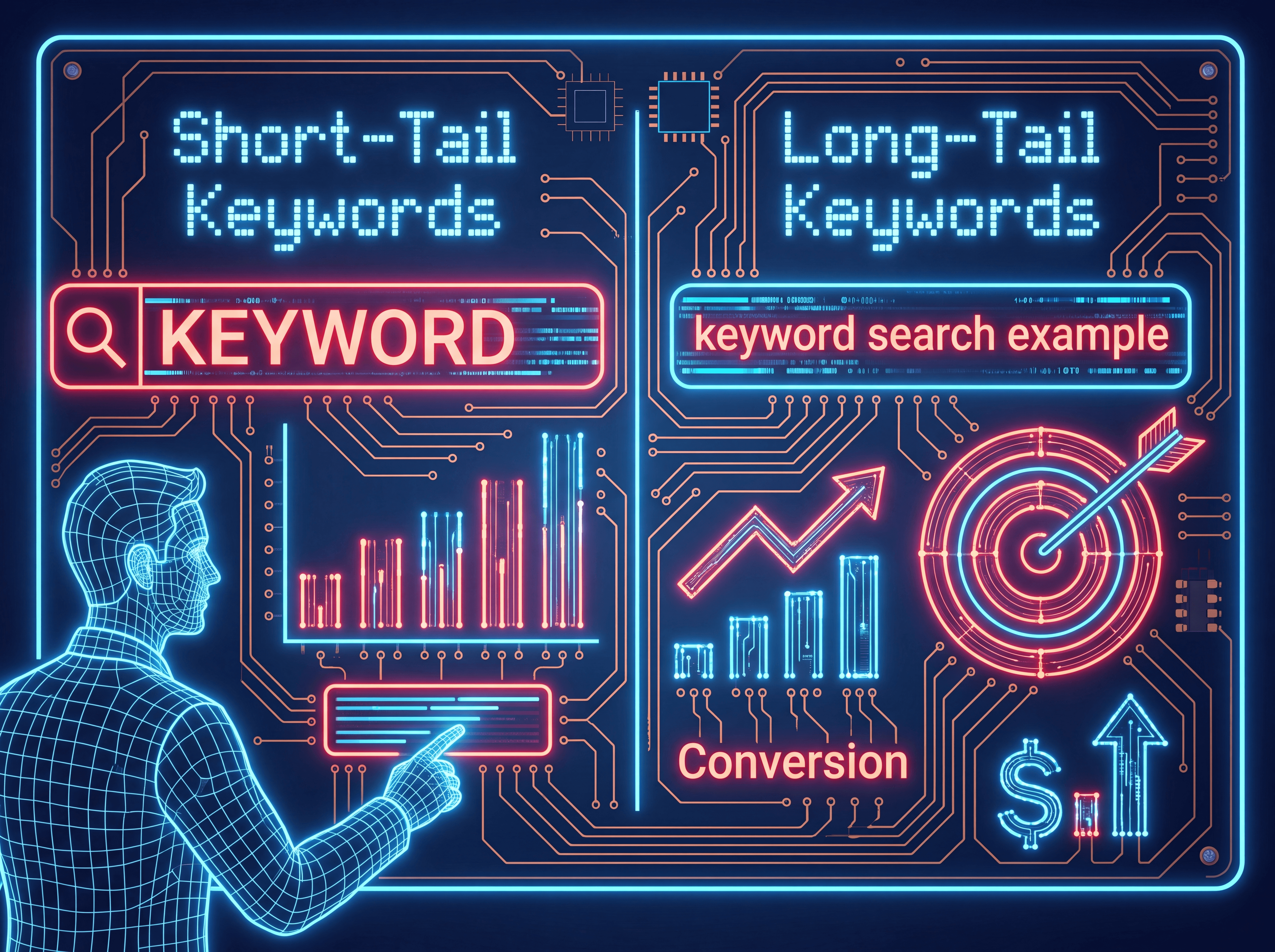
Beyond the four types above, keywords can also be described by their length and specificity.
Short-tail keywords (also called head keywords) are broad, one or two-word searches with very high search volume and extremely high competition.
Examples: "shoes," "insurance," "SEO," "coffee."
Millions of people search these terms every month. Millions of websites are competing for them. Unless your website has enormous authority (think Wikipedia, Amazon, or major media brands), you will not rank for short-tail keywords.
Long-tail keywords are longer, more specific phrases. They get less search volume individually but are far easier to rank for, and they convert much better because the person searching is further along in their journey and more specific about what they want.
Examples: "best waterproof trail running shoes for wide feet," "small business insurance for contractors in Texas," "how to do keyword research for a new website," "light roast single origin coffee beans."
Here is the counterintuitive truth about long-tail keywords: even though each individual long-tail keyword gets fewer monthly searches, together they account for the vast majority of all searches. Research consistently shows that the long tail represents 70% or more of total search volume.
And long-tail keywords convert better. Someone who searches "coffee" could be looking for anything. Someone who searches "buy light roast Ethiopian single origin coffee beans" knows exactly what they want and is ready to purchase.
For new websites, small businesses, and anyone without massive domain authority, long-tail keywords are the primary target. They are winnable. They attract the right people. And they are the building blocks of your SEO foundation.
The Three Most Important Keyword Metrics
When you use any keyword research tool, you will see numbers attached to every keyword. Here are the three that actually matter.
Search Volume
Search volume is the average number of times a keyword is searched per month.
Higher volume means more potential traffic. But high-volume keywords are almost always harder to rank for. The goal is not to find the highest-volume keyword. The goal is to find keywords where the search volume is meaningful AND where you can realistically compete.
For a new or small website, keywords with 100 to 1,000 monthly searches are often perfect starting points. You can rank for them. You can earn traffic. And as your authority grows, you can target higher-volume terms.
Keyword Difficulty
Keyword difficulty (KD) is a score from 0 to 100 that estimates how hard it would be to rank on the first page of Google for a keyword. Different tools calculate this differently, but all of them measure how strong the competing pages are.
A score of 10 is easy. A score of 80 is very hard. A score of 95 means you should probably look for a different keyword unless you have a very established, authoritative website.
For new websites: look for keywords with a difficulty score under 30. For established websites with some authority: you can target up to 50 or 60. For highly authoritative websites: anything is potentially achievable.
Do not get obsessed with exact scores. Different tools give different numbers. Use keyword difficulty as a rough guide, not a precise measurement.
Search Intent
Search intent is not a number. It is a category. But it is arguably the most important of these three metrics.
Search intent (also called user intent) is the reason behind a search. Is the person trying to learn something (informational), find a website (navigational), compare products (commercial), or make a purchase (transactional)? Matching your content to search intent is crucial for ranking in 2026.
If you target a keyword with informational intent and create a product page, you will not rank. Google's algorithm is very good at understanding what type of content the searcher wants. If the top five results for a keyword are all how-to guides, your sales page targeting the same keyword will not rank regardless of how well-optimized it is.
Before you start writing any piece of content, Google your target keyword and look at the top 3 to 5 results. If they are all listicles, write a listicle. If they are all step-by-step guides, write a guide. If they are product pages, your blog post will not rank. Target a different keyword variation instead.
How to Find the Right Keywords: A Step-by-Step Process
Here is a repeatable process you can use for every piece of content you ever create.
Step 1: Start With Seed Keywords
Seed keywords are the broad topic areas your business covers. They are your starting point, not your end point.
If you run a gym, your seed keywords might be: fitness, weight loss, muscle building, workout, nutrition, home gym.
Write down 5 to 10 seed keywords for your business. These are just starting points. You will expand from here.
Step 2: Think Like Your Customer, Not Like Your Business
The most common keyword research mistake is using internal language instead of customer language.
A chiropractor might describe their service as "spinal manipulation therapy." Their patients search for "back pain relief" or "neck pain doctor near me." These are completely different phrases and only one of them is in the customer's vocabulary.
Before you do any keyword research, write down how your best customers would describe their problem, not how you would describe your solution. Talk to actual customers if you can. Read the language they use in online reviews, Reddit threads, and social media posts. That is the language you need to use in your keyword research.
Step 3: Expand Your Seed Keywords Into Keyword Ideas
Use free tools to turn your seed keywords into lists of specific keyword ideas.
Google Autocomplete: Type each seed keyword into Google and watch the suggestions that appear. These are real searches real people are making. Each suggestion is a keyword idea.
People Also Ask: After searching any keyword on Google, look for the "People Also Ask" box. Every question in it is a keyword you could target with a dedicated piece of content.
Google Keyword Planner: Free with a Google Ads account. Enter your seed keywords and get hundreds of related keyword ideas with search volume data direct from Google. This is the most accurate volume data available because it comes from Google itself.
AnswerThePublic: Enter any topic and get hundreds of question-based searches organized by type. Each one is a potential piece of content.
Ahrefs Webmaster Tools (free): After verifying your own website, you can see which keywords Google is already associating with your pages. Sometimes you are ranking for valuable keywords you did not even try for. Find those and lean into them with better content.
Step 4: Filter for Winning Opportunities
Once you have a list of keyword ideas, filter them down to the ones worth targeting. A good keyword meets three criteria:
It has search volume above your minimum threshold (for new sites, this might be 50 to 200 monthly searches; for established sites, maybe 500 or more).
Its difficulty score is achievable for your current website authority.
The search intent matches the type of content you can create. Verify this by checking what is actually ranking on the first page of Google for each keyword.
Remove anything that fails any of these tests.
Step 5: Group Keywords Into Topic Clusters
Modern SEO in 2026 is built on topic authority. Google ranks sites higher when they demonstrate deep expertise on a subject. Rather than targeting individual keywords randomly, group your keywords into topic clusters: one main pillar page covering a broad topic, supported by multiple cluster posts covering specific subtopics.
For example, if your business is about email marketing:
Pillar page (broad): "Email Marketing: The Complete Guide" Cluster posts (specific): "How to write a subject line," "Email list segmentation guide," "Best time to send marketing emails," "Welcome email sequence templates"
Each cluster post links back to the pillar page and to other cluster posts. This internal linking structure signals topical authority to Google and can improve rankings for all the pages in the cluster simultaneously.
Step 6: Prioritize Your List
You cannot create all your content at once. Build a priority order based on three factors:
Business importance: Which keywords, if you ranked for them, would drive the most revenue or leads?
Achievability: Which keywords have difficulty scores you can realistically win right now?
Search intent alignment: Which keywords match content types you are ready and able to create?
Start with high-importance, low-difficulty keywords that match your current content strengths. These are your quick wins. Build from there.
How to Use Keywords Correctly Once You Find Them
Finding the right keywords is half the job. Using them correctly is the other half.
Here is what correct keyword usage looks like in 2026.
Use your main keyword in your page title. The title tag is the most important on-page SEO signal. It tells Google and users what the page is about. Put your main keyword near the beginning of the title and keep the whole title under 60 characters.
Use it in your H1 heading. Your main heading at the top of the page should include your primary keyword. This does not need to be exact. Close variations work fine.
Use it naturally in the first 100 words. Google gives slightly more weight to keywords that appear early in the content. Do not force it unnaturally. Just make sure the page's topic is clear from the very first paragraph.
Use related keywords throughout. Google understands topics, not just exact phrases. Related terms, synonyms, and semantically connected language all contribute to how well Google understands what your page is about. Writing naturally and covering the topic completely will naturally include these terms without any special effort.
Use your keyword in the meta description. The meta description does not directly influence rankings, but it appears in search results and influences whether people click. Include your keyword and make the description genuinely compelling.
Use descriptive, keyword-friendly URL slugs. Compare yoursite.com/p?id=4892 with yoursite.com/keyword-research-guide. The second one tells both Google and users what the page is about before they even click.
Use keywords in image alt text. Google cannot see images. It reads the alt text you write for each one. Describe what is in the image accurately and include your keyword where it makes natural sense.
What to Avoid
Keyword stuffing: Repeating your keyword every few sentences makes your content unreadable and triggers Google's spam detection. Write for humans. Google will understand your topic without needing to see the exact keyword 40 times.
Keyword cannibalization: This happens when multiple pages on your website target the same keyword. They compete against each other in Google's index, and both pages rank lower than one strong page would. Each important keyword should have one primary page targeting it. When you consolidate competing pages into one authoritative resource, traffic can increase dramatically.
Targeting the wrong intent: A blog post targeting a transactional keyword will not rank against product pages. A product page targeting an informational keyword will not rank against comprehensive guides. Always match your content format to what the search results show Google expects for that keyword.
What Changed About Keywords in 2026
Keyword research has evolved. Here is what is different now versus five years ago.
Topics matter more than exact phrases. Google's algorithm is sophisticated enough to understand what a page is about even if it does not contain the exact keyword phrase. A page about "how to grow tomatoes indoors" can rank for "indoor tomato garden tips" without using that exact phrase. Write comprehensively about topics, not mechanically for individual phrases.
AI search is creating new keyword surfaces. AI Overviews change how results appear, but they still source information from well-optimized websites. Brands with strong E-E-A-T signals and well-structured content are more likely to be cited in AI-generated responses. This means keyword research now also informs how you position content to be cited by AI tools, not just to rank in traditional blue links.
Conversational, long-tail queries are growing. Voice search and AI chat interfaces are shifting how people search. Instead of typing "best hiking boots," people are asking "what are the best lightweight hiking boots for a 3-day trip in the Alps in early autumn?" This reinforces the value of long-tail, question-based content.
Intent signals now dominate. Google is extremely good at understanding what a searcher actually wants and matching that to content. Optimizing for intent is now more important than optimizing for keyword density. The content format, depth, and angle need to match what Google's algorithm has learned searchers want for each specific query.
A 30-Minute Keyword Research Session for Beginners
You do not need hours or expensive tools to start. Here is a 30-minute keyword research session that produces real results.
Minutes 1 to 5: Write down your 5 most important business topics. Think about what your customers need help with, not what you sell.
Minutes 6 to 15: Open Google Keyword Planner (free at ads.google.com). Enter each topic. Note down 3 to 5 keyword ideas for each one. Look for keywords with at least some search volume and note the competition level.
Minutes 16 to 22: Open Google in another tab. Search each keyword you noted. Look at the top 5 results. What type of content is ranking (guides, lists, product pages, videos)? Is the search intent informational, commercial, or transactional? Write this down next to each keyword.
Minutes 23 to 28: Cross out any keyword where: the search intent does not match what you can create, the competing pages are from enormous authoritative sites you cannot compete with, or the keyword does not connect to your actual business.
Minutes 29 to 30: Rank your remaining keywords from most valuable to least. The most valuable are the ones where the traffic would directly lead to leads or sales and where you can realistically compete.
You now have a keyword list. Create one piece of content for your top keyword this week. Repeat the process for each one.
The Bottom Line
Keywords are not magic words you stuff into pages to manipulate a search engine.
They are the language your customers use when they need what you offer. Your job is to understand that language, find the specific phrases that balance search volume with competition and intent, and create content that genuinely answers what those searchers need.
With 53.3% of all website traffic coming from organic search, brands that neglect SEO are effectively invisible to the majority of their potential customers. And keyword research is where all of that visibility begins.
Start with your customer's language. Find keywords you can win. Create the best content on the web for each one. Build your topic clusters over time.
That is it. That is the full keyword strategy.
Blogs
More Blogs
From keyword goldmines to AI-driven content hacks—expert insights to help your blog posts dominate the first page.