Top 10 Best Website Authority Checker Tools in 2026 (Ranked & Brutally Honest)
Here's a truth most SEO blogs won't say out loud: website authority scores are made up.
Not in a dishonest way. In a practical way. Google doesn't publish an "authority score." There's no official metric, no certified number, no single source of truth. What we call "domain authority" is every SEO tool's best attempt to answer the question Google refuses to answer publicly: how much does this website matter?
And the uncomfortable follow-up truth? Different tools give you wildly different numbers for the same domain — because they're all measuring slightly different things with different indexes, different algorithms, and different philosophies about what makes a website powerful.
So why bother using them at all?
Because despite the differences, these tools consistently agree on something important: which sites are strong and which are weak. The exact score is noise. The signal — strong vs. weak, growing vs. declining, your site vs. your competitor's — is real and actionable.
This guide covers the 10 best website authority checker tools in 2025, what each one actually measures, who it's best for, and the one thing nobody tells you about each tool. Let's go.
Get Organic SEO Traffic in Days
Ideal for individuals and small teams looking for simple, powerful SEO tools.
Use the code SECRETCODE100 And unlock a free trial!
$0
/month
Free Page Structure Audit
Find top pages by SEO traffic
Backlinks Finder & Builder
AI-visibility Checker
Export data
Color-coded SEO elements
Email Support
LLM Topic Finder
What Is Website Authority - And Why Does It Matter?
Before the tool list, two minutes of foundation that will change how you use every tool on it.
Website authority is a concept, not a metric. It describes a website's overall SEO strength — how likely it is to rank in search results, how much weight its links carry, how much trust it has accumulated over time. The underlying driver of authority is backlinks: other websites linking to yours signal credibility, like citations in academic papers.
The higher your authority relative to your competitors, the better your chances of ranking for contested keywords. A high-authority site can rank for competitive terms that would take a low-authority site years of link building to approach. This is why major publications outrank newer blogs even when the blog post is significantly better — authority is a trust bank, and big sites have been making deposits for decades.
Authority metrics matter practically for three activities: evaluating link-building prospects (is this site worth getting a link from?), benchmarking against competitors (are we stronger or weaker than the sites outranking us?), and tracking your own growth over time (is our link-building strategy working?).
Now — the tools.
1. Moz Link Explorer — The Original, Still Relevant
Metric used: Domain Authority (DA) and Page Authority (PA), scored 0–100
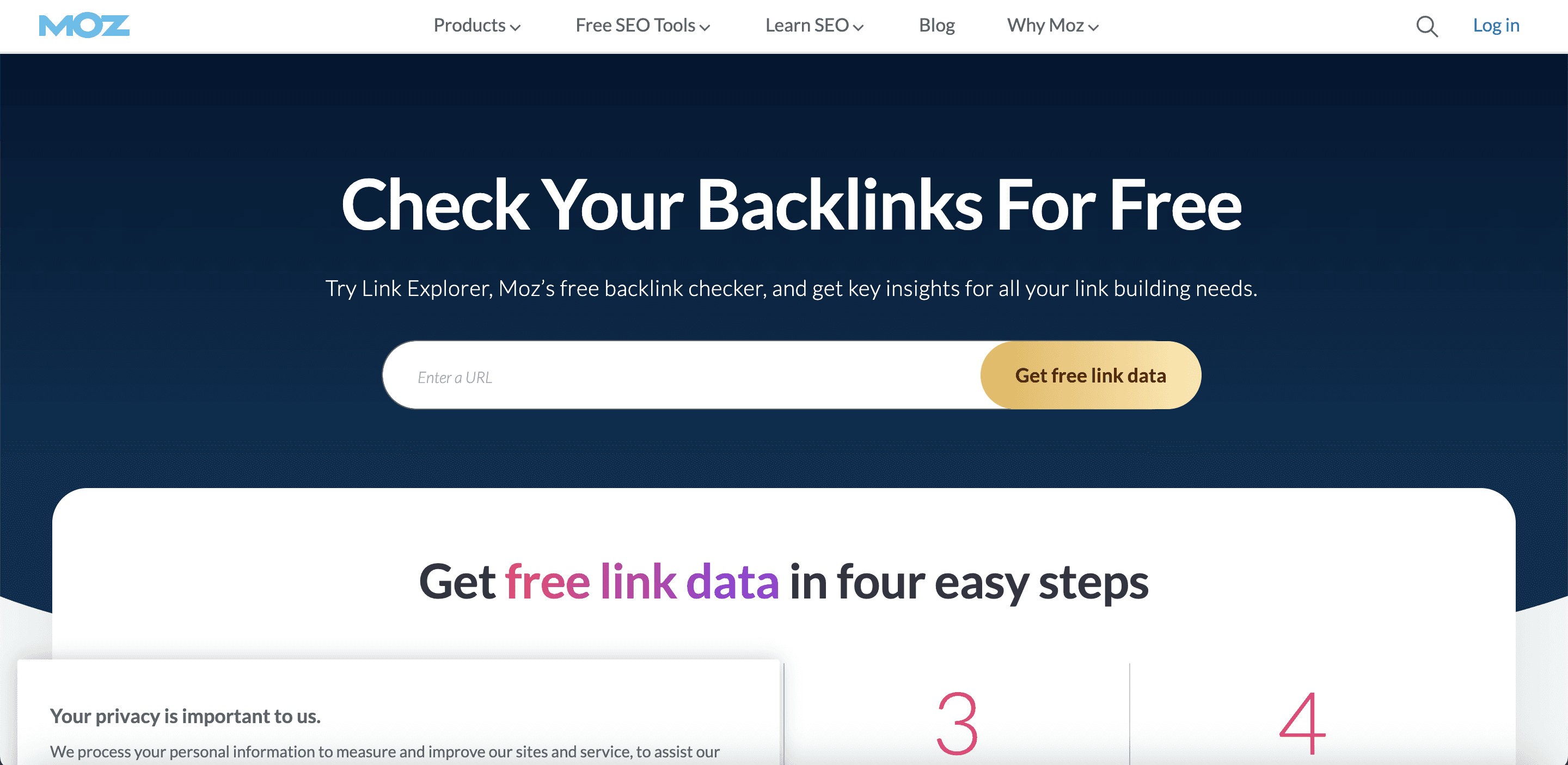
Free tier: 10 queries per month with a free account
Moz invented Domain Authority. That's not a small thing. The term "DA" has become so embedded in the SEO industry that people use it generically to mean "website authority score," even when they're using a different tool entirely. When someone says "what's the DA of that site?" they may or may not mean Moz specifically — but Moz is where the concept originated, which gives the tool a kind of cultural authority that no competitor has matched.
Moz DA is calculated on a logarithmic scale based on the quantity and quality of backlinks pointing to a domain, as analyzed through Moz's own web index (called Mozscape). Higher quality links from high-authority sources carry more weight. The logarithmic scale means it gets progressively harder to move up as you approach 100 — jumping from 20 to 30 is much easier than jumping from 70 to 80.
Beyond DA, Moz Link Explorer gives you Page Authority (PA) for individual URLs, Spam Score (a measure of how many attributes of a domain match known spam sites), linking domains, top linked pages, and — one genuinely useful differentiator — the Link Intersection tool, which shows you which sites link to your competitors but not to you. That's a pre-built link prospect list. Very practical.
What nobody tells you: Moz's index is smaller than Ahrefs' and Semrush's. This means it may miss backlinks that the other tools find, which can result in slightly lower scores for sites with diverse link profiles. The free tier's 10 queries per month is enough for casual monitoring but limiting for any serious research workflow.
Best for: Beginners, agencies that have standardized on DA as their client reporting metric, and anyone who needs the Link Intersection feature.
2. Ahrefs Website Authority Checker — The Backlink Database King
Metric used: Domain Rating (DR), scored 0–100
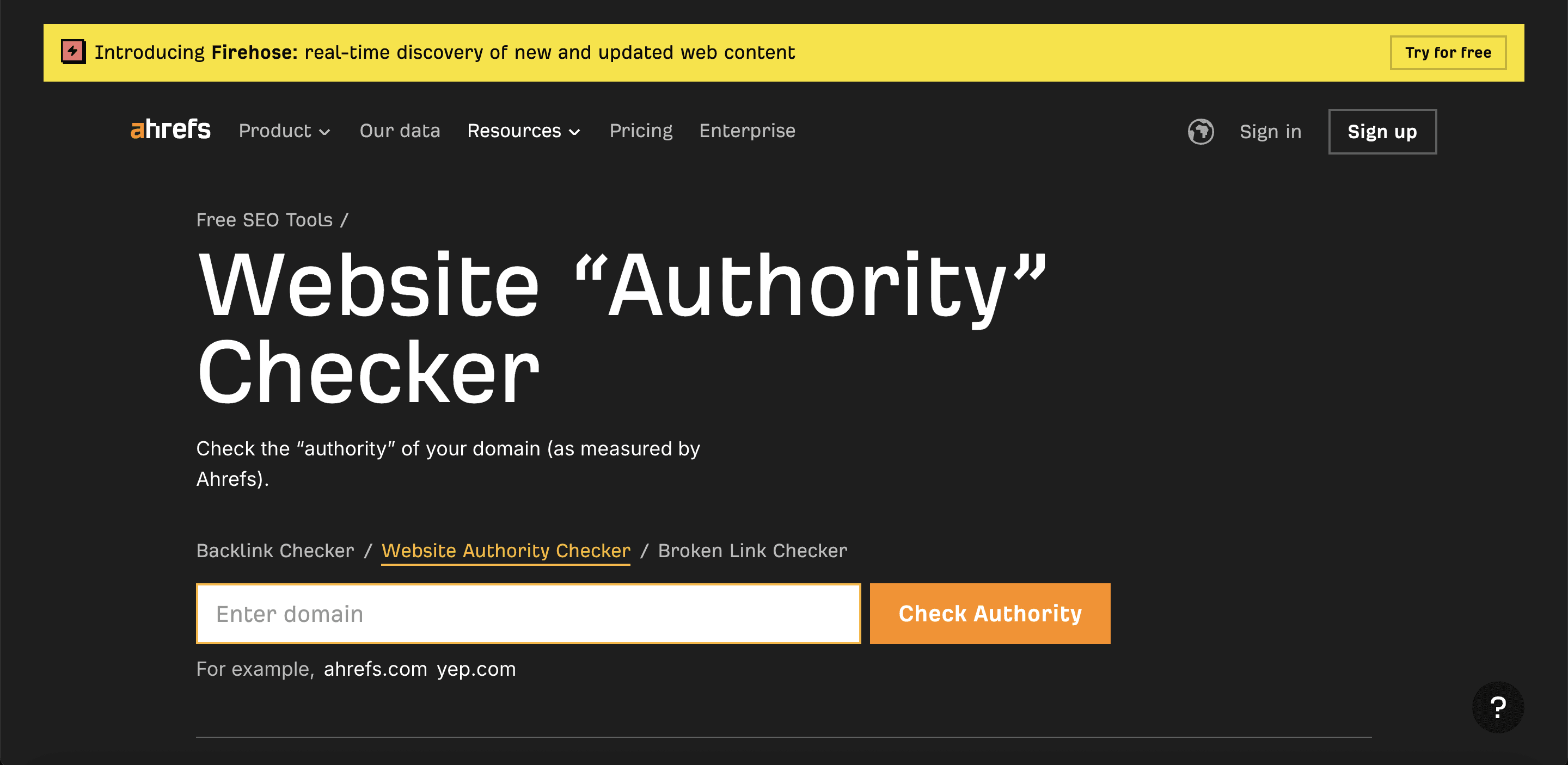
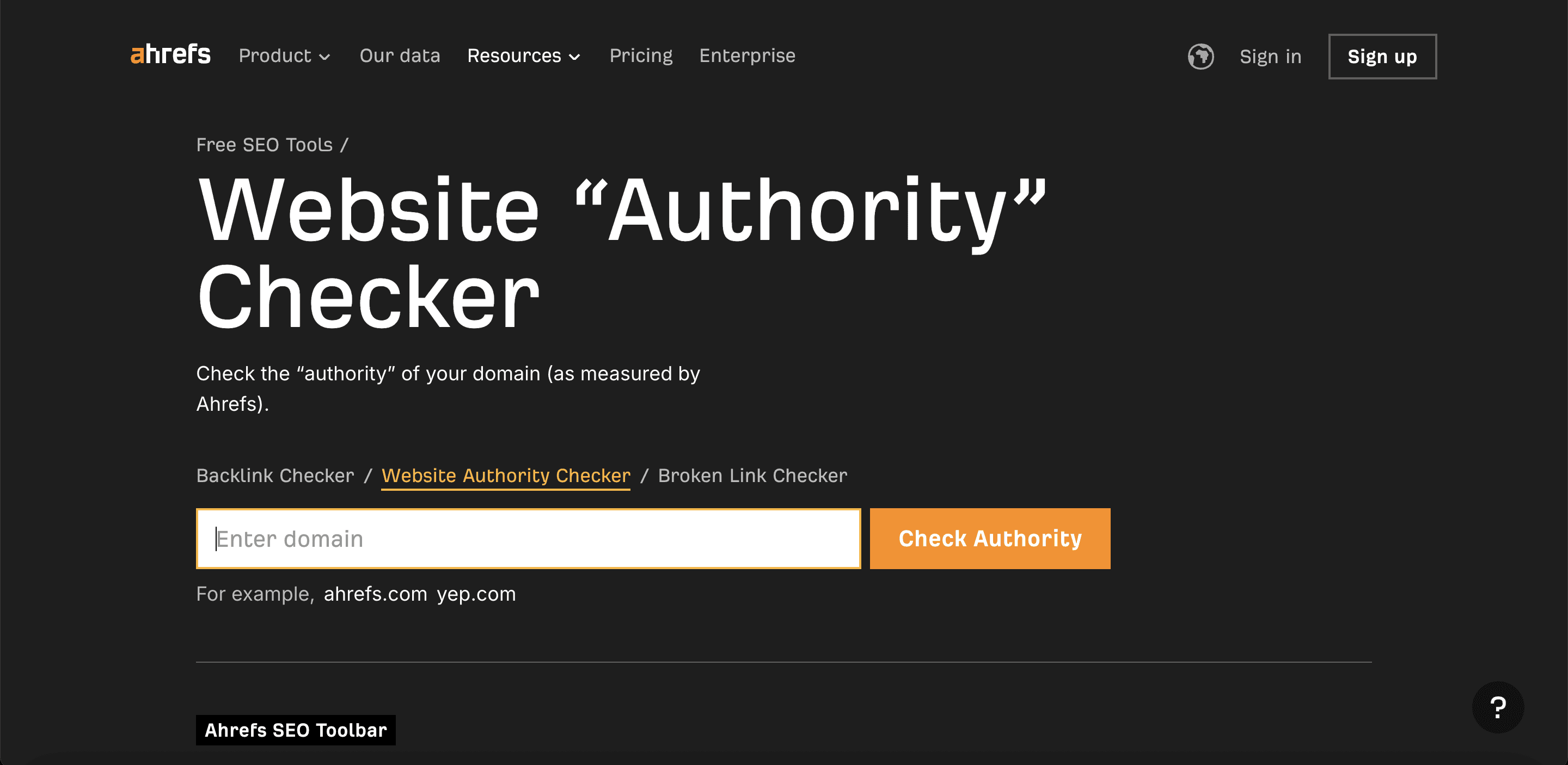
Free tier: Limited free DR checker at ahrefs.com/website-authority-checker (no login required)
Ahrefs built its reputation on the size and freshness of its backlink index — widely considered the largest in the industry. When it comes to finding backlinks, Ahrefs finds more of them than anyone else. That comprehensive index is the foundation of its Domain Rating (DR) metric.
DR measures the strength of a website's backlink profile by evaluating the quantity and quality of unique domains linking to it. The calculation is straightforward in concept: domains with high DR that link to you pass more "rating" to your domain. A link from a DR 90 site is worth dramatically more than a link from a DR 15 site.
One important characteristic of DR: it's almost entirely link-based. Unlike Semrush's Authority Score, Ahrefs DR does not factor in organic traffic or spam signals. This is a deliberate philosophical choice — Ahrefs argues that traffic is an output of good SEO, not an input to authority. Critics argue this makes DR gameable (you can build links without generating any real traffic). Defenders argue it keeps the metric pure and focused on what it's supposed to measure.
Get Organic SEO Traffic in Days
Ideal for individuals and small teams looking for simple, powerful SEO tools.
Use the code SECRETCODE100 And unlock a free trial!
$0
/month
Free Page Structure Audit
Find top pages by SEO traffic
Backlinks Finder & Builder
AI-visibility Checker
Export data
Color-coded SEO elements
Email Support
LLM Topic Finder
The free Ahrefs DR checker is genuinely useful — no account required, instant results, and it's accurate. For anything beyond a quick spot check, Ahrefs' paid suite (Site Explorer, Backlink Analysis, Referring Domains graph over time, Top Anchors) is where the real power lives.
What nobody tells you: DR is a relative metric. A DR of 50 doesn't mean the same thing across all industries. A DR 50 site in a low-competition niche is dominant. A DR 50 site in finance or health is fighting an uphill battle against DR 80+ competitors. Always compare DR within your competitive set, never in isolation.
Best for: Link builders who need the most comprehensive backlink data available, agencies, and anyone who needs a fast, no-login authority check for prospect vetting.
3. Semrush Authority Score — The Manipulation-Resistant Option
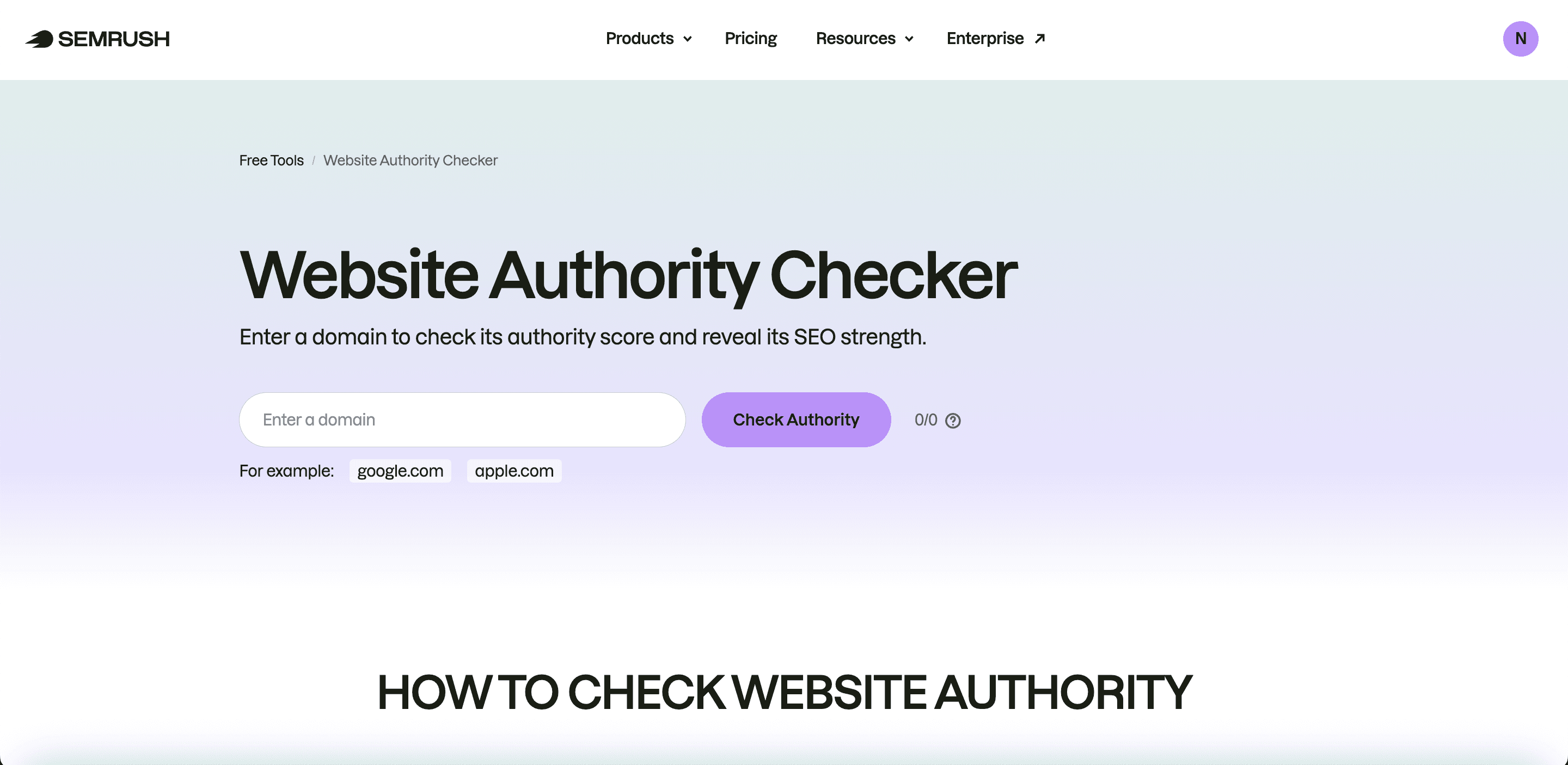
Metric used: Authority Score (AS), scored 0–100
Free tier: Limited daily searches with a free Semrush account
Semrush Authority Score (AS) is the most holistic authority metric on this list. While most tools focus primarily or exclusively on backlinks, Semrush AS incorporates three distinct signal categories: backlink quality and quantity, estimated organic search traffic, and spam/manipulation signals.
The inclusion of organic traffic is Semrush's key differentiator and the source of its most important property: manipulation resistance. A site can accumulate hundreds of purchased or low-quality backlinks and see a meaningless bump in DR or DA. But if those links don't translate into actual search traffic, Semrush Authority Score stays unimpressed. The thinking is that a genuinely authoritative site earns both links and traffic — a site with thousands of links and zero organic traffic is almost certainly gaming the system.
Semrush updated its Authority Score algorithm in 2023 specifically to address link spam and manipulation, adding spam signal detection that looks for patterns like an unusually high percentage of dofollow links, referring domains on the same IP address, and links without corresponding organic visibility.
The Semrush platform that surrounds AS is enormously powerful — keyword research, competitor analysis, site audits, rank tracking, PPC research — all in one interface. It's one of the most complete all-in-one SEO tools available, which means the authority checker isn't a standalone feature but a component of a broader intelligence platform.
What nobody tells you: Because AS incorporates traffic, it can produce counterintuitive results. A niche expert site with a modest but highly relevant backlink profile might score higher than a link-heavy site that gets no actual search traffic. That's often the right call — but it can surprise people coming from pure link-count metrics.
Best for: Digital marketers who want an authority score that's hard to manipulate, anyone running competitor research alongside authority checking, and teams that want a single platform for broad SEO work.
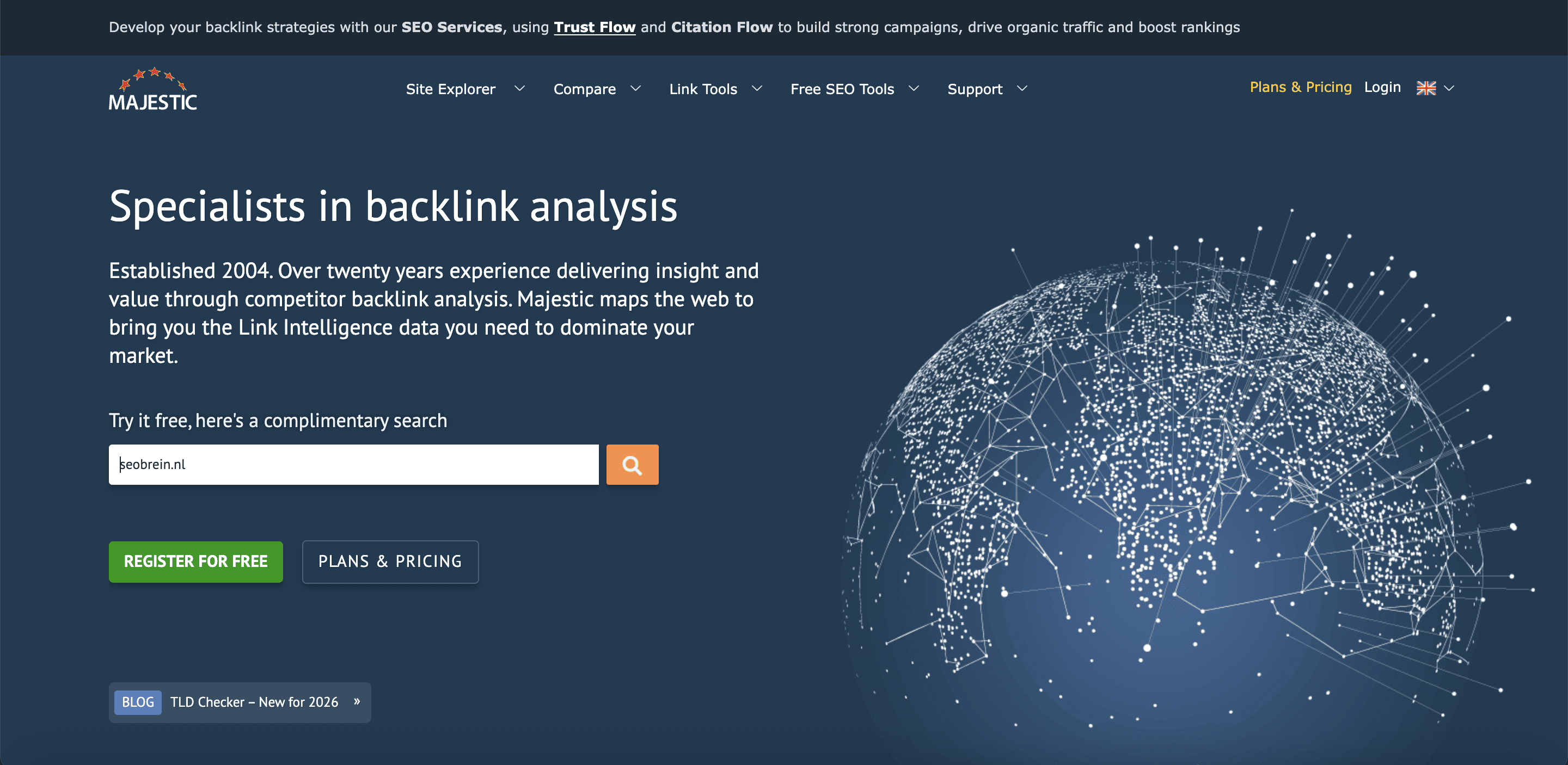
4. Majestic — The Trust Flow Specialist
Metric used: Trust Flow (TF) and Citation Flow (CF), scored 0–100
Free tier: Browser extension with basic metrics; paid plans required for detailed data
Majestic is the tool on this list that thinks most differently about authority. While every other tool uses some variant of "how many quality links point here," Majestic built its authority framework around a concept it calls Trust Flow — a score that measures how close a website is to a trusted seed set of highly reputable websites.
The logic works like this: Majestic starts with a manually curated list of trusted, authoritative websites. Trust "flows" through links from those seed sites outward through the web. A site that receives a direct link from a trusted seed site has higher Trust Flow than one that's two or three link hops removed. The further you are from the trusted core, the lower your Trust Flow.
This is paired with Citation Flow — a measure of raw link quantity, regardless of quality. The ratio between Trust Flow and Citation Flow is often more revealing than either metric alone. A site with high Citation Flow but low Trust Flow has lots of links, but those links aren't from trusted sources — a classic profile of link spam. A site where Trust Flow exceeds Citation Flow is accumulating links from genuinely authoritative sources.
Majestic also introduced Topical Trust Flow, which breaks down a domain's authority by topic category (health, finance, technology, etc.), allowing you to see not just how authoritative a site is, but what it's authoritative about. This is particularly valuable for topical relevance analysis in link building.
What nobody tells you: Majestic's interface is dated and the platform lacks the broader SEO tool suite that competitors offer. It's a specialist tool for link intelligence, not a general-purpose SEO platform. But for pure backlink analysis, particularly around link quality assessment, it has no equal. Domain traders and serious link builders who need to assess the quality of a specific link opportunity use Majestic routinely.
Best for: Link building specialists, domain investors, and anyone who needs to distinguish link quality from link quantity in their analysis.
5. Ubersuggest — The Budget-Friendly Entry Point
Metric used: Domain Score (DS), scored 0–100
Free tier: 3 free searches per day, no account required; paid plans start low
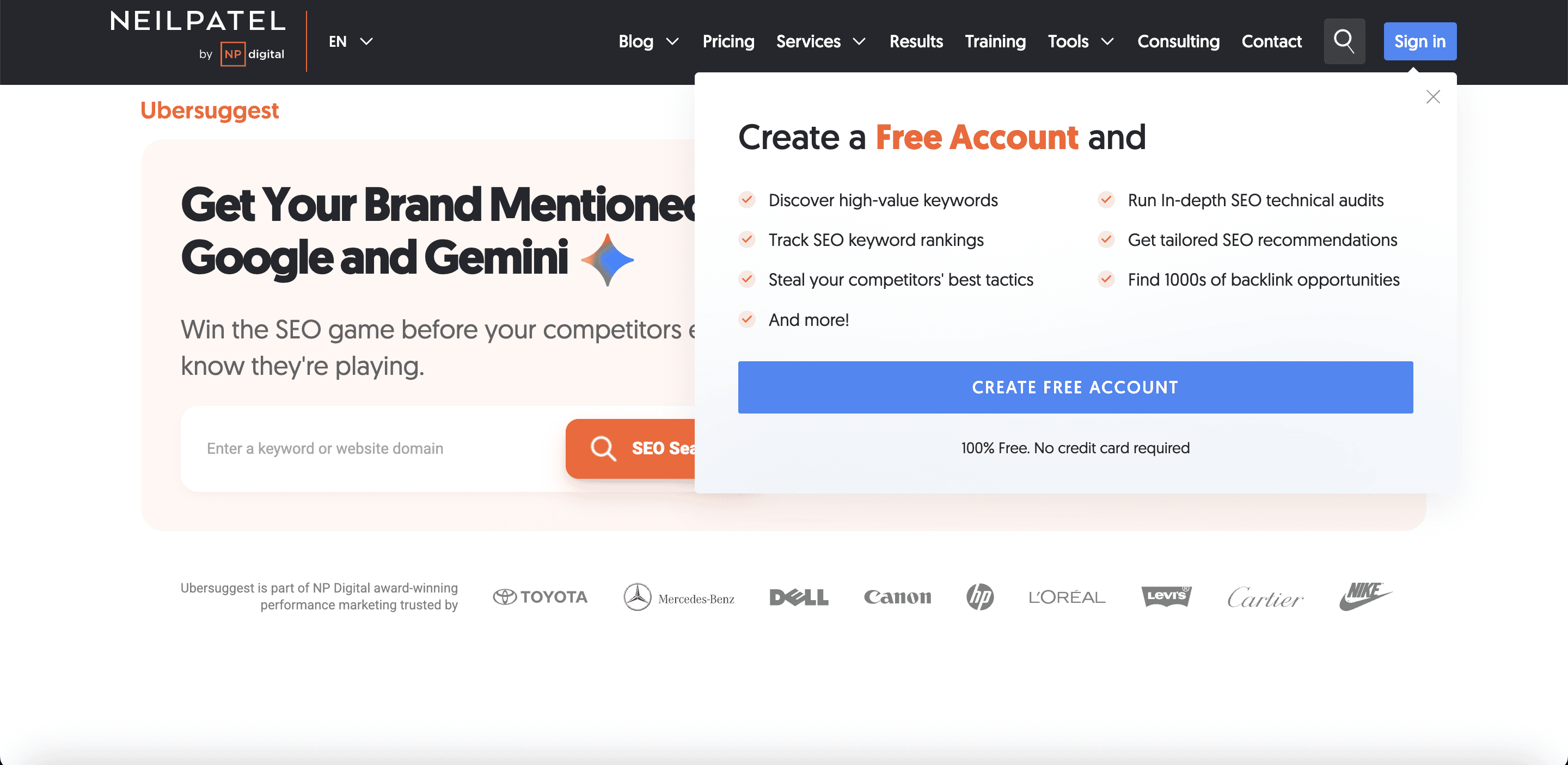
Neil Patel's Ubersuggest occupies a specific and valuable niche: it gives you a genuinely useful authority check alongside keyword data, competitor analysis, and backlink information at a price point that most small businesses and solo marketers can actually afford.
Ubersuggest's Domain Score is primarily link-based, drawing from its own backlink index. It also shows organic monthly traffic estimates, keyword rankings, top pages, and referring domains — all in a clean, digestible interface that doesn't require an SEO background to navigate.
The tool doesn't compete with Ahrefs or Semrush on data depth. Ubersuggest's backlink index is smaller, its traffic estimates are rougher, and its authority score is less sophisticated than Semrush's manipulation-resistant AS. But for someone who needs a quick competitive landscape check, a link prospect score, or an authority baseline for a new client site — without paying enterprise tool prices — Ubersuggest delivers real value.
The Chrome extension is genuinely useful for on-the-fly authority checking as you browse competitor sites or evaluate link prospects.
What nobody tells you: Ubersuggest's data heavily correlates with Ahrefs data because it partially relies on Ahrefs' index. You might occasionally wonder why you're paying for Ubersuggest when you could use Ahrefs' free checker. The answer: Ubersuggest bundles the authority check with keyword and content tools that the free Ahrefs checker doesn't include.
Best for: Small businesses, bloggers, solo SEOs, and anyone who wants a usable all-in-one SEO tool at an affordable price point.
6. SEMrush Free Website Authority Checker (Backlinko Version)
Metric used: Authority Score (powered by Semrush), scored 0–100
Free tier: Completely free, no account required
Backlinko — Brian Dean's SEO resource site — offers a free website authority checker powered by Semrush's Authority Score engine. The interface is simple to the point of elegance: enter a domain, get your Authority Score, backlink count, referring domain count, and organic traffic estimate.
This tool is essentially Semrush's Authority Score made accessible without a Semrush account. The data is identical — same algorithm, same index, same manipulation-resistant approach. What you don't get are the deeper diagnostic tools, historical trends, or competitor comparison features that a Semrush account provides.
For quick one-off authority checks — evaluating a link prospect, doing a fast competitor baseline, checking a client site before a pitch — this is one of the cleanest free options available. No signup friction, instant results, reliable data.
What nobody tells you: Because it's powered by Semrush data, it has the same characteristics as Semrush AS — meaning a site with many links but little organic traffic will score lower than you might expect from the raw backlink numbers. This is accurate and useful, but it surprises people who are used to pure link-based metrics.
Best for: Quick free authority checks without creating accounts, freelancers doing fast prospect vetting, and anyone who wants Semrush-quality data for free.
7. LinkScore.io — Bulk Website Trust & Authority Checker
Metric used: Domain Trust Score, Authority Score and Spam Score (0–100)
Free tier: 5 free website quality checks per day, plus unlimited access to the backlink price checker tool after registration.
LinkScore.io is built for SEOs and outreach specialists who spend too much time vetting link donors and qualifying guest post opportunities manually. Instead of trusting a single SEO metric that can easily be manipulated, LinkScore analyzes domain metadata, search traffic patterns, and spam signals to calculate a realistic Trust Score and Spam Score. This makes it easy to filter out link farms and low-quality blogs, leaving you with genuine, trusted websites.
Two features make LinkScore stand out. First, it lets you cross-reference any high-trust domain you find with marketplaces like Collaborator, WhitePress, and Bazoom, so you can see if it’s available for guest posting and compare prices instantly. Second, it includes an automated Link Monitor that tracks your live links and crowd links to alert you if they are deleted or changed.
What nobody tells you: LinkScore is a screening tool, not a discovery engine. It won’t find new websites for you. You have to upload your own list of prospects. Its real value is saving you from manually checking spam metrics or searching marketplace prices for hundreds of domains one by one to see which ones are actually worth your budget.
Best for: Outreach teams and SEO specialists who need to verify domain lists in bulk and automatically monitor live backlink placements.
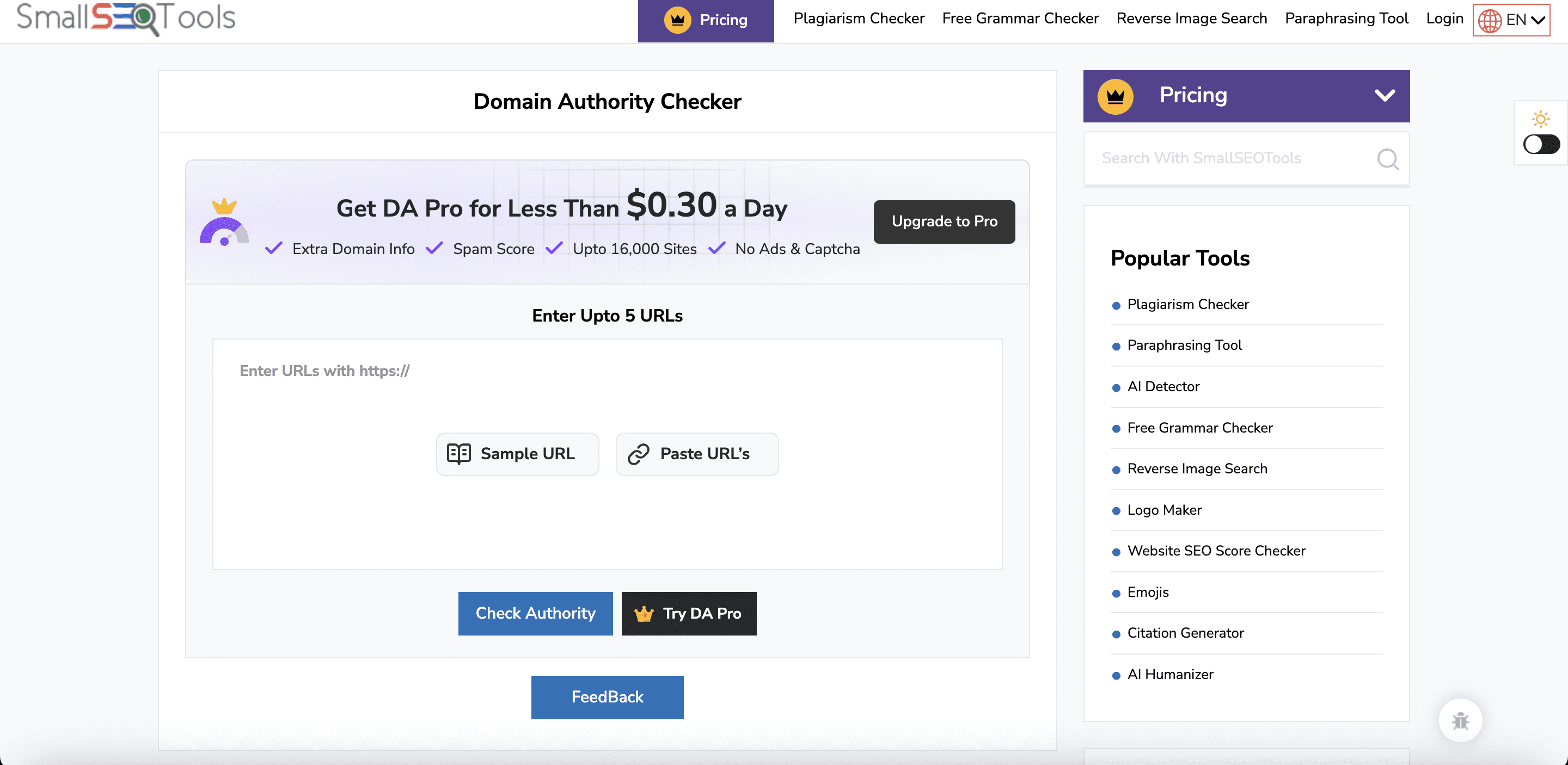
8. Small SEO Tools Domain Authority Checker
Metric used: Domain Authority and Page Authority (powered by Moz), scored 0–100
Free tier: Fully free, no account required, bulk checking up to 10 domains simultaneously
Small SEO Tools is a free utility site that bundles dozens of SEO tools in one place, and its DA checker is among the most-used free authority tools available. The key differentiator from Moz's own free tool? You can check up to 10 domains simultaneously in a single query — no login required.
That bulk-checking capability is genuinely valuable for specific workflows. Running a link prospecting list? Drop in 10 potential sites at once and get DA scores back in seconds. Doing a competitive audit for a client? Check all their top competitors simultaneously. The free Moz tool requires logging in and limits you to single-domain checks; Small SEO Tools removes both friction points for bulk work.
The data pulls from Moz's index, so the scores are consistent with what you'd see in Moz's own tools. You also get Page Authority for each domain's homepage and a basic breakdown of backlinks.
What nobody tells you: Small SEO Tools is ad-supported and the interface reflects that — banner ads and popups are part of the experience. For a workflow where you're doing dozens of quick bulk checks, the ads become friction. But for occasional use, the free bulk-checking feature is hard to beat.
Best for: Link building outreach (vetting prospect lists in bulk), quick competitive audits, and anyone who needs free bulk authority data without paying for a premium tool.
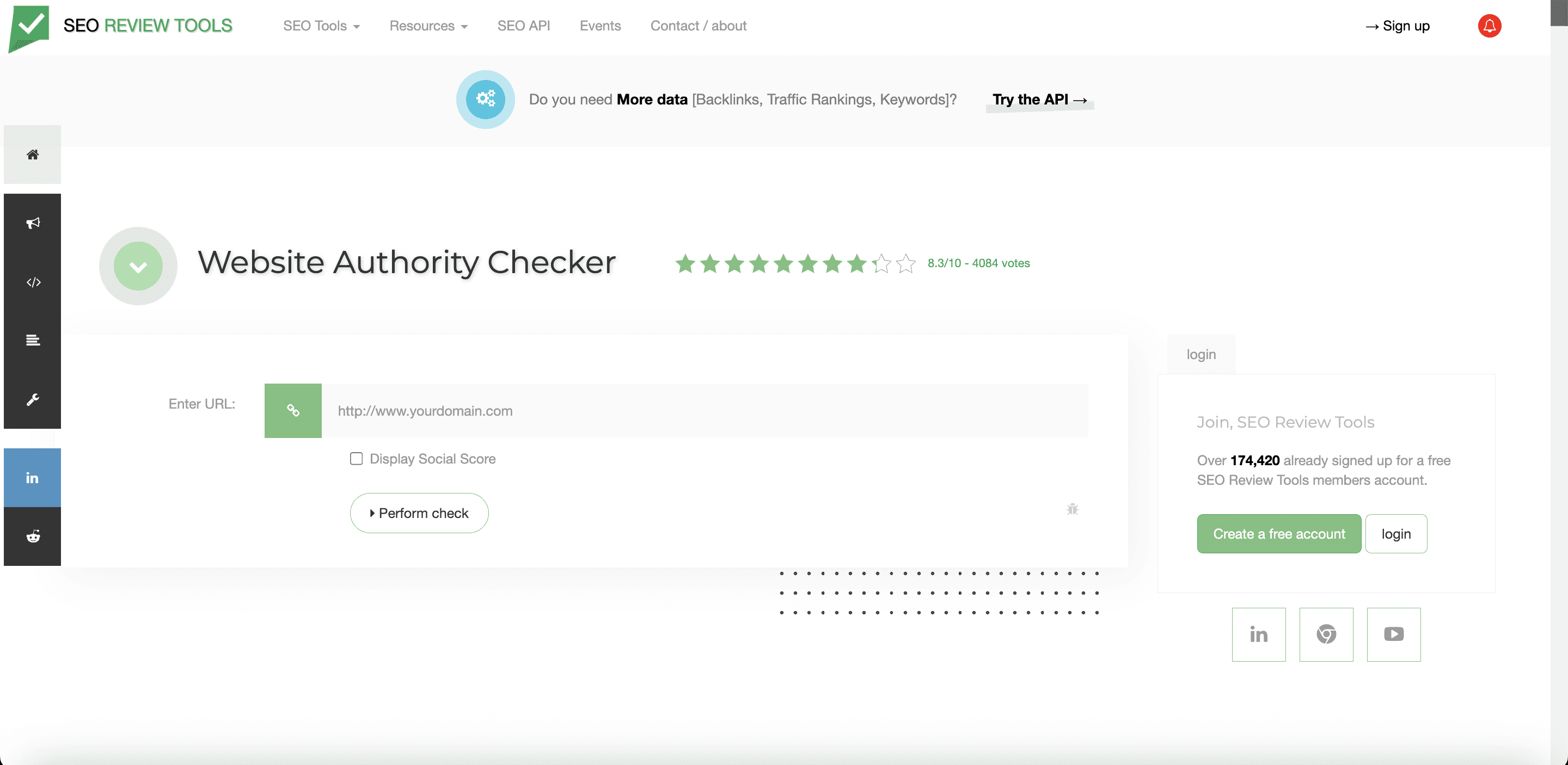
9. SEO Review Tools Domain Authority Checker
Metric used: Domain Authority and Page Authority (Moz) + Authority Score (Semrush) in one view
Free tier: Fully free, with a paid premium tier for bulk checking up to 500 URLs
SEO Review Tools, built by SEO consultant Kris Bogaerts, offers something legitimately differentiated: it shows you multiple authority metrics in a single lookup, pulling from both Moz and Semrush simultaneously. Enter a domain and you see DA, PA, Authority Score, and a selection of other metrics — without having to check each tool separately.
The value of seeing multiple metrics at once can't be overstated for serious authority analysis. A site with high DA but low AS might have a link-inflated profile that doesn't reflect genuine organic authority. A site with moderate DA but high AS might be strong where it counts. Seeing both in one view gives you a more complete picture than either metric alone.
The premium bulk-checker feature — which allows checking up to 500 URLs at once — is purpose-built for agencies doing large-scale link audits or outreach list qualification. At its price point, it's competitive with paying for multiple tool subscriptions.
The tool also recently added context around AI visibility — noting that websites with higher Domain Authority tend to gain more visibility across AI platforms like ChatGPT and Perplexity. As generative AI becomes a discovery channel, authority's importance is extending beyond traditional search rankings.
What nobody tells you: The premium bulk checker is where this tool really shines — the free version has query limits that make high-volume work impractical. If you're doing fewer than 50 lookups a day, the free tier is excellent. If you're qualifying thousands of outreach prospects monthly, the premium tier is worth evaluating.
Best for: Agencies and consultants who want multi-metric authority views in one place, and anyone doing large-scale link prospecting who needs bulk checking at volume.
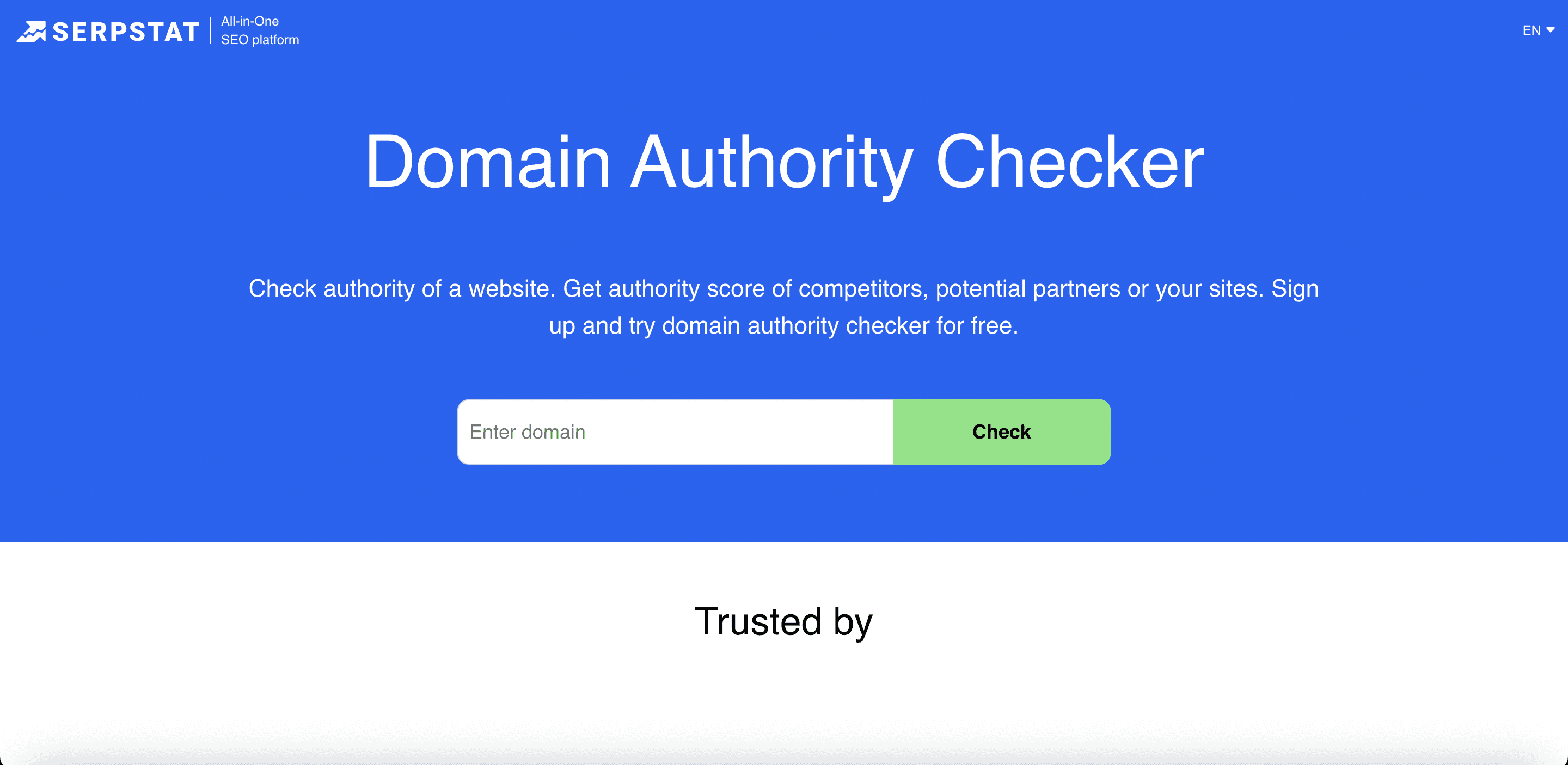
10. Serpstat Website Authority Checker
Metric used: Serpstat Domain Rank (SDR), scored 0–100
Free tier: Limited daily checks with a free account
Serpstat is a full-stack SEO platform built for teams that want comprehensive competitive intelligence without the price tag of Semrush or Ahrefs' premium tiers. Its Domain Rank (SDR) metric is a proprietary authority score based on backlink data from Serpstat's own web index.
What makes Serpstat's approach to authority checking valuable isn't the standalone metric — it's the context around it. Serpstat's platform surrounds the authority score with keyword tracking, SERP position monitoring, backlink analysis, and competitor research tools. This means when you check a domain's authority, you're naturally positioned to immediately drill into why it has that authority: which pages are ranking, which keywords are driving traffic, which sites are linking to it.
Get Organic SEO Traffic in Days
Ideal for individuals and small teams looking for simple, powerful SEO tools.
Use the code SECRETCODE100 And unlock a free trial!
$0
/month
Free Page Structure Audit
Find top pages by SEO traffic
Backlinks Finder & Builder
AI-visibility Checker
Export data
Color-coded SEO elements
Email Support
LLM Topic Finder
For teams managing multiple client accounts or tracking competitive landscapes across several industries, Serpstat's campaign management features let you organize authority tracking in a structured way — monitoring your clients' domains and their top competitors in one organized dashboard.
What nobody tells you: Serpstat's link index is smaller than Ahrefs' or Majestic's, which can mean missing some backlinks, particularly for newer or less-crawled domains. It's a better tool for competitive research and keyword intelligence than for deep backlink audits. Use it as your central SEO command center with authority checking as one of many features, rather than as a dedicated authority specialist.
Best for: Teams managing multiple clients or competitor landscapes who want authority checking built into a broader SEO workflow management platform.
11. Moz Pro's Link Explorer (Advanced)
Metric used: Domain Authority 2.0, Page Authority 2.0, Brand Authority
Free tier: 10 queries/month free; Moz Pro subscription for unlimited access
While the free Moz tool (listed at #1) gives you basic DA, Moz Pro's full Link Explorer is a different beast worth covering separately for what it adds beyond the free version.
Moz introduced Brand Authority as a new supplementary metric — a measure of brand search volume and recognition distinct from link-based authority. The idea: a website can have a strong backlink profile but weak brand recognition, or vice versa. Brand Authority captures the brand awareness dimension that traditional backlink metrics miss entirely.
Moz Pro also includes the Link Intersect tool at full capacity (unlimited competitor comparisons, not the capped free version), Top Linking Domains with detailed quality analysis, Link Tracking Lists for monitoring specific prospect sites over time, and On-Page Grader for evaluating page-level optimization alongside authority.
For agencies that have built their client reporting around Domain Authority as the primary benchmark, Moz Pro is the natural home — it keeps every client's DA history, benchmarks, and link data in a single place with exportable reports designed for client-facing presentations.
What nobody tells you: Moz's crawl frequency is lower than Ahrefs', meaning new backlinks may take longer to appear in your Link Explorer data. If you're actively building links and want to see results quickly, Ahrefs' near-real-time index is more satisfying. Moz Pro is better for tracking trends over weeks and months than for day-to-day link monitoring.
Best for: Agencies standardized on DA as their client reporting metric, teams who want Brand Authority alongside backlink authority, and anyone needing detailed competitor link gap analysis.
Quick Comparison: Which Tool Should You Actually Use?
Here's the honest breakdown by use case.
Just need a fast free check right now? Ahrefs' free DR checker (no login required) or Backlinko's free Authority Score checker. Both take 10 seconds and require nothing.
Running outreach and need to vet a list of 20+ domains? Small SEO Tools bulk DA checker. Drop in up to 10 at a time, free, no account.
Need the most accurate authority score that resists link manipulation? Semrush Authority Score wins here. Its traffic-inclusive algorithm filters out link-spam that inflates DR and DA scores.
Deep-diving a single competitor's link profile? Ahrefs Site Explorer. The largest backlink index with the most detailed link analysis available.
Need to understand link quality, not just quantity? Majestic Trust Flow and Citation Flow. The TF/CF ratio tells you more about link quality than any other metric on the market.
Managing multiple clients and want everything in one place? Semrush or Serpstat for all-in-one workflows; Moz Pro if DA is your standardized client metric.
On a tight budget and need a workable all-in-one tool? Ubersuggest. Not enterprise-grade, but genuinely useful and affordable.
The Uncomfortable Truth About All Authority Scores
Here it is: none of these scores are what Google uses.
Google's John Mueller has acknowledged that Google has something like a sitewide score that "maps to similar things" as what DA/DR/AS measure — but it's not these metrics, it's calculated differently, and it's not something Google shares publicly.
What these tools are measuring is a reasonable proxy. A site with high Ahrefs DR almost certainly has a strong link profile that Google's algorithm values. A site with high Semrush Authority Score likely has both links and organic traffic that signal genuine authority. The correlation between high authority scores and good organic rankings is real and well-documented.
But chasing the number is the wrong goal.
The sites that build real authority don't do it by optimizing for DA or DR. They do it by creating content worth linking to, earning mentions in reputable publications, and building genuine digital relationships over years. The score follows the authority. The authority follows the work.
Use these tools to benchmark, diagnose, and prioritize. Use them to find the gap between your site and your competitors. Use them to qualify link prospects and identify where links are most valuable to acquire.
Don't use them as the thing you're trying to increase. They're the thermometer, not the cure.
How to Improve Your Website Authority (The Actual Way)
Since you're checking authority scores, you presumably want to improve yours. The mechanics are simple. The execution is slow. Here's what actually works.
Earn links from authoritative, relevant sources. A single backlink from a high-DR site in your industry is worth more than 100 links from irrelevant low-DR directories. Relevance is as important as authority. A food blog linking to a food company carries more weight than a tech blog doing the same.
Create things that genuinely get linked to. Original research, comprehensive guides, unique data, free tools, industry surveys. These are the categories of content that earn unsolicited links at scale. Blog posts about common knowledge don't get linked to — they compete with thousands of existing posts covering the same ground.
Digital PR. Getting mentioned in industry publications, news outlets, and authoritative editorial sources is the fastest legitimate path to significant authority gains. One well-placed feature in a domain-rating 80+ publication can do more for your authority than months of traditional link building.
Fix your broken link profile. Use any of the tools on this list to identify lost backlinks, disavow toxic links, and reclaim links that point to pages that no longer exist (301 redirect them to equivalent content).
Be patient. Logarithmic authority scales mean the early gains come fast and the later gains come slow. Going from DA 10 to DA 30 takes less time than going from DA 50 to DA 70. Factor that into your timeline expectations. Authority is a long game.
The tools on this list are the best available in 2025. Use them to see clearly, move strategically, and build something genuinely worth ranking.
Keywords: website authority checker, domain authority checker, best website authority checker, DA checker, Moz domain authority, Ahrefs domain rating, Semrush authority score, free domain authority checker, check website authority, Majestic trust flow, domain authority tools 2025, website authority score, DR checker, domain strength checker, SEO authority tools
Blogs
More Blogs
From keyword goldmines to AI-driven content hacks—expert insights to help your blog posts dominate the first page.