The Four Ps of Marketing: The Complete Practical Guide for 2026
Every successful product launch, every great ad campaign, every business that consistently wins customers over its competitors: they all have something in common.
They figured out the same four things.
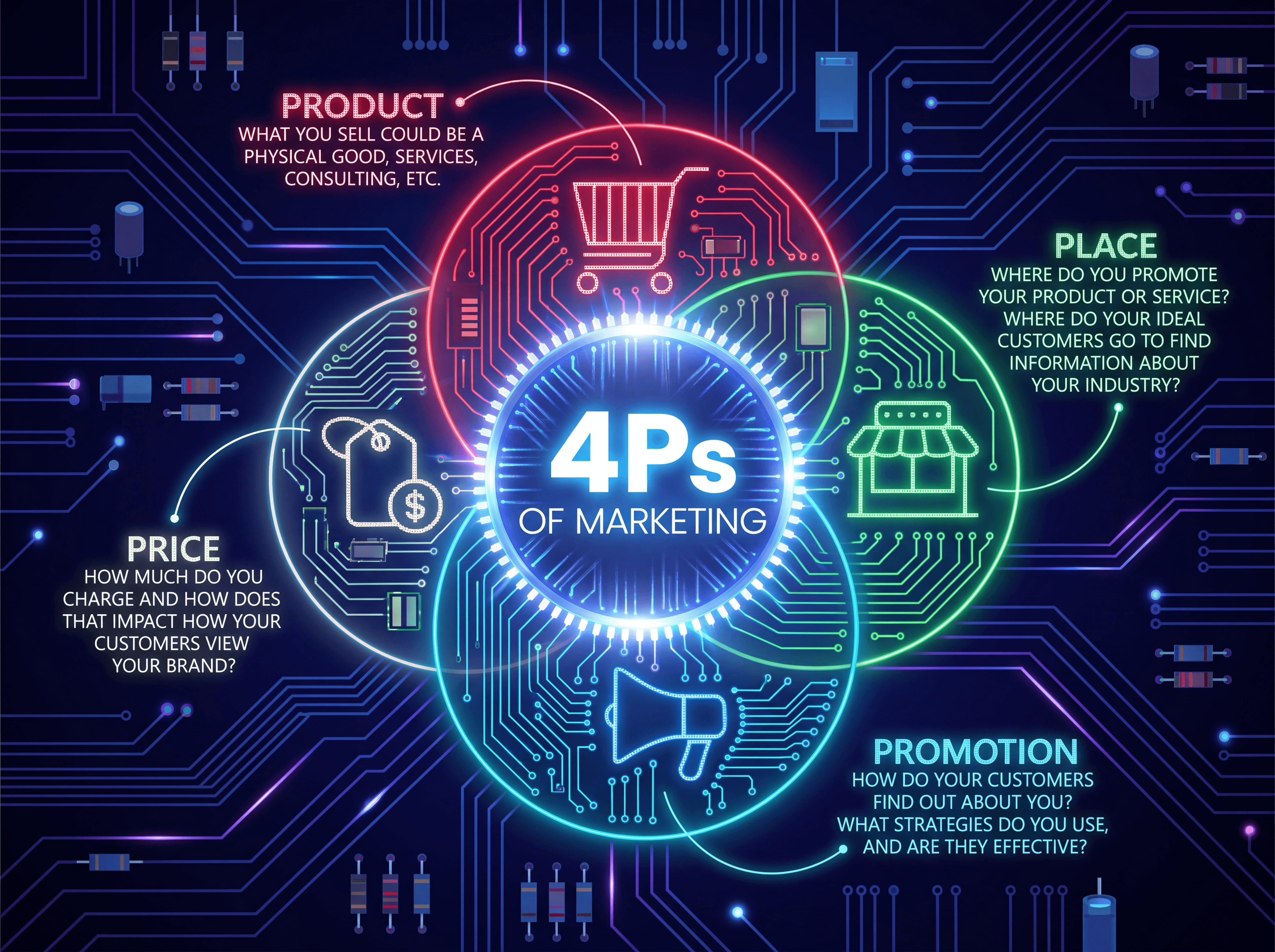
What they are selling. What to charge for it. Where to sell it. And how to tell people about it.
That is the Four Ps of marketing. Product, Price, Place, and Promotion. A framework developed over 60 years ago that still sits at the heart of every effective marketing strategy on the planet today.
The basics have not changed. But how you apply them in 2026 looks very different from how your marketing textbook described them. This guide covers what each P means, why it matters, how great brands use each one, the most common mistakes businesses make with each, and exactly how to apply the framework to your own business.
The History: Where the Four Ps Came From
Neil Borden, an advertising professor at Harvard, introduced the concept of the "marketing mix" in the 1950s. He listed a dozen variables that influenced whether a marketing program succeeded.
E. Jerome McCarthy simplified Borden's list into four categories in his 1960 textbook, Basic Marketing: A Managerial Approach. He called them Product, Price, Place, and Promotion, and the model has been taught in business schools and applied in boardrooms ever since.
Philip Kotler, the most influential marketing academic of the 20th century, brought the Four Ps to global prominence through his own textbooks and research. Today, knowing the Four Ps is considered a baseline requirement for anyone working in marketing.
But here is the thing most textbooks do not tell you: knowing the framework is easy. Applying it well is hard. Most businesses get at least one of the four wrong, and that single weak link can collapse the whole strategy.
P1: Product
What It Is
Product is what you sell. That could be a physical product, a software service, a consulting engagement, a subscription, or an experience. Whatever it is, the Product P covers everything about what you are offering to the market.
But product is much more than just the thing itself. It includes the features that make it work, the design that makes it feel right, the quality level that matches your customer's expectations, the packaging that communicates value before anyone opens the box, the warranty that builds trust, and the overall customer experience of using it.
Think of Product as the answer to the question: "What are we actually providing, and why should someone want it?"
Why It Matters
Product is the foundation of your entire marketing strategy. Get this wrong and the other three Ps cannot save you.
A classic example: the Segway. When it launched in 2001, its inventor promised it would revolutionize transportation. Despite heavy promotion, a premium price that signaled quality, and wide distribution in cities across the world, the product failed commercially. The problem was not the promotion or the price. The problem was that there was no compelling everyday use case for most customers. The product did not solve a problem people urgently had.
Apple's iPhone, launched in 2007, did the opposite. It solved a problem people did not even know they had until they saw the solution. Touch screen. Internet. Camera. Music. All in one device that was beautiful and easy to use. Product excellence created a marketing advantage that competitors struggled to close for years.
Key Product Decisions
What problem does this solve? Successful products solve a real problem, answer a real question, or fulfill a real desire. The more acute the problem and the better your solution, the easier everything else becomes.
What makes it different? In a crowded market, me-too products fail. Your product needs a specific reason to be chosen over alternatives. That difference might be quality, price, features, design, speed, simplicity, or something entirely new.
What is the product lifecycle? Every product has phases: introduction, growth, maturity, and decline. Your marketing strategy should change as the product moves through these phases. What works to launch a product is different from what works to maintain market share in a mature category.
What is the full product experience? The product is not just what is in the box or what the software does. It is the onboarding, the customer service, the packaging, the community around it. 71% of customers expect personalized experiences, and 76% report frustration when businesses fail to deliver them. Your product experience extends well beyond the core offering.
Product in Practice: Netflix
Netflix's product strategy is a masterclass. The core product (streaming video) has remained consistent, but the surrounding product decisions have constantly evolved. Original content. Offline downloads. Multiple screen streams. A tiered pricing model that expands the addressable market. Recommendations that make discovering what to watch feel effortless.
Each of these is a product decision. And each reinforces the others. The product became the reason people chose Netflix over competitors, not just the content.
The Most Common Product Mistake
Falling in love with your own product instead of your customer's problem.
Businesses spend years building something they are proud of, then go to market and discover that the people they are selling to do not experience the problem the same way. The fix: talk to customers before you build, during the build, and after the launch. The product should be defined by the customer's experience, not by the founder's vision.
P2: Price
What It Is
Price is what you charge for your product. But price is not just a number. It is a signal. It tells customers what kind of product they are buying before they ever use it.
High price signals quality, exclusivity, and premium value. Low price signals accessibility and volume. The right price depends on your costs, your competition, your customer's willingness to pay, and the positioning you want in the market.
Why It Matters
Price is the only one of the Four Ps that directly generates revenue. Every other P costs money. Price makes money. That makes pricing decisions some of the most financially significant decisions a business can make.
A 1% improvement in pricing strategy can increase operating profit by 11%, according to research from McKinsey. Yet most businesses set their price once and barely revisit it. This is leaving significant money on the table.
The Main Pricing Strategies
Cost-plus pricing: Calculate what it costs to make the product, add a margin, set the price. Simple but often leaves value on the table. Just because something is cheap to produce does not mean customers place low value on it.
Competitive pricing: Set your price based on what competitors charge. Useful for commoditized markets where customers can easily compare. Dangerous when it starts a race to the bottom.
Value-based pricing: Set your price based on what the product is worth to the customer. This is almost always the most profitable approach, but it requires deep understanding of your customer's alternatives and the value your product creates for them.
Premium pricing: Charge more than competitors to signal quality and exclusivity. This works when the product genuinely delivers premium value and when the target customer identifies themselves as someone who buys premium products. Rolex, Hermès, and Apple all use premium pricing not despite their high prices but because of them. The price is part of the product.
Penetration pricing: Launch at a low price to gain market share quickly, then raise prices as you build a user base. Amazon used this strategy aggressively in e-commerce. Many SaaS products use it with free tiers that convert to paid plans.
Dynamic pricing: Adjust prices in real time based on demand, time, inventory, and customer behavior. Airlines and hotels have used this for decades. Uber's surge pricing is a well-known example. Increasingly, AI tools make dynamic pricing accessible to businesses of all sizes.
Pricing Signals: The Luxury Paradox
Louis Vuitton could sell more handbags by lowering prices. They choose not to, because the high price is part of what makes the bag desirable. The same dynamic applies to any brand competing on exclusivity, craftsmanship, or status.
Strong brands can charge a 15 to 40% premium over competitors without losing significant volume. If you raise your price by 5% and customer churn increases by less than 2%, you likely have room to increase further. If churn spikes 10% or more, you are at your pricing ceiling.
The Most Common Pricing Mistake
Competing on price when you should be competing on value.
When two businesses with similar products compete primarily on price, both get hurt. Margins shrink, the customer trains themselves to wait for discounts, and brand equity erodes. The better strategy is to build a product and a story that justify a higher price, then hold it. Discounting is a short-term tactic. Pricing discipline is a long-term advantage.
P3: Place
What It Is
Place covers how and where your product reaches customers. In traditional marketing, this was primarily about physical distribution: which stores carry your product, how it gets from the factory to the shelf, which distributors you work with.
In 2026, Place has expanded dramatically. It now includes your website, your app, online marketplaces like Amazon, social commerce on Instagram and TikTok, third-party retailers, your own direct-to-consumer stores, and whatever combination of these channels makes it easiest for your customer to find and buy your product.
Why It Matters
The best product at the right price means nothing if it is not available where your customer looks for it. Distribution is a competitive advantage that is hard to build and hard for competitors to copy quickly.
Consider this: customers who engage with a brand across multiple channels spend 30 to 50% more than single-channel customers. Omnichannel presence is not just a nice-to-have. It is a revenue multiplier.
64% of Gen Z, 59% of Millennials, and 47% of Gen X customers have discovered a product on social media in the past three months. 17% of social media users have purchased directly in-app. The place where discovery happens has fundamentally shifted, and marketing strategy must follow.
Key Place Decisions
Direct vs. indirect distribution: Do you sell directly to customers (your own website, your own store) or through intermediaries (retailers, wholesalers, distributors)? Direct gives you more control and higher margins but requires you to build the distribution infrastructure yourself. Indirect gives you scale faster but at lower margins and with less control over the customer experience.
Online vs. offline vs. both: E-commerce has made it possible for any business to sell to anyone anywhere. But physical retail still drives the majority of overall purchases in many categories. The right answer depends on what you sell and who you sell to.
Marketplace presence: Amazon commands 37.6% of all US e-commerce sales. Not being on Amazon in relevant categories means missing a massive portion of where purchase decisions are made. Same principle applies to Etsy for handmade goods, App Store and Google Play for software, and other category-specific marketplaces.
Social commerce: TikTok Shop, Instagram Shopping, and Facebook Marketplace have made it possible to complete purchases without leaving the social media platform. For consumer brands targeting younger demographics, in-app commerce is an increasingly important distribution channel.
Place in Practice: Red Bull
Red Bull does not just sell a drink. It sells energy culture. Their place strategy reflects this. Red Bull is available in convenience stores (impulse purchase), sports venues (contextual relevance), premium bars and clubs (aspirational association), and music events (cultural positioning). Every place Red Bull appears reinforces the brand identity. The distribution is part of the marketing.
The Most Common Place Mistake
Choosing distribution channels based on where it is easy to be rather than where your customer actually looks.
A luxury skincare brand selling on Amazon might gain volume but lose the premium positioning that makes customers willing to pay premium prices. An artisan food brand might avoid large grocery chains to preserve its small-batch story, then find it cannot achieve the scale it needs.
Ask first: where does my specific customer look when they want to find a product like mine? Start there. Work backwards.
P4: Promotion
What It Is
Promotion covers everything you do to communicate your product's value and persuade customers to buy. It includes advertising, content marketing, social media, email marketing, search engine marketing, public relations, influencer partnerships, events, affiliate marketing, direct mail, and any other method of reaching and convincing your target audience.
Promotion is often what most people think of when they think of marketing. But it is only one quarter of the framework, and it depends entirely on the other three Ps to work effectively.
Why It Matters
Great promotion for a bad product accelerates its failure. Great promotion for a product priced wrong sends the wrong customers. Great promotion distributed through the wrong channels reaches the wrong audience.
But great promotion for the right product, at the right price, through the right channels? That is how businesses grow.
In 2026, 60% of marketing spend is digital, and that shift changes how every promotional decision is made. Digital channels offer targeting precision, real-time optimization, and measurable outcomes that traditional media cannot match. Digital ad spend worldwide reached $526 billion in 2024 and is projected to reach $734 billion by 2025.
The Promotional Mix
Advertising: Paid placements in media (TV, radio, digital, print, out-of-home). Provides reach and control over the message but requires budget and loses effectiveness if the creative is weak.
Content marketing: Creating useful, relevant content that attracts customers by solving their problems rather than interrupting them with sales messages. Content generates 3x more leads than outbound at 62% less cost. It also builds long-term SEO equity that keeps delivering after the investment stops.
Social media: Building and engaging an audience on platforms where your customers spend time. 90% of marketers use social media to distribute content. Organic reach is declining on most platforms, but social media's role in discovery and purchase decisions continues to grow.
Email marketing: The highest-ROI promotional channel available. Email returns $36 to $42 for every $1 spent. For owned media, email is unmatched in conversion efficiency.
Search engine marketing: Being found when customers actively search for what you offer, either through SEO (organic) or Google Ads (paid). Website, blog, and SEO is the number one ROI-generating channel for marketers, according to HubSpot's 2026 State of Marketing Report.
Influencer marketing: Borrowing an existing audience's trust by working with creators who have built followings in your category. Returns $5.20 to $5.78 per $1 on average. Micro-influencers (10,000 to 50,000 followers) often outperform celebrity partnerships on engagement and conversion.
Public relations: Earned media coverage from journalists and publications. Cannot be bought, must be earned. But when it works, it carries credibility that advertising cannot achieve.
Promotion in Practice: Old Spice
The Old Spice "The Man Your Man Could Smell Like" campaign is one of the most studied promotional examples of the last 20 years. The brand was in decline, associated with old men. The product had not changed. The price had not changed. The distribution had not changed. What changed was the promotional strategy: a YouTube-first, humor-driven campaign that went viral and grew social media followers by 2,700%. It repositioned an old brand to a younger audience through creative promotion alone.
The lesson: great promotion cannot fix a bad product, but it can completely redefine how a good product is perceived.
The Most Common Promotion Mistake
Promoting everywhere instead of promoting precisely.
Many businesses spread thin promotional budgets across ten channels and do a mediocre job at all of them. The better approach: find the one or two channels where your specific customer is most reachable and most likely to convert. Do those well. Expand only after you have proven what works.
How the Four Ps Work Together
Here is what most explanations of the Four Ps get wrong: they present each P as a separate decision. They are not. They are deeply interconnected. Changing one affects all the others.
If you raise your price (Price), your product may need to deliver more to justify it (Product), you may need different distribution partners who serve premium customers (Place), and your promotional message needs to communicate premium value (Promotion).
If you change your distribution channel from premium retailers to mass market grocery stores (Place), your price will likely need to come down (Price), your product may need to simplify (Product), and your promotional tone shifts from aspirational to accessible (Promotion).
Think of the Four Ps as dials on the same board. Turn one and the others need to be adjusted to stay in balance.
The most powerful marketing strategies are the ones where all four Ps tell the same story. Apple tells a story of premium quality, design excellence, and ease of use through every P simultaneously. The product is beautiful. The price is premium. The place is controlled (primarily Apple's own stores and website). The promotion is clean, aspirational, and minimal. Everything is coherent.
When your Four Ps are misaligned, customers sense it even when they cannot articulate why.
Beyond the Four Ps: When You Need More
The Four Ps were originally designed for physical product marketing. As businesses evolved and services became more important, marketing academics added more Ps.
The Seven Ps add three elements to the original four: People, Process, and Physical Evidence.
People acknowledges that in service businesses, the humans who deliver the service are as much a part of the product as the service itself. A great restaurant with rude staff has a bad product.
Process covers how the service is delivered. A smooth checkout process, a well-designed onboarding flow, a frictionless returns system: these are all process decisions that affect whether customers buy and come back.
Physical Evidence addresses the visual and tangible proof that your claims are real. For service businesses where customers cannot inspect the product before buying, physical evidence, including your office environment, your website design, your packaging, and your reviews, signals quality.
For service businesses, consulting firms, SaaS companies, and any business where experience is central to the offering, the Seven Ps provide a more complete framework than the original four.
Applying the Four Ps to Your Business: A Practical Exercise
You do not need a strategy consultant or a marketing degree to use the Four Ps. Here is a practical exercise you can do this week.
Product questions to answer: What specific problem does my product solve for my best customers? What would my best customers miss most if my product disappeared tomorrow? How is my product different from the top three alternatives?
Price questions to answer: What does it cost me to deliver this product? What do my top three competitors charge? Would my customers pay 10% more than they currently pay? Have I tested raising prices in the last 12 months?
Place questions to answer: Where do my customers actually go when they are looking for a product like mine? Am I present in all those places? Are there channels my competitors use that I am not in?
Promotion questions to answer: Which promotional channel generates the most valuable leads or customers for my business? Am I measuring this accurately? Where am I spending promotional budget that I cannot connect to revenue?
Write down the answer to each question. The gaps in your answers are your marketing priorities.
The Bottom Line
The Four Ps have lasted more than 60 years because they capture something true and permanent about how products find customers and customers find products.
Every business, in every industry, at every size, must answer these four questions: What are we selling and why should someone want it? What do we charge and why is that the right number? Where do customers find and buy this? How do we reach and convince our target audience?
The frameworks change. The tools change. The channels change. But these four decisions remain at the center of every effective marketing strategy ever built.
Answer them well, make sure they all tell the same story, and revisit them regularly as your market evolves. That is the marketing mix in practice.
Blogs
More Blogs
From keyword goldmines to AI-driven content hacks—expert insights to help your blog posts dominate the first page.