
Local keyword research is all about figuring out the exact words and phrases people type into Google when they're looking for products or services in their immediate area. We're talking about high-intent searches like "best pizza near me" or "plumber in Brooklyn." For any business that depends on local customers walking through the door or calling for a service, getting this right isn't just a good idea—it's essential.
Why Local Searches Are Your Secret Weapon
Let's be real—if you run a local business, attracting customers from a thousand miles away isn't going to pay the bills. This is where local keyword research becomes your most powerful tool. It’s not about shrinking your general SEO strategy; it’s a whole different playbook designed to capture high-intent customers who are right in your neighborhood and ready to make a move.
This focused approach turns your website from a passive digital billboard into an active lead-generating machine. Think about a local coffee shop trying to stand out against a huge chain or a plumber aiming to be the first call for everyone in their zip code. These businesses win by showing up for those hyper-specific local searches.
This infographic breaks down the clear, direct path from a local search all the way to a sale.
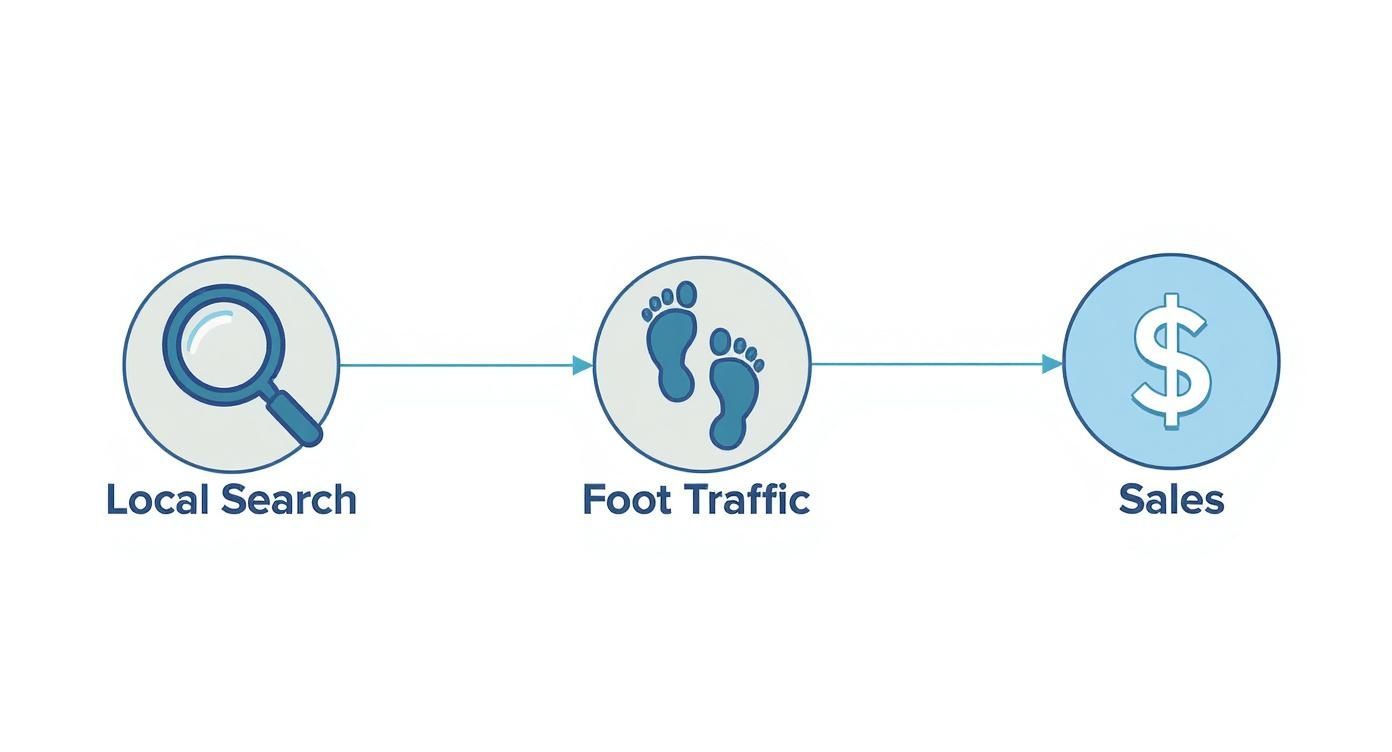
As you can see, when local intent is in the mix, the journey from a customer's discovery to your revenue is incredibly short and sweet.
The Power of Local Intent
The importance of this strategy isn't just anecdotal; it's backed by some serious data. A massive 46% of all Google searches have local intent, which means nearly half of all users are looking for something close by. This translates directly into quality website visits and, more importantly, real-world customers. If you want to explore the bigger picture of optimizing for local customers, check out this comprehensive guide to Local SEO.
Zeroing in on local intent is critical for a few key reasons:
Higher Conversion Rates: Local searchers are usually much further along in their buying journey. Someone looking for "emergency roof repair Austin" needs a solution immediately, not just a blog post about roofing materials.
Increased Foot Traffic: For any brick-and-mortar business, ranking high in local search is the digital equivalent of having the best spot on Main Street. It literally drives people to your front door.
Competitive Advantage: While the big national brands are battling over broad, expensive keywords, you can completely dominate your service area by being the most relevant local option.
By understanding and targeting local search intent, you connect with customers at the exact moment they need you, turning a simple online query into tangible business growth.
This direct connection is what makes local SEO so incredibly effective. In fact, research shows that 22.6% of all web traffic originates from local search queries. This proves that a well-executed local strategy can drive a significant volume of traffic from people who are genuinely ready to buy.
Building Your Initial Keyword Seed List
Before you even think about firing up a fancy SEO tool, your best keyword ideas are probably right in front of you. They're rooted in your own expertise. The bedrock of any good local keyword strategy is a solid "seed list"—which is really just a simple brainstorm of how your customers think and search.
First things first, just list out your core services or products. Don't get caught up in the details yet. If you're a plumber, jot down things like "emergency plumbing," "drain cleaning," and "water heater repair." Own a local cafe? Your list might look like "artisanal coffee," "weekend brunch," and "fresh pastries." Easy.
Combining Services with Location Modifiers
Now, we get local. Take each of those core services and start pairing them with different location-based terms. This is how you bridge the gap between what you do and where you do it. And I don't just mean tacking on your city's name.
You need to think like a true local and get specific:
Cities and Towns: The obvious one, like "plumber in Austin."
Neighborhoods: This is where you get hyper-local. Think "drain cleaning in South Congress."
Counties or Regions: Good for capturing a broader service area, such as "water heater repair Travis County."
Landmarks and Streets: People often search for things relative to where they are, like "coffee near Zilker Park."
Doing this helps you build out a much richer list of potential search terms. You'll quickly move from generic phrases to highly specific combinations like "emergency plumbing in South Congress," which is exactly the kind of thing a real customer in a real hurry would type into Google.
Expanding Beyond the Obvious
Great local keyword research goes beyond just "service in location." You have to get inside the searcher's head and consider how they're searching, especially when they need something right now. This is all about intent.
A customer isn't just looking for a service; they're looking for your service, right now, right here. Your keywords need to tap into that urgency.
Think about it. A search for "best brunch near me" signals that someone is ready to make a decision and walk through a door. Start weaving these kinds of high-intent modifiers into your seed list. A fantastic way to do this is to literally pull up a map of your service area and identify all the distinct neighborhoods, business districts, and well-known landmarks.
This is exactly what I mean—you can see how a city is actually a collection of smaller, unique neighborhoods that locals know by name and search for.
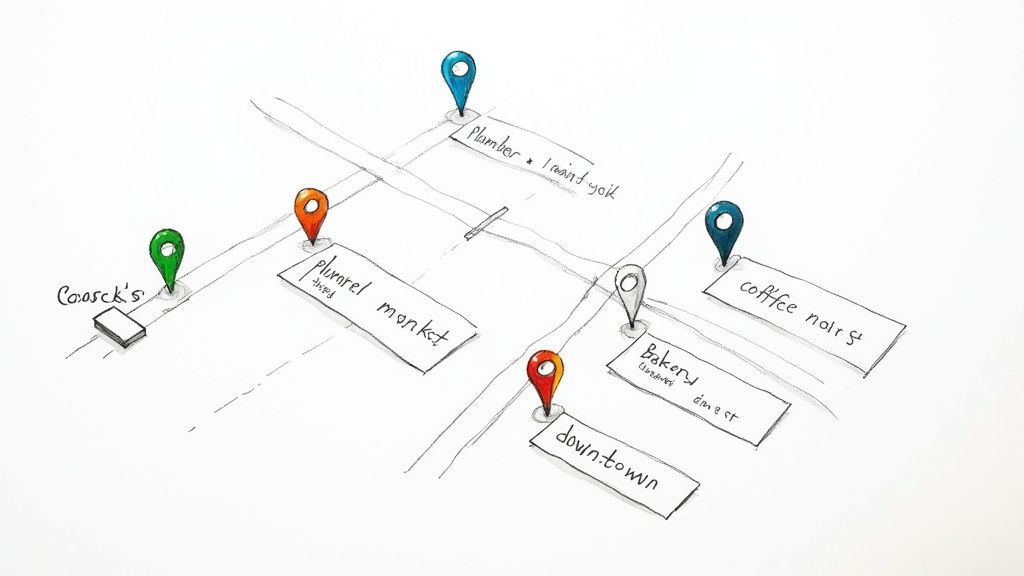
Mapping out your turf like this is a goldmine for discovering neighborhood-specific keywords you would've completely missed otherwise. By taking the time to build this foundational seed list manually, you ground your entire SEO strategy in how real people in your community actually look for the solutions you offer. It’s the single best thing you can do before ever touching a keyword tool.
Using SEO Tools to Uncover Hidden Gems

Alright, you've got your initial list of seed keywords. Now it's time to put on your detective hat and use some powerful tools to see what's actually getting searched. This is where we turn brainstorming into a real, data-backed strategy.
SEO tools are essential for this part of the process. They help you discover keyword variations you’d never think of on your own and give you hard data on things like search volume and competition.
A great place to start, especially if you're on a budget, is the Google Keyword Planner. It’s built for Google Ads, but it’s a goldmine for organic SEO, too. Just pop in your seed keywords, narrow the location down to your city or service area, and Google will spit back a whole list of related terms and their estimated monthly searches.
This is a fantastic way to validate your gut feelings and stumble upon some real opportunities.
Digging into Google's Own Clues
You don't always need a fancy, dedicated tool. Google Search itself is packed with clues that show you exactly what your potential customers are looking for, right now.
Google Autocomplete: Simply start typing one of your core services into the search bar, like "emergency plumber in Austin," and watch the suggestions that appear. These aren't random; they're based on popular, real-time searches.
People Also Ask (PAA): Look for this box in the search results. If you search for "best coffee Austin," the PAA box might show you questions like "best coffee downtown Austin with parking." Boom—that's a super specific, high-intent keyword you can build content around.
Related Searches: Scroll all the way to the bottom of the search results page. This little section is a treasure trove of keyword variations and long-tail alternatives. To really master this, check out our guide on long-tail keyword research to learn how to find these highly specific, conversion-focused phrases.
Ethically Spying on Your Competition
Want a shortcut to a great keyword list? See what's already working for the top players in your town. This isn't about blatant copying; it’s about smart reconnaissance to find patterns and, more importantly, gaps they might have overlooked.
Go ahead and Google your most important keywords and take a hard look at the top three local businesses that show up. Dive into their websites.
What terms are they using in their page titles, headings (H1s, H2s), and throughout their service pages? By reverse-engineering their on-page SEO, you can quickly build a list of terms that Google already sees as relevant to your industry in your specific city.
This process has gotten even more interesting lately. Many modern SEO platforms are now integrating AI to provide real-time, location-specific analytics. This transforms what used to be static research into a dynamic feedback loop. You can now adjust your strategy based on the freshest data, giving you a serious advantage in a crowded local market.
Finding Keywords in Your Community's Voice

Here's a secret that many marketers miss: the best, highest-converting keywords aren't hiding in some expensive SEO tool. They're being spoken, typed, and shared in conversations all around you, every single day.
To really get an edge in local search, you have to go beyond the data and listen to the actual voice of your community. It’s about understanding how real people talk about their problems, not how a machine thinks they talk. This is where you'll find the authentic, hyper-local phrases your competitors are almost certainly ignoring.
Mine Your Customer Reviews for Gold
Think about it: your customer reviews are an absolute goldmine. The same goes for your competitors' reviews on platforms like Google, Yelp, and Angi. These are raw, unfiltered testimonials where customers describe their pain points and your solutions in their own words.
Comb through these reviews. Look for recurring phrases, specific problems, and unique descriptions. You'll be surprised what you find.
For example, a plumber might notice customers repeatedly saying they needed "a plumber who could fix old pipes in a historic home." That’s not just feedback; that's a brilliant, high-intent, long-tail keyword you can build an entire service page around.
The real goal here is to collect the exact phrases people use when they're in a moment of need. These terms are packed with local intent and are far more likely to convert into a lead or a sale.
When you systematically analyze this feedback, you stop guessing what people search for. You see it firsthand, and that gives you a massive advantage.
Tune into Local Online Communities
Your potential customers are already talking online—you just need to know where to listen. Digital community hubs are treasure troves for discovering how locals really talk and what they're looking for.
This isn't about running ads; it's about pure observation. Think of it as digital eavesdropping.
Local Facebook Groups: Search for groups dedicated to your town, neighborhood, or even specific interests within your city. People are constantly asking for recommendations: "Who's the best roofer in the North End?" or "Looking for a family-friendly restaurant near the park."
Reddit and Nextdoor: City-specific subreddits (like r/Austin) or local Nextdoor threads are full of residents discussing local businesses. Pay close attention to the slang, neighborhood nicknames, and specific landmarks they mention.
Community Forums: Don't forget about older, hyper-local blogs or community forums. These can be fantastic sources for uncovering niche concerns and questions.
The table below breaks down some of these unconventional sources and what to look for.
Community Sources for Authentic Keywords
Source | What to Look For | Example Keyword Discovered |
|---|---|---|
Local Facebook Groups | Recommendation requests, complaints about other providers, questions about services. | "best dog groomer for anxious dogs in South Philly" |
Nextdoor | Service requests, neighborhood-specific problems (e.g., pests, contractors). | "townhouse HVAC repair" |
City-Specific Subreddits | Discussions around local events, businesses, and "best of" threads. | "coffee shop near the farmers market" |
Competitor Reviews (Google/Yelp) | Specific pain points customers mention and positive features they praise. | "emergency plumber for a leaky water heater" |
By immersing yourself in these digital spaces, you’ll uncover keyword gems that a standard tool would completely miss. This research goes beyond just finding keywords; it's about deeply understanding the community you serve.
Putting Your Local Keywords to Work
https://www.youtube.com/embed/zrJ6qOWGPfk
You’ve done the hard work and now you’re sitting on a killer list of local keywords. That's a huge first step, but a list by itself doesn't do much. The real magic happens when you strategically put those keywords to work, turning them into actual phone calls, appointments, and customers walking through your door.
This isn't about clumsily stuffing keywords into every nook and cranny of your website. It’s about smart, thoughtful placement. Your goal is to send clear signals to both Google and your potential customers that you are the go-to local expert for what they need, right now.
Supercharge Your Google Business Profile
For any local business, your Google Business Profile (GBP) is your most valuable piece of digital real estate. Seriously. It’s often the first thing people see when they search for you, so it needs to be dialed in perfectly.
A great place to start is your business description. Don't just say, "We are a full-service plumbing company." Instead, weave in your top keywords naturally. Something like, "We are Austin's trusted choice for emergency plumbing services and water heater repair in the South Congress area" is much more powerful.
But don’t stop there. Dive into these other GBP features:
Services: Get granular here. List every single service you offer, using the exact keyword phrases you found. If people are searching for "tankless water heater installation," you better believe that should be listed as a distinct service.
GBP Posts: Treat this like a mini-blog for your business. Share weekly updates about recent projects, special offers, or handy tips. It’s a perfect spot to naturally mention terms like "drain cleaning in East Austin."
Q&A Section: Don't wait for customers to ask questions—seed this section yourself! Add common questions that happen to include your keywords. For example, "Do you offer 24/7 emergency plumbing in Travis Heights?" then provide a detailed, helpful answer.
Think of your GBP not as a static listing, but as a dynamic, keyword-rich hub that constantly tells Google you're an active and relevant local authority.
Build Powerful Location-Specific Pages
If your business serves more than one town, city, or even distinct neighborhood, creating dedicated pages for each is a must. A single, generic "Services" page will almost never outrank a competitor's page that’s built specifically for a local search query.
Let’s imagine a roofer in the Austin area. Instead of just one page for "roof repair," they should build out individual pages targeting high-value searches in their service area:
yoursite.com/emergency-roof-repair-austinyoursite.com/hail-damage-repair-round-rockyoursite.com/commercial-roofing-pflugerville
Each of these pages needs unique content. Don't just copy and paste, swapping out the city name. Talk about local landmarks, mention common roofing issues for that specific area (like damage from a recent storm), and sprinkle in testimonials from clients in that neighborhood. To make sure you’re hitting all the right notes, a good local SEO checklist can be an invaluable guide.
This hyper-targeted approach makes you incredibly relevant for those "near me" searches. And that matters—a lot. Research from SEO.com shows that a staggering 78% of local searches on a mobile device lead to an offline purchase. To keep your own efforts on track, our local SEO checklist offers a comprehensive framework to ensure nothing falls through the cracks.
Common Questions About Local Keyword Research
Even with a solid game plan, local keyword research always throws a few curveballs. Let's clear the air and tackle some of the most common questions and sticking points I see businesses run into all the time.
Getting these details right is what really separates a decent local strategy from one that absolutely dominates the search results. It’s about more than just finding keywords; it’s about using them in a way that genuinely connects with how local customers are actually searching.
How Many Keywords Should I Target Per Page?
This is the classic question, and the honest answer is there's no magic number. Instead of obsessing over quantity, your focus should be on topical relevance. A single page needs to be a deep dive into one core service or topic, along with all its closely related variations.
For instance, if you're building a page for "emergency plumbing in Austin," it should naturally cover terms like "24/7 plumber Austin" and "after-hours plumbing repair Austin." The whole point is to create the single most comprehensive resource for that specific user need. For a much deeper look, our guide on how many keywords to target per page breaks down a complete framework for this.
The goal is to build the most helpful page for a specific local search intent, not to cram as many keywords as possible onto a single URL. A focused, comprehensive approach almost always wins.
Do I Need to Target 'Near Me' Keywords?
This is a big one. People search for "plumber near me" constantly, but that doesn't mean you should stuff the phrase "near me" all over your website. Google is incredibly sophisticated now and understands proximity without you having to spell it out.
Your real job is to send strong, undeniable location signals. Forget about awkwardly using that exact phrase and focus on these practical steps instead:
Dial in Your Google Business Profile: Your address and service area need to be perfectly accurate. This is the #1 signal for "near me" searches.
Build Local Landing Pages: Create dedicated pages for the specific neighborhoods and cities you serve (e.g., "Plumbing in South Congress").
Embed a Map: Add a Google Map of your location or service area right on your contact page.
Get Local Reviews: Reviews that mention the customer's location are gold. They provide powerful social proof and location signals all at once.
By focusing on these core elements, you'll naturally pop up for those "near me" searches without ever having to write clunky sentences like, "We are the best plumber near me."
City vs. Neighborhood: Which Is Better?
The answer is simple: you need both. A smart local keyword strategy isn't an either/or choice between broad city terms and hyper-local neighborhood keywords. You have to use a mix to catch customers at different points in their journey.
Think about it. A potential customer might start with a broad search like "roof repair Austin" when they're just starting their research. But once they're ready to pick up the phone and hire someone, that search often gets way more specific, like "roofing contractor in Travis Heights."
By creating content that targets both levels, you're there for them every step of the way. Your homepage can target the broader city term, while dedicated location pages go after those high-intent neighborhood keywords. This layered approach is key to maximizing your visibility.
Ready to stop guessing and start ranking? Viral SEO's Content Gap Analyzer uncovers the exact keywords your local competitors are using to win customers. Ditch the complicated tools and build a data-driven content strategy that drives real growth. Start your free plan today and see the difference.
Blogs
More Blogs
From keyword goldmines to AI-driven content hacks—expert insights to help your blog posts dominate the first page.