Blog

Blog

How to Write Website Content That Converts

How to Write Website Content That Converts

Blog

How to Write Website Content That Converts

It's tempting to just open a blank document and start writing. We've all been there. But if you want to create website content that actually works—content that attracts the right people and gets them to act—you have to do the groundwork first.

This isn't the glamorous part, but it's what separates content that ranks from content that vanishes without a trace. It’s like building a house; you need a solid blueprint before you start hammering away.

The investment in strategic content is exploding for a reason. The global content marketing market is on track to blow past $107 billion by 2026 and could even hit $2 trillion by 2032. Businesses are pouring money into this because when done right, it delivers.

Get to Know Your Ideal Reader with Audience Personas

Before a single word is written, you need a crystal-clear picture of who you're writing for. This is where audience personas come in. A persona is a detailed, semi-fictional profile of your ideal customer, built from real customer data and solid market research.

This goes way beyond basic demographics. "Males, 30-45" is useless. A powerful persona gets into their head and answers questions like:

  • Pain Points: What's keeping them up at night? What specific problem are they desperate to solve?

  • Goals: What does success look like for them? What are they trying to achieve?

  • Language: How do they talk about their problems? What jargon or slang do they use?

  • Watering Holes: Where do they hang out online? Think specific LinkedIn groups, subreddits, or industry forums.

Answering these questions helps you write for them, not just at them. The tone, examples, and solutions you offer will feel like they were made just for them.

This entire workflow—from understanding the person to analyzing the data—is a repeatable cycle. It’s not just about writing; it’s about a deliberate strategy that leads to measurable growth.
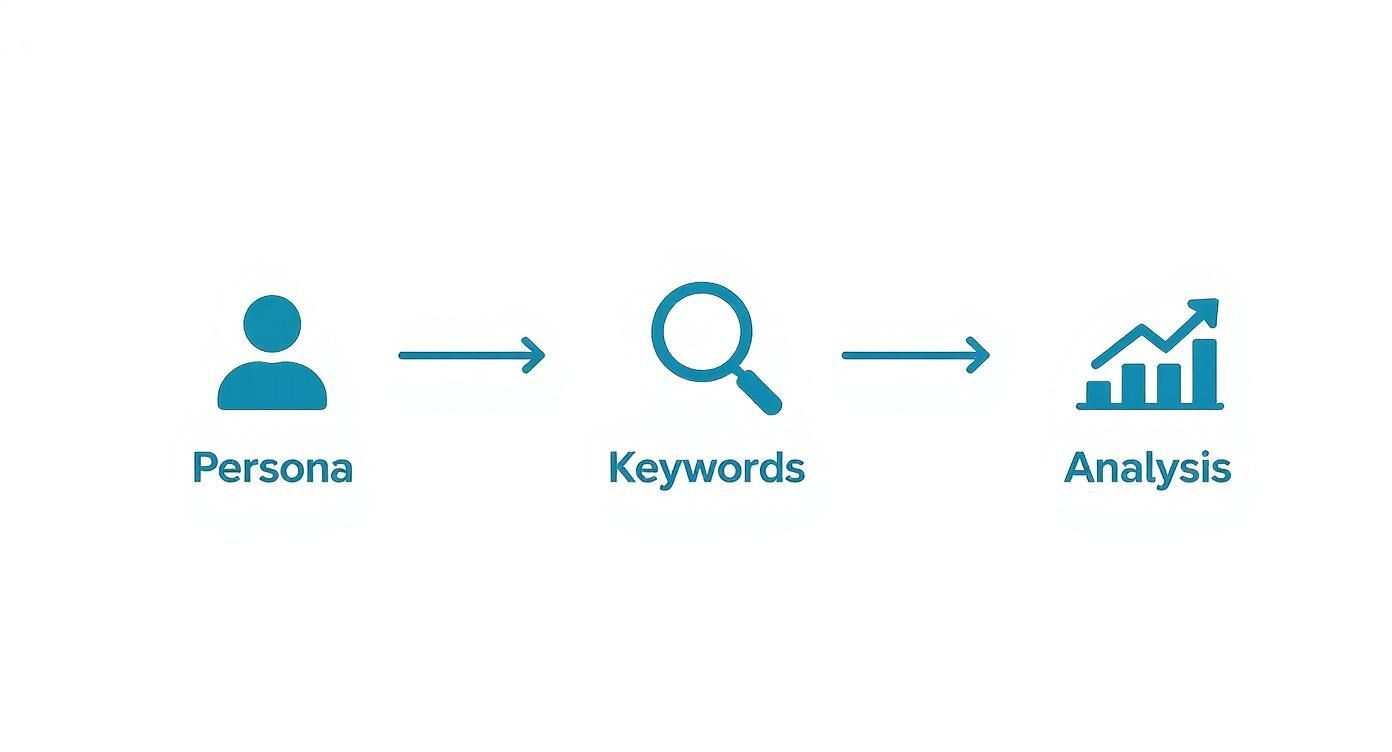
SEO workflow diagram showing three steps: persona research, keyword analysis, and performance analytics with upward growth trend

As you can see, high-performing content isn't an accident. It's the output of a research-driven process.

Discover What Your Audience is Searching For with Keyword Research

Now that you know who you're talking to, keyword research tells you what they're looking for. This isn't about gaming the system by stuffing keywords into your text. It's about deeply understanding search intent—the "why" behind every search. Are they just gathering information, comparing options, or are they ready to pull out their credit card?

Your goal is to find that sweet spot where your audience's needs and your business's expertise overlap. Keyword research is the map that gets you there.

Start with broad "seed" keywords related to your business. From there, you can dig into more specific phrases. A great place to focus is on long-tail keywords. These are longer, more conversational phrases that usually signal someone is much further along in their buying journey. They might have lower search volume, but the intent is often sky-high.

Find Your Opening with a Content Gap Analysis

Finally, it's time to scope out the competition. A content gap analysis shows you what others are ranking for and, more importantly, where they're falling short. This is your opportunity to create something better.

Audit the top-ranking pages for your target keywords and look for weaknesses:

  • Unanswered Questions: What did they miss? What logical next question would a reader have?

  • Outdated Information: Is their data from five years ago? Can you provide a fresh take with current stats?

  • Format Gaps: If every result is a massive blog post, maybe a concise video tutorial, a calculator, or a downloadable template would stand out.

Finding these gaps gives you a clear roadmap. Instead of just adding to the noise, you can create the definitive resource that people have been looking for.

Essential Pre-Writing Checklist

Before you move on to the writing phase, run through this checklist. It summarizes these foundational steps and ensures every piece of content you create is built for success from the very beginning.

Checklist Item

Objective

Recommended Tool

Audience Persona

Define the target reader's pain points, goals, and language.

HubSpot Make My Persona

Keyword Research

Identify primary and long-tail keywords based on search intent.

Ahrefs or Semrush

Content Gap Analysis

Find weaknesses and opportunities in top-ranking competitor content.

Surfer SEO

Completing these three steps gives you a strategic advantage. You'll know exactly who you're writing for, what they want to know, and how you can deliver more value than anyone else.

Structure Your Content for Scannability and Flow
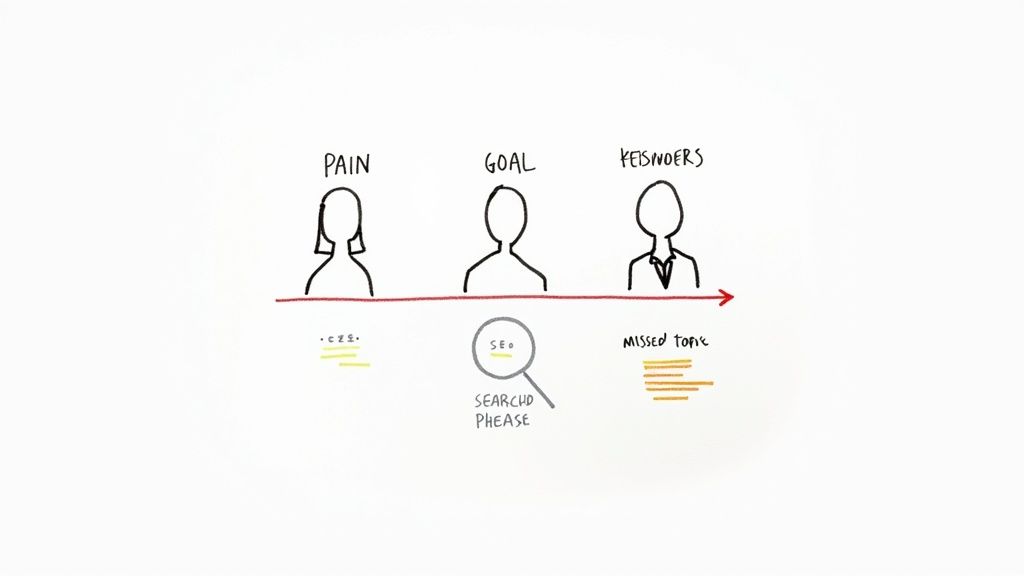
Customer journey diagram showing progression from pain point through goal to keywords with search intent

You’ve done the research and have some fantastic insights to share. But even the most brilliant ideas will fall flat if the page looks like an impenetrable wall of text. Let's be honest: people don't read online; they scan. They’re looking for quick answers and clear takeaways.

A solid structure isn't just about aesthetics—it's about respecting your reader's time and attention. The harsh reality is that most visitors will bounce from a page in just 10–20 seconds. Nothing sends them packing faster than a "wall of text." Your first job is to make your information as easy as possible to find and absorb.

Lead with the Good Stuff: The Inverted Pyramid

Journalists perfected this technique ages ago, and it’s a lifesaver for web content. The inverted pyramid is simple: put your most important information right at the top. Give them the core answer or the main conclusion immediately.

Once you’ve delivered that initial payload, you can work your way down into the supporting details, background information, and finer points. This approach gives the reader an instant win, which builds trust and encourages them to stick around for the deeper dive.

For example, if the page is titled "How to Fix a Leaky Faucet," don't open with the history of indoor plumbing. Start with the most common, easiest fix. That's what they came for.

Guide the Reader with Clear Headings

Think of headings as the signposts on a highway. They break up the journey into manageable chunks and tell the reader what’s coming next, creating a scannable hierarchy that both people and search engines love.

Your main title (the H1) is the big billboard that gets them to pull over. Your subheadings (H2s and H3s) are the smaller signs that guide them through town.

  • H2 Subheadings: Use these to define the major sections of your article. Each H2 should introduce a significant new concept or a key step in a process.

  • H3 Subheadings: These are perfect for breaking down your H2 sections into more specific, granular points.

If someone can understand the entire point of your article just by scanning the headings, you’ve nailed it.

A well-structured page with clear headings doesn't just make for a better user experience. It’s a huge signal to search engines, helping them understand your content's topical relevance and hierarchy.

Use Smart Formatting to Boost Readability

Beyond headings, a few simple formatting tricks can make your content feel effortless to read. This is especially critical on mobile, which now accounts for over 60% of all web traffic.

Your goal is to create visual breaks and breathing room.

  • Embrace Short Paragraphs: Seriously. Keep them to one to three sentences, max. This is one of the easiest and most impactful changes you can make.

  • Use Lists Liberally: Bullet points and numbered lists are your best friends. They are magnets for the eye and make complex information, steps, or features incredibly easy to digest.

  • Be Strategic with Bold Text: Use bolding to make key terms, statistics, or critical takeaways pop. As people scan, their eyes will naturally gravitate to these highlighted phrases.

Imagine your reader scrolling through your page on their phone while waiting for their coffee. Your structure and formatting should be so clean that they can grasp the main points in just a few seconds. That's how you hook them.

Write Clear and Persuasive Copy That Connects


Triangle diagram with red highlighted edge and list of word pairs showing content hierarchy structure

Once you have a solid structure mapped out, it’s time to breathe life into it with words that actually get the job done. This is where your deep understanding of the audience truly meets the art of persuasion. The aim isn't just to list facts; it's to connect, build trust, and gently guide the reader toward taking action.

Great website content shouldn't feel like a sales pitch. It should feel like a helpful conversation. It speaks the reader's language, anticipates their worries, and makes them feel seen. That connection is what separates content that converts from content that people click away from in seconds.

Find and Define Your Brand Voice

Your brand voice is the personality your business shows the world. Is it professional and authoritative? Casual and witty? Or maybe warm and empathetic? There’s no single “right” voice, but inconsistency is definitely wrong. A consistent voice builds familiarity, which is the foundation of trust.

A good way to start is to think of your brand as a person. How would they talk?

  • Professional: You'd use precise language, skip the slang, and maintain a more formal tone. This works well for B2B services or in serious industries like finance and law.

  • Conversational: You'd use contractions, ask questions, and keep things friendly and approachable. This is perfect for most direct-to-consumer brands.

  • Enthusiastic: Here, you're using energetic words and maybe a few exclamation points to get people excited. Think travel, fitness, or entertainment brands.

Once you’ve settled on a voice, write it down. A simple style guide outlining your brand's personality, tone, and specific vocabulary (words to use, words to avoid) is invaluable. It keeps everyone who writes for you on the same page.

Write with Clarity and Simplicity

The most persuasive copy is almost always the simplest. Your readers are busy. They’re probably skimming. They don't have time to unpack dense sentences or look up industry jargon. Your job is to make your message effortless to absorb.

That means choosing clarity over trying to sound clever, every single time.

Good writing is clear thinking made visible. If your sentences are convoluted and your points are buried, it signals that you haven’t fully clarified your own message. Make it simple for them by first making it simple for you.

You can get there by adopting a few straightforward writing habits:

  1. Use the Active Voice: The active voice is direct and has more energy. Instead of, "The report was written by our team," just say, "Our team wrote the report." It’s a small change that makes a big impact.

  2. Cut the Jargon: Unless you're writing for a niche technical audience that expects it, get rid of the buzzwords. If a technical term is unavoidable, explain it simply.

  3. Keep Sentences Short: Long, winding sentences are a chore to read. Break down your complex ideas into shorter, more digestible sentences. A good target is an average sentence length of 15-20 words.

Ultimately, great copy grabs and holds your audience's attention. If you want to go deeper, there are some excellent techniques on how to write engaging content people actually want to read.

Use Storytelling to Make Your Message Stick

Facts inform, but stories are what people remember. We’re all wired to connect with narratives. Weaving small stories into your content can make abstract ideas feel real and your brand more human.

A "story" doesn't have to be some grand epic. It can be a quick anecdote, a customer success story, or a simple before-and-after scenario. Instead of just listing your software's features, tell the story of a customer who was struggling and how your product helped them succeed.

This narrative approach turns a boring feature list into a compelling solution. It lets the reader picture themselves in the story, making your value proposition feel personal and tangible.

Craft Compelling Calls to Action

Finally, every page on your site needs a purpose. What do you want the reader to do next? Your call-to-action (CTA) is the critical link between your content and your business goals. Without a clear CTA, even the most persuasive writing falls flat.

A good CTA should feel like the obvious next step. It needs to be clear, concise, and focused on action.

Weak CTA

Strong CTA

Why It Works

Submit

Get Your Free Quote

"Get" is an action word, and it specifies the value.

Click Here

Download the Ebook Now

"Now" adds a sense of immediacy and clarifies the action.

Learn More

Explore Our Features

"Explore" is far more engaging and less generic.

Place your CTAs where the reader's motivation is at its peak—usually right after you've delivered a ton of value or made a powerful point. And make the button or link stand out visually. You can't afford for them to miss it. Your CTA is the final handshake that turns a passive reader into an active lead or customer.

Nail Your On-Page SEO

Hand-drawn clipboard showing story argument brainstorming list with four numbered creative writing ideas

Writing content that genuinely connects with people is priority number one, but it’s really only half the job. If search engines can't find and make sense of your work, your ideal audience will never even get a chance to read it. This is where on-page SEO comes in—it’s the technical layer that makes your great writing discoverable.

Think of it as leaving a clear trail of breadcrumbs for Google. Good on-page SEO isn't about gaming the system or stuffing keywords into every sentence. It’s all about structuring your content so you clearly communicate its topic, relevance, and value. That's what helps search engines match your page with the right person's search.

These aren't just technical afterthoughts; they're the final, critical steps that bridge the gap between your brilliant content and the people actively searching for it.

Craft Titles and Descriptions That Beg to Be Clicked

Your title tag and meta description are your page's first handshake with a potential reader on Google. They function as your digital billboard, fighting for attention in a sea of other blue links. Their one job is to convince someone that your page holds the best answer.

A great title tag is a mix of art and science. It needs to be compelling enough to spark curiosity while also clearly describing the page's content and including your primary keyword, ideally near the front.

Your meta description is your 155-character elevator pitch. While it doesn't directly affect your rankings, it has a huge impact on whether someone clicks. A well-written description quickly summarizes the page's value and often includes a soft call to action, like "Learn the exact steps..." or "Discover how to..."

Weave Keywords in Naturally

Once someone clicks, the content has to deliver on the promise your title and description made. This is where your keywords come in, but they should play a supporting role, not the lead. The trick is to use them in a way that feels completely natural to the reader.

You'll want to place your primary keyword in a few key spots:

  • The first 100 words: Placing your main topic early on signals its importance to both readers and search engines.

  • At least one subheading (H2 or H3): This helps structure the content and reinforces what the page is about.

  • Naturally within the body text: Let the keyword flow with the writing. Never force it where it sounds awkward.

Sprinkle in your secondary keywords and related terms to build out the topic's depth. This shows search engines you’re covering the subject from all angles. For a deeper dive, our guide on how many keywords to use per page breaks this down further.

At its core, on-page SEO is really about user experience. Search engines want to reward content that's clear, well-organized, and genuinely helpful. When you optimize for your reader, you're also optimizing for search.

The length of your content is another piece of the puzzle. While quality always trumps quantity, word count often correlates with thoroughness. As a general rule, standard blog posts should aim for more than 300 words to provide real value. For foundational, cornerstone content, you should be aiming for over 900 words to truly cover a topic in detail. Yoast has a great article that explores how word count impacts SEO if you want to learn more.

Build Authority with Smart Internal Linking

Internal linking is one of the most powerful—and most overlooked—parts of writing for SEO. It’s simply the practice of linking from one page on your site to another relevant page on your site. This simple act achieves three critical things for you.

First, it helps users discover more of your great content, keeping them engaged and on your site longer. Second, it helps search engine crawlers find their way around your site more easily, allowing them to understand the relationships between your pages. Finally, it passes authority (or "link equity") from one page to another, which can help boost the rankings of your entire website.

Don't Forget About Your Images

Every single image on your page is another opportunity to optimize. Since search engines can't "see" pictures, they rely on the text you provide to understand what an image is about. This is where alt text is indispensable.

Alt text is a short, descriptive sentence you add to an image's code. Its primary job is accessibility—it allows screen readers to describe the image to visually impaired users. But it also gives search engines valuable context. By including your keyword in a descriptive and natural-sounding alt tag, you give your content another small but meaningful SEO boost.

Measure and Refine Your Content for Better Results

Think you’re done once you hit "publish"? Not even close. That’s actually when the real work begins. The best website content is never static—it’s a living asset that you need to monitor, tweak, and improve based on how real people are actually using it.

This iterative process is what separates decent content from content that genuinely drives revenue. You stop guessing and start listening to what your audience and the search engines are telling you. This skill is in high demand, too. The content writing services market is expected to grow at a compound annual rate of about 5.5% through 2030, because businesses need experts who can both create and optimize content for peak performance.

The Essential Post-Publishing Review

Before you even glance at your analytics, you need to run a quick but critical check on the live page. This isn't just another proofread; it’s about making sure the user experience you designed is the one your visitors are actually getting.

The moment a piece of content goes live, run through this quick audit:

  • Proofread It Live: Read through the final version on the site. You'd be amazed how easily a small typo or grammatical flub can slip through, and they can instantly hurt your credibility.

  • Check Every Single Link: Click on all internal and external links. Do they go where they're supposed to? A broken link is a dead end for your reader and a frustrating experience.

  • Test on Multiple Devices: Pull up the page on your desktop, a tablet, and your phone. Does the formatting look clean? Are all the images loading properly? Is the text still easy to read on a smaller screen?

  • Confirm Your CTA: Is your primary call-to-action clear, visible, and working correctly? Don’t lose a lead because of a broken button.

This whole process takes maybe five minutes, but it can save you from a ton of simple mistakes that undermine all your hard work.

Focus on Metrics That Actually Matter

Diving into analytics can feel like drinking from a firehose. Instead of getting lost in a sea of data, just focus on a handful of key performance indicators (KPIs) that give you a clear picture of your content’s health. For this, your two best friends are going to be Google Analytics (GA4) and Google Search Console (GSC).

Your data tells a story about what your audience wants. Learning to read that story is how you move from just writing content to building a genuine connection that drives results.

So, where should you start? Let's talk about the most important metrics to watch.

Key Content Performance Metrics

Here’s a quick guide to the core metrics you should be tracking to understand how your content is performing and where you can make improvements.

Metric

What It Measures

Tool for Tracking

Organic Traffic

The number of visitors arriving from search engines.

Google Analytics

Time on Page / Engagement Time

How long users are actively engaged with your content.

Google Analytics

Keyword Rankings

Your page's position in search results for target queries.

Google Search Console

Click-Through Rate (CTR)

The percentage of people who click your link in search results.

Google Search Console

These four metrics alone give you a powerful snapshot. You can quickly see if your content is being found (Organic Traffic), if it’s holding people's attention (Engagement Time), if it's visible for the right searches (Keyword Rankings), and if your title is compelling enough to earn the click (CTR).

Identify and Refresh Underperforming Content

Let your content sit for a few months to gather data. You'll quickly see which articles are your rockstars and which are, well, falling a bit flat. This is where the opportunity lies. Look for content with high potential but lackluster performance—a page that’s stuck on the second page of Google for a really valuable keyword is a perfect candidate.

Your mission is to turn these underperformers into high-value assets. For a local business, this could mean beefing up service pages with more targeted details. Our local SEO checklist is a great resource for tackling these kinds of on-page improvements systematically.

Here’s a simple process for breathing new life into old content:

  1. Diagnose the Problem: First, figure out why it's underperforming. Is it not ranking? Check GSC to see the keywords it’s almost ranking for. Is engagement low? The content might not be satisfying search intent, or it could just be boring.

  2. Spy on the Competition: Go back and look at the top-ranking pages for your target keyword. What are they doing that you aren't? Maybe they have more current data, better examples, or a more helpful page layout.

  3. Update and Upgrade: Refresh your content with new information, add better visuals like a helpful video or a new infographic, and improve its readability. Learning how to improve website conversion rates can give you great ideas for making your CTAs and overall page more effective.

  4. Relaunch and Repromote: Once you’ve updated the content, change the "last updated" date and push it out again through your marketing channels as if it’s brand new.

This cycle of measuring, analyzing, and refining is the secret sauce. It’s how you build a website that doesn’t just get traffic, but consistently turns that traffic into a loyal audience and, ultimately, paying customers.

Got Questions? We've Got Answers

Creating great website content can feel like you're trying to hit a moving target. You're juggling what your audience wants, what Google demands, and what your business actually needs. It's a lot.

Here are answers to a few of the most common questions that come up, whether you're just starting out or have been at this for years.

What’s the Magic Word Count for a Page or Post?

Everyone wants a magic number, but the honest answer is: it depends. The right length is determined by the topic and what someone is looking for when they search for it. A detailed guide on "how to build a deck" will naturally be much longer than a product page for a pair of hiking boots.

That said, we do have some good data-backed guidelines. For a standard blog post, you'll want to hit at least 300 words to be on Google's radar. But if you're tackling a competitive topic or creating a "cornerstone" piece of content—the kind you want to be the ultimate resource on the subject—you should really be aiming for 900 words or more.

The real goal isn't hitting a word count; it's being thorough. Answer every potential question your reader might have, and you'll naturally arrive at the right length.

Should I Write for People or for Google?

This is the classic content creator's dilemma, but it's really a trick question. You don't have to choose. The modern, effective way to approach this is to write for your reader first and then polish it for search engines.

Gone are the days of keyword stuffing and trying to fool algorithms. Today, SEO is all about delivering an exceptional user experience.

When you focus on creating content that's genuinely helpful, logically structured, and easy to digest, you’re already doing 90% of the work for SEO. Search engines are designed to find and reward content that people actually like.

Always start by focusing on clarity, providing real value, and solving your audience's problems. Things like keyword placement and meta descriptions are the finishing touches that help the right people find the brilliant content you've already created.

How Often Do I Really Need to Publish New Content?

Here's a little secret: consistency trumps frequency every time. It’s far better to publish one high-quality article every other week than to churn out four mediocre posts a month. Sticking to a predictable schedule builds trust with your audience and shows search engines your site is alive and well.

To figure out the right rhythm for you, consider these points:

  • Your Resources: Be honest about your team's capacity. Quality is non-negotiable, so don't commit to a schedule that forces you to cut corners.

  • Your Niche: A fast-paced industry like SaaS or digital marketing might demand more frequent content than a more traditional field like manufacturing.

  • Your Goals: If your strategy is aggressive growth—aiming to rank for a ton of keywords quickly—then you’ll need to publish more often.

My advice? Start with a schedule you know you can maintain without burning out. You can always ramp it up later once you've got your process down.

Ready to stop guessing and start ranking? Viral SEO gives you the tools to analyze competitors, find high-impact content ideas, and optimize every page with confidence. Get started for free and build a content strategy that works.

It's tempting to just open a blank document and start writing. We've all been there. But if you want to create website content that actually works—content that attracts the right people and gets them to act—you have to do the groundwork first.

This isn't the glamorous part, but it's what separates content that ranks from content that vanishes without a trace. It’s like building a house; you need a solid blueprint before you start hammering away.

The investment in strategic content is exploding for a reason. The global content marketing market is on track to blow past $107 billion by 2026 and could even hit $2 trillion by 2032. Businesses are pouring money into this because when done right, it delivers.

Get to Know Your Ideal Reader with Audience Personas

Before a single word is written, you need a crystal-clear picture of who you're writing for. This is where audience personas come in. A persona is a detailed, semi-fictional profile of your ideal customer, built from real customer data and solid market research.

This goes way beyond basic demographics. "Males, 30-45" is useless. A powerful persona gets into their head and answers questions like:

  • Pain Points: What's keeping them up at night? What specific problem are they desperate to solve?

  • Goals: What does success look like for them? What are they trying to achieve?

  • Language: How do they talk about their problems? What jargon or slang do they use?

  • Watering Holes: Where do they hang out online? Think specific LinkedIn groups, subreddits, or industry forums.

Answering these questions helps you write for them, not just at them. The tone, examples, and solutions you offer will feel like they were made just for them.

This entire workflow—from understanding the person to analyzing the data—is a repeatable cycle. It’s not just about writing; it’s about a deliberate strategy that leads to measurable growth.

SEO workflow diagram showing three steps: persona research, keyword analysis, and performance analytics with upward growth trend

As you can see, high-performing content isn't an accident. It's the output of a research-driven process.

Discover What Your Audience is Searching For with Keyword Research

Now that you know who you're talking to, keyword research tells you what they're looking for. This isn't about gaming the system by stuffing keywords into your text. It's about deeply understanding search intent—the "why" behind every search. Are they just gathering information, comparing options, or are they ready to pull out their credit card?

Your goal is to find that sweet spot where your audience's needs and your business's expertise overlap. Keyword research is the map that gets you there.

Start with broad "seed" keywords related to your business. From there, you can dig into more specific phrases. A great place to focus is on long-tail keywords. These are longer, more conversational phrases that usually signal someone is much further along in their buying journey. They might have lower search volume, but the intent is often sky-high.

Find Your Opening with a Content Gap Analysis

Finally, it's time to scope out the competition. A content gap analysis shows you what others are ranking for and, more importantly, where they're falling short. This is your opportunity to create something better.

Audit the top-ranking pages for your target keywords and look for weaknesses:

  • Unanswered Questions: What did they miss? What logical next question would a reader have?

  • Outdated Information: Is their data from five years ago? Can you provide a fresh take with current stats?

  • Format Gaps: If every result is a massive blog post, maybe a concise video tutorial, a calculator, or a downloadable template would stand out.

Finding these gaps gives you a clear roadmap. Instead of just adding to the noise, you can create the definitive resource that people have been looking for.

Essential Pre-Writing Checklist

Before you move on to the writing phase, run through this checklist. It summarizes these foundational steps and ensures every piece of content you create is built for success from the very beginning.

Checklist Item

Objective

Recommended Tool

Audience Persona

Define the target reader's pain points, goals, and language.

HubSpot Make My Persona

Keyword Research

Identify primary and long-tail keywords based on search intent.

Ahrefs or Semrush

Content Gap Analysis

Find weaknesses and opportunities in top-ranking competitor content.

Surfer SEO

Completing these three steps gives you a strategic advantage. You'll know exactly who you're writing for, what they want to know, and how you can deliver more value than anyone else.

Structure Your Content for Scannability and Flow

Customer journey diagram showing progression from pain point through goal to keywords with search intent

You’ve done the research and have some fantastic insights to share. But even the most brilliant ideas will fall flat if the page looks like an impenetrable wall of text. Let's be honest: people don't read online; they scan. They’re looking for quick answers and clear takeaways.

A solid structure isn't just about aesthetics—it's about respecting your reader's time and attention. The harsh reality is that most visitors will bounce from a page in just 10–20 seconds. Nothing sends them packing faster than a "wall of text." Your first job is to make your information as easy as possible to find and absorb.

Lead with the Good Stuff: The Inverted Pyramid

Journalists perfected this technique ages ago, and it’s a lifesaver for web content. The inverted pyramid is simple: put your most important information right at the top. Give them the core answer or the main conclusion immediately.

Once you’ve delivered that initial payload, you can work your way down into the supporting details, background information, and finer points. This approach gives the reader an instant win, which builds trust and encourages them to stick around for the deeper dive.

For example, if the page is titled "How to Fix a Leaky Faucet," don't open with the history of indoor plumbing. Start with the most common, easiest fix. That's what they came for.

Guide the Reader with Clear Headings

Think of headings as the signposts on a highway. They break up the journey into manageable chunks and tell the reader what’s coming next, creating a scannable hierarchy that both people and search engines love.

Your main title (the H1) is the big billboard that gets them to pull over. Your subheadings (H2s and H3s) are the smaller signs that guide them through town.

  • H2 Subheadings: Use these to define the major sections of your article. Each H2 should introduce a significant new concept or a key step in a process.

  • H3 Subheadings: These are perfect for breaking down your H2 sections into more specific, granular points.

If someone can understand the entire point of your article just by scanning the headings, you’ve nailed it.

A well-structured page with clear headings doesn't just make for a better user experience. It’s a huge signal to search engines, helping them understand your content's topical relevance and hierarchy.

Use Smart Formatting to Boost Readability

Beyond headings, a few simple formatting tricks can make your content feel effortless to read. This is especially critical on mobile, which now accounts for over 60% of all web traffic.

Your goal is to create visual breaks and breathing room.

  • Embrace Short Paragraphs: Seriously. Keep them to one to three sentences, max. This is one of the easiest and most impactful changes you can make.

  • Use Lists Liberally: Bullet points and numbered lists are your best friends. They are magnets for the eye and make complex information, steps, or features incredibly easy to digest.

  • Be Strategic with Bold Text: Use bolding to make key terms, statistics, or critical takeaways pop. As people scan, their eyes will naturally gravitate to these highlighted phrases.

Imagine your reader scrolling through your page on their phone while waiting for their coffee. Your structure and formatting should be so clean that they can grasp the main points in just a few seconds. That's how you hook them.

Write Clear and Persuasive Copy That Connects


Triangle diagram with red highlighted edge and list of word pairs showing content hierarchy structure

Once you have a solid structure mapped out, it’s time to breathe life into it with words that actually get the job done. This is where your deep understanding of the audience truly meets the art of persuasion. The aim isn't just to list facts; it's to connect, build trust, and gently guide the reader toward taking action.

Great website content shouldn't feel like a sales pitch. It should feel like a helpful conversation. It speaks the reader's language, anticipates their worries, and makes them feel seen. That connection is what separates content that converts from content that people click away from in seconds.

Find and Define Your Brand Voice

Your brand voice is the personality your business shows the world. Is it professional and authoritative? Casual and witty? Or maybe warm and empathetic? There’s no single “right” voice, but inconsistency is definitely wrong. A consistent voice builds familiarity, which is the foundation of trust.

A good way to start is to think of your brand as a person. How would they talk?

  • Professional: You'd use precise language, skip the slang, and maintain a more formal tone. This works well for B2B services or in serious industries like finance and law.

  • Conversational: You'd use contractions, ask questions, and keep things friendly and approachable. This is perfect for most direct-to-consumer brands.

  • Enthusiastic: Here, you're using energetic words and maybe a few exclamation points to get people excited. Think travel, fitness, or entertainment brands.

Once you’ve settled on a voice, write it down. A simple style guide outlining your brand's personality, tone, and specific vocabulary (words to use, words to avoid) is invaluable. It keeps everyone who writes for you on the same page.

Write with Clarity and Simplicity

The most persuasive copy is almost always the simplest. Your readers are busy. They’re probably skimming. They don't have time to unpack dense sentences or look up industry jargon. Your job is to make your message effortless to absorb.

That means choosing clarity over trying to sound clever, every single time.

Good writing is clear thinking made visible. If your sentences are convoluted and your points are buried, it signals that you haven’t fully clarified your own message. Make it simple for them by first making it simple for you.

You can get there by adopting a few straightforward writing habits:

  1. Use the Active Voice: The active voice is direct and has more energy. Instead of, "The report was written by our team," just say, "Our team wrote the report." It’s a small change that makes a big impact.

  2. Cut the Jargon: Unless you're writing for a niche technical audience that expects it, get rid of the buzzwords. If a technical term is unavoidable, explain it simply.

  3. Keep Sentences Short: Long, winding sentences are a chore to read. Break down your complex ideas into shorter, more digestible sentences. A good target is an average sentence length of 15-20 words.

Ultimately, great copy grabs and holds your audience's attention. If you want to go deeper, there are some excellent techniques on how to write engaging content people actually want to read.

Use Storytelling to Make Your Message Stick

Facts inform, but stories are what people remember. We’re all wired to connect with narratives. Weaving small stories into your content can make abstract ideas feel real and your brand more human.

A "story" doesn't have to be some grand epic. It can be a quick anecdote, a customer success story, or a simple before-and-after scenario. Instead of just listing your software's features, tell the story of a customer who was struggling and how your product helped them succeed.

This narrative approach turns a boring feature list into a compelling solution. It lets the reader picture themselves in the story, making your value proposition feel personal and tangible.

Craft Compelling Calls to Action

Finally, every page on your site needs a purpose. What do you want the reader to do next? Your call-to-action (CTA) is the critical link between your content and your business goals. Without a clear CTA, even the most persuasive writing falls flat.

A good CTA should feel like the obvious next step. It needs to be clear, concise, and focused on action.

Weak CTA

Strong CTA

Why It Works

Submit

Get Your Free Quote

"Get" is an action word, and it specifies the value.

Click Here

Download the Ebook Now

"Now" adds a sense of immediacy and clarifies the action.

Learn More

Explore Our Features

"Explore" is far more engaging and less generic.

Place your CTAs where the reader's motivation is at its peak—usually right after you've delivered a ton of value or made a powerful point. And make the button or link stand out visually. You can't afford for them to miss it. Your CTA is the final handshake that turns a passive reader into an active lead or customer.

Nail Your On-Page SEO

Hand-drawn clipboard showing story argument brainstorming list with four numbered creative writing ideas

Writing content that genuinely connects with people is priority number one, but it’s really only half the job. If search engines can't find and make sense of your work, your ideal audience will never even get a chance to read it. This is where on-page SEO comes in—it’s the technical layer that makes your great writing discoverable.

Think of it as leaving a clear trail of breadcrumbs for Google. Good on-page SEO isn't about gaming the system or stuffing keywords into every sentence. It’s all about structuring your content so you clearly communicate its topic, relevance, and value. That's what helps search engines match your page with the right person's search.

These aren't just technical afterthoughts; they're the final, critical steps that bridge the gap between your brilliant content and the people actively searching for it.

Craft Titles and Descriptions That Beg to Be Clicked

Your title tag and meta description are your page's first handshake with a potential reader on Google. They function as your digital billboard, fighting for attention in a sea of other blue links. Their one job is to convince someone that your page holds the best answer.

A great title tag is a mix of art and science. It needs to be compelling enough to spark curiosity while also clearly describing the page's content and including your primary keyword, ideally near the front.

Your meta description is your 155-character elevator pitch. While it doesn't directly affect your rankings, it has a huge impact on whether someone clicks. A well-written description quickly summarizes the page's value and often includes a soft call to action, like "Learn the exact steps..." or "Discover how to..."

Weave Keywords in Naturally

Once someone clicks, the content has to deliver on the promise your title and description made. This is where your keywords come in, but they should play a supporting role, not the lead. The trick is to use them in a way that feels completely natural to the reader.

You'll want to place your primary keyword in a few key spots:

  • The first 100 words: Placing your main topic early on signals its importance to both readers and search engines.

  • At least one subheading (H2 or H3): This helps structure the content and reinforces what the page is about.

  • Naturally within the body text: Let the keyword flow with the writing. Never force it where it sounds awkward.

Sprinkle in your secondary keywords and related terms to build out the topic's depth. This shows search engines you’re covering the subject from all angles. For a deeper dive, our guide on how many keywords to use per page breaks this down further.

At its core, on-page SEO is really about user experience. Search engines want to reward content that's clear, well-organized, and genuinely helpful. When you optimize for your reader, you're also optimizing for search.

The length of your content is another piece of the puzzle. While quality always trumps quantity, word count often correlates with thoroughness. As a general rule, standard blog posts should aim for more than 300 words to provide real value. For foundational, cornerstone content, you should be aiming for over 900 words to truly cover a topic in detail. Yoast has a great article that explores how word count impacts SEO if you want to learn more.

Build Authority with Smart Internal Linking

Internal linking is one of the most powerful—and most overlooked—parts of writing for SEO. It’s simply the practice of linking from one page on your site to another relevant page on your site. This simple act achieves three critical things for you.

First, it helps users discover more of your great content, keeping them engaged and on your site longer. Second, it helps search engine crawlers find their way around your site more easily, allowing them to understand the relationships between your pages. Finally, it passes authority (or "link equity") from one page to another, which can help boost the rankings of your entire website.

Don't Forget About Your Images

Every single image on your page is another opportunity to optimize. Since search engines can't "see" pictures, they rely on the text you provide to understand what an image is about. This is where alt text is indispensable.

Alt text is a short, descriptive sentence you add to an image's code. Its primary job is accessibility—it allows screen readers to describe the image to visually impaired users. But it also gives search engines valuable context. By including your keyword in a descriptive and natural-sounding alt tag, you give your content another small but meaningful SEO boost.

Measure and Refine Your Content for Better Results

Think you’re done once you hit "publish"? Not even close. That’s actually when the real work begins. The best website content is never static—it’s a living asset that you need to monitor, tweak, and improve based on how real people are actually using it.

This iterative process is what separates decent content from content that genuinely drives revenue. You stop guessing and start listening to what your audience and the search engines are telling you. This skill is in high demand, too. The content writing services market is expected to grow at a compound annual rate of about 5.5% through 2030, because businesses need experts who can both create and optimize content for peak performance.

The Essential Post-Publishing Review

Before you even glance at your analytics, you need to run a quick but critical check on the live page. This isn't just another proofread; it’s about making sure the user experience you designed is the one your visitors are actually getting.

The moment a piece of content goes live, run through this quick audit:

  • Proofread It Live: Read through the final version on the site. You'd be amazed how easily a small typo or grammatical flub can slip through, and they can instantly hurt your credibility.

  • Check Every Single Link: Click on all internal and external links. Do they go where they're supposed to? A broken link is a dead end for your reader and a frustrating experience.

  • Test on Multiple Devices: Pull up the page on your desktop, a tablet, and your phone. Does the formatting look clean? Are all the images loading properly? Is the text still easy to read on a smaller screen?

  • Confirm Your CTA: Is your primary call-to-action clear, visible, and working correctly? Don’t lose a lead because of a broken button.

This whole process takes maybe five minutes, but it can save you from a ton of simple mistakes that undermine all your hard work.

Focus on Metrics That Actually Matter

Diving into analytics can feel like drinking from a firehose. Instead of getting lost in a sea of data, just focus on a handful of key performance indicators (KPIs) that give you a clear picture of your content’s health. For this, your two best friends are going to be Google Analytics (GA4) and Google Search Console (GSC).

Your data tells a story about what your audience wants. Learning to read that story is how you move from just writing content to building a genuine connection that drives results.

So, where should you start? Let's talk about the most important metrics to watch.

Key Content Performance Metrics

Here’s a quick guide to the core metrics you should be tracking to understand how your content is performing and where you can make improvements.

Metric

What It Measures

Tool for Tracking

Organic Traffic

The number of visitors arriving from search engines.

Google Analytics

Time on Page / Engagement Time

How long users are actively engaged with your content.

Google Analytics

Keyword Rankings

Your page's position in search results for target queries.

Google Search Console

Click-Through Rate (CTR)

The percentage of people who click your link in search results.

Google Search Console

These four metrics alone give you a powerful snapshot. You can quickly see if your content is being found (Organic Traffic), if it’s holding people's attention (Engagement Time), if it's visible for the right searches (Keyword Rankings), and if your title is compelling enough to earn the click (CTR).

Identify and Refresh Underperforming Content

Let your content sit for a few months to gather data. You'll quickly see which articles are your rockstars and which are, well, falling a bit flat. This is where the opportunity lies. Look for content with high potential but lackluster performance—a page that’s stuck on the second page of Google for a really valuable keyword is a perfect candidate.

Your mission is to turn these underperformers into high-value assets. For a local business, this could mean beefing up service pages with more targeted details. Our local SEO checklist is a great resource for tackling these kinds of on-page improvements systematically.

Here’s a simple process for breathing new life into old content:

  1. Diagnose the Problem: First, figure out why it's underperforming. Is it not ranking? Check GSC to see the keywords it’s almost ranking for. Is engagement low? The content might not be satisfying search intent, or it could just be boring.

  2. Spy on the Competition: Go back and look at the top-ranking pages for your target keyword. What are they doing that you aren't? Maybe they have more current data, better examples, or a more helpful page layout.

  3. Update and Upgrade: Refresh your content with new information, add better visuals like a helpful video or a new infographic, and improve its readability. Learning how to improve website conversion rates can give you great ideas for making your CTAs and overall page more effective.

  4. Relaunch and Repromote: Once you’ve updated the content, change the "last updated" date and push it out again through your marketing channels as if it’s brand new.

This cycle of measuring, analyzing, and refining is the secret sauce. It’s how you build a website that doesn’t just get traffic, but consistently turns that traffic into a loyal audience and, ultimately, paying customers.

Got Questions? We've Got Answers

Creating great website content can feel like you're trying to hit a moving target. You're juggling what your audience wants, what Google demands, and what your business actually needs. It's a lot.

Here are answers to a few of the most common questions that come up, whether you're just starting out or have been at this for years.

What’s the Magic Word Count for a Page or Post?

Everyone wants a magic number, but the honest answer is: it depends. The right length is determined by the topic and what someone is looking for when they search for it. A detailed guide on "how to build a deck" will naturally be much longer than a product page for a pair of hiking boots.

That said, we do have some good data-backed guidelines. For a standard blog post, you'll want to hit at least 300 words to be on Google's radar. But if you're tackling a competitive topic or creating a "cornerstone" piece of content—the kind you want to be the ultimate resource on the subject—you should really be aiming for 900 words or more.

The real goal isn't hitting a word count; it's being thorough. Answer every potential question your reader might have, and you'll naturally arrive at the right length.

Should I Write for People or for Google?

This is the classic content creator's dilemma, but it's really a trick question. You don't have to choose. The modern, effective way to approach this is to write for your reader first and then polish it for search engines.

Gone are the days of keyword stuffing and trying to fool algorithms. Today, SEO is all about delivering an exceptional user experience.

When you focus on creating content that's genuinely helpful, logically structured, and easy to digest, you’re already doing 90% of the work for SEO. Search engines are designed to find and reward content that people actually like.

Always start by focusing on clarity, providing real value, and solving your audience's problems. Things like keyword placement and meta descriptions are the finishing touches that help the right people find the brilliant content you've already created.

How Often Do I Really Need to Publish New Content?

Here's a little secret: consistency trumps frequency every time. It’s far better to publish one high-quality article every other week than to churn out four mediocre posts a month. Sticking to a predictable schedule builds trust with your audience and shows search engines your site is alive and well.

To figure out the right rhythm for you, consider these points:

  • Your Resources: Be honest about your team's capacity. Quality is non-negotiable, so don't commit to a schedule that forces you to cut corners.

  • Your Niche: A fast-paced industry like SaaS or digital marketing might demand more frequent content than a more traditional field like manufacturing.

  • Your Goals: If your strategy is aggressive growth—aiming to rank for a ton of keywords quickly—then you’ll need to publish more often.

My advice? Start with a schedule you know you can maintain without burning out. You can always ramp it up later once you've got your process down.

Ready to stop guessing and start ranking? Viral SEO gives you the tools to analyze competitors, find high-impact content ideas, and optimize every page with confidence. Get started for free and build a content strategy that works.