Tracking your SEO rankings isn't about vanity. It's about connecting the work you do to real business results. Let's be honest—it's the only way to prove your SEO strategy is actually moving the needle. Monitoring your keyword positions helps you see what’s working, spot new opportunities, and justify the time and money you're investing.
Why You Can't Afford to Skip Rank Tracking
Just publishing content and crossing your fingers is a surefire way to waste resources. When you learn how to properly track your SEO rankings, you stop guessing and start making decisions based on solid data. It’s the difference between flying blind and having a clear map to your destination.
Without good tracking, how can you tell if a traffic dip is from a Google algorithm update, a competitor's aggressive new campaign, or a technical glitch on your own site? You can't.
A solid rank tracking process is the backbone of any serious SEO campaign. It lets you:
Measure SEO ROI: By tying ranking boosts directly to more organic traffic, leads, and sales, you can show stakeholders the clear financial return on their investment.
Find Strategic Opportunities: See a keyword jump from page two to the top of page one? You know whatever you did is working. On the flip side, keywords that are slipping in the rankings are an early warning sign that you need to take action.
Analyze Your Competitors: Keeping an eye on competitor rankings reveals their strategy. You can spot gaps in their content that you can jump on to get a competitive advantage.
Connecting Rankings to What Actually Matters: Business Goals
Nobody cares about vanity metrics. Your tracking has to tie back to tangible business objectives.
If you run an e-commerce store, your goal might be to lock down a top-three spot for a high-intent keyword like "buy leather messenger bag." If you're a local plumber, you need to dominate the Google Map Pack for searches like "emergency plumbing services near me."
The real goal isn't just to rank. It's to rank for the keywords your ideal customers are typing in right before they pull out their credit card or pick up the phone. That's when tracking becomes true business intelligence.
The simple workflow below shows how to turn raw ranking data into a smart, actionable strategy.
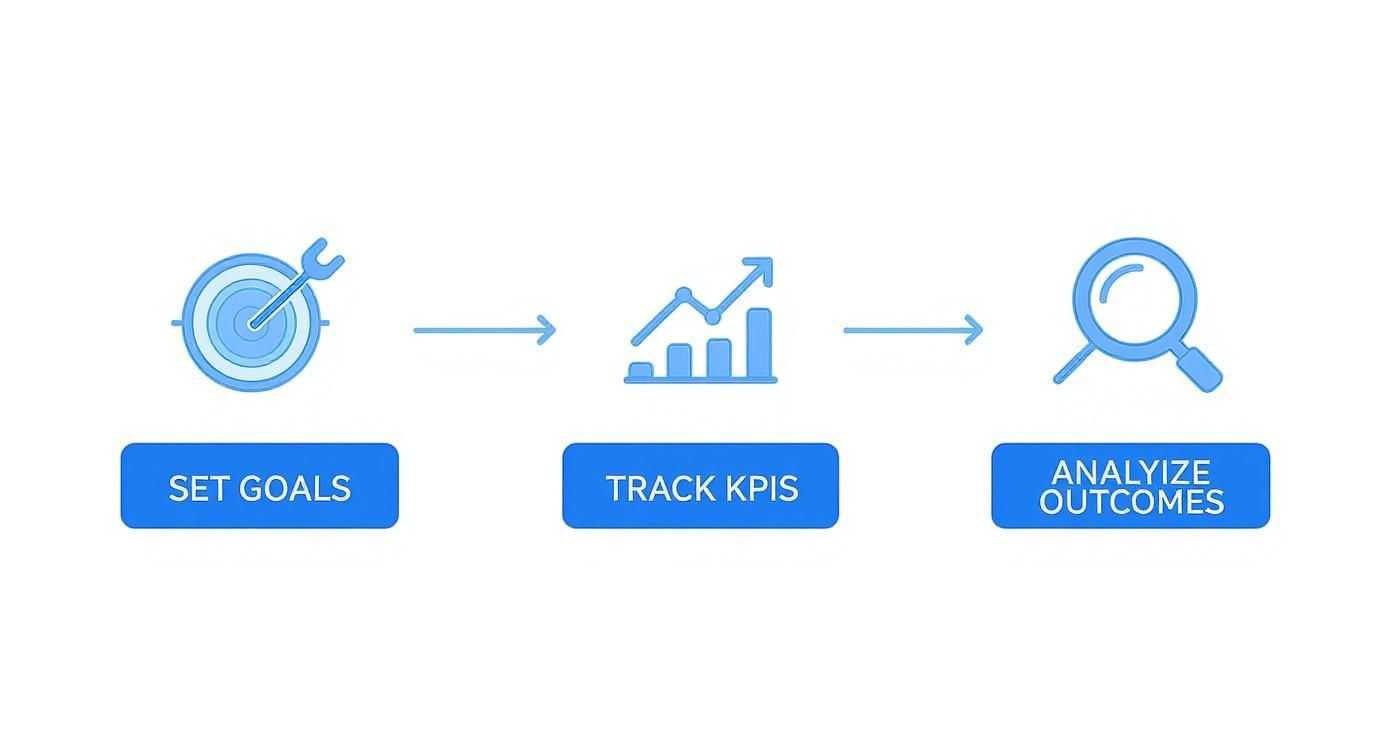
This loop—setting clear goals, tracking the right KPIs, and analyzing what happens—is the engine of every successful SEO campaign. When you build this foundation first, you ensure every data point you collect has a purpose. It guides you toward measurable growth instead of just letting you drown in numbers.
Building Your SEO Rank Tracking Tech Stack
Forget about frantically Googling your own keywords to see where you land. That’s not a strategy; it’s a guessing game. To track your SEO performance like a pro, you need to build a proper tech stack. This just means picking the right tools that work together to give you a complete and accurate picture of how you're really doing.
And your foundation, without question, starts with the free, powerful tools Google gives you.
First up is Google Search Console (GSC). This is non-negotiable. GSC is the absolute source of truth for how Google sees your website. Forget about a single, static ranking number. GSC shows you the average position for your pages across thousands, if not millions, of different searches. This is so much more valuable than a vanity check because it reflects actual user behavior, not just what you see on your computer.
This report gives you a high-level view of your site's health in the search results, showing total clicks, impressions, average click-through rate (CTR), and that all-important average position.
The Power of Free Google Tools
The real magic of GSC happens when you dive into the queries report. You’ll see every keyword—or "query," as Google calls them—that’s driving impressions and clicks to your site. I can’t tell you how many times I’ve found clients ranking for terms they never even thought to target. It’s a goldmine for new content ideas.
Now, pair that with Google Analytics 4 (GA4). This is where you connect the dots. By linking GSC and GA4, you can see not just how people find you, but what they do once they arrive.
Think of it like this:
GSC tells you what happens before the click. It’s all about your visibility in Google's world—how often you show up (impressions) and how many people click through.
GA4 tells you what happens after the click. It reveals how visitors from organic search behave on your site—which pages they look at, how long they stick around, and if they end up converting.
Together, they create a seriously robust, and completely free, foundation for understanding your entire SEO funnel.
Why You Need a Dedicated Rank Tracker
As essential as Google's tools are, they have their limits. The data in GSC is always averaged and usually delayed by a day or two. This makes it tough to see the immediate impact of your work. Did that new blog post or on-page tweak actually move the needle today? GSC won't tell you that.
This is exactly why dedicated rank tracking tools like Semrush, Ahrefs, or Serpstat are a necessary investment for any serious SEO campaign.
These platforms offer a level of detail that GSC simply can't provide. You can feed them a specific list of your most important keywords and get daily updates, giving you near real-time feedback on your efforts. This is absolutely critical when you launch a new service page or optimize a crucial piece of content and need to know if it's working.
They also let you get way more specific. For example, if you run a local business, your rank in the Google Map Pack is everything. Paid tools are brilliant at tracking these specific SERP features—like featured snippets, image packs, and "People Also Ask" boxes—that now dominate the search results page. If you're focusing on local, you'll want to dig into a comprehensive https://getviralseo.com/articles/local-seo-checklist to make sure you’re hitting all the right signals.
To help clarify the roles of these different tools, let's break them down.
Comparison of Core SEO Tracking Tools
This table highlights how foundational tools from Google and specialized third-party trackers serve different, but complementary, purposes in your workflow.
Tool | Primary Function | Data Granularity | Best For |
|---|---|---|---|
Google Search Console | Measures impressions, clicks, CTR, and average position from Google's own data. | Aggregated & Averaged | Understanding broad visibility, discovering new keywords, and getting a site-wide performance baseline. |
Google Analytics 4 | Tracks user behavior on your website after they arrive from search. | User & Session-level | Analyzing post-click engagement, conversion rates, and the true business value of organic traffic. |
Dedicated Rank Trackers | Monitors specific keyword rankings at set locations and intervals (daily, weekly). | Precise & Real-time | Tracking high-priority keywords, monitoring SERP features, and analyzing competitor movements. |
Ultimately, a complete tech stack gives you the best of both worlds.
Investing in a dedicated rank tracker isn't about replacing Google Search Console. It's about augmenting it. GSC provides the broad, historical truth, while a paid tool gives you the precise, daily data needed to make agile, informed decisions.
And to truly get ahead, you can't just look at your own data. To understand your position in the market, your stack should also include resources like these AI-powered competitor analysis tools. By combining Google's free suite with paid specialist tools, you build a system that gives you a 360-degree view of your rankings and overall organic health.
Organizing Keywords for Actionable Insights
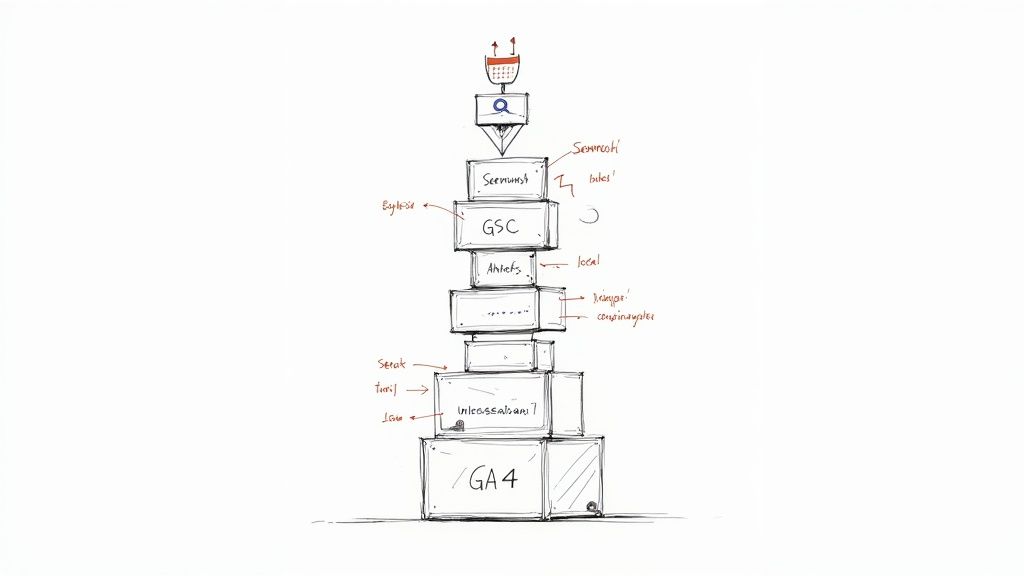
The secret to tracking your SEO rankings effectively comes down to one thing: how you organize your keywords. If you just throw every keyword you can think of into one giant, unfiltered list, you're setting yourself up for a world of data-induced headaches. It's a classic recipe for missed opportunities and analysis paralysis.
Smart keyword segmentation is what separates the pros from the amateurs. It turns a firehose of raw ranking data into clear, actionable intelligence that you can actually use to make business decisions.
The best way I've found to do this is by grouping keywords in a way that mirrors your customer's journey and your own business structure. This creates a much more focused lens for analyzing performance.
A great place to start is by segmenting based on user intent. This immediately tells you which stage of the buying funnel is pulling its weight in search.
Informational Intent: Group together all those "how to," "what is," and "guide" type queries. This is how you keep a finger on the pulse of your top-of-funnel content.
Commercial Intent: Create a separate bucket for terms with commercial modifiers like "buy," "price," "best," or "review." These are the money keywords that measure your ability to attract people who are ready to open their wallets.
Navigational Intent: Don't forget to track your brand name and any product variations. This helps you monitor brand visibility and keeps you alert to any competitors trying to bid on your turf.
Segmenting by Business Priority
Beyond intent, you absolutely have to segment keywords by your company’s product or service lines. If you run a digital marketing agency, for example, you should have separate groups for "SEO Services," "PPC Management," and "Content Marketing."
It’s a simple setup, but it’s incredibly powerful. When you see a drop in rankings, this structure tells you instantly if it's a site-wide problem or an issue isolated to just one service area. It pinpoints exactly where you need to focus your time and energy for the biggest impact.
Don't treat all keywords as equal. A top-three ranking for a high-value commercial keyword is far more impactful than a number one spot for a low-traffic informational term. Segmentation gives you the context to make that distinction instantly.
Balancing Head Terms and Long-Tail Keywords
A truly robust keyword strategy needs a healthy mix of both broad, high-volume "head" terms (like "CRM software") and those super-specific "long-tail" keywords (like "best CRM software for small real estate teams").
Head terms offer the dream of massive traffic, but long-tail keywords are often the unsung heroes that drive higher conversion rates by capturing incredibly specific needs. As search continues to grow—Google is projected to process 5.99 trillion searches in 2025—this becomes even more critical. With 50% of searches being four words or longer, you're leaving a ton of opportunity on the table if you ignore them. You can learn more about this approach in our guide to long-tail keyword research.
Most modern rank tracking tools make this easy, allowing you to use tags or folders to build out these segments. While you're at it, make sure to also configure tracking for different devices (desktop vs. mobile) and any specific geographic locations that matter to your business. This level of detail is how you uncover those hidden performance gaps and truly understand how different customers find you.
Decoding Ranking Changes and Finding the Cause
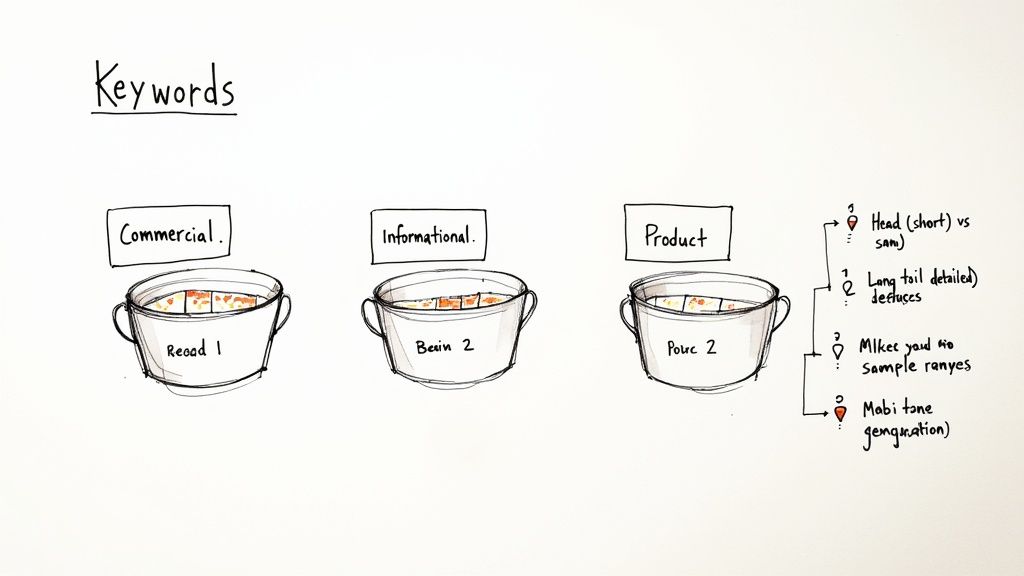
Seeing a keyword suddenly tank can be jarring, but the real skill in SEO is calmly figuring out why it happened. Not every fluctuation is a catastrophe; Google’s results are always in motion. The trick is to know the difference between minor, daily shifts and a significant drop that signals a real problem.
Before you hit the panic button, take a breath and run through a mental checklist. A structured approach turns a stressful situation into a solvable puzzle, helping you find the root cause without jumping to the wrong conclusions.
First, check for the most obvious culprit: a confirmed Google algorithm update. SEO news sites are great for tracking these, and if your drop lines up with a major shake-up, you've probably found your answer.
Your Diagnostic Checklist for Ranking Drops
If a big algorithm update isn't to blame, it’s time to look closer to home. You need to systematically work through these potential issues to isolate what’s really going on.
Technical SEO Glitches: Pop open Google Search Console and hunt for new indexing errors, manual actions, or strange crawl anomalies. A page that Google can't crawl or index will vanish from the rankings. It’s as simple as that.
On-Page Content Changes: Did you—or someone else on your team—tweak the page recently? Even a seemingly small change, like accidentally removing the target keyword from an H1 tag or deleting a key internal link, can have a surprisingly big impact.
Lost Backlinks: Use a tool like Ahrefs or Semrush to see if you’ve recently lost any important backlinks. If a high-authority link that was propping up your page disappears, your rank can fall right along with it. To get a better handle on this, check out our guide on how to find domain authority.
Investigating Competitor Movements
Sometimes, a ranking drop isn't about something you did wrong, but something a competitor did right.
Maybe a rival just published a massive, comprehensive new article targeting your keyword. Or perhaps they overhauled their page's user experience or landed a powerhouse backlink. It happens.
Take a hard look at the pages that have jumped ahead of you. What are they doing differently? This isn't just about troubleshooting; it’s a golden opportunity for competitive analysis that can sharpen your entire strategy moving forward.
Key Takeaway: A ranking drop is often a symptom, not the disease. Your job is to be a detective, methodically investigating technical health, on-page factors, backlinks, and the competitive landscape to find the true cause.
Attributing Gains and Proving ROI
On the flip side, it's just as crucial to understand why your rankings improve. Connecting positive movement to specific actions is exactly how you prove the value of your SEO work and figure out what to do more of.
Did a keyword jump to page one a week after you launched a new content cluster around that topic? That’s a clear win you can report. Did your rankings for "local coffee shops" tick up after you focused on a local link-building campaign? You need to connect that activity to the result.
Google's algorithm considers over 200 ranking factors, and while you can't track everything, a diversified approach is essential. Keeping an eye on your main KPIs helps connect actions to outcomes, which is especially important when even something as basic as a title tag can be a big deal—particularly when Google rewrites 76% of titles. You can dig into the full research on these complex ranking factors to see how it all fits together.
By carefully correlating your actions with ranking data, you build a repeatable playbook for success. This transforms tracking from a simple monitoring task into a powerful strategic tool for predictable growth.
Reporting SEO Performance That Gets Noticed

Let’s be honest: dropping a spreadsheet full of keyword rankings into a manager's inbox is the fastest way to have your hard work ignored. Raw data is noise. To prove your value, you need to turn that data into a story that grabs attention and shows how your SEO work is fueling real business growth.
The first move is to ditch the last-minute, manual report scramble. Get into your rank tracking tool and set up automated, scheduled reports to go out weekly or monthly. This isn't just about saving time—it's about building trust through consistency.
Know Your Audience, Tailor Your Report
A one-size-fits-all report is a one-size-fits-none report. Your C-suite cares about completely different things than your marketing colleagues. Customizing what you share is absolutely essential if you want your insights to land with any real impact.
Think about who you're talking to and what they actually care about.
For the C-Suite: They want the bottom line, fast. Give them a high-level, one-page dashboard. Show them the big picture with metrics like year-over-year organic traffic growth, the bump in qualified leads from search, and, most importantly, the revenue you can attribute directly to the organic channel.
For Your Marketing Team: This is where you can geek out. They'll want to see the detailed breakdown of keyword segments, how you’re stacking up against competitors, and which SERP features you’re starting to own. This report should be tactical, focusing on what’s working and what the next big opportunity is.
When you tailor the report, you're speaking their language. The data instantly becomes relevant and easy to grasp.
Crafting a Monthly Performance Story
A truly great report doesn't just show numbers on a page; it tells the story behind them. Your monthly performance review needs to be a narrative connecting your day-to-day work to the company's biggest goals.
A report is your chance to translate SEO jargon into business impact. Don't just say rankings went up. Explain why they went up and what that means for the bottom line. This is how you shift the perception of SEO from a cost center to a powerful growth engine.
To really make your reports pop and get the attention they deserve, you could even leverage AI to create compelling presentations.
No matter the format, every solid monthly review should hit these four points:
Key Wins & Highlights: Always lead with the good news. Did you finally snag that #1 spot for a money keyword? Did you capture a featured snippet that's driving a ton of clicks? Put your best foot forward.
Performance vs. Goals: Show exactly how you're tracking against the KPIs you set from the beginning. Simple charts are perfect here for visualizing progress toward goals like boosting organic leads or improving overall keyword visibility.
Analysis & Context: This is the "why" section. If rankings dipped, maybe it was a Google algorithm update. If they shot up, point directly to that new content cluster you launched. You have to provide the context behind every significant change.
Action Plan for Next Month: End with a clear, forward-looking plan. What are you going to tackle next? Lay out your specific priorities to build on the wins and shore up any weaknesses. This shows you’re not just reporting on the past—you’re strategically planning for the future.
Common Questions About Tracking SEO Rankings
Even with the best workflow in place, you’re bound to run into a few questions when you start digging into your SEO rankings. Let’s clear up some of the most common ones I hear from clients. Getting these details right helps you make smart, strategic moves instead of just reacting to random data points.
And these details matter. A lot. The data doesn't lie: the #1 spot in Google pulls in a staggering 39.8% of all clicks. That drops by more than half to just 18.7% for the second position. When you consider that 75% of people never even click to the second page, you realize how every single ranking position counts. You can dig deeper into these kinds of numbers by checking out these SEO metrics that actually matter on ninepeaks.io.
How Often Should I Check My SEO Rankings?
It’s so tempting to hit refresh on your rank tracker every morning, but honestly, that’s a recipe for anxiety. Daily checks usually just highlight normal, insignificant SERP fluctuations.
For most businesses, a weekly check-in is the sweet spot. It's frequent enough to catch any real, meaningful shifts before they become problems, but it keeps you from getting bogged down in the day-to-day noise.
Now, there are times when daily tracking is absolutely the right call:
During a major site migration or a big redesign.
Right after launching a critical new product or service page.
In the days following a confirmed Google algorithm update.
My advice? Let your automated tools gather the data daily in the background, but schedule your own deep-dive analysis for once a week.
Why Do My Rankings Look Different Than a Manual Search?
This is probably the question I get most often. You type your keyword into Google, see your site on page one, but your rank tracker says you're on page two. What gives?
The results you see in your own browser are hyper-personalized. Google is using your location, your search history, and even the device you're on to show you what it thinks you personally want to see.
A professional rank tracker strips all of that away. It simulates a search from a specific, neutral location using a clean browser session. This gives you an objective view of how a typical potential customer would see the search results, which is far more valuable for making business decisions.
Your manual search shows your personal reality; a rank tracking tool shows the market's reality. Trust the tool. It’s showing you what your customers actually see.
Should I Focus on Rankings or Organic Traffic?
This isn't an either/or question. You need to track both because they tell you two different, but connected, parts of the story. Think of it as cause and effect.
Rankings are your leading indicator. When your keyword positions start to climb, it’s a strong signal that more traffic is likely on its way. They’re your diagnostic tool, helping you see what's working and spot opportunities early on.
Organic traffic is your lagging indicator. This is the payoff. It’s the proof that your SEO efforts are actually driving people to your site and generating real business value.
A solid SEO strategy uses ranking data to understand why performance is changing, while looking at traffic and conversions to measure the bottom-line impact. If you only track one, you're flying blind and can't connect your actions to the results they produce.
Ready to stop guessing and start seeing real results? The Viral SEO platform provides a simple, conversion-focused workflow to analyze content gaps and accelerate your organic growth. Start your free trial today and build a content strategy that ranks.
Blogs
More Blogs
From keyword goldmines to AI-driven content hacks—expert insights to help your blog posts dominate the first page.