
When you're looking for low-competition keywords, you're essentially hunting for search terms that give you a real shot at landing on Google's first page. These are often the phrases with lower search volume that bigger competitors simply ignore, creating the perfect opening for newer or smaller sites to gain traction.
Why Low Competition Keywords Are Your SEO Game Changer

Let’s be honest, trying to rank for a term like "project management software" as a new blog is a recipe for disaster. You’re going up against industry titans with colossal backlink profiles and years of authority. A much smarter path is to sidestep that head-on collision and focus on racking up smaller, more targeted wins.
This is the real value of learning how to find low competition keywords. It’s not about taking the easy way out; it’s about putting your energy where it will actually get you results, and fast.
The Stepping Stone Strategy
Think of every low-competition keyword as a strategic stepping stone. When you rank for these less-contested terms, you're doing more than just bringing in a small stream of traffic. You're sending a powerful signal to Google that your site is a credible source on that topic.
As you start collecting rankings for a variety of related long-tail keywords, you accomplish a few crucial things:
Build Topical Authority Faster: Google starts to see your site as an expert in its niche. This makes it much easier to rank for more competitive terms down the road.
Attract a Motivated Audience: Highly specific searches often come from people who know exactly what they want and are closer to making a decision or purchase.
Generate Quicker Wins: Seeing your content hit the first page builds momentum and gives you real-world data on what actually connects with your audience.
A series of small, strategic wins is far more valuable than one massive, failed attempt at a high-difficulty keyword. This incremental approach builds a solid foundation for sustainable, long-term organic growth.
For instance, a brand-new project management blog would be better off targeting "best Trello alternative for freelance designers" than the generic "best project management tools." The search volume is obviously lower, but the user's intent is razor-sharp, and the competition is a fraction of what it would be otherwise. Nailing a top spot for that term builds instant credibility and pulls in a super-relevant audience.
To really get the hang of this, it helps to have a solid grasp of the fundamentals. Diving into proven strategies for conducting keyword research will give you that strong foundation.
Digging for Long-Tail Keyword Gold

Alright, this is where the real work begins. We're not just downloading some generic keyword list that everyone else is using. Instead, we’re going to get our hands dirty with repeatable methods for finding those valuable long-tail keywords—the ones that signal genuine user intent and are much, much easier to rank for.
The secret is to stop thinking like a marketer and start thinking like your customer. What specific, conversational phrases are they typing into Google when they're on the hunt for a solution? Making this mental shift is the first step to uncovering the keyword opportunities your competitors are completely missing.
Let Google Be Your Guide
Believe it or not, Google’s own search results are a treasure trove of keyword ideas if you know how to read the signs. Features like ‘People Also Ask’ (PAA) and ‘Related Searches’ offer a direct window into the user’s journey. They literally show you the questions people ask before and after their initial search, mapping out their entire thought process for you.
Let’s say your broad topic is ‘project management software.’ A quick search will bring up a PAA box loaded with ideas:
What is the best simple project management software?
Is Trello or Asana better?
How do I choose project management software?
Every single one of these is a potential long-tail keyword you can build content around. They’re far less competitive than the original term and target users who have a specific, well-defined problem they need to solve. This is the foundation of smart long-tail keyword research.
From Broad Topics to Specific Wins
Let's walk through a quick example. We'll start with our head term, "project management software," which is brutally competitive and nearly impossible to rank for. But by using clues from the SERPs, we can start to chisel it down into something actionable.
Remember, the goal isn't just to find a keyword; it's to find a problem. Your content becomes the solution, and the long-tail keyword is what connects a searching user to that solution.
From the PAA box, you noticed the word "simple." So, you search for "simple project management software." Now, scroll to the bottom of the page and look at the 'Related Searches.' You might see something like "best project management software for small teams." We're getting warmer.
This is where you layer on your own expertise. Let’s say your target audience is creative agencies. Combine these insights, and you land on a true gem: "best project management software for small creative teams." This is a highly specific, low-competition keyword that speaks directly to a user's pain point.
This method works because it prioritizes specificity. In fact, research shows that longer phrases, typically three or more words, don't just have lower competition—they also get 1.76 times more clicks than single-word head terms. Why? Because the user intent is so much higher. They know exactly what they’re looking for, and you’re the one providing the perfect answer.
Digging for Keyword Gold in Niche Communities
Your favorite SEO tools are great, but let's be honest—they often overlook the real gems. The most authentic, low-competition keywords aren't found in a database; they're hiding in plain sight where your audience actually hangs out online.
Think about it. The real gold is buried in places like Reddit, Quora, and niche industry forums. This is where people discuss their problems using their own words, not the polished terms we SEOs usually target.
Tap Into Real Conversations
These online communities are raw, unfiltered firehoses of customer pain points. People aren't trying to game a search engine; they're just looking for help. This is where you'll find the exact language your competitors are totally missing, giving you a direct line to searchers who are ready to take action.
The whole process is more about listening than searching. Instead of just plugging seed keywords into a tool, you're immersing yourself in genuine conversations to understand what people really want.
For example, I once spent a few weeks lurking in a small business subreddit. I kept seeing a recurring theme: entrepreneurs constantly venting about their "frustrating accounting software."
That one observation was a goldmine. It immediately sparked a ton of content ideas built around real-world phrases like:
"easy alternative to quickbooks for freelancers"
"simple invoicing software for side hustles"
"accounting software that doesn't need an expert"
These aren't terms from a keyword generator; they're born from genuine frustration. They pinpoint specific problems that need specific solutions, making them perfect targets for high-value, low-competition content.
A Practical Framework for Community Research
First things first, figure out where your audience gathers. Are they regulars in the r/entrepreneur subreddit? Do they hang out in specific Facebook groups for SaaS founders or old-school industry forums? Find a few promising spots and start digging.
The goal isn't just to collect keywords; it's to spot recurring problems. When you see the same questions and complaints over and over, you've hit a content nerve that's begging for a solution.
Keep an eye out for threads with high engagement—lots of comments, upvotes, and back-and-forth. Pay close attention to the exact phrasing people use in their posts and replies. Jot down the specific terms, questions, and even the analogies they use to describe their challenges. This hands-on approach gives you a qualitative edge that automated tools just can't match.
If you're looking for a more structured way to do this, check out these strategies for uncovering hidden gems with keyword tracking on Reddit. This guide can help you systematize the discovery process on one of the best platforms out there. By actually listening to these conversations, you’ll build a list of keyword ideas that are not only low in competition but incredibly high in relevance and user intent.
Alright, you've done the creative legwork, digging through forums and brainstorming long-tail ideas. You're sitting on a promising list of potential keywords. But hold on—before you dive into writing, there's a critical validation step that separates the pros from the amateurs.
A keyword difficulty (KD) score is a helpful first glance, but it doesn't tell the whole story. The real art and science of SEO lies in manually analyzing the Search Engine Results Page (SERP). This hands-on review shows you what a simple metric can't: what it will actually take to outrank the pages sitting in those top spots.
Moving Beyond the Numbers
A low KD score is a great sign, but it can be deceptive. I've seen plenty of keywords with a low score where the top-ranking pages are absolute powerhouses—they just don't happen to target that exact phrase. A manual SERP check lets you spot these traps before you invest time and resources.
Think of it like this simple decision tree.
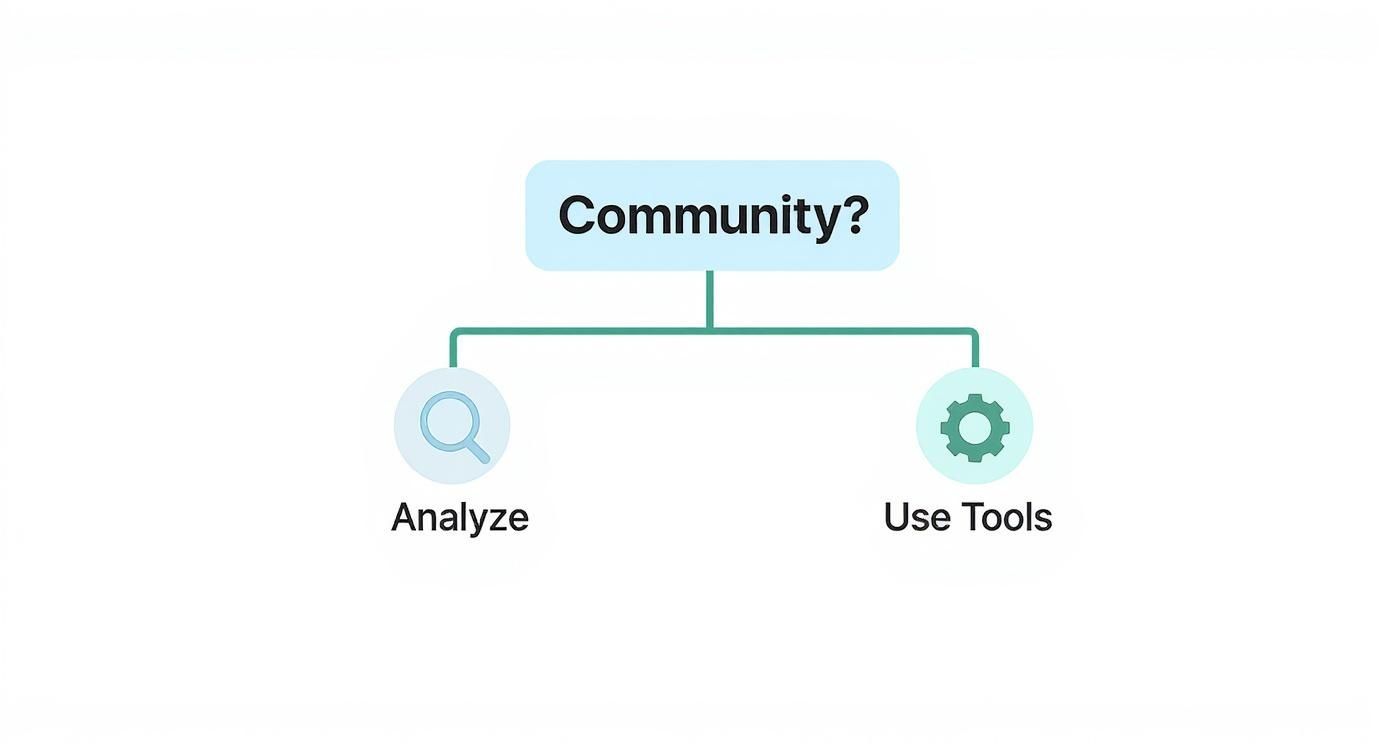
As you can see, while tools are your starting point, that manual analysis is a non-negotiable final check, especially for keywords you've sourced directly from community research.
What to Look for on Page One
When you punch your target keyword into Google, you're not just searching; you're doing opposition research. Your mission is to size up the strength of the top 10 results and look for cracks in their armor.
So, what are the green flags that signal a golden opportunity?
User-Generated Content (UGC): Are you seeing forum posts from Reddit, Quora, or other communities ranking on page one? This is a huge tell. It means Google is actively looking for better, more authoritative content and is settling for a discussion thread. Your well-structured article can blow this out of the water.
Low-Authority Sites Ranking: Do you spot a few websites with low Domain Authority (DA) hanging out in the top 10? Fantastic. That's a strong sign that you don't need to be an industry giant to compete. If you're not sure, it's easy to learn how to find domain authority with a browser extension.
Outdated or Thin Content: Click on the top-ranking pages. Is the content from 2019? Is it superficial, poorly written, or just not that helpful? If you can confidently say, "I can create something much better than this," you've found a winner.
To make this process methodical, I use a quick mental checklist every time I analyze a SERP.
Keyword Competition Signals to Analyze on the SERP
Signal to Check | What to Look For (Low Competition) | What it Indicates |
|---|---|---|
User-Generated Content | Forum threads (Reddit, Quora) ranking in the top 10. | Google lacks dedicated, high-quality content for this query. |
Domain Authority (DA) | Multiple sites with a DA under 40 on page one. | You don't need a high-authority site to rank. |
Content Freshness | Top results are several years old (e.g., published before 2021). | The topic is ripe for an updated, more current article. |
Content Quality | Pages are thin, poorly formatted, or lack depth. | A comprehensive, well-structured post can easily outperform them. |
Search Intent Match | The results don't perfectly answer the user's question. | There's an opportunity to create content that better satisfies intent. |
Title Tag Targeting | Title tags don't include the exact or a close variant of the keyword. | The competition isn't intentionally targeting this specific query. |
This quick scan tells you almost everything you need to know about the keyword's true difficulty.
SERP analysis is your secret weapon. It transforms keyword research from a guessing game based on metrics into a clear strategy based on observable weaknesses in the competition.
On the flip side, if page one is a fortress of well-known brands, super-detailed guides published last month, and major news outlets, it's time to pivot. For example, trying to rank for "best CRM software" puts you in a cage match with Salesforce, HubSpot, and Gartner. That’s a losing battle.
But a search for something like "simple CRM for solo real estate agents" might turn up smaller blogs and forum threads. That's your opening. This manual check takes just a few minutes per keyword, but it can save you months of wasted effort. It’s the single most important step in finding those truly winnable keywords.
Finding Keyword Opportunities in Your Industry
Not every industry is a level playing field when it comes to SEO. The keyword battleground in finance looks nothing like the one for a local plumber, and knowing this difference from the get-go is key to building a strategy that actually works. You have to play the game on the field you're given.
This means a niche SaaS product will chase a completely different set of keywords than a broad e-commerce store. A one-size-fits-all approach is a recipe for wasted time and money. What you need is a sharp analysis of your industry's landscape to find those hidden pockets of opportunity.
Sizing Up Your Niche’s Keyword Landscape
Before you dive into a specific keyword tool, take a moment to get a bird's-eye view of your industry. This helps you understand what you're up against and where the easy wins might be hiding. It’s not about getting scared off by the big players; it's about finding the path of least resistance.
For instance, a study of keyword difficulty across different sectors revealed some pretty stark contrasts. Local Services came out on top as the most accessible, with an incredible ratio of 93 low-difficulty keywords for every single high-difficulty one. E-commerce wasn't far behind, with 48% of its keywords sitting in the low-competition bucket. This data is exactly why a small business targeting a specific town or city can often see results so much faster.
If you're in that local space, our comprehensive local SEO checklist is a great place to kick things off.
On the other end of the spectrum, the Finance industry was a warzone. A massive 63% of its keywords were classified as medium difficulty, signaling a market where you need serious authority and a hefty content budget to even make a ripple. You can dig into the complete keyword competition findings on Semrush.com to see how your industry stacks up. This kind of high-level insight helps you set realistic goals from day one.
Matching Your Approach to Your Market
Once you know the general difficulty of your industry, you can get much more specific with your keyword research. It’s all about working smarter.
For High-Competition Niches (like SaaS or Finance): You need to get hyper-specific. Forget broad terms. Instead of targeting "project management software," you'd be better off going after something like "Asana alternative for remote marketing teams." The goal is to find pain points so specific that the giants of the industry haven't bothered to create content for them.
For Low-Competition Niches (like Local Services or new hobbies): You have a bit more breathing room. Long-tail keywords are still your friend, but you can also realistically target broader, foundational topics much earlier. Your content can focus on answering the core "what is" and "how to" questions to build a solid base of authority.
The key is to stop thinking about keywords in a vacuum. Your industry is the context that makes a keyword good or bad for you.
By understanding the unique dynamics of your industry, you can aim your research efforts where they’ll make the biggest splash. This lets you sidestep the crowded arenas and plant your flag where competitors aren't even looking, paving the way for faster results and real, sustainable growth.
Answering Your Top Keyword Questions
As you start digging for these low-competition gems, you're bound to have some questions. It's totally normal. Let's walk through some of the most common ones I hear from people just starting out with this strategy.
One of the first things that trips people up is search volume. You see a keyword with only 50 or 100 monthly searches and your first instinct might be to just toss it aside. I get it, but that's usually a mistake.
Here’s something you learn from experience: keyword tools are almost always underestimating the real traffic potential. A single, well-written article doesn’t just rank for one keyword. It naturally starts pulling in traffic for dozens of other long-tail variations. Trust me, ranking on the first page for a term with 100 searches is a thousand times better than being stuck on page five for a keyword with 10,000 searches.
How Long Until I Actually See Rankings?
Okay, the big question: how long does this stuff take? There's no single answer, of course, but what I can tell you is that it's almost always faster than you think.
We're not talking about those super competitive keywords that can take a year or more to even make a dent. With these genuinely low-competition terms, you can often see your content start to climb the rankings in just a few weeks or a couple of months.
A few things can speed this up or slow it down:
Your Website's Authority: If your site already has a bit of a reputation with Google, you'll see results faster than a brand-new domain.
The Quality of Your Content: Is it actually the best answer out there? Genuinely helpful content gets rewarded, and often pretty quickly.
The Real Competition: This goes back to what we covered earlier. Manually checking the SERPs is the only way to know for sure what you're up against.
The best part about targeting these keywords is the momentum it builds. Getting those quick wins doesn't just bring in traffic; it gives you immediate feedback on what's working so you can double down on the right topics.
Should I Live and Die by the Keyword Difficulty Score?
This is a crucial one. It’s so easy to get fixated on that Keyword Difficulty (KD) score you see in your favorite tool. But should it be the be-all and end-all? Absolutely not.
Think of a low KD score as a signal to start your investigation, not a guarantee of an easy win. It’s a great way to filter a massive list of ideas down to a manageable size, but that's where its job ends.
You have to follow that up with your own manual analysis of the search results. Spotting forums, Quora pages, or super old articles on page one is a much more reliable sign that you can win than any score a tool can spit out. The KD score is like a compass—it points you in a general direction, but you still need to look at the map to navigate the actual terrain.
Ready to stop guessing and start finding the keyword opportunities your competitors are missing? The Content Gap Analyzer from Viral SEO uncovers top-performing pages in a single click, giving you a data-backed roadmap for your content strategy. Start your free plan today at getviralseo.com.
Blogs
More Blogs
From keyword goldmines to AI-driven content hacks—expert insights to help your blog posts dominate the first page.