Blog

Blog

How Many Keywords Should I Use For SEO? A Modern Guide

How Many Keywords Should I Use For SEO? A Modern Guide

Blog

How Many Keywords Should I Use For SEO? A Modern Guide

Let’s cut to the chase: forget everything you’ve heard about keyword density. That’s old-school SEO. The modern, effective approach is all about strategic layering. For any given page, you should be targeting one primary keyword, 2-3 secondary keywords, and a whole cluster of 10-20+ semantic or long-tail variations. This method mirrors how today's sophisticated search engines actually understand topics, not just individual words.

Shifting From Keyword Count to Topical Authority

Hand-drawn SEO strategy diagram with concentric circles showing primary, secondary, long tail, coffee, synergy, and niche.

The question "how many keywords should I use for SEO?" is a holdover from a much simpler time in search. Back then, SEO was a numbers game, and we obsessed over keyword density—stuffing our main keyword onto a page as many times as possible. Frankly, that thinking is not only outdated but can actively get you penalized today.

Modern search engines like Google have gotten much smarter. They're looking for content that shows you truly know your stuff and comprehensively answers a searcher's question. They don't just count keywords anymore; they analyze the relationships between concepts to grasp a page's expertise. It's a fundamental shift in how we need to think about content.

Instead of asking, "how many keywords," we should be asking, "How can I layer my keywords to build deep topical authority and completely satisfy the user's query?"

Understanding the Modern Keyword Framework

I like to explain this with a simple coffee shop analogy. Your keyword strategy has a natural hierarchy, with each layer adding more specific detail, just like placing an order.

  • Primary Keyword: This is your main event, the big topic. It’s like walking in and just saying "coffee." It's broad and sets the core focus for the entire page.

  • Secondary Keywords: These add crucial context. Think "latte" or "cold brew." They're closely related subtopics that a lot of people searching for "coffee" are also interested in.

  • Long-Tail & Semantic Keywords: These are the super-specific, conversational phrases. This is your "iced vanilla latte with oat milk." They reveal exactly what a user wants and are often much less competitive to rank for.

When you layer these keyword types together, you create a rich, context-heavy page. It sends a powerful signal to search engines that your content is an authoritative resource on the subject.

Why Keyword Density is a Flawed Metric

The whole idea of keyword density has become a distraction. In fact, most research today suggests that an ideal keyword density is actually below 3%. It's a game of diminishing returns—and one you can easily lose.

Think about it: a 6% keyword density on a tiny 100-word paragraph looks incredibly spammy. But that same percentage on a 1,000-word article might not even register. This is why focusing on a specific percentage is the wrong approach. You can explore more insights on ideal keyword counts, but the real takeaway is to focus on natural language and comprehensive coverage.

For a quick overview, here's a handy reference table that breaks down how to think about keyword targeting at different scales.

Keyword Targeting Quick Reference Guide

Keyword Level

Recommended Count

Purpose

Primary Keyword (Per Page)

1

Defines the page's core topic and main ranking goal.

Secondary Keywords (Per Page)

2-3

Adds context, captures related searches, and builds topical depth.

Long-Tail Keywords (Per Page)

10-20+

Targets specific user intent, answers detailed questions, and captures "easy win" traffic.

Topic Cluster (Multiple Pages)

20-50+

Establishes broad authority on a subject by interlinking related pillar and cluster pages.

Entire Website (All Pages)

500-1000+

Creates a comprehensive semantic network, positioning the site as an industry expert.

This table shows how the strategy scales up, from a single piece of content to an entire site-wide SEO plan. Each level builds upon the last to create a powerful, cohesive signal of authority.

Building Your Keyword Foundation With Primary and Secondary Terms
A handwritten diagram illustrates a conceptual flow from 'BUILDING' to 'KEYWORD', 'PRIMARY', and 'KEYWADY'.

Think of your page's content like building a house. Every solid house starts with a strong foundation, and for SEO, that foundation is made of primary and secondary keywords. These two work hand-in-hand to signal to Google exactly what your page is about, making sure you show up for the right people.

Your primary keyword is the main structural beam of your house. It's the one, single topic you want the page to rank for. This term should be the absolute heart of the content, answering the core question your visitor is asking.

For example, if you run a pet supply store, a product page might be laser-focused on "grain-free dog food" as its primary keyword. Everything on that page, from the headline down to the product descriptions, needs to support that one central idea.

Defining Your Primary Keyword

Picking the right primary keyword is a make-or-break decision. It sets the entire direction for your content. A huge part of this process is getting a realistic grip on SEO keyword difficulty. It’s tempting to go after a term with massive search volume, but if you’re up against industry giants, you’ll just be spinning your wheels.

A great primary keyword usually checks three boxes:

  • High Relevance: It’s a perfect match for what’s on the page.

  • Significant Search Volume: Enough people are actually looking for it to make it worthwhile.

  • Achievable Difficulty: You have a fighting chance to rank for it with your site's current authority.

It's all about finding that sweet spot between what people want and what you can realistically compete for. This single choice can determine whether your page succeeds or gets lost on page ten.

Using Secondary Keywords for Context

If your primary keyword is the main beam, then secondary keywords are the supporting pillars. These are closely related terms and subtopics that give your content essential context and depth. For every one primary keyword, you should aim to weave in 2-3 strong secondary keywords.

These terms help you build a more complete picture for both users and search engines, which lets you cast a wider net.

Secondary keywords aren't just synonyms. They are distinct subtopics that someone interested in your main keyword would also care about. This strategy makes your page a more comprehensive resource.

Let’s stick with our "grain-free dog food" example. Instead of just using variations like "dog food without grain," your secondary keywords would explore related concepts people search for:

  • "best food for dogs with allergies"

  • "high-protein dog food brands"

  • "puppy food grain-free options"

By working these ideas into your headings and body paragraphs, you create a much more helpful page. More importantly, you tell search engines that you’re an authority on the topic, which is exactly what they want to see before they give you a top ranking.

Expanding Your Reach With Long-Tail and Semantic Keywords

Once you’ve locked in your primary and secondary keywords, it’s time to go from simply covering a topic to truly owning it. This is where long-tail and semantic keywords come into play. Think of them as the very specific, conversational questions your audience is typing into Google.

These phrases are your secret weapon for capturing visitors who are deep into their research and know exactly what they need.

For example, a broad term like "SEO software" is a battleground. But long-tail variations unlock a whole different ball game. Phrases like “best SEO software for a small business” or “how to use SEO software for competitor analysis” attract a much more motivated searcher and face way less competition.

Uncovering High-Intent Phrases

Finding these conversational gems is easier than you might think. You don't need a suite of expensive tools to get started; you just have to listen to what your audience is already asking.

Here are a few simple ways to discover long-tail keywords:

  • Google's "People Also Ask" Box: This is a goldmine. It shows you the immediate follow-up questions people have about your main topic.

  • Online Forums (like Reddit or Quora): Jump into these communities. Search for your primary keyword and pay close attention to the exact language real people use when they talk about their problems.

  • Competitor Analysis: Check out the top-ranking articles for your primary keyword. What specific subheadings and questions are they answering? That's your roadmap.

When you weave these phrases into your content, you’re not just optimizing for search engines—you’re directly addressing your reader’s pain points. Your page quickly becomes the most helpful resource they can find. For a deeper dive, mastering long-tail keyword research can give you a serious edge in targeting these specific queries.

The Power of Long-Tail Keywords

Don't underestimate the impact of these longer phrases. The data is pretty clear: a staggering 91.8% of all search queries are long-tail keywords. People just don't search in one- or two-word bursts anymore.

These multi-word phrases, which average 3.2 to 3.5 words on top-ranking sites, also pack a serious punch when it comes to results, generating 2.5 times higher conversion rates than their shorter counterparts.

The question isn't really "how many keywords should I use?" It's about comprehensive topic coverage. A single, authoritative page can naturally rank for hundreds of long-tail variations without ever feeling forced or over-optimized.

Ultimately, you want to create a piece of content so thorough that it answers your reader's next question before they even think to ask it. Our own guide on long-tail keyword research has more advanced strategies for this. When you adopt this mindset, you create content that not only ranks but also builds real trust and authority.

How to Map Keywords and Avoid Cannibalization

A powerful keyword strategy isn't just about a single page—it's about your entire website's architecture. To really get the most out of your SEO efforts, you need a clear plan, or what we call a keyword map. This simple tool helps you avoid a common and incredibly frustrating problem: keyword cannibalization.

Keyword cannibalization is what happens when your own pages accidentally compete against each other for the same search terms.

Imagine you've written two blog posts, both trying to rank for "best grain-free dog food." Google's crawlers get confused. They can't tell which page is the real authority, so they might rank both of them poorly or keep swapping them in and out of the results. This splits your traffic and dilutes your authority. A good keyword map gives every important page on your site a unique job to do.

This strategic assignment of keywords makes your site structure crystal clear to search engines, helping them understand what each page is about and how everything fits together.

Creating Your Keyword Map

The process is pretty straightforward. You'll assign one unique primary keyword to each of your core pages. Then, you'll support that primary keyword with a group of relevant secondary and long-tail terms. This creates a logical hierarchy that guides both your content creation and your internal linking.

Think of it like organizing a library. Every book (your page) has a main subject (your primary keyword), and related topics (secondary keywords) are shelved nearby. This system makes it easy for anyone—or any search engine—to find exactly what they're looking for.

This hierarchy also helps you think about keywords from broad to specific, covering every stage of a user's search journey.
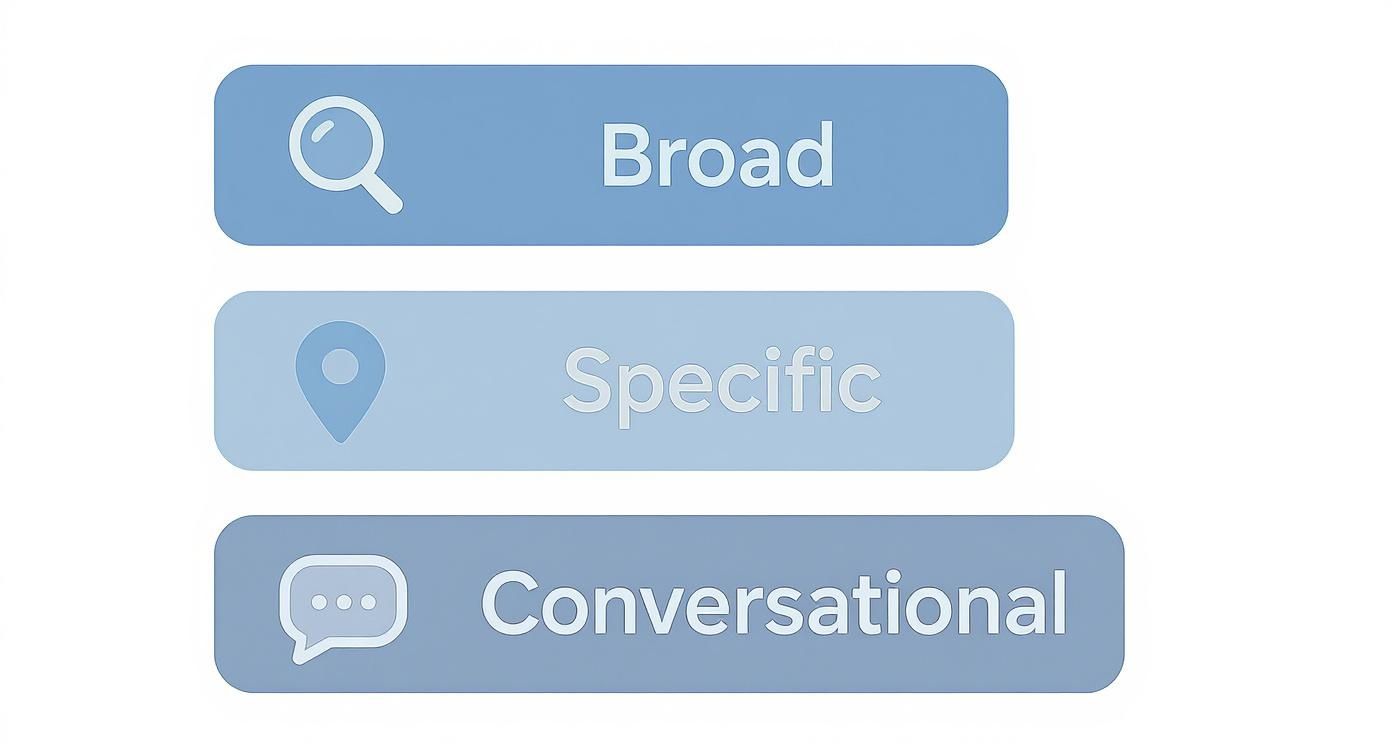
Three blue buttons labeled 'Broad', 'Specific', and 'Conversational' with corresponding icons.

The image above shows this funnel perfectly, moving from general interest to highly specific needs. Your keyword map should reflect this same logic.

You can start by creating a simple spreadsheet. Just list your most important URLs and assign their target keywords.

A keyword map is your website's SEO blueprint. It dictates which pages target which terms, ensuring every piece of content has a distinct purpose and a clear path to ranking without internal competition.

For example, here’s what the keyword map for a local bakery might look like:

Example Keyword Map for a Small Business Website

This table demonstrates how to assign and organize primary and secondary keywords across different pages of a website to prevent keyword cannibalization.

Page URL

Primary Keyword

Secondary Keywords

User Intent

/

artisan bakery Austin

"bakery near me", "best bakery Austin TX", "fresh bread Austin"

Navigational/Informational: Find a local bakery

/wedding-cakes

custom wedding cakes Austin

"wedding cake prices Austin", "modern wedding cakes", "cake tasting Austin"

Commercial: Research and buy a wedding cake

/blog/how-to-choose-wedding-cake

how to choose a wedding cake

"wedding cake flavor ideas", "questions to ask your baker", "wedding cake checklist"

Informational: Get advice and ideas for a wedding

Notice how each page has a clear, non-competing focus? This structured approach is crucial, especially for businesses trying to attract local customers. If that's you, our local SEO checklist provides a step-by-step framework to get your local strategy dialed in.

The Benefits of a Clear Map

By mapping your keywords, you take all the guesswork out of your SEO. You'll know exactly what content to create, which pages to optimize, and how they should all link together to build topical authority.

This process transforms your website from a random collection of pages into a cohesive, organized resource. That kind of clarity is rewarded by search engines with better rankings and more consistent organic traffic, finally giving you a site-wide answer to "how many keywords should I use for SEO?"

Common Keyword Mistakes That Hurt Your Rankings

Just knowing how many keywords to target is only half the battle. You can do the most brilliant keyword research in the world, but if you stumble on the implementation, all that work goes right out the window. Let's walk through some of the biggest pitfalls I see all the time that can absolutely wreck your SEO performance—and how to sidestep them.

The most infamous mistake, one that just won't seem to die, is keyword stuffing. This is an ancient practice of cramming your main keyword into your content over and over again, thinking you can game the system. Today's search algorithms are way too smart for that. They spot it from a mile away, and it leads to a clunky, awful user experience that can get you penalized.

Here's a simple test: read your content out loud. If it sounds unnatural or robotic, you're doing it wrong.

Overlooking User Intent

Another massive error is targeting the wrong user intent. This is what happens when the content you create doesn't match what the searcher is actually trying to do. For example, you wouldn't write a 3,000-word blog post on the history of sneakers for the keyword "buy running shoes online." That's a classic mismatch. The intent behind that search is clearly transactional—they have their credit card out and want to shop, not read an encyclopedia.

Aligning your content with intent isn't just a good idea; it's essential for ranking.

  • Informational Intent: Someone wants to learn. Think "how to train for a marathon." Your job is to answer their question with a detailed guide, a tutorial, or a how-to article.

  • Transactional Intent: The user is ready to buy. A query like "Nike Pegasus 41 sale" means you should send them straight to a product or category page to complete a purchase.

  • Commercial Intent: They're in the final stages of research before buying, like "best marathon running shoes." This is your chance to shine with in-depth reviews, comparison tables, or feature breakdowns.

Getting this wrong is a surefire way to get abysmal engagement and watch your rankings plummet.

Ignoring Title Tag Best Practices

I also see a lot of people fumbling their title tags, usually by stuffing them with keywords. But here's an interesting twist: recent data shows there's no direct link between cramming exact-match keywords into your title and ranking high. What matters more? Getting the click.

It turns out that title tags between 15-40 characters get an 8.6% higher click-through rate (CTR) than those that are longer. And titles written as questions? They get a whopping 14.1% more clicks. You can discover more insights about SEO stats that really drive home how much user engagement matters over old-school tactics.

The goal isn't just to rank—it's to get the click. An optimized title tag is a promise to the user that your content has the answer they need, compelling them to choose your page over a competitor's.

Finally, a silent killer of many SEO strategies is keyword cannibalization. This happens when you have multiple pages on your own website fighting each other for the same primary keyword. It just confuses search engines and dilutes your authority, splitting it between two (or more) pages.

This is exactly why having a clear keyword map from the start is so important. If you spot two of your pages flip-flopping in the search results for the same query, you've got a problem. The fix is usually to merge the two pages into one powerhouse piece of content or to refocus one of the pages on a different keyword entirely. Cleaning up these issues is critical for building a strong site architecture and improving your overall authority. If you want to get a better handle on that, check out our guide on how to find domain authority.

Frequently Asked Questions About Keyword Usage

Alright, let's move from theory to practice. Once you start trying to apply these ideas, a few common questions always seem to pop up. Knowing the "rules" is one thing, but putting them to work on a real website is another.

Here, we'll tackle the most frequent questions we get from clients and in workshops. Think of this as the practical, no-fluff guide to clearing up any confusion so you can get back to optimizing your site.

Should Every Single Page Target a Keyword?

Absolutely not. Trying to assign a keyword to every page on your site is a classic rookie mistake, and honestly, it's a huge waste of time.

You need to focus your SEO firepower where it counts: on the pages built to attract search traffic. These are your heavy-hitters—the homepage, your main product or service pages, and your most important blog articles.

Pages like "About Us," "Contact," or your privacy policy have a different job. They're there for people who have already found your site. Don't worry about keywords for them. Pour your energy into the pages that answer a question or solve a problem your ideal customer is actively searching for.

How Do I Know if I’m Using Too Many Keywords?

Here’s the simplest test in the book: read your content out loud.

Does it sound like a normal human conversation? Or does it sound clunky, repetitive, and a little robotic? If you catch yourself repeating a phrase in a way you'd never say to another person, you’re probably keyword stuffing.

Modern search engines are incredibly sophisticated. They're designed to understand context and natural language, not just count keywords. Their main goal is to reward content that gives people a great experience. Awkward, over-stuffed writing is a massive red flag.

Your focus should always be on creating genuinely helpful, readable content. When you do that, your keywords will fit in naturally. Write for the reader first, and the algorithm will follow.

Is It Really Possible for One Page to Rank for Hundreds of Keywords?

Yes, it is! In fact, this is the hallmark of a truly great piece of content.

While you might only be actively targeting one primary keyword and a few secondary ones, a deep, well-written page will naturally start ranking for hundreds of related long-tail and semantic variations over time.

This isn't about cramming hundreds of keywords into the text. It happens when search engines see your page as the definitive resource on a subject. You create content so thorough that it organically answers a whole spectrum of related questions a user might have.

For example, a detailed guide on "how to bake sourdough bread" could easily end up ranking for things like:

  • "what temperature to bake sourdough"

  • "how long to let sourdough rise"

  • "sourdough starter feeding schedule"

  • "common sourdough baking mistakes"

This is the natural result of creating top-tier, comprehensive content that completely nails user intent.

How Often Should I Revisit the Keyword Strategy for a Page?

For most pages, a quarterly review is a great rhythm to get into. SEO isn't a one-and-done task; it needs regular check-ins. Your best friend for this is Google Search Console.

Jump into the "Performance" report and see what queries are actually bringing people to your page. You'll often be surprised by valuable long-tail keywords you never even thought to target. This data is pure gold.

If you see a page’s performance start to dip or just flatline, that's your cue to take action. It might be time to refresh the content, re-evaluate your keyword targets against new search trends, or see what your competitors are up to. Sometimes, a simple content update is all it takes to start climbing again.

Stop guessing and start winning. Viral SEO's Content Gap Analyzer shows you the exact topics your competitors are ranking for so you can build a content plan that drives real, predictable growth. Start your free plan today at getviralseo.com.

Let’s cut to the chase: forget everything you’ve heard about keyword density. That’s old-school SEO. The modern, effective approach is all about strategic layering. For any given page, you should be targeting one primary keyword, 2-3 secondary keywords, and a whole cluster of 10-20+ semantic or long-tail variations. This method mirrors how today's sophisticated search engines actually understand topics, not just individual words.

Shifting From Keyword Count to Topical Authority

Hand-drawn SEO strategy diagram with concentric circles showing primary, secondary, long tail, coffee, synergy, and niche.

The question "how many keywords should I use for SEO?" is a holdover from a much simpler time in search. Back then, SEO was a numbers game, and we obsessed over keyword density—stuffing our main keyword onto a page as many times as possible. Frankly, that thinking is not only outdated but can actively get you penalized today.

Modern search engines like Google have gotten much smarter. They're looking for content that shows you truly know your stuff and comprehensively answers a searcher's question. They don't just count keywords anymore; they analyze the relationships between concepts to grasp a page's expertise. It's a fundamental shift in how we need to think about content.

Instead of asking, "how many keywords," we should be asking, "How can I layer my keywords to build deep topical authority and completely satisfy the user's query?"

Understanding the Modern Keyword Framework

I like to explain this with a simple coffee shop analogy. Your keyword strategy has a natural hierarchy, with each layer adding more specific detail, just like placing an order.

  • Primary Keyword: This is your main event, the big topic. It’s like walking in and just saying "coffee." It's broad and sets the core focus for the entire page.

  • Secondary Keywords: These add crucial context. Think "latte" or "cold brew." They're closely related subtopics that a lot of people searching for "coffee" are also interested in.

  • Long-Tail & Semantic Keywords: These are the super-specific, conversational phrases. This is your "iced vanilla latte with oat milk." They reveal exactly what a user wants and are often much less competitive to rank for.

When you layer these keyword types together, you create a rich, context-heavy page. It sends a powerful signal to search engines that your content is an authoritative resource on the subject.

Why Keyword Density is a Flawed Metric

The whole idea of keyword density has become a distraction. In fact, most research today suggests that an ideal keyword density is actually below 3%. It's a game of diminishing returns—and one you can easily lose.

Think about it: a 6% keyword density on a tiny 100-word paragraph looks incredibly spammy. But that same percentage on a 1,000-word article might not even register. This is why focusing on a specific percentage is the wrong approach. You can explore more insights on ideal keyword counts, but the real takeaway is to focus on natural language and comprehensive coverage.

For a quick overview, here's a handy reference table that breaks down how to think about keyword targeting at different scales.

Keyword Targeting Quick Reference Guide

Keyword Level

Recommended Count

Purpose

Primary Keyword (Per Page)

1

Defines the page's core topic and main ranking goal.

Secondary Keywords (Per Page)

2-3

Adds context, captures related searches, and builds topical depth.

Long-Tail Keywords (Per Page)

10-20+

Targets specific user intent, answers detailed questions, and captures "easy win" traffic.

Topic Cluster (Multiple Pages)

20-50+

Establishes broad authority on a subject by interlinking related pillar and cluster pages.

Entire Website (All Pages)

500-1000+

Creates a comprehensive semantic network, positioning the site as an industry expert.

This table shows how the strategy scales up, from a single piece of content to an entire site-wide SEO plan. Each level builds upon the last to create a powerful, cohesive signal of authority.

Building Your Keyword Foundation With Primary and Secondary Terms

A handwritten diagram illustrates a conceptual flow from 'BUILDING' to 'KEYWORD', 'PRIMARY', and 'KEYWADY'.

Think of your page's content like building a house. Every solid house starts with a strong foundation, and for SEO, that foundation is made of primary and secondary keywords. These two work hand-in-hand to signal to Google exactly what your page is about, making sure you show up for the right people.

Your primary keyword is the main structural beam of your house. It's the one, single topic you want the page to rank for. This term should be the absolute heart of the content, answering the core question your visitor is asking.

For example, if you run a pet supply store, a product page might be laser-focused on "grain-free dog food" as its primary keyword. Everything on that page, from the headline down to the product descriptions, needs to support that one central idea.

Defining Your Primary Keyword

Picking the right primary keyword is a make-or-break decision. It sets the entire direction for your content. A huge part of this process is getting a realistic grip on SEO keyword difficulty. It’s tempting to go after a term with massive search volume, but if you’re up against industry giants, you’ll just be spinning your wheels.

A great primary keyword usually checks three boxes:

  • High Relevance: It’s a perfect match for what’s on the page.

  • Significant Search Volume: Enough people are actually looking for it to make it worthwhile.

  • Achievable Difficulty: You have a fighting chance to rank for it with your site's current authority.

It's all about finding that sweet spot between what people want and what you can realistically compete for. This single choice can determine whether your page succeeds or gets lost on page ten.

Using Secondary Keywords for Context

If your primary keyword is the main beam, then secondary keywords are the supporting pillars. These are closely related terms and subtopics that give your content essential context and depth. For every one primary keyword, you should aim to weave in 2-3 strong secondary keywords.

These terms help you build a more complete picture for both users and search engines, which lets you cast a wider net.

Secondary keywords aren't just synonyms. They are distinct subtopics that someone interested in your main keyword would also care about. This strategy makes your page a more comprehensive resource.

Let’s stick with our "grain-free dog food" example. Instead of just using variations like "dog food without grain," your secondary keywords would explore related concepts people search for:

  • "best food for dogs with allergies"

  • "high-protein dog food brands"

  • "puppy food grain-free options"

By working these ideas into your headings and body paragraphs, you create a much more helpful page. More importantly, you tell search engines that you’re an authority on the topic, which is exactly what they want to see before they give you a top ranking.

Expanding Your Reach With Long-Tail and Semantic Keywords

Once you’ve locked in your primary and secondary keywords, it’s time to go from simply covering a topic to truly owning it. This is where long-tail and semantic keywords come into play. Think of them as the very specific, conversational questions your audience is typing into Google.

These phrases are your secret weapon for capturing visitors who are deep into their research and know exactly what they need.

For example, a broad term like "SEO software" is a battleground. But long-tail variations unlock a whole different ball game. Phrases like “best SEO software for a small business” or “how to use SEO software for competitor analysis” attract a much more motivated searcher and face way less competition.

Uncovering High-Intent Phrases

Finding these conversational gems is easier than you might think. You don't need a suite of expensive tools to get started; you just have to listen to what your audience is already asking.

Here are a few simple ways to discover long-tail keywords:

  • Google's "People Also Ask" Box: This is a goldmine. It shows you the immediate follow-up questions people have about your main topic.

  • Online Forums (like Reddit or Quora): Jump into these communities. Search for your primary keyword and pay close attention to the exact language real people use when they talk about their problems.

  • Competitor Analysis: Check out the top-ranking articles for your primary keyword. What specific subheadings and questions are they answering? That's your roadmap.

When you weave these phrases into your content, you’re not just optimizing for search engines—you’re directly addressing your reader’s pain points. Your page quickly becomes the most helpful resource they can find. For a deeper dive, mastering long-tail keyword research can give you a serious edge in targeting these specific queries.

The Power of Long-Tail Keywords

Don't underestimate the impact of these longer phrases. The data is pretty clear: a staggering 91.8% of all search queries are long-tail keywords. People just don't search in one- or two-word bursts anymore.

These multi-word phrases, which average 3.2 to 3.5 words on top-ranking sites, also pack a serious punch when it comes to results, generating 2.5 times higher conversion rates than their shorter counterparts.

The question isn't really "how many keywords should I use?" It's about comprehensive topic coverage. A single, authoritative page can naturally rank for hundreds of long-tail variations without ever feeling forced or over-optimized.

Ultimately, you want to create a piece of content so thorough that it answers your reader's next question before they even think to ask it. Our own guide on long-tail keyword research has more advanced strategies for this. When you adopt this mindset, you create content that not only ranks but also builds real trust and authority.

How to Map Keywords and Avoid Cannibalization

A powerful keyword strategy isn't just about a single page—it's about your entire website's architecture. To really get the most out of your SEO efforts, you need a clear plan, or what we call a keyword map. This simple tool helps you avoid a common and incredibly frustrating problem: keyword cannibalization.

Keyword cannibalization is what happens when your own pages accidentally compete against each other for the same search terms.

Imagine you've written two blog posts, both trying to rank for "best grain-free dog food." Google's crawlers get confused. They can't tell which page is the real authority, so they might rank both of them poorly or keep swapping them in and out of the results. This splits your traffic and dilutes your authority. A good keyword map gives every important page on your site a unique job to do.

This strategic assignment of keywords makes your site structure crystal clear to search engines, helping them understand what each page is about and how everything fits together.

Creating Your Keyword Map

The process is pretty straightforward. You'll assign one unique primary keyword to each of your core pages. Then, you'll support that primary keyword with a group of relevant secondary and long-tail terms. This creates a logical hierarchy that guides both your content creation and your internal linking.

Think of it like organizing a library. Every book (your page) has a main subject (your primary keyword), and related topics (secondary keywords) are shelved nearby. This system makes it easy for anyone—or any search engine—to find exactly what they're looking for.

This hierarchy also helps you think about keywords from broad to specific, covering every stage of a user's search journey.

Three blue buttons labeled 'Broad', 'Specific', and 'Conversational' with corresponding icons.

The image above shows this funnel perfectly, moving from general interest to highly specific needs. Your keyword map should reflect this same logic.

You can start by creating a simple spreadsheet. Just list your most important URLs and assign their target keywords.

A keyword map is your website's SEO blueprint. It dictates which pages target which terms, ensuring every piece of content has a distinct purpose and a clear path to ranking without internal competition.

For example, here’s what the keyword map for a local bakery might look like:

Example Keyword Map for a Small Business Website

This table demonstrates how to assign and organize primary and secondary keywords across different pages of a website to prevent keyword cannibalization.

Page URL

Primary Keyword

Secondary Keywords

User Intent

/

artisan bakery Austin

"bakery near me", "best bakery Austin TX", "fresh bread Austin"

Navigational/Informational: Find a local bakery

/wedding-cakes

custom wedding cakes Austin

"wedding cake prices Austin", "modern wedding cakes", "cake tasting Austin"

Commercial: Research and buy a wedding cake

/blog/how-to-choose-wedding-cake

how to choose a wedding cake

"wedding cake flavor ideas", "questions to ask your baker", "wedding cake checklist"

Informational: Get advice and ideas for a wedding

Notice how each page has a clear, non-competing focus? This structured approach is crucial, especially for businesses trying to attract local customers. If that's you, our local SEO checklist provides a step-by-step framework to get your local strategy dialed in.

The Benefits of a Clear Map

By mapping your keywords, you take all the guesswork out of your SEO. You'll know exactly what content to create, which pages to optimize, and how they should all link together to build topical authority.

This process transforms your website from a random collection of pages into a cohesive, organized resource. That kind of clarity is rewarded by search engines with better rankings and more consistent organic traffic, finally giving you a site-wide answer to "how many keywords should I use for SEO?"

Common Keyword Mistakes That Hurt Your Rankings

Just knowing how many keywords to target is only half the battle. You can do the most brilliant keyword research in the world, but if you stumble on the implementation, all that work goes right out the window. Let's walk through some of the biggest pitfalls I see all the time that can absolutely wreck your SEO performance—and how to sidestep them.

The most infamous mistake, one that just won't seem to die, is keyword stuffing. This is an ancient practice of cramming your main keyword into your content over and over again, thinking you can game the system. Today's search algorithms are way too smart for that. They spot it from a mile away, and it leads to a clunky, awful user experience that can get you penalized.

Here's a simple test: read your content out loud. If it sounds unnatural or robotic, you're doing it wrong.

Overlooking User Intent

Another massive error is targeting the wrong user intent. This is what happens when the content you create doesn't match what the searcher is actually trying to do. For example, you wouldn't write a 3,000-word blog post on the history of sneakers for the keyword "buy running shoes online." That's a classic mismatch. The intent behind that search is clearly transactional—they have their credit card out and want to shop, not read an encyclopedia.

Aligning your content with intent isn't just a good idea; it's essential for ranking.

  • Informational Intent: Someone wants to learn. Think "how to train for a marathon." Your job is to answer their question with a detailed guide, a tutorial, or a how-to article.

  • Transactional Intent: The user is ready to buy. A query like "Nike Pegasus 41 sale" means you should send them straight to a product or category page to complete a purchase.

  • Commercial Intent: They're in the final stages of research before buying, like "best marathon running shoes." This is your chance to shine with in-depth reviews, comparison tables, or feature breakdowns.

Getting this wrong is a surefire way to get abysmal engagement and watch your rankings plummet.

Ignoring Title Tag Best Practices

I also see a lot of people fumbling their title tags, usually by stuffing them with keywords. But here's an interesting twist: recent data shows there's no direct link between cramming exact-match keywords into your title and ranking high. What matters more? Getting the click.

It turns out that title tags between 15-40 characters get an 8.6% higher click-through rate (CTR) than those that are longer. And titles written as questions? They get a whopping 14.1% more clicks. You can discover more insights about SEO stats that really drive home how much user engagement matters over old-school tactics.

The goal isn't just to rank—it's to get the click. An optimized title tag is a promise to the user that your content has the answer they need, compelling them to choose your page over a competitor's.

Finally, a silent killer of many SEO strategies is keyword cannibalization. This happens when you have multiple pages on your own website fighting each other for the same primary keyword. It just confuses search engines and dilutes your authority, splitting it between two (or more) pages.

This is exactly why having a clear keyword map from the start is so important. If you spot two of your pages flip-flopping in the search results for the same query, you've got a problem. The fix is usually to merge the two pages into one powerhouse piece of content or to refocus one of the pages on a different keyword entirely. Cleaning up these issues is critical for building a strong site architecture and improving your overall authority. If you want to get a better handle on that, check out our guide on how to find domain authority.

Frequently Asked Questions About Keyword Usage

Alright, let's move from theory to practice. Once you start trying to apply these ideas, a few common questions always seem to pop up. Knowing the "rules" is one thing, but putting them to work on a real website is another.

Here, we'll tackle the most frequent questions we get from clients and in workshops. Think of this as the practical, no-fluff guide to clearing up any confusion so you can get back to optimizing your site.

Should Every Single Page Target a Keyword?

Absolutely not. Trying to assign a keyword to every page on your site is a classic rookie mistake, and honestly, it's a huge waste of time.

You need to focus your SEO firepower where it counts: on the pages built to attract search traffic. These are your heavy-hitters—the homepage, your main product or service pages, and your most important blog articles.

Pages like "About Us," "Contact," or your privacy policy have a different job. They're there for people who have already found your site. Don't worry about keywords for them. Pour your energy into the pages that answer a question or solve a problem your ideal customer is actively searching for.

How Do I Know if I’m Using Too Many Keywords?

Here’s the simplest test in the book: read your content out loud.

Does it sound like a normal human conversation? Or does it sound clunky, repetitive, and a little robotic? If you catch yourself repeating a phrase in a way you'd never say to another person, you’re probably keyword stuffing.

Modern search engines are incredibly sophisticated. They're designed to understand context and natural language, not just count keywords. Their main goal is to reward content that gives people a great experience. Awkward, over-stuffed writing is a massive red flag.

Your focus should always be on creating genuinely helpful, readable content. When you do that, your keywords will fit in naturally. Write for the reader first, and the algorithm will follow.

Is It Really Possible for One Page to Rank for Hundreds of Keywords?

Yes, it is! In fact, this is the hallmark of a truly great piece of content.

While you might only be actively targeting one primary keyword and a few secondary ones, a deep, well-written page will naturally start ranking for hundreds of related long-tail and semantic variations over time.

This isn't about cramming hundreds of keywords into the text. It happens when search engines see your page as the definitive resource on a subject. You create content so thorough that it organically answers a whole spectrum of related questions a user might have.

For example, a detailed guide on "how to bake sourdough bread" could easily end up ranking for things like:

  • "what temperature to bake sourdough"

  • "how long to let sourdough rise"

  • "sourdough starter feeding schedule"

  • "common sourdough baking mistakes"

This is the natural result of creating top-tier, comprehensive content that completely nails user intent.

How Often Should I Revisit the Keyword Strategy for a Page?

For most pages, a quarterly review is a great rhythm to get into. SEO isn't a one-and-done task; it needs regular check-ins. Your best friend for this is Google Search Console.

Jump into the "Performance" report and see what queries are actually bringing people to your page. You'll often be surprised by valuable long-tail keywords you never even thought to target. This data is pure gold.

If you see a page’s performance start to dip or just flatline, that's your cue to take action. It might be time to refresh the content, re-evaluate your keyword targets against new search trends, or see what your competitors are up to. Sometimes, a simple content update is all it takes to start climbing again.

Stop guessing and start winning. Viral SEO's Content Gap Analyzer shows you the exact topics your competitors are ranking for so you can build a content plan that drives real, predictable growth. Start your free plan today at getviralseo.com.