Let's get right to it. The question on everyone's mind is, "How long does SEO actually take?" In my experience, you can generally expect to see the first signs of life—some initial movement in the rankings—within 4 to 6 months. But for the kind of results that really move the needle and drive your business forward, you're usually looking at a 6 to 12-month journey.
Setting Realistic SEO Expectations
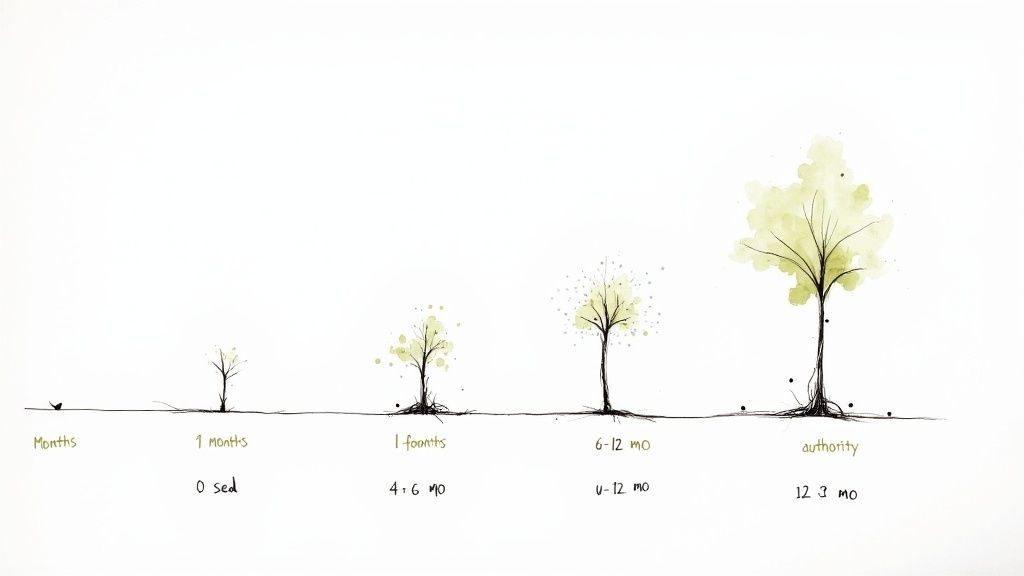
I always tell my clients to think of search engine optimization like planting a tree. You wouldn't plant a seed and expect a towering oak the next morning. It takes consistent watering, sunlight, and patience. Over time, that small sprout grows into something strong and lasting.
That's SEO in a nutshell. It's the complete opposite of paid ads, which turn on traffic instantly but vanish the moment you stop paying. SEO is about building a permanent digital asset. Every optimized page, every backlink you earn, works for you around the clock, compounding in value over time. This is why patience isn't just a virtue in organic search—it's a core part of the strategy.
Your Starting Point Matters
On average, a solid SEO campaign starts showing noticeable gains in organic traffic around that 4 to 6-month mark. But that's just an average; your specific situation could speed things up or slow them down. A huge factor is your website's history. If you're working with an established site that already has some content and authority, you'll likely see results faster.
A brand-new website, on the other hand, is starting from scratch. The initial months are all about laying the groundwork—fixing technical issues, building out a content base, and just getting on Google's radar. You can discover more insights about campaign timelines to get a better sense of where you might fall.
This early phase is crucial for building trust with search engines. Before Google sends its users your way, it needs to see that your site is:
Technically Sound: Can its crawlers easily navigate and understand your site without hitting roadblocks?
Authoritative: Are other respected websites linking to you, vouching for your credibility?
Relevant: Does your content actually solve problems and answer the questions people are searching for?
SEO is a marathon, not a sprint. Those first few months are for pouring the foundation. The later months are when you start building the skyscraper on top of it. Rushing the process just leads to a shaky structure and wasted resources.
To help you map out what to expect, the table below gives a quick snapshot of typical timelines based on your website's starting point.
Quick SEO Timeline Estimates
This table provides a general overview of what you can expect based on your site's current status and the competitiveness of your industry.
Website Status | Initial Results Timeline | Significant Impact Timeline |
|---|---|---|
Brand New Website | 6–9 Months | 12+ Months |
Existing Site (Low Competition) | 3–6 Months | 6–12 Months |
Existing Site (High Competition) | 6–12 Months | 12–18+ Months |
Remember, these are just estimates. A well-executed strategy can often accelerate these timelines, while a poorly planned one can stretch them out indefinitely.
The 6 Key Factors That Control Your SEO Timeline
So, how long does SEO really take? If you've asked this question, you've probably received a frustratingly vague answer: "It depends." And while that's true, it's not very helpful. The reality is that every website's starting line is different.
Think of it like training for a marathon. A seasoned runner will get race-ready much faster than someone who's never run a mile. Several key factors determine your pace, and understanding them helps you set realistic expectations for when you'll cross the finish line.
Let's break down what's really driving your results.
Your Website Authority and History
Your website's history and authority are like its credit score with Google. An older site with a solid track record and a bunch of high-quality backlinks is already seen as trustworthy. When it publishes something new, Google tends to pay attention and rank it faster.
A brand-new domain, however, is a total unknown. It has no history, no trust, and no established reputation. It has to earn that credibility from scratch, which takes time. This is often measured with metrics like Domain Authority (DA). If you're starting from zero, a great first step is learning how to find domain authority and building it up.
Content Quality and Strategy
Let's be blunt: if your content is bad, your SEO will go nowhere. Time won't fix it. Google’s entire job is to give people the best possible answer to their query. If your articles are thin, poorly written, or miss the point of what someone is searching for, they'll never see the light of day on page one.
A winning content strategy always prioritizes:
Relevance: Is your content a direct and helpful answer to the searcher's problem?
Depth: Does it cover the topic so well that the reader doesn't need to go anywhere else?
Freshness: Are you consistently publishing new content and keeping your existing articles up-to-date? This shows Google your site is alive and well.
Think of your content as the fuel for your SEO engine. You can have a Ferrari, but if you fill it with cheap, watered-down gas, you're not going to win any races. High-quality content is the premium fuel that drives real performance.
Competition and Industry
The industry you're in plays a massive role in your timeline. Trying to rank for a term like "best credit cards" is like trying to open a new burger joint next to a McDonald's—you're up against titans with unlimited budgets and decades of brand recognition. Breaking through will take a long, long time.
On the other hand, if you're targeting a less crowded niche, like "hand-crafted dog leashes in Austin," you have a much better shot at ranking quickly. It’s like being the only coffee shop in a small town. You can become the go-to source and see results much faster. A clear-eyed look at your competition is crucial for setting goals you can actually hit.
Your Month-by-Month SEO Results Roadmap
So, what does the journey actually look like? To make the answer to "how long does SEO take?" more concrete, let's walk through a typical campaign, phase by phase. This roadmap helps you see what's happening behind the scenes, even when the big traffic numbers haven't shown up yet. While every campaign is unique, the progression usually follows a familiar path.
This infographic does a great job of breaking down the core elements—like competition, content, and links—that shape your specific timeline.
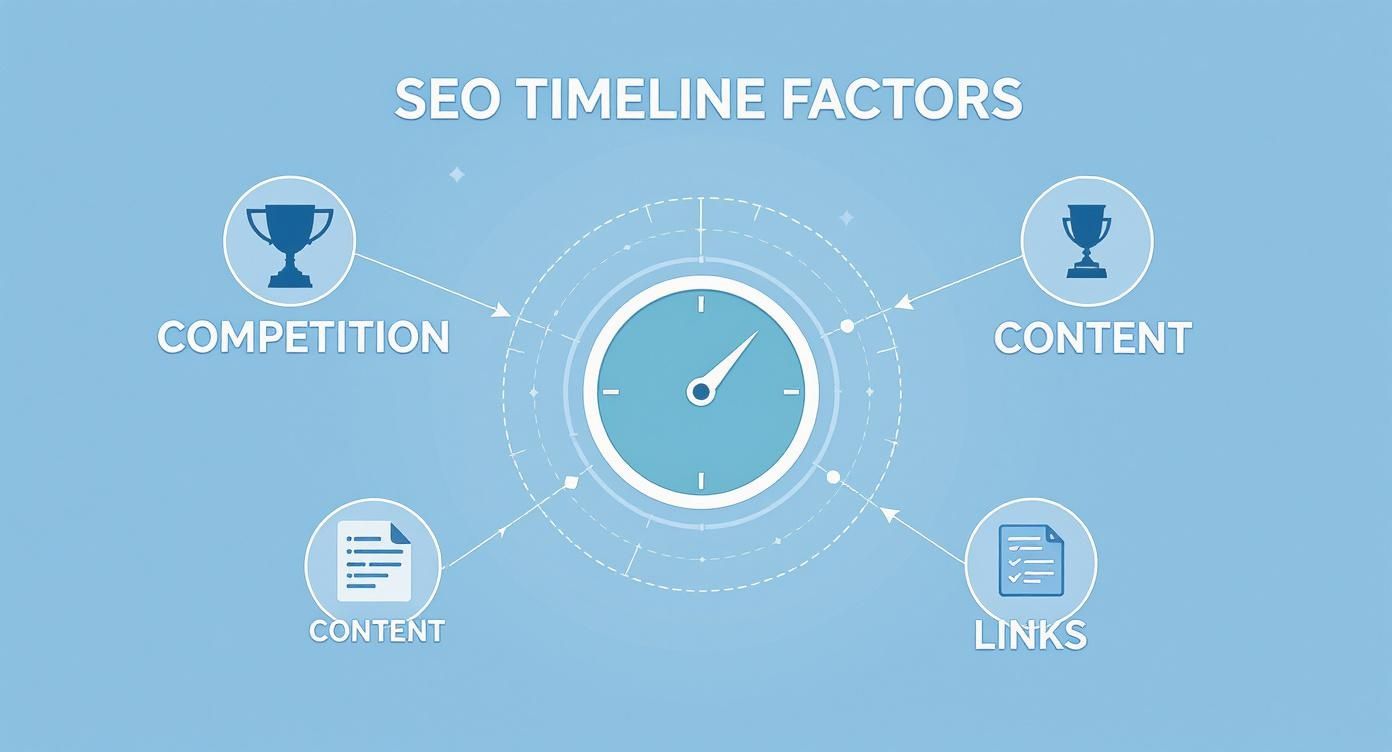
As you can tell, these factors all feed into one another. A solid content plan, for instance, is what helps you earn those valuable links and pull ahead of the competition.
Months 1-3: The Foundation Phase
The first three months are all about laying the groundwork. This is where the most critical, yet often invisible, work gets done. Your SEO team will be buried in analysis—running technical audits to clean up site errors, conducting deep keyword research, and figuring out what your competitors are up to.
Don't expect a huge jump in traffic here. That's perfectly normal. The real goal is to build a rock-solid foundation so that everything you do later on has maximum impact. For local businesses, this is also the ideal time to button up your online presence using a detailed local SEO checklist.
Months 4-6: Gaining Traction
Around the four-month mark, the first real signs of life should start to appear. We call this the "gaining traction" phase. You’ll likely see your site start to pop up in search results for less competitive, long-tail keywords—those longer, more specific phrases people type in.
This is a really exciting stage because it’s the first concrete proof that the strategy is clicking. You'll notice a small but measurable uptick in organic traffic as Google starts to see your site as a credible source.
Think of this period as the moment your SEO efforts start to bubble to the surface. The initial investment of time and resources begins to pay off with measurable ranking improvements and the first wave of new organic visitors.
It's also worth remembering that a site's starting point matters immensely. For brand-new websites in competitive industries, it can take 12 to 18 months to see substantial results. On the other hand, an established site with some existing authority might get there in 9 to 12 months.
Months 7-12: Building Momentum
Once you hit the second half of the year, your campaign should be building some serious momentum. Traffic increases will become more significant, and you'll start going head-to-head with competitors for more valuable, higher-volume keywords. By the one-year mark, you’re no longer just building a foundation—you’re starting to establish real authority in your space.
To give you a clearer picture, here’s a table outlining what to expect at each stage.
SEO Campaign Phases and Expected Outcomes
Timeframe | Key Activities | Expected Results |
|---|---|---|
Months 1–3 | Technical audit, keyword research, on-page optimization, content planning, competitor analysis. | Minimal traffic changes. Improved site health and crawlability. |
Months 4–6 | Content creation, initial link building, local SEO optimization. | Rankings for long-tail keywords appear. A slight increase in organic traffic. |
Months 7–12 | Consistent content production, strategic link acquisition, performance analysis. | Significant traffic growth. Rankings for higher-competition keywords improve. |
Year 2+ | Advanced content strategies, authority building, conversion rate optimization (CRO). | Established authority. High rankings for core keywords. Consistent lead/revenue growth. |
This table serves as a general guide. Consistent, high-quality work in the early months is what sets the stage for the significant gains you see later on.
Why SEO Is a Long-Term Game Worth Playing
I get it—patience is tough, especially when you want results now. But in SEO, patience isn't just about waiting around; it's a core part of the strategy that builds real, lasting value. Think about it this way: with paid ads, your visibility vanishes the second you turn off the budget. SEO is the complete opposite.
Every single piece of content you optimize and every quality backlink you earn becomes a permanent asset for your business. It's like planting a tree. It takes time to grow, but eventually, it provides shade and fruit for years to come. This is the magic of compounding returns—an article you publish today can keep bringing in traffic and leads 24/7, long after you've hit "publish."
The Financial Payoff of Patience
While the first few months of an SEO campaign can feel like a slow burn, the financial payoff down the road often blows short-term tactics out of the water. The real, tangible returns usually start kicking in between 6 and 12 months.
Research shows that while it might take a full year just to break even, the peak financial impact often doesn't hit until the second or even third year. For some industries, the results are staggering. The real estate sector, for example, has seen an average ROI of 1,389% once the initial investment period is over. You can dig into more stats on SEO's financial impact across different industries to see what's possible.
The true value of SEO isn't just in the traffic it generates this month, but in the sustainable, predictable growth engine it builds for the future. It’s a shift from renting attention to owning your audience.
Building Lasting Digital Equity
Ultimately, the answer to "how long does SEO take?" comes down to the kind of value you're trying to create. Sure, you can find quick fixes that might give you a temporary boost, but they won't last. Committing to a long-term strategy builds something far more powerful: digital equity.
This is the trust and authority your brand earns in the eyes of Google and your audience. Over time, that equity creates a competitive moat. The stronger your rankings become, the harder it is for a newcomer to knock you off your spot. Your consistent presence builds brand recognition and credibility, turning SEO into a self-sustaining marketing channel that pays you back long after the initial work is done.
How to Speed Up Your SEO Results
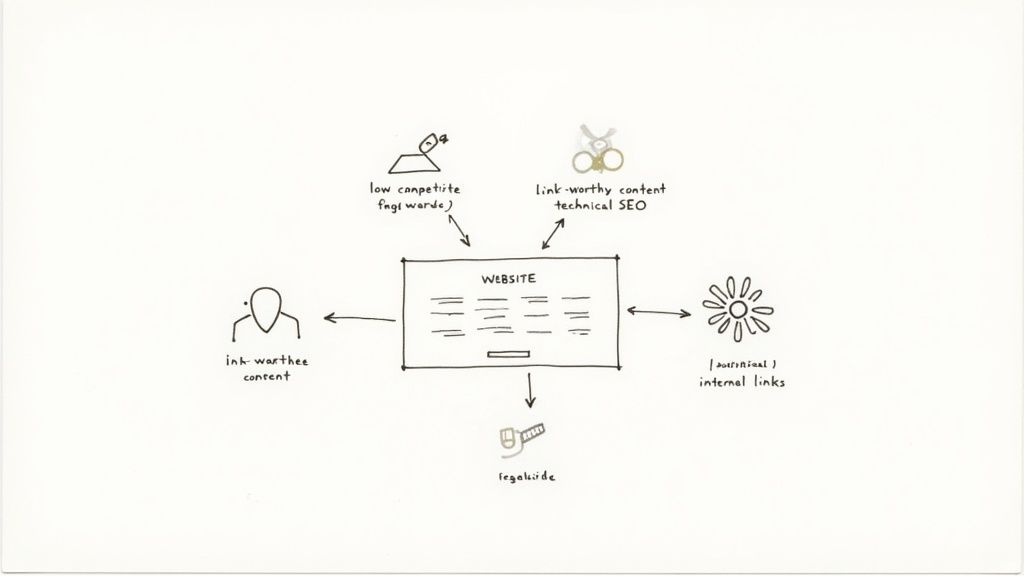
While you can't snap your fingers and appear on page one, you can definitely take steps to shorten the timeline. SEO isn't just a waiting game; it's about making smart, strategic moves that build momentum faster than your competition.
Think of it like finding the express lane on a packed highway. With the right approach, you can bypass the usual traffic jams and get to your destination sooner. Here are a few proven ways to do just that.
Go After Low-Competition Keywords First
A classic rookie mistake is aiming for the most competitive, high-volume keywords right away. A much faster way to get traffic is by targeting low-competition, long-tail keywords instead. These are longer, more specific search queries that are easier to rank for and often have much higher conversion intent.
For example, a new company has almost no chance of ranking for "CRM software." But they have a real shot at "CRM software for small real estate teams." This strategy banks quick wins, builds your site's authority on a topic, and starts pulling in the right kind of traffic almost immediately. Your first step should always be solid long-tail keyword research.
Create Content That Earns Links Naturally
Everyone knows backlinks are a huge ranking factor, but actively begging for them is a slow, painful process. The secret is to create content so genuinely useful that other websites want to link to it. This shifts your role from a link-chaser to a link-magnet.
Here are a few types of content that attract links on their own:
Original Research: Be the source of new data by publishing unique surveys, industry studies, or in-depth case studies.
Ultimate Guides: Create the single best, most thorough resource available on a subject.
Free Tools: Build a simple calculator, a downloadable template, or a helpful checklist that solves a real problem for your audience.
Your goal should be to create a resource so good it becomes the definitive reference for a topic. When you're the source of truth, the backlinks will follow.
Nail Your Technical SEO and Core Web Vitals
You could write the most amazing article in the world, but if your site is slow, buggy, or confusing for Google to crawl, it won’t matter. Fixing your technical SEO is like tuning up an engine before a race—it ensures all that power actually gets to the wheels.
A great place to start is with your Core Web Vitals, Google’s metrics for measuring user experience things like load speed and interactivity. A fast, mobile-friendly website gets a leg up in the rankings and gives visitors a better experience, sending all the right signals to search engines. For a closer look at what it takes, this guide on how to improve SEO for higher rankings is a fantastic resource. A clean technical foundation makes every other SEO effort more effective, and faster.
Common Questions About SEO Timelines
Even with a good grasp of the basics, some specific questions always come up about how long SEO really takes. Let's dig into a few of the most common ones I hear from clients.
Why Does SEO Take So Much Longer Than PPC Ads?
This is a great question, and the answer comes down to one core idea: ownership vs. renting.
Think of SEO as buying and building your own house. Every piece of content you create, every quality backlink you earn—it’s like adding a new room or upgrading the foundation. It takes time and effort, but you're building a valuable, long-term asset that will pay dividends for years to come. You're earning trust with search engines, brick by brick.
PPC ads, on the other hand, are like renting an apartment. You get instant visibility and a place to live for the night, which is great for short-term needs. But the second you stop paying rent, you're out. The benefits vanish. SEO takes longer because you’re building lasting equity, not just paying for a temporary billboard.
PPC buys you traffic. SEO earns you traffic. The time you invest in earning it creates a far more durable and valuable asset than a channel that disappears the moment you turn off your credit card.
How Can I See Progress Before the Traffic Numbers Go Up?
It's easy to get impatient when you don't see a huge spike in website visitors right away. But a big traffic jump is a lagging indicator—it’s one of the last things to happen. To really see if your strategy is on the right track early on, you need to watch the leading indicators.
These are the behind-the-scenes metrics that show your efforts are working. Look for:
Keyword Ranking Improvements: Don't just fixate on hitting page one. Moving a keyword from page ten to page three is a huge win! It’s a clear signal that Google is starting to see your content as more relevant.
Backlink Profile Growth: Are more quality websites linking back to you? That's a direct sign that your site's authority is growing in your niche.
Increase in Indexed Pages: When you see Google recognizing and adding more of your pages to its index, it means your overall site health and crawlability are improving.
Can Hiring an SEO Agency Guarantee Faster Results?
A good, experienced SEO agency can absolutely speed things up. They bring expertise, proven systems, and professional tools to the table, helping you hit the ground running and sidestep the common pitfalls that slow most people down.
But—and this is a big but—be very cautious of any agency that "guarantees" a #1 ranking or a specific timeline. That's a major red flag. Nobody can control Google's algorithms. The real value of a great agency isn't in making impossible promises; it's in giving you a much faster and more reliable path to success than you could probably manage on your own.
Ready to stop guessing and start building a predictable content strategy? Viral SEO gives you the tools to uncover what your competitors are ranking for and organize your content plan for maximum impact. Start your free plan and see the difference.
Blogs
More Blogs
From keyword goldmines to AI-driven content hacks—expert insights to help your blog posts dominate the first page.