TL;DR
Marketing success comes from setting clear, measurable goals that directly support business growth—not chasing vanity metrics.
Key takeaway: A marketing goal is the outcome you want, a metric is any data point, and a KPI is the specific metric that measures progress toward your goal. Focus on 3–5 KPIs per goal instead of tracking everything.
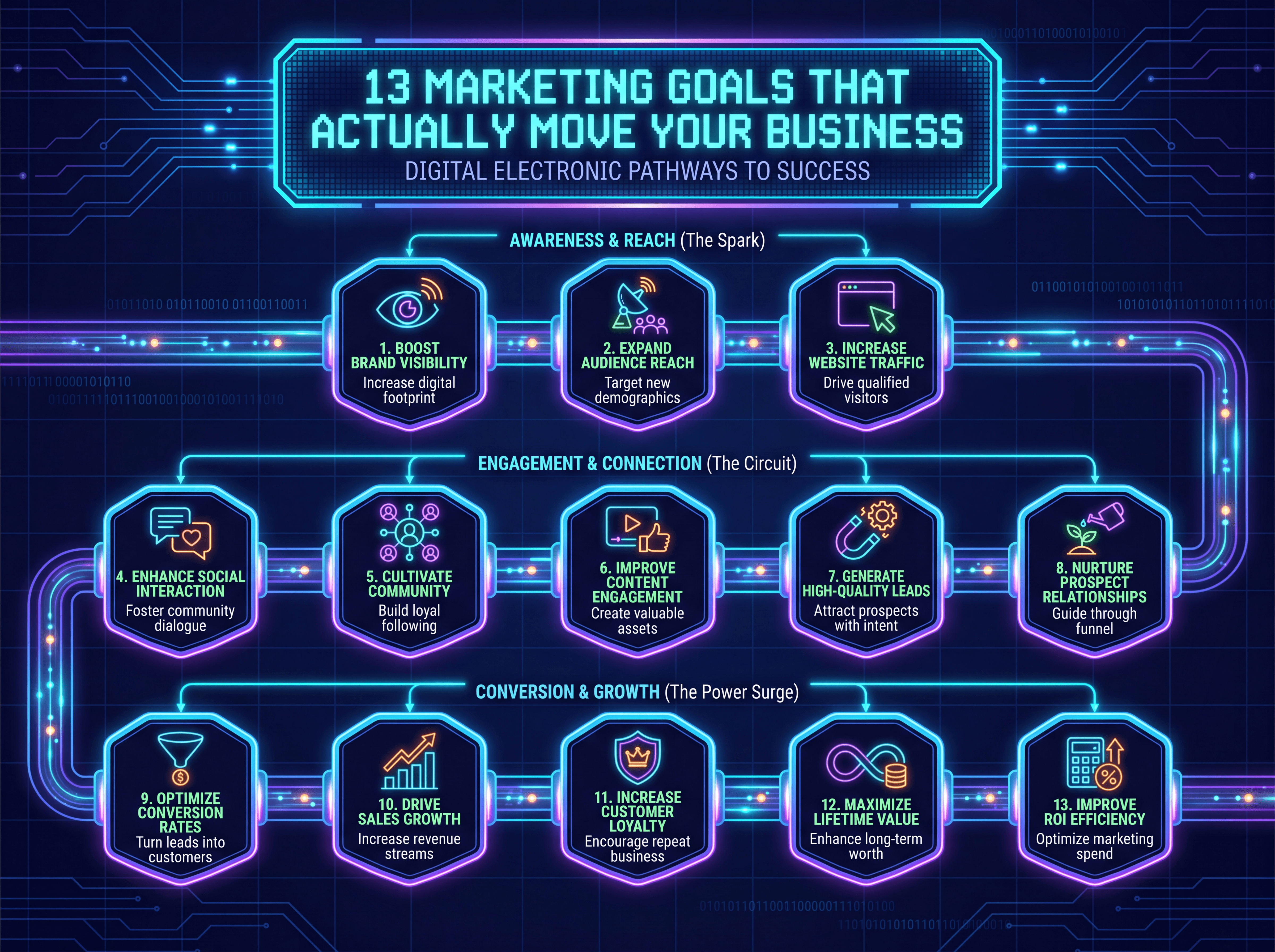
The 13 Marketing Goals That Matter
Increase brand awareness
Generate qualified leads
Grow marketing-attributed revenue
Improve conversion rates
Increase organic search traffic
Grow your email list
Increase customer retention
Improve customer lifetime value (CLV)
Build thought leadership and authority
Lower customer acquisition costs (CAC)
Increase meaningful social media engagement
Launch and validate new products or markets
Increase customer advocacy and referrals
How to Set Effective Goals
Start with a business objective (revenue, growth, retention, etc.).
Choose the right marketing goal.
Establish a baseline.
Create a SMART target (Specific, Measurable, Achievable, Relevant, Time-bound).
Define your KPIs before launching campaigns.
Set ambitious but realistic targets and review progress regularly.
Match KPIs to the Customer Journey
Awareness: Reach, impressions, branded search.
Consideration: Website traffic, engagement, email signups.
Conversion: Conversion rate, CPA, ROAS, sales.
Retention: Churn, repeat purchases, CLV, NPS.
Common Mistakes to Avoid
Tracking too many KPIs.
Focusing on vanity metrics (likes, followers, pageviews).
Ignoring negative signals like rising CAC or churn.
Setting goals that don't influence day-to-day decisions.
Never revisiting goals as the market changes.
Making reporting so complicated that no one reviews it.
———————————————————————————————-
13 Marketing Goals That Actually Move Your Business (And How to Measure Each One)
Most marketing teams are busy. Very few can prove they are effective.
The difference almost always comes down to goals. Not vague hopes like "grow our brand" or "get more engagement." Real goals: specific, measurable outcomes that connect marketing activity to business results.
Here is the core distinction this whole article rests on: marketing objectives translate broad ambitions, such as "grow the business," into concrete targets like "increase qualified leads by 30% in two quarters" that teams can plan, budget, and measure against. The first sounds nice in a meeting. The second changes what your team does on Monday morning.
This guide covers the 13 marketing goals that matter most, the exact KPIs to measure each one, how to set targets the right way, and the mistakes that quietly sink most marketing plans
First: Goals, KPIs, and Metrics Are Not the Same Thing
Before the list, three definitions that prevent most confusion.
A goal is the outcome you want: "Increase qualified leads by 30% by Q3."
A metric is any measurable data point: pageviews, bounce rates, email sends, social likes. Metrics show what is happening.
A KPI (Key Performance Indicator) is a metric you have specifically chosen because it tracks progress toward a critical goal. All KPIs are metrics, but not all metrics are KPIs. A social media like is a metric. The conversion rate of social visitors into email subscribers is a KPI.
Why this matters: teams that track everything act on nothing. The businesses that improve fastest choose a small set of KPIs per goal and stay loyal to them. The rule of thumb from the data: limit your focus to three to five primary KPIs per campaign.
Now, the 13 goals.
Goal 1: Increase Brand Awareness
What it means: Getting more of your target market to know you exist and remember you when the need arises.
Why it matters: Nobody buys from a business they have never heard of. Awareness is the top of every funnel, and for new businesses or new markets, it comes before everything else.
KPIs to track: Reach, impressions, video views, and the most underrated one: branded search volume. When more people type your business name into Google month over month, awareness is genuinely growing. Track it free in Google Search Console.
A real target looks like: "Increase branded search volume by 25% over the next two quarters" or "Grow monthly reach across social channels from 40,000 to 75,000 by December."
The trap to avoid: Impressions without recall. A million impressions that nobody remembers are worth less than 10,000 views of content people actually engage with. Pair reach numbers with engagement signals to keep yourself honest.
Goal 2: Generate More Qualified Leads
What it means: Increasing the number of people who raise their hand and show genuine interest: filling out forms, requesting demos, downloading resources.
Why it matters: Leads are the bridge between marketing and revenue. For most B2B and service businesses, this is the single most important marketing goal.
KPIs to track: Total leads, cost per lead (CPL), lead-to-MQL rate, and conversion rate from visitor to lead. The word "qualified" is doing heavy lifting here: 1,000 leads that never buy are worth less than 100 that convert at 20%.
A real target looks like: "Generate 80 marketing-qualified leads per month at a maximum cost per lead of $45 by the end of Q3."
The trap to avoid: Optimizing for lead volume instead of lead quality. The fix used by high-performing teams: aim toward a zero-waste approach where the lead-to-MQL rate climbs toward 100% by targeting audiences that mirror your qualification criteria from the start.
Goal 3: Grow Revenue From Marketing
What it means: Directly increasing the sales that marketing activities produce and can prove they produced.
Why it matters: This is the goal leadership actually cares about. Marketing teams that can show revenue contribution get budgets approved. Teams that show only activity get budgets cut.
KPIs to track: Marketing-attributed revenue, return on ad spend (ROAS), cost per acquisition (CPA), and pipeline value for B2B. Track both micro-conversions (downloads, pricing page visits, email clicks) and macro-conversions (demos, quote requests, purchases), because tracking only the final sale overvalues channels that drive volume without moving anyone closer to revenue.
A real target looks like: "Increase marketing-attributed revenue from $120,000 to $180,000 per quarter by Q4" or "Achieve a blended ROAS of 4:1 across paid channels."
The trap to avoid: Claiming credit for revenue that would have happened anyway. Use consistent attribution rules and be honest about marketing's role versus sales, referrals, and repeat purchases.
Goal 4: Improve Conversion Rates
What it means: Getting a higher percentage of your existing traffic to take the action you want, without spending more to get traffic.
Why it matters: This is the highest-leverage goal on the list. Doubling your conversion rate doubles your results at zero additional traffic cost. Every other goal gets cheaper when this one improves.
KPIs to track: Conversion rate by page and by channel, form completion rate, and cart abandonment rate for e-commerce.
A real target looks like the textbook SMART example: "Raise conversion rate from 2.1% to 3.5% by Q3 2026." Notice the structure: current baseline, specific target, deadline. Pull your real current number first so the target is grounded, not guessed.
The trap to avoid: Testing random changes. Conversion improvement comes from identifying specific friction (confusing copy, too many form fields, surprise costs, slow pages) and removing it, then measuring the result.
Goal 5: Grow Organic Search Traffic
What it means: Increasing the visitors who find you through unpaid Google results.
Why it matters: Organic search is the largest traffic source for most websites and the one that compounds: content that ranks keeps delivering visitors for years at no per-click cost.
KPIs to track: Organic sessions (Google Search Console), keyword rankings for your priority terms, and, critically, conversions from organic traffic, not just visits.
A real target looks like: "Increase monthly organic sessions from 6,000 to 9,000 by June 30 by publishing three keyword-targeted posts per month and fixing technical issues by February 15."
The trap to avoid: Celebrating traffic that does not convert. A post ranking for an irrelevant keyword can flood your analytics with useless visits. Tie organic traffic goals to the conversion behavior of that traffic.
Goal 6: Build Your Email List
What it means: Growing the number of people who have given you permission to contact them directly.
Why it matters: Email returns $36 to $42 for every $1 spent, the highest ROI in marketing, and your list is the one audience no algorithm can take away from you. Every other channel rents attention. Email owns it.
KPIs to track: New subscribers per month, list growth rate, signup conversion rate on key pages, and unsubscribe rate (a quality check on how you got those subscribers).
A real target looks like: "Grow the email list from 3,400 to 5,000 subscribers by September 30 by adding a lead magnet to the homepage and running one signup campaign per month."
The trap to avoid: Buying lists or using deceptive signups. A list of 2,000 people who want your emails outperforms 20,000 who do not, and purchased lists destroy deliverability.
Goal 7: Increase Customer Retention
What it means: Keeping the customers you already have buying longer and more often.
Why it matters: The economics are overwhelming. Acquiring a new customer can cost five times more than retaining an existing one, and a 5% increase in retention can lead to 25% to 95% higher profits. Retention is the most profitable goal most marketing teams ignore.
KPIs to track: Repeat purchase rate, churn rate, customer lifetime value (CLV), and retention cohorts at 7, 30, and 90 days depending on your business model.
A real target looks like: "Reduce monthly customer churn from 4.5% to 3% by year end through a new onboarding email sequence and a quarterly win-back campaign."
The trap to avoid: Treating retention as customer service's problem. Onboarding content, education emails, loyalty programs, and community are all marketing work, and they usually cost less per dollar of revenue than any acquisition channel.
Goal 8: Improve Customer Lifetime Value
What it means: Increasing the total revenue an average customer generates over their entire relationship with you.
Why it matters: CLV determines what you can afford to spend acquiring customers. A business that raises CLV can outbid every competitor for attention while staying profitable.
KPIs to track: Average order value (AOV), purchase frequency, CLV itself, and the CLV-to-CAC ratio (lifetime value divided by acquisition cost; healthy businesses typically target 3:1 or better).
A real target looks like: "Increase average order value from $54 to $65 by Q4 through product bundling and post-purchase cross-sell emails."
The trap to avoid: Squeezing customers with aggressive upsells that raise short-term AOV but increase churn. CLV is a long-game metric. Optimize the relationship, not the transaction.
Goal 9: Establish Thought Leadership and Authority
What it means: Becoming the brand people in your industry trust, cite, and turn to for answers.
Why it matters: Authority lowers the cost of everything else. Trusted brands convert better, earn media coverage, attract talent, and increasingly get cited by AI systems when people ask for recommendations.
KPIs to track: Backlinks and referring domains, media mentions, podcast and speaking invitations, branded search growth, and a new one for 2026: AI visibility, meaning whether your brand appears when people ask ChatGPT, Perplexity, or Google's AI Overviews questions in your category. AI search KPIs now belong in the standard tracking stack.
A real target looks like: "Earn 15 new referring domains per quarter through original research and guest contributions" or "Appear in AI-generated answers for 5 of our 10 priority category questions by year end."
The trap to avoid: Producing generic content and calling it thought leadership. Authority comes from original data, genuine experience, and positions that competitors cannot copy-paste.
Goal 10: Improve Marketing Efficiency (Lower Acquisition Costs)
What it means: Getting the same or better results while spending less per customer acquired.
Why it matters: Budgets are under pressure everywhere, and efficiency goals turn marketing from a cost center into a competitive weapon. When your CAC is half your competitor's, you can outspend them profitably in every auction.
KPIs to track: Customer acquisition cost (CAC) overall and by channel, cost per lead by channel, and ROMI (return on marketing investment), which links total marketing spend to financial outcomes.
A real target looks like: "Reduce blended CAC from $110 to $85 by Q4 by shifting 20% of paid budget into the organic channels with proven lower cost per lead."
The trap to avoid: Cutting your way to efficiency. Slashing spend usually lowers volume, not cost per result. Real efficiency comes from reallocating toward what works and fixing conversion leaks.
Goal 11: Grow Social Media Engagement (The Right Way)
What it means: Building an active, responsive audience on the platforms where your customers spend time.
Why it matters: Done correctly, social builds the awareness, trust, and community that make every other channel cheaper. Done as a vanity project, it produces impressive charts and zero revenue.
KPIs to track: Engagement rate (not follower count), website clicks from social, conversions from social traffic, and share of voice versus competitors. Follower counts are the textbook example of a vanity metric: avoid making them your headline KPI.
A real target looks like: "Increase Instagram engagement rate from 1.8% to 3.5% in 90 days and grow monthly website sessions from social from 800 to 1,500."
The trap to avoid: Measuring likes when the goal is business. Always pair engagement KPIs with a downstream number (clicks, leads, or sales from social) so the effort stays connected to outcomes.
Goal 12: Launch and Validate New Products or Markets
What it means: Using marketing to introduce something new and prove (or disprove) demand quickly.
Why it matters: Launches concentrate risk. A structured launch goal with clear validation criteria saves months of wasted investment on offers the market does not want.
KPIs to track: Pre-launch signups or waitlist size, launch-period sales versus target, cost per acquisition during launch, and early retention or refund rates (the honesty check on whether the product delivers).
A real target looks like: "Generate 500 waitlist signups pre-launch and 150 sales in the first 30 days at a CPA under $60; if CPA exceeds $100, pause and reassess positioning."
The trap to avoid: Launching without a kill criterion. Decide in advance what numbers mean "double down," "adjust," and "stop." Emotional attachment makes those calls impossible after the fact.
Goal 13: Increase Customer Advocacy and Referrals
What it means: Turning happy customers into an active acquisition channel through reviews, referrals, and word of mouth.
Why it matters: Referred customers cost almost nothing to acquire, convert at higher rates, and stay longer. Advocacy is the compounding endgame of every other goal done well.
KPIs to track: Net Promoter Score (NPS), review volume and average rating, referral-attributed customers, and user-generated content volume. Go beyond the NPS number itself: analyze the comments and segment by persona to pinpoint exactly where friction lives.
A real target looks like: "Increase Google reviews from 45 to 120 by year end through an automated post-purchase review request, and launch a referral program generating 20 new customers per quarter."
The trap to avoid: Asking for advocacy you have not earned. Review requests and referral programs amplify the existing experience. If the experience is mediocre, they amplify that too.
How to Set These Goals the Right Way: The 6-Step Process
Knowing the 13 goals is half the job. Setting them correctly is the other half. Here is the process the best teams follow.
Step 1: Start from a business goal. Every marketing objective must trace back to something leadership cares about: revenue, market share, retention, or profitability. If you cannot draw that line, the goal is decoration.
Step 2: Choose the objective type. Decide whether your real gap is awareness, leads, revenue, retention, or advocacy. Most businesses need two or three of the thirteen goals above at any given time, not all of them.
Step 3: Set a measurable baseline. Pull your current number, whether that is a 2.1% conversion rate or 3,400 subscribers, so the target is grounded, not guessed. Goals without baselines are wishes with deadlines.
Step 4: Define the SMART target. Add the specific metric, the change, and the deadline: "raise conversion rate from 2.1% to 3.5% by Q3 2026." Specific, Measurable, Achievable, Relevant, Time-bound. Every word earns its place.
Step 5: Pick the KPIs and tracking before you start. Decide exactly how you will measure and in which tool before the campaign launches, not after. Retroactive measurement is guesswork wearing a spreadsheet.
Step 6: Stress-test for achievability. Compare the target against your historical performance and your resources. Ambitious is good. Impossible is demoralizing and produces bad behavior (inflated numbers, vanity reporting, quiet abandonment).
Match Your KPIs to the Funnel Stage
One more framework that keeps goal-setting honest: different KPIs matter at different stages of the customer journey, and measuring the full journey beats measuring random interactions.
Awareness (top of funnel): reach, impressions, video views, brand search volume.
Consideration (middle): website traffic, engagement rates, email signups, content downloads.
Conversion (bottom): conversion rate, cost per acquisition, ROAS, sales.
Retention (after purchase): churn rate, repeat purchase rate, NPS, customer satisfaction.
And adapt to your business model: a SaaS company tracks monthly recurring revenue and churn, an e-commerce business focuses on average order value and cart abandonment, and B2B service firms prioritize pipeline value and lead-to-close velocity. The same goal wears different numbers in different industries.
The Mistakes That Quietly Sink Marketing Goals

Tracking too many KPIs. Teams often fail by tracking too many numbers and losing focus. When you measure everything, you act on nothing. Three to five KPIs per goal, maximum.
Choosing vanity metrics. Follower counts and raw pageviews feel good and prove nothing. Every KPI should answer "so what?" with a business outcome.
Ignoring the warning signs. Focusing only on positive metrics while ignoring churn, rising CAC, or falling engagement means problems compound in the dark. Track the uncomfortable numbers too.
Setting goals that never shape weekly behavior. Goals only matter when they influence what you do. If your KPIs never change a weekly decision, they are ideas, not strategy. After setting goals, outline the specific actions that support each one.
Treating goals as fixed contracts. Marketing changes fast: platforms update, customer expectations shift, new tools arrive monthly. A goal set in January may not make sense by June. Treat goals as a living framework: refine them when new insights emerge, recalibrate when you discover a better channel. Goals are supposed to give you clarity, not trap you.
Making measurement a hassle. The biggest reason businesses ignore their KPIs is that checking them is annoying. Build one simple dashboard, review it on a fixed weekly schedule, and the goals stay alive.
The Bottom Line
Marketing goals are the difference between busy and effective.
The 13 that matter: awareness, qualified leads, revenue, conversion rate, organic traffic, email list growth, retention, lifetime value, authority, efficiency, social engagement, launches, and advocacy. Most businesses need two or three at a time, chosen by where their real gap is.
Set them right: start from a business goal, pull your baseline, write the SMART target with a metric and deadline, pick three to five KPIs before launching, and stress-test for achievability.
Then do the part most teams skip: check the numbers weekly, let them shape your actual behavior, and refine the goals as reality teaches you what works.
Vague goals produce vague results. Specific goals, measured honestly and reviewed consistently, produce the compounding improvements that make marketing a growth engine instead of an expense line.
Pick your two or three. Write the baselines and targets today.
Blogs
More Blogs
From keyword goldmines to AI-driven content hacks—expert insights to help your blog posts dominate the first page.