Let’s break it down. SEO copywriting is the skill of writing incredible content that people actually want to read, while also making sure search engines like Google can find it and understand what it’s about.
It’s about striking that perfect balance. You’re writing to solve a person's problem, but you’re also using the right signals so that search engines will show your content to that person in the first place.
The Dual Purpose of SEO Copywriting
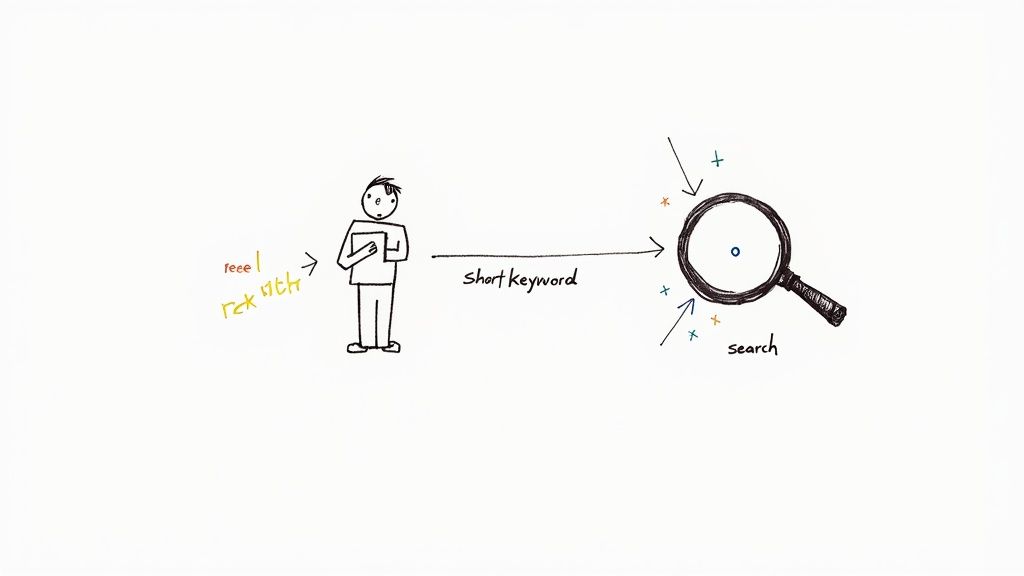
Think of an SEO copywriter as a bridge-builder. On one side, you have a real person with a question or a need. On the other, you have a search engine trying to find the best answer for them. Your job is to build a bridge of high-quality content that connects the two.
This skill is becoming more valuable every single day. The global copywriting market is expected to balloon from USD 27.96 billion in 2025 to USD 42.83 billion by 2030. A huge driver of this growth is the relentless need for content that doesn't just attract eyeballs from search results but actually turns those visitors into customers.
Serving Two Masters: Human Readers and Search Engines
Ultimately, SEO copywriting comes down to serving two very different, but equally important, audiences. You have to craft content that speaks to both people and algorithms.
For your human readers, the content needs to be genuinely helpful. It should be clear, engaging, and provide the answers they're looking for, building trust along the way.
For search engines, the content must be structured in a way that’s easy for them to crawl and index. This means including relevant keywords, using logical headings, and following technical best practices.
The secret is that these two goals are more aligned than you might think. When you focus on creating the absolute best, most comprehensive resource for a person, you're usually checking all the boxes that Google wants to see, too.
To really nail this, you need a solid grasp of what content optimization involves. It's the process of refining your content so it has the best possible chance of reaching the people who need it most.
The Dual Focus of SEO Copywriting
The table below breaks down how each element of SEO copywriting is tailored to satisfy both search engines and your audience.
Component | Focus for Search Engines | Focus for Human Readers |
|---|---|---|
Keywords | Signals topic relevance and helps algorithms categorize the content. | Reflects the exact language and search terms the reader is using. |
Headings & Structure | Provides a clear content hierarchy for crawlers to understand. | Creates scannable, easy-to-read content that's simple to navigate. |
Content Quality | Assesses factors like depth, originality, and authority (E-E-A-T). | Delivers real value, answers questions, and builds trust with the reader. |
Internal Links | Helps search bots discover other relevant pages on your site. | Guides the reader to more helpful resources and keeps them engaged. |
As you can see, great SEO copywriting isn’t about choosing one over the other; it’s about creating a unified experience where what's good for the user is also good for Google.
Why SEO Copywriting Is Your Strongest Growth Lever
Putting real effort into SEO copywriting isn't just about tweaking a few words on your website. It's a fundamental shift in how your business finds and connects with new customers.
Think of it like this: without SEO, your business is like a fantastic little shop hidden away on a quiet side street. People might stumble upon it, but most potential customers will walk right past on the main road, completely unaware you exist.
SEO copywriting is the giant, flashing neon sign you hang above your door on that busy main street. It’s the tool that grabs the attention of the exact people who are already looking for what you sell. When you get it right, your website stops being a static online brochure and becomes a 24/7 lead-generating powerhouse.
Tapping Into Massive Search Demand
The sheer scale of this opportunity is hard to wrap your head around. People are searching for answers more than ever. By 2025, it's estimated that Google will process a staggering 16.4 billion searches every single day. That’s more than double the 7 billion daily searches from back in 2020.
This isn't just noise; it's a tidal wave of customer intent. You can either ride that wave or get left behind.
Each one of those billions of searches is a real person asking a question or looking for a solution. SEO copywriting is your bridge to them, positioning your brand as the go-to expert at the very moment they need you most.
SEO copywriting is the art of showing up. It ensures that when someone raises their hand with a problem, your content is the first and best answer they find. This builds trust long before they ever consider a purchase.
This consistent visibility creates a powerful, self-sustaining growth engine. More targeted traffic brings in more qualified leads and sales, which in turn boosts your website's authority in the eyes of search engines.
A stronger site authority makes it easier to rank for even more valuable keywords, fueling a predictable and sustainable growth cycle. You can learn more about how to check your website's domain authority to see how you're tracking.
This isn't just a hypothetical idea. Businesses that nail their SEO copywriting consistently leave their competitors in the dust. They build a reliable stream of organic traffic that doesn't depend on pouring money into ads that disappear the second you stop paying. They own their audience because they've earned their trust, one helpful piece of content at a time.
The Core Elements of High-Performing SEO Copy
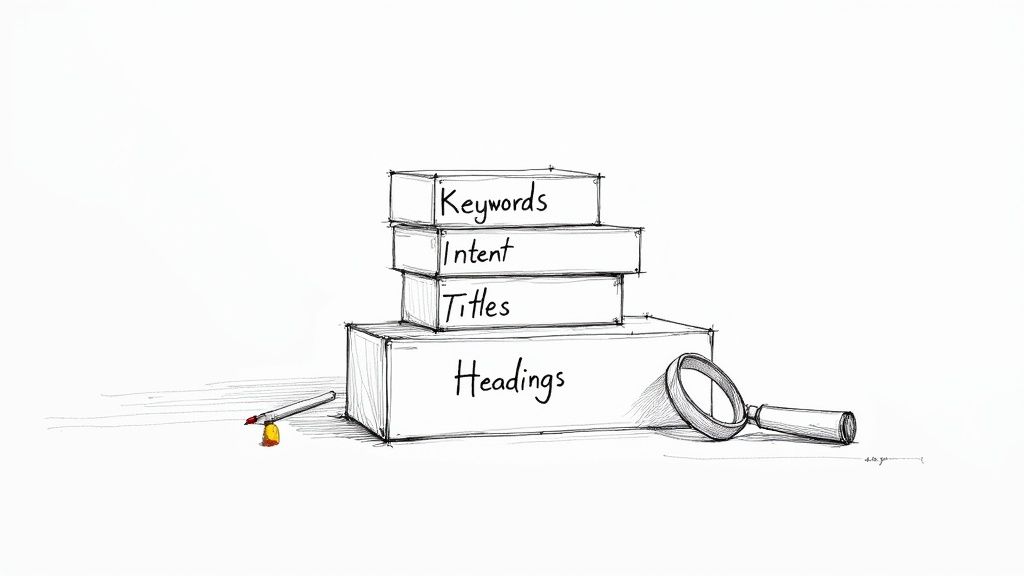
Great SEO copy doesn't just happen. It's built on a few core principles that work together to impress both your readers and the search engines. Getting these right is what separates content that gets buried on page ten from the articles that consistently bring in traffic.
Think of it like building a house. You need a solid blueprint and the right materials. In SEO copywriting, your keyword strategy is the blueprint, search intent is the foundation, and your on-page optimizations are the structural beams holding everything up. Each one is critical.
Mastering Strategic Keyword Research
It all starts with keywords, but we're not talking about just stuffing repetitive phrases into your text anymore. That old-school tactic is long dead. Today, keyword research is about understanding the actual language your audience uses. What words and questions are they typing into Google when they need an answer?
Good research helps you find the topics people are genuinely curious about, showing you where you can step in and provide real value. This isn't a one-and-done task; it’s about keeping a constant pulse on what your audience needs.
Primary Keywords: This is your main topic, the "head" term like "what is seo copywriting." It’s the central theme of your page.
Secondary Keywords: These are related phrases that add context and depth. Think "seo writing tips" or "how to write for seo."
Long-Tail Keywords: These are the goldmines. They're longer, super-specific queries like "best seo copywriting examples for beginners" that reveal exactly what a user wants. They're often less competitive, too.
To really dig into this first step, check out our guide on effective long-tail keyword research and start finding those untapped opportunities.
Understanding and Matching Search Intent
Keyword research tells you what people are looking for. Search intent tells you why they're looking. This is probably the single most important part of modern SEO. If you misjudge what the user is trying to accomplish, even the most beautifully written article will flop because it doesn't give them the answer they need.
Search intent is the silent question behind every query. Your content's job is to be the loudest, clearest, and most helpful answer to that question.
Google has gotten incredibly smart at figuring out what kind of content a user wants to see. Let's break down the main types of intent:
Informational Intent: The user wants to learn something. They're looking for guides, tutorials, or simple definitions (e.g., "how does seo work").
Navigational Intent: The user knows where they want to go and is just using Google to get there (e.g., "Viral SEO login").
Transactional Intent: The user has their wallet out and is ready to buy. They're searching for product pages (e.g., "buy seo copywriting tool").
Commercial Investigation: The user plans to buy soon but is still doing their homework, looking for reviews and comparisons (e.g., "best seo tools for startups").
Aligning your content format with the user's intent isn't just a good idea—it's non-negotiable if you want to rank.
Executing Flawless On-Page SEO
Okay, so you've got your keywords and you know the user's intent. On-page SEO is how you signal all that good stuff to the search engines. These are the technical and structural tweaks you make directly on your page.
Think of it as adding clear signposts to your content. These elements help both your readers and Google's crawlers quickly figure out what your page is about and how it's organized.
Here are the on-page elements that matter most:
Compelling Title Tags: This is the blue clickable headline in the search results. It has to include your primary keyword and make someone want to click.
Click-Worthy Meta Descriptions: The little blurb under the title. While not a direct ranking factor, a great one can dramatically boost your click-through rate.
Logical Heading Structure (H1, H2, H3): Headings break your content into scannable sections for people and create a clean outline for search engines.
Optimized URLs: A short, clean URL that includes your main keyword is much better than a long string of numbers and gibberish.
Internal Linking: Pointing to other relevant pages on your own website is huge. It helps users find more of your content and shows search engines how your pages are connected.
SEO Copywriting vs. Traditional Copywriting
To really get a handle on what SEO copywriting is, it’s just as important to understand what it isn’t. While both SEO and traditional copywriting aim to persuade with words, they operate in completely different arenas with different rulebooks and finish lines. Knowing the difference makes it clear why each one is a unique skill.
Think of a traditional copywriter as a sprinter. Their job is all about explosive, short-term impact. They’re crafting that perfect, punchy message for a specific campaign—a billboard you see on your commute, a glossy magazine ad, or a 30-second radio spot. The race is quick, and you know if you won based on immediate results, like a spike in sales from that one promotion.
Now, picture an SEO copywriter as a marathon runner. They aren’t focused on a single, short burst of energy. Their work is built to gain momentum over months, even years. They're creating a piece of content that becomes a durable, long-term asset, continuously working for the business long after it's published.
Goals and Audiences
The main goal of traditional copy is to spark an immediate action through a specific, often paid, channel. The message is pushed to an audience. A Facebook ad copywriter, for instance, is gunning for a click and a conversion right now.
SEO copywriting, however, is playing a double game. First, it has to attract people who are actively looking for answers by getting on the good side of search engine algorithms. Then, once it has their attention, it needs to engage and persuade them, building the kind of trust that leads to a conversion down the road. The audience pulls the information they need, when they need it.
The core difference lies in the approach to the audience. Traditional copy interrupts and persuades. SEO copy attracts and serves, earning the right to persuade over time.
This fundamental split in approach shapes everything from the tone of voice to the very structure of the content, making them two truly distinct disciplines.
Key Differences SEO vs Traditional Copywriting
To put it all into perspective, it helps to see a direct comparison. While both disciplines are about persuasion, how they get there and what success looks like couldn't be more different. The table below breaks down the most important distinctions.
Attribute | SEO Copywriting | Traditional Copywriting |
|---|---|---|
Primary Goal | Attract, engage, and convert organic traffic over the long term. | Drive immediate action or sales from a specific campaign. |
Audience | Actively searching for information or solutions (pull marketing). | Targeted based on demographics and interests (push marketing). |
Key Metrics | Organic traffic, keyword rankings, time on page, backlinks, leads. | Direct sales, conversion rate, ad clicks, coupon redemptions. |
Focus | Providing value and answering user intent to build trust and authority. | Creating a compelling, persuasive message for a specific offer. |
Lifespan | Long-term asset; value can compound over months or years. | Short-term; tied to the duration of a single campaign. |
Ultimately, one isn't "better" than the other—they just have different jobs. A great marketing strategy often uses both, but it's crucial to know which one to deploy and when.
Metrics and Channels
Because the goals are so different, how you measure success also changes dramatically. A traditional campaign might track coupon redemptions or a direct lift in sales over a few weeks. An SEO copywriter, on the other hand, has their eyes on a much longer-term set of metrics.
Organic Traffic Growth: Is the content pulling in more visitors from search engines month after month?
Keyword Rankings: Is the content climbing up the search results for the terms that matter most?
Time on Page: Are people actually sticking around and reading, or are they bouncing right away?
Lead Generation: Is this content consistently feeding the sales pipeline over the long haul?
The channels are worlds apart, too. Traditional copy exists in paid or owned media spaces with a clear expiration date. SEO copy lives out on the open web, mostly found through search engines like Google, where its value can grow and compound almost indefinitely. This split is exactly why you need to know which kind of writer you need for the job at hand.
How to Put SEO Copywriting Into Action
Alright, let's move from theory to practice. Great SEO copywriting doesn't just happen by accident. It’s not about just sitting down and letting the words flow. It’s a deliberate process, a repeatable system that ensures every single piece of content you create is built to both rank on Google and connect with your audience.
Following a clear workflow means you're not just writing—you're engineering success from the ground up. You’re building something that serves real people and pleases search engine algorithms at the same time.
This infographic breaks down the core differences between an SEO copywriter's process and a traditional copywriter's approach.
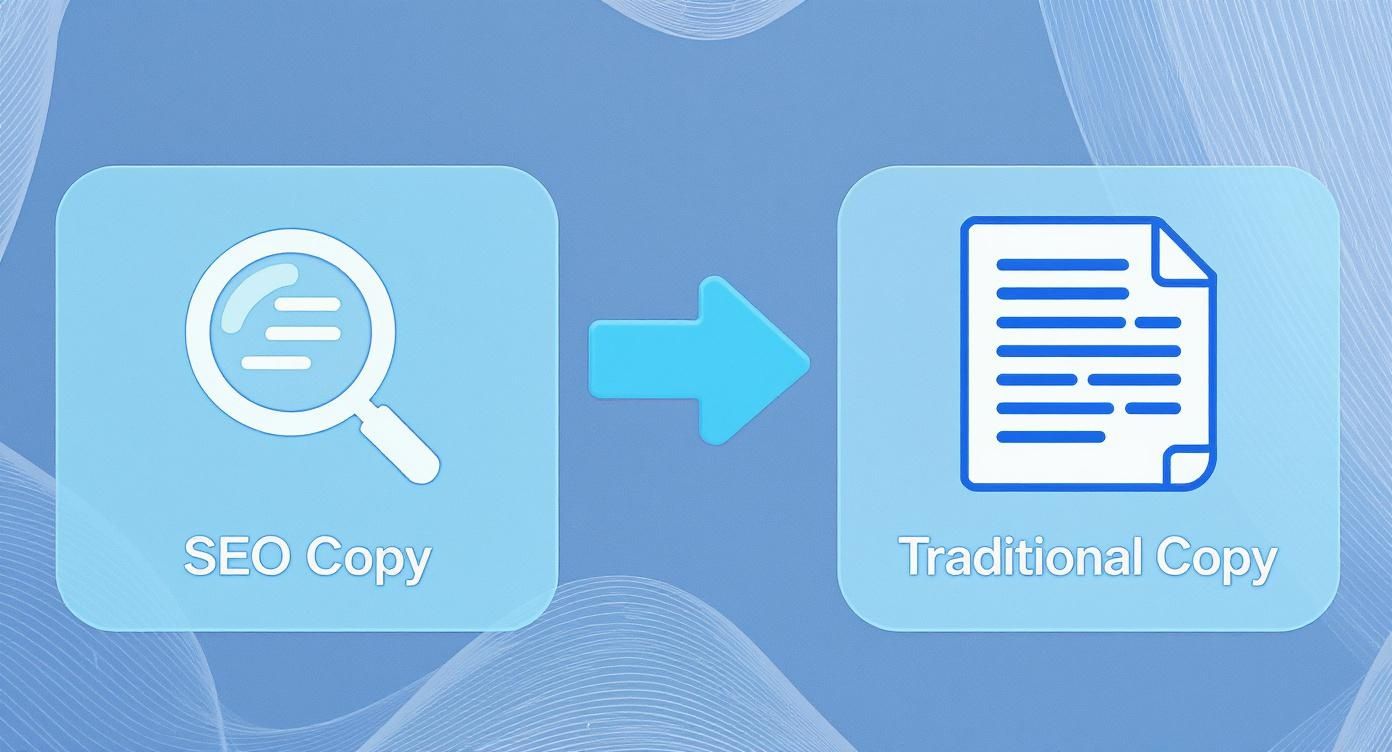
As you can see, SEO copywriting is never really "done." It’s a cycle of research, writing, and refining. Traditional copywriting, on the other hand, usually works toward a campaign with a specific start and end.
Step 1: Build a Detailed Audience Persona
First things first: you absolutely have to know who you're writing for. And I don’t mean guessing. I mean creating a detailed, almost tangible persona of your ideal reader. Get specific about their goals, their biggest frustrations, and even the exact language they use.
What problems are they trying to solve? What keeps them scrolling for answers late at night? Getting inside their head is the only way to create content that actually feels helpful and relevant to them.
An audience persona is your compass. Without it, you’re just creating content in the dark, hoping someone stumbles upon it. With it, every word you write is aimed directly at the person you want to attract.
This crucial first step will guide every other decision you make, from the keywords you choose to the tone you write in.
Step 2: Conduct Effective Keyword Research
With a clear picture of your reader, it’s time to find out what they're actually typing into Google. This is the heart and soul of SEO copywriting. Your mission is to identify one strong primary keyword and a handful of related secondary keywords that perfectly match what your audience is looking for.
Don’t get mesmerized by massive search volumes. The real gold is in keywords that reveal user intent. A thoughtfully chosen keyword set becomes the blueprint for your entire article, keeping it focused and on-topic. You can learn more about how many keywords a page should target over at our guide: https://getviralseo.com/articles/seo-how-many-keywords-per-page.
Step 3: Outline for Maximum Impact
Before you even think about writing your first sentence, build a solid outline. Trust me, this is the secret weapon for creating comprehensive articles that people actually want to read. Use your keyword research to map out your H2 and H3 headings, turning common questions into the sections of your article.
This structure pulls double duty:
It helps your readers by making the content easy to scan and digest.
It helps search engines by creating a logical hierarchy, making it simple for them to understand what your page is about.
Think of your outline as the skeleton. The writing part is just adding the muscle.
Step 4: Write and Optimize the Draft
Now, it's time to bring it all to life. Get that first draft down, focusing completely on writing for your human reader. Use a natural, conversational tone. Your main goal is to provide clear, helpful, and actionable answers to their questions.
Once the draft is done, put on your optimizer hat. This is where you go back and strategically place your keywords in the most important spots: the title tag, meta description, URL, and definitely within the first 100 words of your content. This final pass is absolutely critical. For example, a popular and effective application of this is creating SEO-optimized blog posts to capture search traffic, a tactic even podcasters use to grow their audience.
Your SEO Copywriting Questions, Answered
As you get your hands dirty with SEO copywriting, you're bound to have some questions. It's only natural. Let's tackle a couple of the most common ones that come up when people are just starting out.
How Long Until I See Results?
This is the big one, isn't it? The honest answer is: it’s a long game. SEO copywriting isn't a magic button you press for instant traffic. You're building a foundation for sustainable growth.
Generally, you can expect to see real, meaningful movement in your search rankings within 3 to 6 months. Of course, this isn't set in stone. The timeline can shift based on things like your website's current authority, how tough the competition is for your keywords, and the quality and consistency of your new content. Think of it like planting a tree—it takes time, but the payoff is well worth the wait.
If there's one thing to focus on, it's user intent. Google's whole mission is to give people the best possible answer to their questions. If you obsess over creating truly helpful, comprehensive content for your audience, you're aligning yourself with Google's goal. Get that right, and the rankings will naturally follow.
Can I Just Use AI for This?
AI tools are incredible assistants, no doubt about it. They can be a lifesaver for breaking through writer's block, brainstorming topics, or even knocking out a rough first draft. But should they handle the whole job? Absolutely not.
Think of AI as a very capable junior copywriter. It's fast and full of ideas, but it needs your expertise and oversight to produce something truly great. Here’s why a human touch is non-negotiable:
Fact-Checking: AI can confidently make things up. You need to be the one to ensure everything is accurate.
Brand Voice: AI doesn't know your brand's unique personality. It can't capture the tone and nuance that makes you, you.
Real Connection: Empathy and emotional connection are human traits. Your writing needs that spark to truly resonate with readers.
Nuanced Intent: A human writer can understand the subtle differences in why someone is searching for a term and craft content that perfectly meets that specific need.
Your strategic oversight is what elevates a generic piece of text into a high-performing article that actually connects with people and drives results.
Ready to stop guessing and start ranking? Viral SEO provides the tools you need to analyze competitors, find high-impact content ideas, and optimize your pages with confidence. Start making smarter SEO decisions today.
Blogs
More Blogs
From keyword goldmines to AI-driven content hacks—expert insights to help your blog posts dominate the first page.