What Is PPC Marketing? The Complete Beginner's Guide With Real Numbers
You have seen them thousands of times.
The top results on Google with the small "Sponsored" label. The ads that appear before YouTube videos. The banner at the top of a news website. The promoted post in your Instagram feed.
All of those are PPC ads. And every single time you clicked one, the advertiser paid.
PPC stands for Pay-Per-Click. It is one of the most powerful and measurable forms of advertising ever invented. And in 2026, global PPC spend will reach $306 billion, growing at 11% year over year. That is not a niche tactic. That is the backbone of digital advertising for businesses of every size on earth.
This guide explains exactly what PPC is, how it works, what it costs, how much it returns, which platforms to use, and how to run your first campaign without wasting your budget.
No fluff. No vague advice. Just what you actually need to know.
What Is PPC Marketing?

PPC marketing is a form of online advertising where you pay only when someone clicks your ad.
You do not pay for your ad to be seen. You pay for the click. If 10,000 people see your ad and nobody clicks, you pay nothing. If 100 people click, you pay for 100 clicks.
This is radically different from traditional advertising, where you pay for exposure regardless of results. A billboard costs the same whether 10 people walk past or 10,000 people walk past and none of them call you.
With PPC, you only pay when someone takes an action. That makes it highly measurable and highly controllable.
The most important thing to understand about PPC: the people clicking your ads are actively searching for what you sell. They typed a specific phrase into Google and your ad appeared because it matched. That intent is what makes PPC so powerful compared to interruption-based advertising.
Why PPC Matters: The Numbers That Make the Case
Let's look at the data before we get into the mechanics.
Businesses earn an average of $2 for every $1 spent on Google Ads. That is a 200% return. Google itself estimates its platform delivers an 800% ROI when campaigns are well managed. The average conversion rate for Google Ads search campaigns sits between 3.1% and 6%, which is 35% higher than the conversion rate from organic search.
Paid ads increase brand awareness by up to 33%. Consumers are 50% more likely to purchase after clicking a paid ad compared to an organic result. And the top three paid results on Google capture roughly 46% of all clicks on the results page.
More than 79% of marketers say PPC advertising is vital to their company's success. And around 96% of brands invest some portion of their marketing budget in Google Ads.
Paid search commands 44% of all US digital advertising budgets in 2026. It is the single largest category of digital ad spend. Not social. Not display. Search.
Why does it dominate? Because search advertising reaches people at the exact moment they are looking for something. That timing advantage over every other advertising channel is enormous.
How PPC Works: The Auction Explained Simply
Every time someone searches on Google, an auction happens in milliseconds.
Here is what occurs:
You set up a campaign in Google Ads. You choose which search terms you want your ad to appear for. You tell Google the maximum you are willing to pay each time someone clicks your ad. This is your maximum bid.
When someone searches that term, Google runs an instant auction. Every advertiser who has bid on that keyword enters the auction. The winner gets their ad shown.
But here is the key: the winner is not simply whoever bids the most money. Google uses something called Ad Rank.
Ad Rank is calculated from two main things: your bid and your Quality Score. Quality Score is Google's rating of how relevant and useful your ad and landing page are to the person searching. It is scored from 1 to 10.
This matters enormously. An advertiser with a high Quality Score can win a top position against an advertiser with a much higher bid. And they pay less per click because Google rewards relevance.
What this means practically: writing better ads, matching them to specific search terms, and sending clicks to highly relevant landing pages is not just good practice. It directly lowers what you pay per click and improves where your ad appears.
The formula in simple terms: better ads plus relevant landing pages equals higher position at lower cost.
The Five Types of PPC Ads
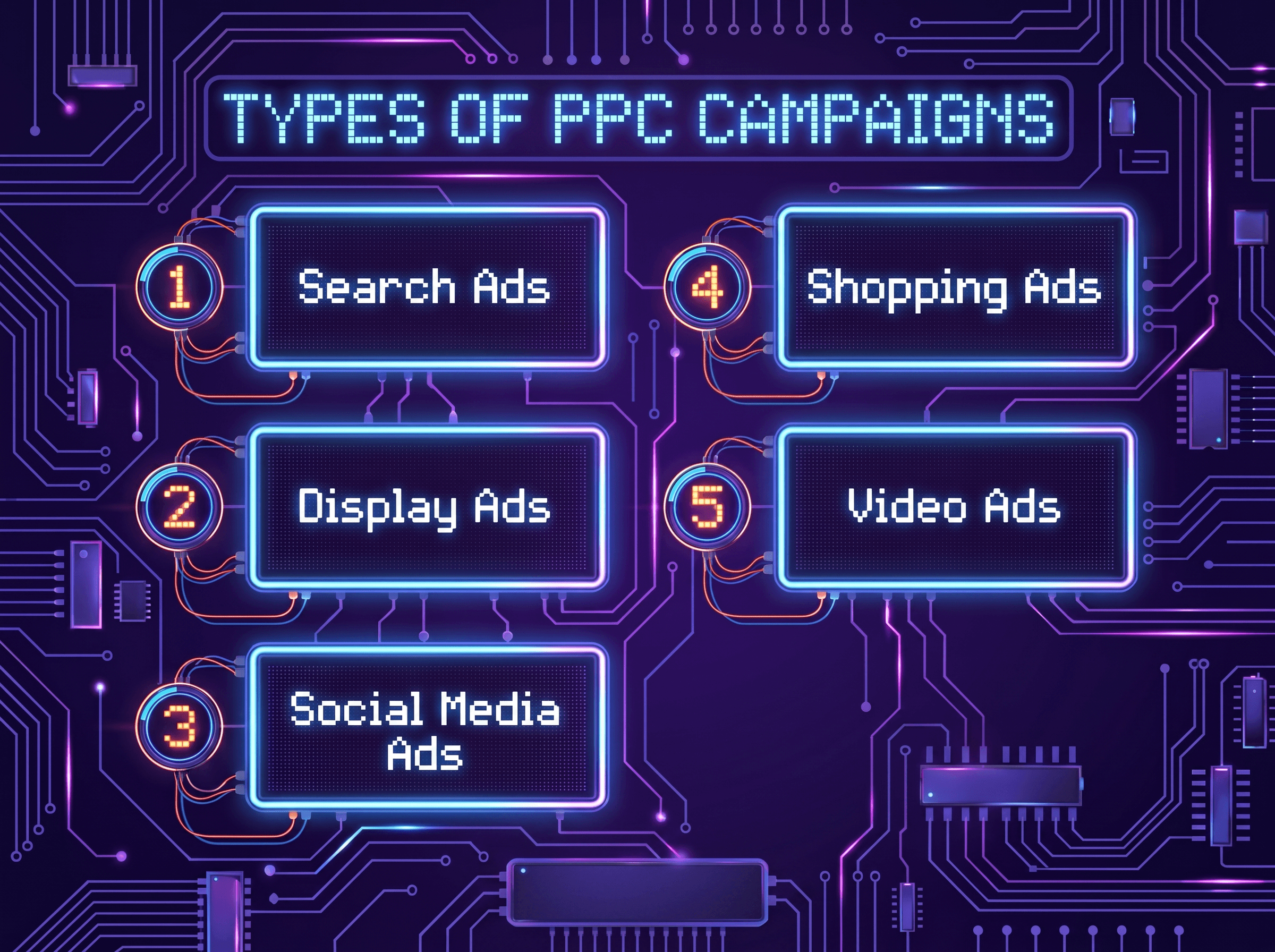
PPC is not just search ads on Google. It covers a wide range of formats across different platforms.
1. Search Ads
These are the text ads that appear at the top and bottom of Google search results. They show up when someone actively searches for a specific term. This is the highest-intent ad format that exists because the person has already told you what they are looking for.
The average click-through rate for the top-ranking Google search ad is 7.94%. That is a meaningful percentage of people actively choosing to click an ad over an organic result.
Search ads work for almost every business because they capture demand that already exists. Someone searching "emergency plumber in Austin" is ready to call. An ad that appears for that search captures that person at the perfect moment.
2. Shopping Ads
Shopping ads show a product image, price, and store name directly in Google search results. They appear when someone searches for a product.
Google Shopping Ads drive 85.3% of all clicks on Shopping campaigns and account for more than 75% of US retail search ad spend. Their average cost per click is just $0.66, making them highly budget-efficient for e-commerce.
If you sell physical products online, Shopping Ads are not optional. They are essential.
3. Display Ads
Display ads are image-based banner ads that appear on websites across Google's Display Network. That network includes over 2 million websites and apps. Display ads do not appear in search results. They appear while people are reading articles, watching videos, or using apps.
Display ads are better for brand awareness than for capturing immediate purchase intent. They are excellent for retargeting: showing ads to people who have previously visited your website but did not buy.
The click-through rate for display ads is much lower than search ads (around 0.05% to 0.12%), which is why cost-per-click for display is also much lower.
4. Video Ads
Video ads appear before, during, or after YouTube videos. YouTube is the second-largest search engine in the world, with over 2 billion logged-in users every month.
Video ads are growing fast. They generate higher engagement than static ads and are particularly powerful for brand awareness, product demonstrations, and reaching audiences who have already shown interest in related content.
5. Social Media PPC
Facebook, Instagram, LinkedIn, TikTok, and X (Twitter) all run PPC ad systems. You pay when someone clicks your ad. The targeting options are different from Google: instead of targeting by search intent, you target by demographics, interests, behavior, and lookalike audiences.
Social PPC is powerful for reaching people who do not yet know they need your product. It is interruption advertising, but highly targeted interruption. The best social PPC campaigns put the right message in front of people who are likely to want it before they have thought to search for it.
How Much Does PPC Cost?
This is the question everyone asks first. The honest answer is: it depends on your industry, your keywords, and how well your campaigns are managed.
Here are the real benchmarks for 2025 and 2026:
The average cost per click on Google Ads is around $4.22 across all industries. But this varies enormously. Google Shopping Ads average $0.66 per click. Legal and attorney keywords can cost $130 to $150 per click. Finance and insurance keywords regularly exceed $50 per click. Retail, e-commerce, and home services sit in the $2 to $10 range for most keywords.
The average cost per lead across all industries on Google Ads is $70.11. The lowest is automotive repair at $28.50. The highest is legal services at $131.63.
Most small and mid-sized businesses spend between $1,000 and $10,000 per month on Google Ads campaigns. Professional PPC management from an agency typically costs an additional $500 to $3,000 per month.
Cost-per-click has been rising. Industry data shows 8 to 12% year-over-year increases in average CPC across most categories. More advertisers are competing for the same inventory. Costs will likely keep rising.
What this means for you: the budget you need depends on your industry and your goal. A local restaurant testing local awareness ads needs far less than a B2B software company trying to generate enterprise leads. Start with what you can afford to spend and learn from, not with what you think you need to compete.
PPC vs SEO: The Real Difference
This comparison comes up in every PPC conversation. Here is the honest answer.
PPC and SEO are not competitors. They solve different problems.
PPC: Immediate traffic. You set up a campaign today and get visitors today. You pay for every click. The moment you stop paying, the traffic stops. You know exactly what you spend and what you get.
SEO: Slow to build but durable once established. Traffic from organic search is free per click but requires months of investment in content and link building to achieve. The traffic keeps coming even when you stop actively working on it.
The smart approach: use PPC to get immediate traffic and test which keywords and messages convert. Use SEO to build long-term organic rankings for the keywords you have validated through PPC. Let each channel inform the other.
A business launching a new website should almost certainly run PPC while waiting for SEO to build. A mature business with strong organic rankings can use PPC to capture high-intent keywords where they do not rank organically, or to retarget website visitors who did not convert.
One important data point: paid search visits are 35% more likely to convert than organic search visits. Intent matters. People who click a paid ad are often further along in the buying process than someone browsing organic results.
Key PPC Terms You Need to Know
You cannot manage PPC campaigns without understanding the vocabulary. Here are the essential terms, explained without jargon.
CPC (Cost Per Click): What you pay each time someone clicks your ad. Your actual CPC is almost always lower than your maximum bid because the auction is competitive and efficient.
CTR (Click-Through Rate): The percentage of people who see your ad and click it. Calculated as clicks divided by impressions. A higher CTR means your ad is relevant and compelling. It also improves your Quality Score, which lowers your CPC.
Quality Score: Google's 1 to 10 rating of how relevant your keyword, ad, and landing page are to each other. Higher Quality Score means better ad position and lower costs. This is the most important lever you have for improving PPC efficiency.
Impression: One display of your ad. You are not charged per impression in most PPC models.
Conversion: When someone who clicked your ad takes the action you wanted. Filling in a form, making a purchase, calling your number, signing up for a trial. Conversions are what actually matter, not clicks.
Conversion Rate: The percentage of clicks that result in a conversion. Industry average for Google Ads search campaigns is 3.1% to 6%.
CPA (Cost Per Acquisition or Cost Per Action): How much you pay for each conversion. Calculated as total spend divided by number of conversions. This is the metric that tells you whether your campaigns are profitable.
ROAS (Return On Ad Spend): Revenue generated divided by ad spend. Average ROAS for Google Ads across industries is around 200% (a 2:1 return). Some industries achieve 5x to 7x. The minimum viable ROAS for profitability depends on your margins.
Impression Share: The percentage of auctions where your ad actually appeared versus the total number of auctions where it was eligible to appear. Low impression share means you are losing auctions, usually due to low bids or low Quality Score.
Negative Keywords: Words that tell Google NOT to show your ad for certain searches. If you sell premium handmade coffee tables, you might add "free" and "cheap" as negative keywords so your ad does not appear for "free coffee table" or "cheap coffee table." Negative keywords are one of the most important budget-saving tools in PPC.
Google Ads vs Other PPC Platforms
Google dominates PPC. It controls 80.2% of the global PPC market. But it is not the only option.
Google Ads is the default starting point for most businesses because Google handles more than 8 billion searches per day. If someone is actively looking for your product or service, they are probably searching on Google.
Microsoft Advertising (Bing Ads) is dramatically underutilized. Bing Ads deliver CPCs that are 33% lower than Google Ads while delivering comparable conversion rates. Advertisers allocate only 6% of their paid search budgets to Microsoft Advertising. That is a real opportunity for businesses willing to diversify beyond Google. The Bing audience skews older and higher-income, making it excellent for B2B and high-consideration purchases.
Amazon Ads is the dominant platform for product advertising. Amazon Ads have an average CPC of just $0.81 and conversion rates of 9.47%. If you sell physical products and are not advertising on Amazon, you are likely missing your highest-intent buyers.
Meta Ads (Facebook and Instagram) do not work on search intent. They work on audience targeting. You define who you want to reach and Meta shows your ads to those people. Excellent for brand awareness, top-of-funnel lead generation, and remarketing. Less effective for capturing immediate purchase intent.
LinkedIn Ads are the most expensive PPC platform by CPC. But for B2B businesses targeting specific job titles, company sizes, or industries, LinkedIn's targeting precision can justify the premium cost. The platform is particularly effective for high-value enterprise deals.
TikTok Ads are growing fast and CPCs are still relatively low compared to more established platforms. If your target audience skews younger (under 35), TikTok advertising deserves serious consideration.
Setting Up Your First PPC Campaign: A Practical Step-by-Step
You do not need to spend thousands before you know what you are doing. Here is a realistic path to your first campaign.
Step 1: Define your goal before you open Google Ads.
What do you want people to do after clicking your ad? Call you? Fill in a form? Buy a product? Visit a specific page? Your goal determines everything: your campaign type, your landing page, and how you measure success. Do not touch the platform until this is clear.
Step 2: Do keyword research.
Use Google's free Keyword Planner (inside Google Ads) to find the specific phrases your potential customers search for. Look for keywords with clear commercial intent, meaning people searching with the intent to buy or inquire. "How to fix a leaky tap" has informational intent. "Emergency plumber London" has commercial intent. Start with commercial intent keywords.
Also build your negative keyword list from day one. Before you spend a dollar, add irrelevant terms you want to exclude.
Step 3: Write ads that match the search.
Your ad headline should include the keyword someone searched for. If someone types "accounting software for small business" and your headline says "Accounting Software for Small Business," they see immediate relevance. This increases CTR and improves Quality Score.
Write at least 3 headlines and 2 descriptions for each ad. Google's Responsive Search Ads will mix and match them to find the best combinations. Use your top benefit, a key feature, and a clear call to action (Book a Free Demo, Get a Quote Today, Shop Now).
Step 4: Build a dedicated landing page.
This is the most skipped step and the most costly mistake in PPC. Do not send ad traffic to your homepage.
A landing page is a single page built for one purpose: converting the visitor who clicked that specific ad. It should match the headline and promise of the ad. It should have one clear action. It should be fast on mobile. And it should not have navigation that sends visitors elsewhere before they convert.
Landing page quality directly affects your Quality Score. A high-quality landing page lowers your cost per click. A poor landing page wastes your entire budget.
Step 5: Set up conversion tracking before you launch.
If you cannot measure conversions, you cannot improve your campaigns. Set up Google Ads conversion tracking or connect Google Analytics 4. Define what counts as a conversion: a thank-you page load, a phone call, a form submission.
Spend zero dollars on ads until conversion tracking is confirmed working.
Step 6: Start with a small daily budget.
Set a daily budget you are comfortable losing while you learn. For most small businesses, $20 to $50 per day is enough to gather data within 2 to 4 weeks. You need enough clicks to see patterns. Too small a budget and the data is meaningless.
Step 7: Review and optimize weekly.
PPC is not set and forget. Every week, check: which keywords are getting clicks and converting, which are getting clicks and not converting (pause those), what your average CPC and CPA are, and whether your impression share suggests you are losing auctions you should be winning.
The accounts that perform best are reviewed and refined regularly. The accounts that waste money are launched and ignored.
The Biggest PPC Mistakes Beginners Make
Sending traffic to the homepage. This wastes most of your budget. Build landing pages that match your ads.
Ignoring negative keywords. Without them, your budget goes to irrelevant searches. Check your Search Terms report weekly and add anything irrelevant to your negative list.
Setting and forgetting. PPC requires active management. Bids, quality scores, and competition change constantly. A campaign that worked in January may need changes in April.
Bidding on too many keywords too broadly. Beginners often try to target every possible keyword. Start narrow and specific. Expand once you know what converts.
Not tracking conversions. If you do not know which clicks become customers, you cannot make good decisions. Set this up before anything else.
Expecting instant profitability. PPC campaigns need data to optimize. Your first month is often about learning, not profits. Set realistic expectations: 60 to 90 days of consistent management before drawing strong conclusions about campaign performance.
PPC in 2026: What Is Changing
AI is automating bidding and creative. Smart Bidding from Google now handles individual bid decisions using machine learning. Smart bidding campaigns using Target CPA or Target ROAS outperform manual bidding for most advertisers. The advertisers winning now set clear conversion goals and let the AI optimize, rather than trying to manually manage every bid.
AI search platforms are entering advertising. ChatGPT ads launched and hit $100 million in annualized revenue within 6 weeks. Perplexity has advertising. These platforms are still small but they represent where a growing share of search behavior is moving. Early advertisers on new platforms often benefit from lower costs before competition catches up.
Performance Max is reshaping Google Ads. Performance Max campaigns use AI to find conversions across all Google channels simultaneously: Search, Display, Shopping, YouTube, Gmail, and Maps. They require good creative assets and clear conversion data to perform well. The tradeoff is less manual control in exchange for broader automated reach.
CPCs will keep rising. More advertisers, same inventory. The only defense is improving your Quality Score, your conversion rate, and your landing page experience. Efficiency wins when costs rise.
The Bottom Line
PPC marketing is one of the fastest, most measurable, and most controllable forms of advertising available.
You choose who sees your ads. You choose what you pay. You see exactly which clicks become customers. You can turn campaigns on or off instantly. You can scale what works and pause what does not.
The data is clear: businesses earn an average of $2 for every $1 spent. The top three paid results capture 46% of clicks. Paid search visitors are 35% more likely to convert than organic visitors.
But PPC only works when it is done correctly. Bad campaigns waste money fast. Good campaigns deliver real, measurable returns.
Start with a clear goal. Do your keyword research. Write ads that match the search. Build proper landing pages. Set up conversion tracking. Start small. Optimize weekly.
That is PPC marketing in practice. The rest is refinement.
Blogs
More Blogs
From keyword goldmines to AI-driven content hacks—expert insights to help your blog posts dominate the first page.