The Role of SEO in Digital Marketing: The Practical Guide With 2026 Numbers

Ask ten digital marketers which channel delivers the best return and nine of them will say the same thing.
SEO.
Not social media. Not email. Not paid ads. Organic search. <cite index="50-1">By ROI, SEO, websites, and blogs lead all digital channels at 27%, followed by paid social at 26% and organic social at 24%.</cite> This is not a close race. SEO is not just one tool in the digital marketing kit. For most businesses, it is the highest-returning tool in the whole kit.
And yet it is also the most misunderstood. Most people know SEO exists. Far fewer understand what role it actually plays in a complete digital marketing strategy and how it connects to every other channel they are running.
This guide covers that. What SEO's specific role is in digital marketing. Why it outperforms other channels on the metrics that matter most. How it connects to and amplifies content marketing, paid advertising, social media, and email. And exactly how to think about where SEO fits in your own strategy.
What Makes SEO Different From Every Other Marketing Channel
Every major digital marketing channel works on one of two models.
The first model: you pay to reach people. Google Ads, Meta Ads, display advertising. You pay for impressions. You pay for clicks. The moment you stop paying, the traffic stops. You are renting visibility. You never own anything.
The second model: you earn reach that compounds over time. SEO. Content marketing. Email list building. These require upfront investment and time. But once they work, they keep working. A page that ranks well today can bring in customers next year without a single additional dollar spent.
This difference is fundamental. And it is why <cite index="43-1">organic search generates 44.6% of all revenue attributed to digital channels and remains more effective than paid search for long-term growth.</cite>
<cite index="44-1">68% of online experiences begin with a search engine.</cite> More than two thirds of every online journey starts with someone typing a question into Google. If your business shows up for those questions, you are present at the very beginning of the buyer's journey. If you do not show up, a competitor does.
<cite index="44-1">SEO drives over 1,000% more traffic than organic social media. The average website receives 53.3% of its traffic from organic search compared to 5% from social media.</cite>
One thousand percent more traffic. From a channel that, once established, costs you nothing per click.
That is the core argument for SEO's role in digital marketing. It is the highest-traffic, highest-ROI channel available, and the traffic it delivers compounds rather than evaporates.
The ROI Numbers That Define SEO's Role
Before we discuss how SEO fits into a broader marketing strategy, it is worth being clear about the return on investment data, because the numbers are extraordinary.
<cite index="43-1">A well-executed SEO campaign can yield a median ROI of approximately 748%, meaning roughly $7.48 back for every $1 spent, with some sectors reporting ROI over 900 to 1,100% in 2025 alone.</cite>
Compare that to the alternatives. Google Ads return approximately $2 for every $1 spent. <cite index="46-1">SEO delivers an 8x ROI, which is twice that of PPC.</cite>
The cost per lead comparison is even more striking. <cite index="43-1">Organic channels like SEO cost about $31 per lead, while PPC costs about $181 per lead, meaning SEO can generate about 5.8 times more leads per dollar spent.</cite>
And the quality of those leads matters too. <cite index="52-1">SEO leads close at 14.6%, compared to just 1.7% for outbound leads like cold calls and direct mail. That is an 8.6 times difference in close rate.</cite> SEO targets people who are actively searching for what you sell. Paid ads and outbound marketing reach people who may have no interest at all.
These numbers explain why <cite index="52-1">49% of marketers identify organic search as the top ROI-driving channel</cite> and why <cite index="52-1">88% of marketers maintain or increase their SEO budgets year over year.</cite>
How SEO Connects to Every Other Digital Marketing Channel
This is the part most people miss. SEO is not separate from your other marketing channels. It connects to all of them, amplifies some, and depends on others.
SEO and Content Marketing
These two are inseparable. You cannot do SEO without content, and content without SEO rarely reaches the people who need it.
Content marketing creates the pages, articles, guides, and resources that Google indexes and ranks. SEO determines which content gets created (based on keyword research and search intent), how that content is structured (based on what Google wants to rank), and how it is distributed (through the search results pages where people find it organically).
The relationship works both ways. Strong content earns backlinks, which improve domain authority, which makes it easier for everything else you publish to rank. An SEO-informed content strategy does not just produce individual pieces that rank. It builds an asset base that compounds in authority over time.
<cite index="52-1">Companies publishing 16 or more blog posts per month get 3.5 times more traffic than those publishing less frequently.</cite> Publishing velocity directly correlates with traffic growth, but only when that content is keyword-targeted and built around real search demand.
The practical integration: your content calendar should start with keyword research, not topic brainstorming. Every piece of content you invest in should target a specific search query with documented monthly search volume. Content that nobody is searching for is content that reaches nobody.
SEO and Paid Advertising
The common mistake is treating SEO and paid search (PPC) as competitors. They are partners.
PPC delivers immediate traffic. You need to sell something this week? Run a paid campaign. SEO takes months to build. You need traffic three years from now without paying per click? Build your SEO.
The smartest businesses use PPC to fund their operations in the short term while SEO builds the long-term organic presence that reduces their dependence on paid ads. <cite index="46-1">Companies that implement SEO strategies save up to 400% on ad spend without affecting the attraction of their target audience</cite> once organic rankings mature.
PPC also provides data that accelerates SEO. When you run paid campaigns, you discover which keywords convert at what rates. You test headlines and descriptions and learn what language your customers respond to. You identify which landing pages convert and which do not. All of this data informs your organic SEO strategy: which keywords to target, how to frame your content, and which pages deserve the most SEO investment.
The practical integration: run paid campaigns on your highest-priority keywords while your organic rankings build. When an organic ranking reaches page one for a keyword, evaluate whether you still need the paid campaign for that term. Gradually shift budget from paid to organic as rankings mature.
SEO and Social Media
<cite index="44-1">The average website receives 53.3% of its traffic from organic search compared to 5% from social media.</cite> Social media is not a traffic engine for most businesses. It is a brand-building and discovery mechanism.
But social media and SEO interact in ways that make both more effective.
Social media amplifies content. When you publish a piece of content that ranks well for a keyword, sharing it on social media extends its reach. People who discover it through social may link to it on their own websites or mention it in their content, building the backlinks that strengthen the page's SEO authority.
Social media also influences what people search for. When your brand or product becomes a social media topic, branded search volume increases. People who see you on Instagram search for you on Google. That branded search activity signals to Google that your brand has genuine demand, which influences how your pages rank for non-branded queries too.
And in 2026, social platforms are increasingly becoming search engines themselves. <cite index="44-1">Over 40% of Gen Z uses TikTok as their primary search engine for product discovery and local recommendations instead of Google.</cite> This means SEO thinking, optimizing content to answer specific questions, needs to extend to your social content as well.
The practical integration: use social media to amplify your best-performing SEO content. Track branded search volume in Google Search Console as a metric for social media effectiveness. And apply keyword research principles to your social content, especially on TikTok and YouTube, where search is central to how people discover content.
SEO and Email Marketing
Email marketing and SEO do not directly interact in the traditional sense. Google does not read your emails. But they work together powerfully.
Email drives traffic to your SEO-optimized pages. When you publish new content, your email list is your instant audience. A piece of content that gets shared and linked to by email subscribers earns backlinks that strengthen its SEO authority. The faster content accumulates links after publication, the faster it climbs in rankings.
Email also captures the audience that SEO builds. Someone who finds you through organic search may not buy on that first visit. But if they subscribe to your email list, you have a direct line to them that does not depend on Google's algorithm. Email is how you convert SEO traffic into a relationship you own.
The practical integration: include email capture prompts on every high-traffic organic page. Offer a lead magnet relevant to the page's topic. The pages ranking for commercial or informational keywords are your best lead generation assets. Treat them as acquisition funnels, not just content.
The Specific Roles SEO Plays at Each Stage of the Marketing Funnel
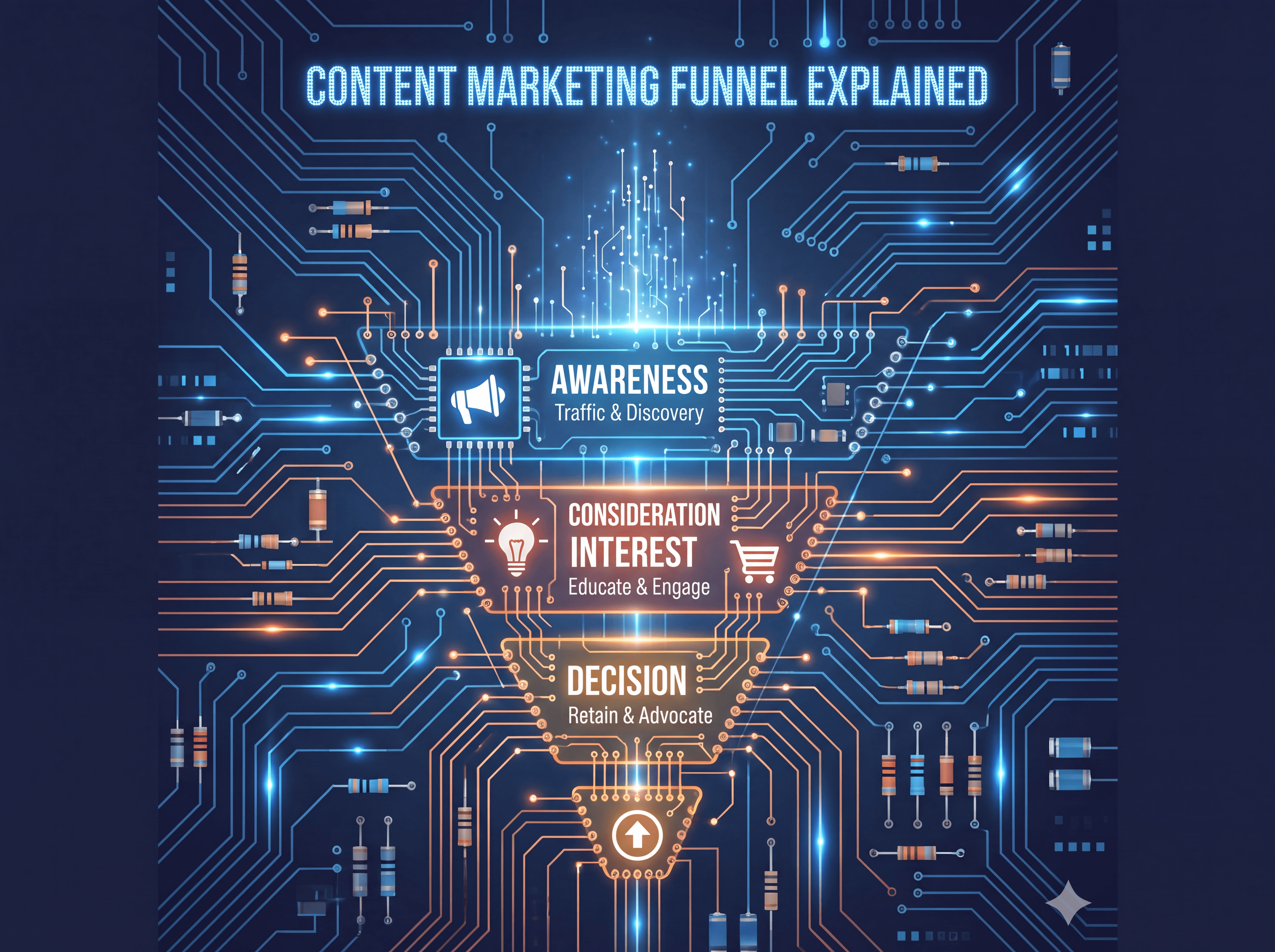
SEO is not just a top-of-funnel traffic driver. It operates at every stage of the buying journey.
Top of Funnel: Awareness
At this stage, potential customers do not know you exist. They are searching for information, not for you.
"How do I fix a leaky pipe?" "What are the symptoms of a vitamin deficiency?" "How does project management software work?"
These are informational searches. Creating content that ranks for these queries puts your brand in front of people at the very beginning of their journey. They learn from you. They form a relationship with your brand before they are ready to buy. When they eventually become ready to purchase, they think of the brand that already helped them.
This is awareness without advertising cost. Every informational piece that ranks brings in warm prospects who chose to read your content because it answered something they cared about.
Middle of Funnel: Consideration
At this stage, people know they have a problem and are evaluating options.
"Best project management software for small teams." "Ahrefs vs Semrush comparison." "Top accounting tools for freelancers."
These commercial keywords are searched by buyers who are close to a decision. They want comparisons, reviews, and feature breakdowns. Content that ranks for these queries connects you with buyers at exactly the moment they are deciding whether your product belongs on their shortlist.
This is where SEO drives qualified traffic most directly. <cite index="52-1">60% of marketers say inbound strategies like SEO generate the highest-quality leads.</cite> The reason: people searching these commercial terms are raising their hand and telling you what they are evaluating.
Bottom of Funnel: Decision
At this stage, buyers are ready to purchase. They are looking for confirmation that their decision is right.
"[Your brand] reviews." "Is [your product] worth it?" "How to get started with [your product]."
These branded and transactional searches happen when someone is on the verge of buying. If your website does not appear prominently for branded searches, or if negative reviews dominate the results, you lose sales at the final moment.
SEO at the bottom of funnel means: owning your brand's search presence, ranking for "[your brand] review" and "[your brand] vs competitor" queries, and making sure the pages that appear when someone researches your specific product or service present the best possible case for buying.
Why SEO's Role Is Expanding in the AI Era
The search landscape is changing. Google AI Overviews appear in nearly half of all informational searches. ChatGPT has over 900 million weekly users. Perplexity is growing fast.
Some people interpret this as SEO becoming less important. The data says the opposite.
<cite index="46-1">AI Overviews redistribute clicks inside the top results. Ranking remains necessary, but traffic now depends on whether a page is selected as a cited source inside AI answers.</cite>
The brands that appear in AI-generated answers are almost exclusively the ones with strong SEO foundations. When ChatGPT searches the web to answer a question, it cites the pages that rank well in Google. When Google generates an AI Overview, it pulls from pages it has already determined to be authoritative through its ranking signals.
Good SEO makes you appear in traditional search results. Good SEO also makes you appear in AI-generated answers. The same content quality, authority, and structure that helps you rank on Google helps you get cited by AI systems.
The shift that does matter: <cite index="52-1">content now needs to directly answer specific questions in clear, structured formats to be selected as a cited source in AI summaries.</cite> FAQ sections, direct Q&A structure, and factual density in content all increase the likelihood of appearing in AI answers, which is the new version of appearing in the featured snippet.
SEO's role is not shrinking. It is expanding to cover a broader surface area of search, including AI-generated discovery.
The Practical Hierarchy: How SEO Fits Into Your Marketing Strategy
Here is how to think about SEO's role in practical terms.
SEO is the foundation. It determines whether your digital presence can be found by the people who need you. Without SEO, your content marketing produces content nobody finds. Your paid campaigns send traffic to pages that are slow, unstructured, and unconvincing. Your brand has a website that exists but not one that works.
Content marketing is the engine. SEO defines what to create. Content creates the assets that rank. Neither works effectively without the other.
Paid advertising is the accelerator. While SEO builds, paid ads provide immediate traffic and conversion data. Once organic rankings mature, the budget previously spent on paid can be reduced or redirected.
Social media and email are the amplifiers. They extend the reach of your SEO content, build the relationships that turn organic visitors into loyal customers, and create the brand awareness that drives branded search volume.
This hierarchy determines where SEO investment should sit in budget conversations. If SEO is the foundation, it needs consistent investment before other channels can operate effectively. Brands that try to build on a weak SEO foundation, heavy social media spend with a website that does not convert or rank, end up paying repeatedly for traffic they could be earning.
What SEO Cannot Do (Being Honest About Its Limits)
SEO's role in digital marketing is central, but it is not unlimited. Understanding the limits helps you use it well.
SEO takes time. Most campaigns take 6 to 12 months to produce meaningful results. <cite index="43-1">Most SEO campaigns begin generating positive returns within 6 to 12 months.</cite> If you need customers this week, SEO is not the answer. Paid advertising is. SEO is the strategy for next year, not next Tuesday.
SEO requires ongoing investment. Rankings are not permanent. Google updates its algorithm hundreds of times per year. Competitors publish content. Rankings shift. SEO requires consistent content creation, technical maintenance, and link building to hold and improve positions.
SEO cannot save a bad product or a weak offer. Traffic is not customers. If your product does not meet the need of the people who find you through search, they will click away. High traffic and low conversion is a product or offer problem, not an SEO problem.
SEO does not replace the full marketing stack. Even a website with excellent organic rankings benefits from email marketing to retain those visitors, social media to build brand identity, and paid advertising to capture high-intent buyers who are searching right now.
Measuring SEO's Role: The Metrics That Actually Matter
Most people track SEO with the wrong metrics. Rankings feel important. Traffic feels important. But neither of these tells you what SEO is actually doing for your business.
The metrics that connect SEO to business outcomes:
Organic traffic by segment. Track organic visitors to commercial pages (product pages, service pages, comparison pages) separately from informational pages. Commercial organic traffic converts. Informational traffic builds awareness. Both matter, but they serve different purposes.
Organic conversion rate. What percentage of organic visitors take the action you want? A 1% organic conversion rate with 10,000 monthly visitors produces 100 leads. A 3% rate with 5,000 visitors produces 150. More targeted traffic from better-intent keywords beats raw traffic volume.
Cost per organic lead. Divide your total SEO investment (content creation, tools, agency fees, internal time) by the number of leads or sales attributed to organic search. Compare this to your cost per lead from paid channels. This is the ROI comparison that justifies continued SEO investment.
Revenue influenced by organic search. Use multi-touch attribution in GA4 to see how many sales involved an organic search touchpoint, even if organic was not the last click before purchase. Organic search often plays an assist role in conversions that are attributed to email or direct.
Branded search volume. Track how often people search for your brand name in Google Search Console. Growing branded search volume means growing brand awareness. It is a leading indicator of SEO's contribution to overall marketing effectiveness.
Your SEO Integration Action Plan
Here is how to make SEO the foundation it should be in your digital marketing strategy.
Week 1: Audit where you stand. Set up Google Search Console if you have not. Look at which searches are currently bringing people to your site. Identify your top five pages by organic traffic. Check whether those pages have clear calls to action and email capture.
Week 2: Connect SEO to your content plan. Do keyword research for your five most important topics. Use Google Keyword Planner and the "People Also Ask" section on search results pages. Build a content calendar for the next three months where every piece targets a specific keyword with documented search volume.
Week 3: Fix technical foundations. Run your site through Google PageSpeed Insights. Fix the most urgent speed issues. Check that your most important pages have self-referencing canonical tags, clear title tags, and meta descriptions.
Week 4: Build the measurement system. Set up UTM parameters for every non-organic traffic source so you can compare organic and paid accurately. Create a monthly reporting template that includes organic traffic, organic conversion rate, cost per organic lead, and branded search volume.
That is the foundation. Build on it consistently for six months before evaluating results. SEO compounds. The businesses dominating organic search today did not build that position in four weeks.
The Bottom Line
<cite index="44-1">68% of online experiences begin with a search engine.</cite> More than half of all website traffic comes from organic search. <cite index="43-1">A well-executed SEO campaign can yield a median ROI of approximately 748%.</cite> <cite index="52-1">SEO leads close at 14.6% compared to 1.7% for outbound marketing.</cite>
These numbers define SEO's role in digital marketing. Not as one tactic among many. As the channel that underlies everything else, the foundation on which content works, paid advertising gets smarter, social media builds brand value, and email captures and retains the audience that organic search delivers.
The businesses that treat SEO as a foundation rather than an afterthought build compounding traffic advantages that become increasingly difficult for competitors to close.
Start now. Measure correctly. Build consistently. The returns compound.
Blogs
More Blogs
From keyword goldmines to AI-driven content hacks—expert insights to help your blog posts dominate the first page.