TL;DR
Between 20-70% of CRM projects fail. Not because the software is bad. Because nobody uses it. Here's how to be in the winning group:
A CRM is your business's shared memory. Every contact, deal, note, and follow-up in one place. Without it, deals live in people's heads and fall through the cracks when someone forgets or quits.
Don't open the software first. Draw your real customer flow on paper: where leads come from, how they move, where they stall. That map is your blueprint.
Pick one goal with a number. "Get organized" is a vibe. "Follow up with every lead within 24 hours" is a goal. Your goal decides what you build.
Clean your data before importing it. 76% of CRM users say less than half their data is accurate. Dirty data kills trust. Dead trust kills usage. Dedupe, delete old contacts, standardize formats first.
Build pipeline stages that are facts, not feelings. "Interested" is a feeling. "Demo booked" is a fact. Five to seven stages max, each with a one-sentence rule for when a deal enters it.
Keep fields minimal. Every required field is a tax. Start with name, contact method, source, owner, and stage. Add fields later only when someone genuinely needs them.
Segment your contacts. Customers, leads, past customers. By product interest. By activity level. Lists that drive action beat a giant pile every time.
Automate three things only. Instant hello to new leads, silence alarm when deals go quiet, handoff when a deal is won. That's enough for year one.
Win the adoption war. Leaders must use it visibly. Kill the old spreadsheet on a set date. Make data entry stupid-easy with email sync and mobile apps. Train in 30-minute bites, not all-day workshops. Measure updated deals, not logins.
Keep it clean weekly. Merge duplicates, chase deals with no next step, archive dead leads. A pipeline full of zombie deals makes every forecast a lie.
Watch five numbers monthly. Speed to first touch, deals with a next step, update freshness, win rate by stage, and forecast accuracy. That's the whole dashboard.
One line summary: map your process first, clean your data, build a small honest pipeline, automate the bottlenecks, make leadership use it visibly, and kill the spreadsheet. Do that and you join the companies pulling $8.71 back for every $1 spent.
——————————————————————————————————————————-
Setting Up Your CRM: The No-Fluff Guide That Actually Gets Used
Here's an ugly number. Somewhere between 20% and 70% of CRM projects fail.
Not because the software breaks. Because nobody uses it. The team goes right back to sticky notes, spreadsheets, and memory. The expensive new system sits there like a gym membership in February.
Now the good number. Companies that get CRM setup right earn back about $8.71 for every $1 they spend. They see higher sales, better productivity, and forecasts they can actually trust.
Same software. Wildly different results. The difference is the setup.
This guide shows you how to set up a CRM that your team actually uses. It pulls from setup playbooks, hard data, and the brutally honest complaints of salespeople on Reddit. Follow it and you'll land in the winning group.
Let's build it right.
What a CRM Really Is (In One Sentence)
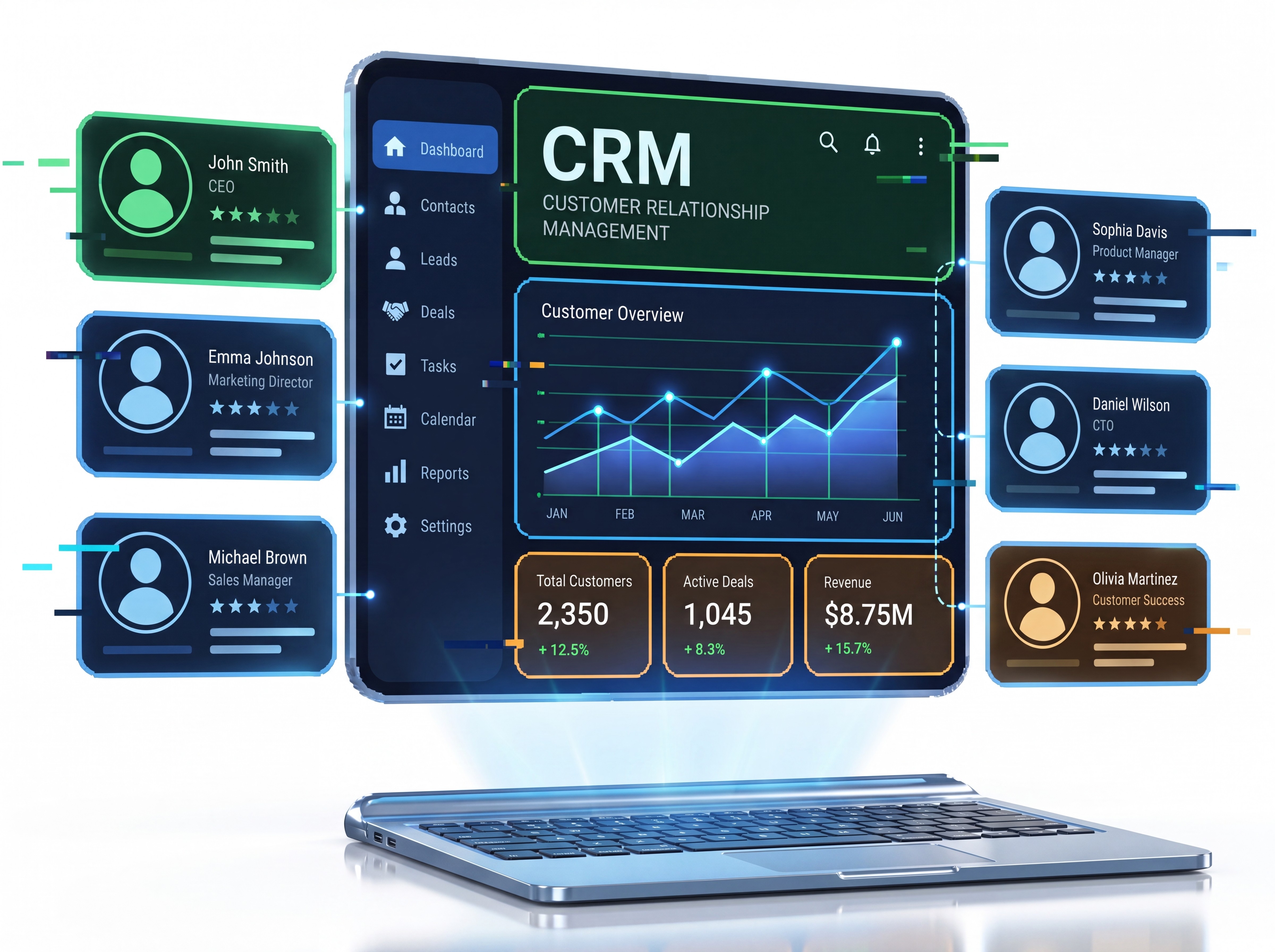
Strip away the jargon and a CRM is one thing: your business's shared memory.
Every contact. Every call. Every email. Every deal, note, and promise. All in one place, visible to everyone who needs it.
Without that shared memory, your business runs on private memories. Deals live in one person's head. Follow-ups live in another person's inbox. When someone quits or forgets, customers fall through the cracks.
With it, anyone can pick up any customer conversation and know exactly what's going on. That's the whole promise.
Keep that sentence in mind through every setup decision: does this help our shared memory, or clutter it?
Wait, Do You Even Need a CRM Yet?
Honest sidebar for solo founders and tiny teams.
If you have under 20 contacts and one deal a month, a spreadsheet or a notebook is fine. Don't let anyone shame you into software you don't need yet.
You've crossed the line and need a CRM when any of these hit:
You forgot to follow up with someone, and it cost you money.
A customer repeated their whole story because you lost the notes.
You can't answer "how many open deals do we have?" in under a minute.
A second person joined and now two memories need to become one.
Sound familiar? Then yes, it's time, and here's the encouraging part: setting up while you're small is ten times easier. Fifty clean contacts import in minutes. Five thousand messy ones take weeks. The best time to build your shared memory is before you desperately need it.
And if you're solo, shrink this whole guide: one pipeline, four stages, five fields, one automation (the silence alarm), and a ten-minute Friday cleanup. That tiny setup will still beat the memory of the sharpest founder alive.
Step 0: Put the Software Down
The biggest setup mistake happens before the setup. People open the software first and think second.
Do this instead. Grab paper or a whiteboard and map how a customer actually flows through your business today:
Where do leads come from?
What happens when one arrives? Who touches it first?
What are the real steps between "stranger" and "paying customer"?
Where do deals usually stall or die?
What happens after the sale?
Be honest, not fancy. Map what really happens, not what should happen.
This map is your blueprint. Every pipeline stage, field, and automation you build later should match it. Businesses that treat CRM setup as a people-and-process project first and a software task second are the ones that succeed. The ones that treat it as "installing a program" join the failure statistics.
Step 1: Pick One Goal With a Number
"Get organized" is not a goal. It's a vibe.
Pick one measurable target for your CRM's first 90 days. For example:
Follow up with every new lead within 24 hours.
Stop losing deals to forgotten follow-ups. Zero deals go silent for more than a week.
Know our real pipeline number every Monday morning.
One goal. One number. Write it down.
This matters because it decides what you build. If your goal is fast follow-up, you'll set up lead alerts and reminders. If it's pipeline truth, you'll focus on clean deal stages. A CRM configured for everything serves nothing.
Step 2: Choose a CRM You'll Actually Use
Quick buying advice, because setup starts with the right tool.
Match the tool to your size. A five-person shop doesn't need an enterprise monster that requires a full-time admin. Heavy platforms with steep learning curves kill adoption in small teams. Simple and used beats powerful and ignored.
Test with real users. Companies that succeed involve the actual daily users in testing, not just the boss. Run this test: can a new person add a contact and log a call in under two minutes without help? If finding basic functions takes twenty minutes of clicking, imagine daily life with it.
Check your connections. Your CRM should plug into the tools you already live in: your email, your calendar, your accounting software. Lack of integration is one of the top reasons CRM projects die. If your team works in their inbox, a CRM that syncs email automatically will win. One that demands copy-pasting will lose.
Start cheap and flexible. Most major CRMs have free or low-cost starter tiers. Begin there. Upgrade when you actually hit a wall, not before.
Step 3: Clean Your Data Before It Moves In
This step is boring. It's also where half of all CRM dreams die.
Here's a stat that should scare you: 76% of CRM users say less than half the data in their system is accurate or complete.
Think about what that does. A rep opens a contact, hits a dead phone number and a bounced email, and stops trusting the system. Once trust dies, usage dies. Experts call it the data quality death spiral, and it's the real villain behind most "our team won't adopt it" stories.
So clean before you import. Gather your contacts from everywhere: spreadsheets, inboxes, phones, business card piles. Then:
Kill duplicates. Three versions of the same customer means nobody knows which is real.
Delete the dead. Contacts from five years ago with no email and no notes? Let them go.
Standardize the format. Pick one way to write names, phone numbers, and company names. Stick to it.
Fill the blanks that matter. Every contact needs at least a name, one working way to reach them, and where they came from.
Yes, this takes a weekend. Do it anyway. Importing garbage just gives you faster, more expensive garbage.
Step 4: Build Pipeline Stages That Match Reality
The pipeline is the heart of your CRM. It shows every deal and what stage it's in.
Here's the trap: using the generic template stages that came in the box. Your business doesn't work like a template. Set up stages that match your actual sales process, the one you mapped on paper in Step 0.
Good stages follow two rules:
Rule 1: Each stage is a fact, not a feeling. "Interested" is a feeling. "Demo booked" is a fact. Stages should be things that clearly happened: New lead. Contacted. Meeting held. Quote sent. Won. Lost.
Rule 2: Fewer is better. Five to seven stages is plenty. Twelve stages means nobody knows where anything goes, so nothing gets updated.
Add one power move: define what makes a deal move forward. Write one sentence per stage: "A deal enters Quote Sent when the customer has the PDF in their inbox." Now two people can't argue about where a deal sits. Your Monday pipeline number becomes real.
Step 5: Fewer Fields, More Truth
Every field you add is a tiny tax on your team. Ten required fields per contact means nobody fills any of them honestly.
Start with the minimum:
Name and company
One working contact method
Where they came from (source)
Owner (who's responsible)
Stage and next step
That's it. Add a field later only when someone says "I keep needing to know X and it's not there."
The pros' advice for small businesses is nearly unanimous: start with essential features, skip the heavy customization at first, and choose data quality over data quantity. A CRM with five honest fields beats one with thirty empty ones.
Step 6: Organize Contacts Into Lists That Do Work
Once contacts live in your CRM, don't leave them as one giant pile. Segment them. This is where contact management turns into money.
Segmenting just means grouping people by what they have in common. Simple, useful groups to start:
Customers vs. leads vs. past customers. The most basic split, and you'd be shocked how many businesses never make it.
By interest or product line. People who asked about Service A shouldn't get emails about Service B all day.
By activity. Hot leads who engaged this month. Cold ones who've gone quiet.
By value. Your top 20% deserve a different level of attention.
Why bother? Because the moment you want to send a message, run a promotion, or plan follow-ups, these groups are ready. "Email every past customer who bought Product A" becomes two clicks instead of two hours of spreadsheet surgery.
Rule of thumb: build a list only when it changes what you'll do. Groups without actions are just decoration.
Step 7: Automate Three Things, Not Thirty
Automation is the fun part, so people overdo it on day one. Don't. Turning on every feature at once is a proven fast track to overwhelm and abandonment.
Pick two or three automations aimed at your real bottlenecks, like:
The instant hello. New lead comes in, they get a friendly reply, and the owner gets an alert. Speed wins deals.
The silence alarm. A deal sits untouched for X days, and the owner gets a nudge. This one automation pays for the whole CRM. Deals mostly die of neglect, not rejection.
The handoff. When a deal is marked Won, tasks fire automatically for whoever handles delivery or onboarding. Customers stop falling into the gap between sales and service.
Run those for a month. Once they feel natural, add more. Automation should remove work your team already does, not invent new work nobody asked for.
Step 8: Win the Adoption War
Now the hard truth from every sales forum on the internet. The software is never the problem. Usage is.
Listen to what reps actually say: "Using the system takes too much time." "I've been successful without it, why change?" One Reddit thread from heavy-industry sales nailed it: reps who spend their day putting out fires on job sites are not going to sit down and lovingly update deal stages. The system has to meet them where they are.
So engineer for laziness. Here's the playbook:
1. Leaders go first, visibly. Adoption follows whoever's watching. If managers pull every report from the CRM and reference it in meetings, reps follow. If the boss secretly runs the real business from a spreadsheet, everyone knows, and the CRM is dead. This is the single biggest factor.
2. Kill the spreadsheet. One system of truth. If the CRM and the old spreadsheet both live, the spreadsheet wins. Set a date, announce it, and stop accepting deal updates from anywhere else.
3. Make entry stupid-easy. Mobile app installed on every phone. Email sync turned on so conversations log themselves. Voice notes if the tool supports them. Every minute of manual typing you remove buys you adoption.
4. Train in bites, not marathons. A two-day workshop spikes usage for a week, then everyone drifts back. Better: 30 minutes on day one covering only the three things each person does daily. Then 15-minute refreshers weekly for a month. Train by role, because a salesperson and a support person need different skills.
5. Don't mandate garbage. Forcing usage without fixing friction gets you compliance, not adoption. Reps will backfill junk data to check the box, and then nobody trusts the system. Fix the friction first, then hold the standard.
6. Measure real usage, not logins. Someone logging in daily but never updating deals isn't adopting. Watch for updated deals, logged calls, and clean pipelines. Praise publicly what you want repeated.
The Weekly Hygiene Habit
A CRM is a garden. Skip the weeding and it turns to jungle.
Put 30 minutes on the calendar every week, same time, for whoever owns the CRM:
Merge any new duplicates.
Chase deals with no next step.
Archive dead leads honestly. A pipeline full of zombie deals makes every forecast a lie.
Spot-check five random contacts for accuracy.
And once a quarter, do a bigger review: are the stages still matching reality? Are the automations helping? What field does everyone ignore? Kill what's not working. The best CRM setups are pruned, not piled on.
The Numbers That Tell You It's Working
Once you're live, watch a few simple numbers each month. They tell you if your setup is paying off or quietly rotting.
Speed to first touch. How fast does a new lead hear from you? This number should shrink after setup. If it doesn't, your alerts aren't working or nobody's watching them.
Deals with a next step. What percent of open deals have a clear next action and date? Aim for 100. Every deal without a next step is a deal drifting toward death.
Update freshness. How many deals went untouched in the last two weeks? A rising number means the team is sliding back to old habits. Catch it early.
Win rate by stage. Where do deals die most? If everything dies at Quote Sent, your problem isn't leads. It's pricing or follow-up. The CRM just handed you your biggest fix for free.
Pipeline truth test. Compare what the CRM predicted last month to what actually closed. The gap should shrink every month. When your forecast starts matching reality, your shared memory has officially become your most valuable business tool.
Fifteen minutes a month on these five numbers. That's the whole dashboard a small business needs.
Your 30-Day Setup Plan
Here's the whole guide as a calendar.
Week 1: Think and clean. Map your customer flow on paper. Pick your one goal with a number. Gather every contact source you have and clean the data: dedupe, delete, standardize.
Week 2: Build the skeleton. Import your clean contacts. Set up five to seven pipeline stages that match your real process, with a one-sentence rule for each. Trim fields to the essential handful. Connect email and calendar.
Week 3: Add the muscles. Build your starter segments: customers, hot leads, cold leads. Turn on your two or three automations: instant hello, silence alarm, won-deal handoff. Install the mobile app on every phone.
Week 4: Launch and lead. Run short role-based training on daily tasks only. Announce the spreadsheet funeral date. Leaders run every meeting from CRM screens from day one. Book the weekly 30-minute hygiene slot forever.
Thirty days, and you're in the minority of businesses that did this right.
The Mistakes That Kill CRM Setups

The wall of shame. Dodge every one:
Setup by software first, thinking later. Map the process on paper before touching settings.
Importing dirty data. Garbage in, distrust out, adoption dead.
Template pipeline stages. Your business is not a template. Match reality.
Field bloat. Every required field is a tax. Tax lightly.
Turning everything on at once. Overwhelm is abandonment with extra steps.
Bosses who don't use it. The team copies what leadership does, not what it says.
Keeping the old spreadsheet alive. Two systems of truth means zero systems of truth.
Training once, then never. Little and often beats big and forgotten.
Measuring logins. Measure updated deals and clean pipelines instead.
Set it and forget it. No weekly hygiene means slow rot.
The Bottom Line
A CRM is not software you install. It's a habit you build, with software attached.
The winning formula is almost boring: map your real process first, clean your data like it matters (because it does), build a small honest pipeline, keep fields minimal, group your contacts into lists that drive action, automate a few real bottlenecks, and then win adoption by making the easy way and the right way the same way.
Do that and you join the companies pulling nearly nine dollars back for every one they put in. Skip it and you buy an expensive place for data to die.
Your shared memory is waiting to be built.
Start with a piece of paper, today.
Blogs
More Blogs
From keyword goldmines to AI-driven content hacks—expert insights to help your blog posts dominate the first page.