SEO, GEO, and AEO: The Plain-English Guide to Getting Found in 2026
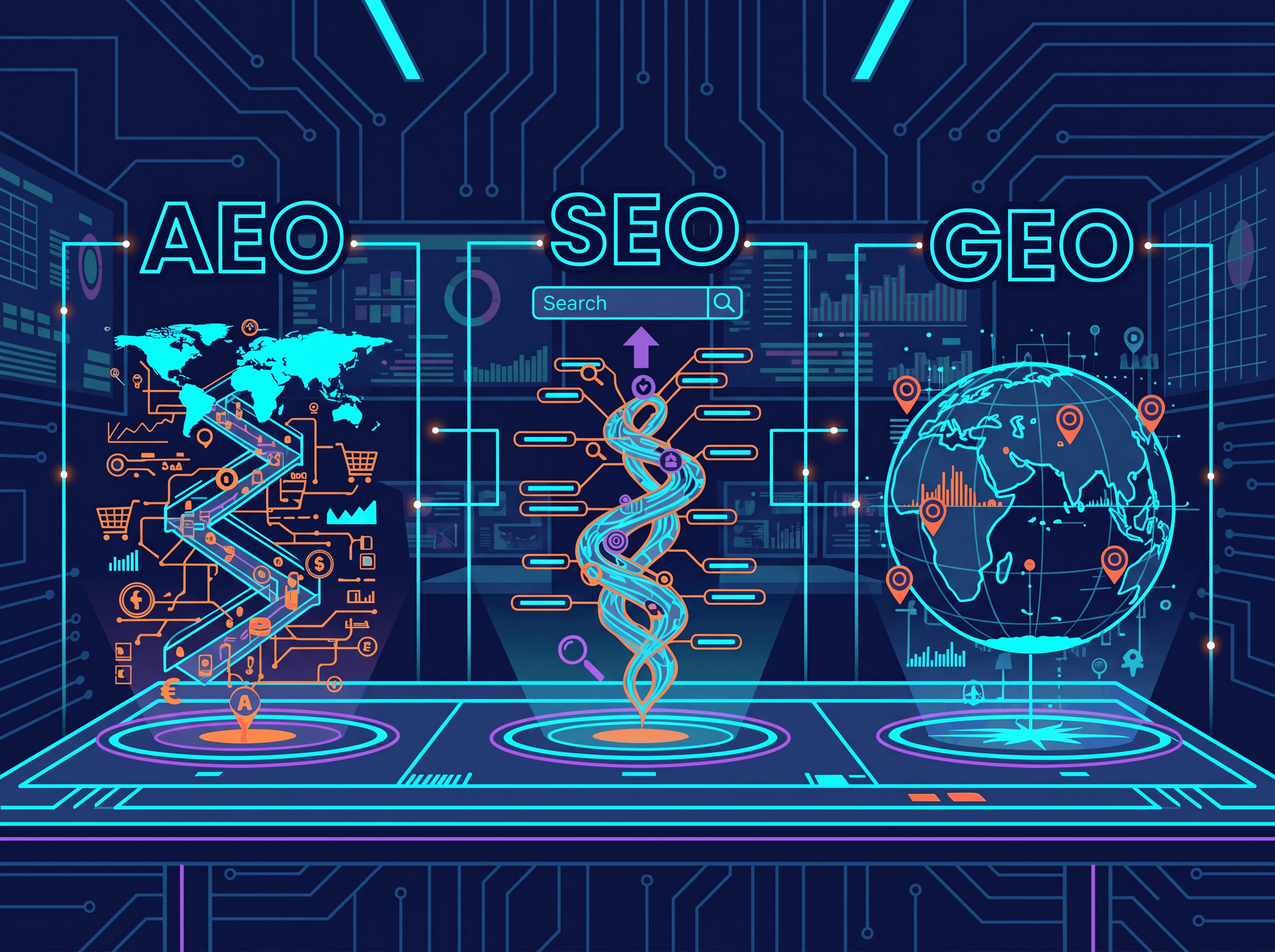
Search has changed more in the last two years than in the previous ten.
Google used to show you ten blue links. Now it shows you an AI-written summary at the top of the page. ChatGPT used to only answer questions from its training data. Now it searches the live web and cites sources. Perplexity, Gemini, and Claude are all doing the same thing.
The result: three different games are happening at the same time. And most businesses are only playing one of them.
This guide explains all three, in plain English, with specific steps for each. By the end, you will know what SEO, GEO, and AEO each mean, how they overlap, what is different about each one, and exactly what to do about it starting this week.
The Big Picture: Why Search Is Being Rebuilt
Here is a number that should stop you in your tracks: 65% of Google searches now end without anyone clicking a website.
More than half the time, the person gets their answer directly on the search results page and never visits any website at all. That number has been climbing for years and it is not going down.
At the same time, ChatGPT now has over 900 million weekly users as of April 2026, doubling from 400 million in just eight months. Google's AI Overviews now appear on roughly 20% of all Google searches. AI-referred sessions jumped 527% year over year in the first half of 2025. These are not rounding errors. This is the search landscape changing shape.
For businesses, this creates a new challenge. Getting a click used to mean ranking on the first page of Google. Now there are three different surfaces that matter: traditional search results, AI-generated answers on Google, and AI tools like ChatGPT and Perplexity. Each rewards slightly different things. And 47% of brands still have no strategy for the new surfaces at all.
That gap is your opportunity.
Part One: SEO (Search Engine Optimization)
What It Is
SEO is the original game. It means making your website show up in Google's traditional search results when people type in a query.
You probably know the basics: keywords on your pages, links from other websites pointing to yours, fast load speed, mobile-friendly design. SEO has been the foundation of online visibility for 25 years and it remains essential.
Here is the key thing to understand in 2026: SEO is not dying. It is feeding everything else.
When ChatGPT searches the web to answer a question, it tends to cite pages that rank in the top positions on Google. One SEO consultant discovered in July 2025 that ChatGPT had quietly switched from using Bing to using Google for its web searches, and that its citations follow Google's search rankings closely. Strong SEO directly improves your GEO and AEO performance because AI systems rely heavily on what Google already trusts.
Think of SEO as the foundation. If the foundation is weak, everything built on top of it is unstable.
What Still Works in 2026
The core of SEO has not changed. What Google wants has always been the same: trustworthy, useful, well-organized content that answers what the person actually searched for.
Keywords still matter. Not keyword stuffing, not cramming a phrase in 40 times, but using the natural language your customers use when they are looking for what you offer.
Backlinks still matter. When respected websites link to yours, Google treats it as a vote of confidence. AI systems also use backlink profiles as a proxy for authority when deciding which sources to cite.
Technical health still matters. Fast load speed, HTTPS security, mobile-friendly design, clean URL structure. These are table stakes. Without them, no amount of content will get you ranked.
E-E-A-T matters more than ever. Experience, Expertise, Authoritativeness, and Trustworthiness. Google evaluates these signals through real author credentials, cited sources, consistent publishing history, and mentions from credible third parties. With AI-generated content flooding the web, genuine human expertise stands out more than it used to.
What to Do Right Now
Run your site through Google Search Console. Look at which searches bring you traffic, which pages are indexed, and any errors. This is free and takes 15 minutes to set up.
Use Google's free PageSpeed Insights to test your site speed. Fix the issues it flags. A page that loads in under 2 seconds gets meaningfully better rankings than one that takes 5 seconds.
Find 10 keywords your customers actually search for using Google Autocomplete and the "People Also Ask" section. Write one piece of thorough, helpful content targeting each one.
Make sure every important page has a clear, keyword-rich title tag under 60 characters. Check that your meta descriptions are compelling and under 160 characters.
Part Two: GEO (Generative Engine Optimization)
What It Is
GEO is the new layer built on top of SEO. It means optimizing your content to appear inside the answers that AI tools generate, not just in the traditional list of search results.
When someone asks ChatGPT "what is the best accounting software for a small restaurant?" they do not get ten blue links. They get a synthesized answer that pulls from multiple sources across the web. GEO is the practice of making sure your brand, your data, and your content are part of that answer.
The formal term was coined in a Princeton, Georgia Tech, and IIT Delhi research paper in 2023. It entered mainstream marketing vocabulary in 2025 as AI search became impossible to ignore. By 2026, most large marketing teams have a GEO strategy. Most small and mid-sized businesses have not started yet.
That is the first-mover window. It will not stay open forever.
Why GEO Is Different From SEO
In traditional SEO, success means ranking high in a list. In GEO, success means being cited inside an answer.
Here is the economic difference. With traditional SEO: your link appears in position three. The user may or may not click. With GEO: the AI cites your brand name, statistic, or definition directly in its answer. The user absorbs your information and associates it with your brand, even if they never visit your website.
This is the new currency. Not clicks. Brand association through citation.
Research from the overlap between top Google links and AI-cited sources shows the gap is growing. The two used to overlap 70% of the time. Now they overlap less than 20% of the time in some categories. You can appear in AI answers without ranking at the top of traditional search, and you can rank at the top of traditional search without appearing in AI answers. They are related but separate games.
What GEO Actually Rewards
AI systems prefer content that is:
Structured for extraction. The AI does not read your whole page the way a human does. It scans for specific facts, definitions, and answers it can lift and use. Content organized with clear headings, short paragraphs, direct answers at the start of each section, and bullet points for lists is far more likely to be cited than dense, unbroken prose.
Dense with specific, dated facts. AI systems prefer content that includes statistics from named sources, current data with years attached, and specific numbers rather than vague claims. "Email marketing returns $36 for every $1 spent, according to Litmus research (2025)" is far more citation-worthy than "email marketing has a great ROI."
Fresh. AI platforms prefer content that is 25.7% fresher than content cited in traditional search results. Updating your best pages with current data and adding "What changed in [current year]" sections signals freshness to AI systems.
From authoritative, trusted sources. Your own website is not always your best GEO asset. AI platforms often trust third-party sources more than brand-owned content. Getting mentioned in industry publications, earning press coverage, being cited in other people's research, and having genuine customer reviews on trusted review platforms all strengthen your GEO presence.
Covering comparison angles. Research from Princeton found that 32.5% of AI citations come from comparison articles. When someone asks "which is better, X or Y?" the AI tends to cite sources that cover both options fairly. Creating comparison content and use-case-specific content ("which tool is best for X type of company") gives you strong GEO footing.
What to Do Right Now for GEO
Start with your direct answer first. Whatever question your page is answering, put the answer in the first 40 to 60 words. Do not build up to it. Do not use the opening paragraph as a warm-up. State the answer immediately. This is how AI systems retrieve information: they look for the direct answer near the top of sections, not buried in paragraph seven.
Reformat your best content. Go to your top three pages and restructure them. Use clear question-based headings like "How does X work?" followed by a direct 2 to 3 sentence answer. Use bullet points for lists. Use short paragraphs of 2 to 3 sentences. Make it easy for a machine to find and extract specific facts.
Add a TL;DR at the top. Many GEO experts recommend putting a summary box or brief summary at the very top of long articles. This gives AI systems an easy extraction point and also helps human readers decide quickly if the page is what they need.
Build your presence beyond your website. Get quoted in industry publications. Contribute data or research that others cite. Be mentioned in podcasts with show notes. Show up on trusted review platforms. AI systems trust the web's consensus about your brand, not just what your website says about itself.
Check if AI crawlers can access your site. Many sites are accidentally blocking AI crawlers through their robots.txt settings. If you use Cloudflare, its default settings may have blocked AI bots automatically. Check your robots.txt file and make sure you are not inadvertently making your content invisible to AI systems.
Part Three: AEO (Answer Engine Optimization)
What It Is
AEO is the practice of making your content the direct answer to specific questions, across featured snippets, voice search, Google's "People Also Ask" boxes, and AI-generated answer summaries.
If SEO is about ranking in a list and GEO is about being cited inside an AI answer, AEO is specifically about being selected as the single best answer to a question.
The terms AEO and GEO are often used interchangeably in the industry and that is fine. There is a useful distinction though. AEO is about winning specific question-answer moments. GEO is about influencing how AI systems describe and recommend your brand more broadly. In practice, the tactics overlap heavily.
The Numbers That Make AEO Urgent
Google's AI Overviews now appear in 20% of all searches. Roughly 60% of searches end without any click at all. Voice search has stabilized at around 20% of all queries globally. And Gartner predicts that traditional search volume will drop 25% by 2026 as users shift to AI chatbots and virtual assistants.
These numbers add up to one thing: the answer box is becoming more important than the ranking.
And here is the most useful finding for anyone building an AEO strategy: pages previously selected for Google Featured Snippets are cited in AI Overviews at roughly twice the rate of pages that were never featured. Winning the old answer boxes still helps you win the new ones.
What AEO Actually Rewards
Concise, direct answers to specific questions. Voice assistants read a single answer aloud. Featured snippets show a single excerpt. AI answers cite a specific passage. All of these favor the same thing: a clear, accurate answer to the question right at the top of the relevant section.
For voice search specifically, the ideal answer is 20 to 30 words. That is one or two sentences. Natural, spoken language. No jargon.
FAQ structure. The most AEO-friendly content format is a question followed immediately by a 1 to 3 sentence answer, followed by more detail for readers who want it. This mirrors exactly how AI systems extract information and how featured snippets get populated.
Schema markup. Schema is code you add to your website that tells search engines exactly what your content means. FAQPage schema, HowTo schema, and Speakable schema (specifically for voice content) are the most valuable types for AEO. Research on schema's direct impact on AI citation is mixed, but FAQPage schema consistently correlates with a 35% higher chance of capturing featured snippets, which in turn doubles your AI Overview citation rate.
Complete coverage of follow-up questions. Modern AI systems engage in multi-turn conversations. A user does not just ask one question and leave. They ask a question, get an answer, and then ask a follow-up. Content that anticipates and answers the obvious follow-up questions within the same page keeps the AI in your content rather than moving to a competitor's.
What to Do Right Now for AEO
Build a question inventory. Write down the 15 most common questions your customers ask before buying from you. Talk to your sales team. Read your customer reviews. Look at the "People Also Ask" section on Google for your main topics. Look at Reddit threads in your industry. These questions are your AEO content map.
Restructure existing content around questions. Take your best pages and add a section of clear question-and-answer pairs at the bottom or throughout the content. Use the exact phrasing people use when they search, not formal or technical language.
Optimize for featured snippets specifically. For any question you want to capture, structure it this way: use the question as a heading, then put the answer in the very first paragraph under that heading. Keep the answer to under 100 words. Structured, direct, complete.
Add FAQ schema markup. Use Google's free Structured Data Helper (search "Google Structured Data Markup Helper") to add FAQPage schema to your most important pages. This is a free tool that generates the code you need.
Test yourself. Open ChatGPT, Perplexity, and Google. Ask the questions your customers would ask about your product, service, or industry. Do you appear in the answers? Are competitors appearing instead? This tells you exactly where you need to focus.
How SEO, GEO, and AEO Work Together
These are not three separate strategies. They are three layers of the same strategy.
SEO builds the foundation. It makes your website trusted, fast, and indexed by the systems that power everything else. Without solid SEO, GEO and AEO are building on sand.
GEO builds your presence across AI systems broadly. It is about being a recognized, trusted, citable source that AI tools draw on when generating answers about your category.
AEO captures specific high-value moments. It is about being the precise answer when someone asks a specific question, whether through voice, a featured snippet, or an AI answer box.
The good news: the same core activity drives all three. Write genuinely helpful content that directly answers real questions, backed by real expertise, organized clearly, and updated regularly. That content wins on Google, gets cited by AI tools, and shows up in answer boxes.
The difference between the three is in the details: the structure of your content, whether you have schema markup, whether AI crawlers can access your pages, whether you are building presence across trusted third-party platforms, and whether you are measuring the right things.
The Metrics That Matter for Each
For SEO: Organic traffic from Google Search Console, keyword rankings, engagement rate in GA4, and conversion rate from organic visitors.
For GEO: Brand mention count in AI tools (manually test 10 to 15 queries in ChatGPT, Perplexity, and Gemini monthly), AI referral traffic in GA4 (track sessions from chat.openai.com, perplexity.ai, and gemini.google.com separately), and how your brand is described when it appears in AI answers.
For AEO: Featured snippet visibility (track in Google Search Console by filtering for queries with high impressions but low clicks, which often means you are appearing in a snippet), People Also Ask presence, and voice search performance for your most common questions.
Your First Week Action Plan

Day 1: Open ChatGPT and Perplexity. Type in the five questions your customers most commonly ask about your product or service. Write down whether you appear in the answers. Write down who does appear. This is your competitive landscape for GEO and AEO.
Day 2: Go to Google Search Console. Look at your queries with the highest impressions but lower-than-expected click-through rates. These are often queries where Google is already showing a featured snippet or AI Overview from your page or a competitor's. These are your AEO opportunities.
Day 3: Pick your three highest-traffic pages. Add a direct answer to the main question in the first paragraph of each one. Keep it to 40 to 60 words. Clear, specific, no preamble.
Day 4: Add an FAQ section to each of those three pages. Write 5 real questions your customers ask. Write direct 2 to 3 sentence answers for each. Add FAQPage schema markup using Google's Structured Data Markup Helper.
Day 5: Check your robots.txt file at yourdomain.com/robots.txt. Make sure you are not blocking major AI crawlers. Common ones to allow include GPTBot (ChatGPT), PerplexityBot, GoogleBot, ClaudeBot, and Applebot.
Day 6: Find one piece of original data your business has that no one else does. A survey result. A unique analysis of your customer data. An original insight from your industry experience. Turn it into a stat you can use in your content and that others would want to cite. This is what gets you GEO traction.
Day 7: Set up monthly tracking. Every month, manually test 10 queries in ChatGPT, Perplexity, and Gemini. Note whether and how your brand appears. Track it in a simple spreadsheet. This is your GEO and AEO scoreboard.
The Bottom Line
The rules of search visibility are being rewritten in real time.
Traditional SEO is not dead. It is the foundation everything else is built on. But relying only on traditional SEO in 2026 means you are playing a game that is shrinking while ignoring two games that are growing fast.
GEO is about becoming the source AI tools trust and cite. AEO is about being the exact answer when someone asks a specific question. Both are accessible to any business willing to restructure how they think about content.
The brands that will dominate search visibility in 2027 are making these moves now. Most of their competitors are still focused only on where they rank on page one of Google.
That gap is your opportunity. Start closing it this week.
Blogs
More Blogs
From keyword goldmines to AI-driven content hacks—expert insights to help your blog posts dominate the first page.