Blog

Blog

SEO for SaaS Startups a Growth Blueprint

SEO for SaaS Startups a Growth Blueprint

Blog

SEO for SaaS Startups a Growth Blueprint

When you're building an SEO strategy for a SaaS startup, the goal isn't just traffic. It's about creating a predictable, scalable engine for customer acquisition. The entire game hinges on a deep understanding of your users' problems, carefully mapping keywords to their journey, and then building content that perfectly bridges the gap between their search and your solution.

Laying the Groundwork for SaaS SEO Success

Before you write a single blog post, you need a solid blueprint. The SaaS market is far too competitive for generic advice. A winning strategy starts with a foundation built on sharp competitor insights, thoughtful keyword mapping, and a content architecture that can actually scale. Nailing this initial groundwork ensures every piece of content you create pushes you closer to your business goals, turning organic search into your most reliable growth channel.

Start With Smart Competitor Analysis

First things first: you need to see what your competitors are doing right. This isn't just about glancing at their domain authority; it's about digging deep to reverse-engineer their success and spot the opportunities they've overlooked.

Analyze their top-performing pages. What content formats are working for them? Are they crushing it with long-form guides, interactive tools, or sharp feature comparisons? Figuring this out gives you a clear roadmap of what resonates with your shared audience, saving you from months of painful guesswork. If you need a refresher, check out our guide on how to find domain authority to see how you and your competitors stack up.

"Many SaaS startups begin their content marketing in the middle of the marketing ecosystem, neglecting the foundational discovery component... We're operating on the premise that you need far more people to be aware of your company than are right now."

This is a classic mistake. So many companies focus only on bottom-of-funnel content without building the awareness that feeds it. Your competitor analysis is the perfect tool to uncover these exact gaps.

Map Keywords Across the Full Customer Journey

Now, take what you've learned from your competitors and build a keyword strategy that mirrors the actual customer journey. People don't just wake up one day and search for your brand. Their path starts with a nagging problem, moves toward exploring potential solutions, and only then ends with choosing a specific product.

You need to map your keywords to each of these distinct stages. To make this really practical, I like to organize it into a simple framework that anyone on the team can understand.

SaaS Customer Journey Keyword Mapping

Funnel Stage

User Intent

Keyword Type Examples

Content Format

Top of Funnel (ToFu)

Awareness & Education

"how to improve team productivity," "project tracking challenges," "content marketing tips for beginners"

Blog posts, guides, infographics, checklists

Middle of Funnel (MoFu)

Consideration & Comparison

"best project management software," "Mailchimp alternatives," "Asana vs Trello"

Comparison pages, case studies, webinars, in-depth product reviews

Bottom of Funnel (BoFu)

Decision & Purchase

"[Your Brand] pricing," "[Competitor] vs [Your Brand]," "[Your Brand] demo," "[Your Brand] integration"

Landing pages, pricing pages, feature pages, free trial sign-ups

This approach ensures you're creating content that meets users exactly where they are, guiding them from a broad problem straight to your solution.

This infographic lays out the whole process, from research to content creation.
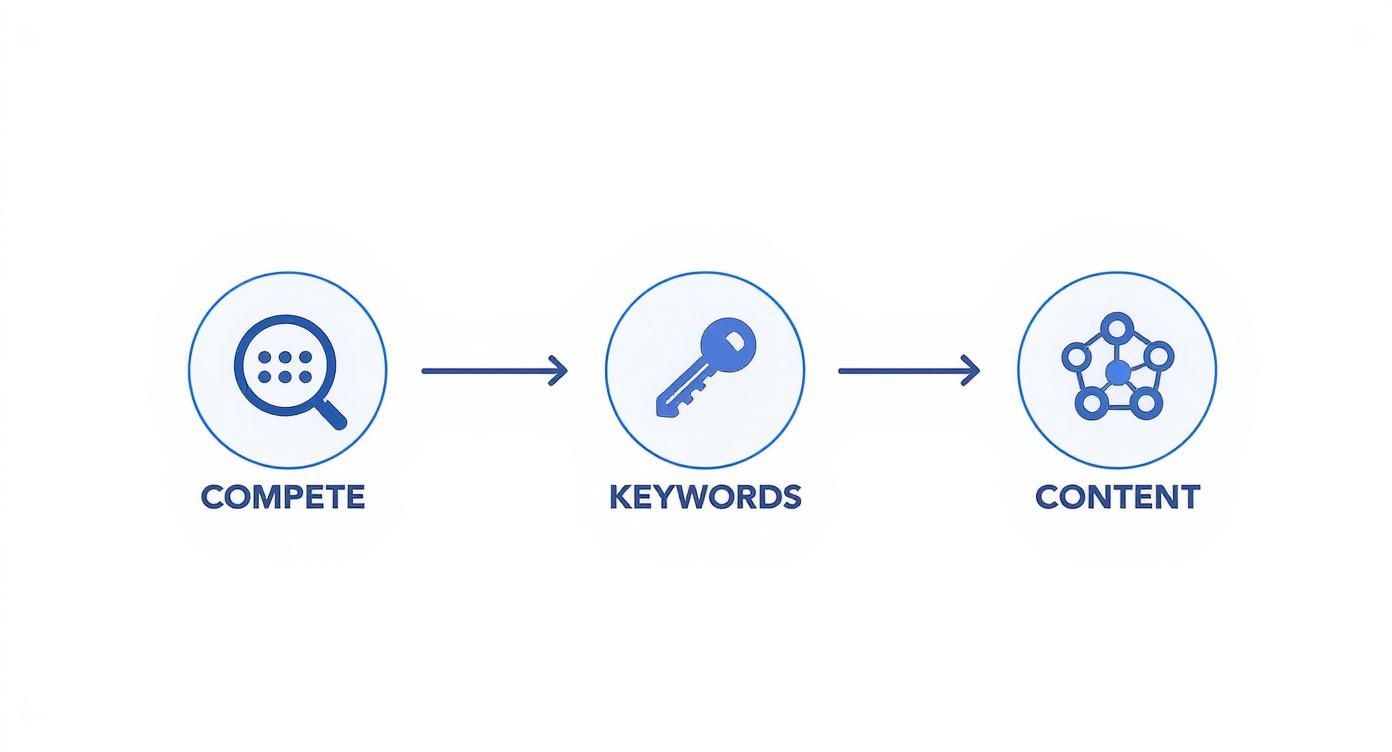
Infographic about seo for saas startups

As you can see, strategic content isn't the starting point—it's the output of careful analysis.

Build Topical Authority With the Hub and Spoke Model

Finally, let's talk about structure. The hub and spoke model is a game-changer for building the kind of topical authority that Google absolutely loves.

Here’s how it works:

  • Your "hub" is a massive, comprehensive pillar page covering a core topic, like "The Ultimate Guide to Project Management."

  • Your "spokes" are shorter, more focused articles that dive into specific sub-topics ("Kanban vs. Scrum," "How to Run an Effective Sprint Planning Meeting") and—this is key—link back to the hub.

This structure does two things brilliantly. It creates a powerful internal linking network that signals your deep expertise to search engines. But more importantly, it gives users a logical path to follow, guiding them from general information right to the specific solutions your product offers.

Investing in this groundwork isn't just about climbing the rankings; it's about building a sustainable asset for your business. For a deeper dive, check out this excellent Guide to SEO for SaaS Companies. The numbers don't lie: SEO can deliver an average ROI of 702% for B2B SaaS startups, often breaking even in just seven months. It's a powerful channel worth getting right from the start.

Finding Keywords That Drive Product-Led Growth
A person using a laptop with keyword research tools on the screen, symbolizing the process of finding valuable search terms.

Real SaaS keyword research is less about chasing massive search volumes and more about getting inside your customer's head. You’re looking for the exact phrases people type into Google the moment they feel the pain your software solves. It's about nailing their intent, not just collecting terms.

Let's be honest, your future customers aren't searching for your brand name. Not yet, anyway. Their journey starts with a problem, a frustration, a roadblock. Your job is to meet them right there and show them a better way—a seamless path from their problem to your free trial.

Uncover Problem-Aware Keywords

This is the absolute goldmine for SEO for SaaS startups. Problem-aware keywords are what people search when they know they have an issue, but they have no idea a tool like yours even exists to fix it. This is your opening to become their go-to resource.

Think about the actual, day-to-day frustrations your product eliminates. A swamped project manager isn't just looking for "collaboration software." They're typing their pain points directly into the search bar.

  • how to track team progress remotely

  • my project deadlines keep slipping

  • spreadsheet for task management is a mess

  • automate weekly status reports

These phrases are pure gold because they reveal true intent. You know exactly what’s bothering them, which means you can create content that gives them an immediate answer while subtly introducing your product as the hero they’ve been looking for. Getting in front of this audience builds trust way before they're even thinking about buying anything.

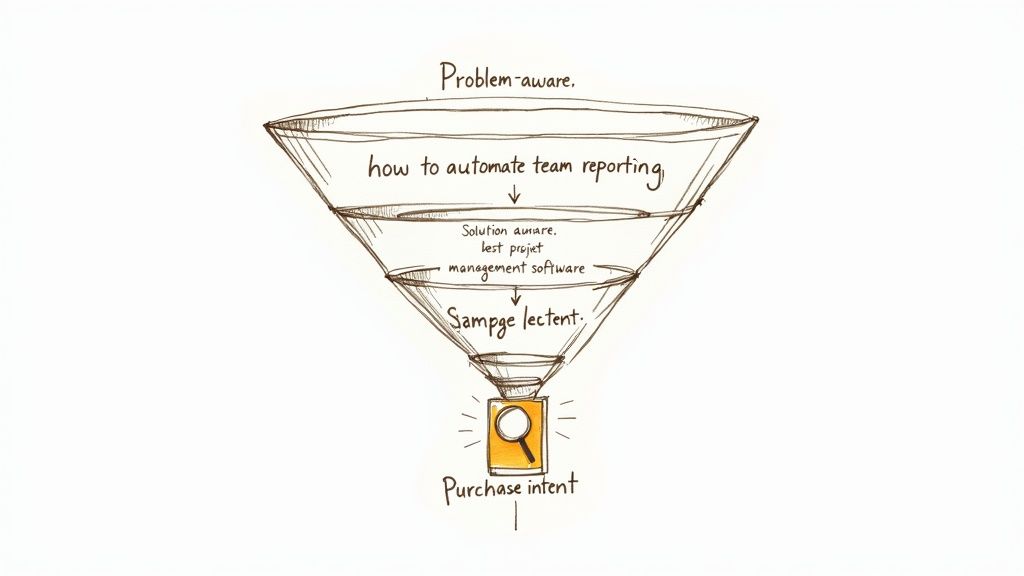
A user searching "how to automate team reporting" is the perfect audience for a blog post like "5 Ways to Automate Team Reporting (Without Wasting Hours)." From there, it's a natural next step to guide them toward your project management tool's slick reporting features.

Connect Problems to Solutions

Once you’ve grabbed their attention with problem-focused content, it's time to connect the dots to your product. This is where solution-aware and product-specific keywords enter the picture. Now they know tools exist to solve their problem, and they're starting to weigh their options.

We're in the middle of the funnel here, where direct comparisons and feature-focused articles really shine. The goal shifts from education to persuasion. You need to show how your product isn't just an option, but the best option for their specific needs.

Keyword Intent Comparison

Mapping your keywords to the user's mindset is critical. It ensures you're delivering the right message at the right time.

Keyword Intent

User Mindset

Example Keyword

Ideal Content

Problem-Aware

"I have a problem and need help."

"how to manage multiple projects"

Educational blog post

Solution-Aware

"What tools can solve my problem?"

"best project management software"

Comparison landing page

Product-Aware

"Is this specific tool right for me?"

"Asana vs Trello"

Head-to-head analysis page

Brand-Aware

"I want to buy this specific tool."

"[Your Brand] pricing"

Pricing page

When you map your keywords across these stages, you build a cohesive content machine that guides a user all the way from "I have a problem" to "take my money."

Analyze Competitor Keyword Gaps

Your competitors have already done a ton of the heavy lifting for you. Digging into their keyword strategy is one of the fastest ways to find high-value opportunities you’ve overlooked. But don't just see what they rank for—figure out why they rank for it.

Using a tool like Viral SEO's Content Gap Analyzer, you can quickly spot the keywords driving traffic to their blog, feature pages, and landing pages. Are they ranking for a bunch of long-tail phrases you’ve been ignoring? A deep dive into long-tail keyword research often uncovers high-intent, low-competition terms that convert like crazy. For more on this, check out our guide here: https://getviralseo.com/articles/long-tail-keyword-research.

Look for the patterns. Maybe they own every keyword related to a specific integration or a niche use case. This is your cue. You can either decide to challenge them with a much better piece of content or pivot to target an underserved segment of the market they've completely missed. This is how you turn research into revenue—by building a keyword map that connects these gaps directly to your own product's strengths.

Designing SaaS Landing Pages That Convert
A visually engaging SaaS landing page on a laptop screen, highlighting a clear headline, social proof, and a prominent call-to-action button.

Getting the right people to your website is a huge victory, but let’s be honest—it's only half the battle. Your landing page has to do the real work of turning that traffic into trial sign-ups, demo requests, or paying customers. This isn't just about pretty design; it's a careful dance between a great user experience and smart on-page SEO.

A truly effective landing page answers a visitor's unspoken questions within seconds, all while signaling its authority to search engines. The best ones don't feel like a sales pitch. They feel like the most logical next step for someone trying to solve a problem. They blend persuasive copy, intuitive design, and just enough keyword optimization to make both users and Google happy.

Grab Their Attention Above the Fold

You've got about three seconds. That's it. The "above the fold" section—what visitors see without scrolling—is your most critical real estate. It has to instantly confirm they've landed in the right place and spell out your value proposition with zero ambiguity.

Your headline is everything here. Forget the vague marketing fluff like "The Future of Collaboration." Get specific and focus on the outcome. Something like "Stop Drowning in Spreadsheets. Manage Your Entire Project in One Place" immediately connects with a real pain point and offers a clear solution.

This top section needs to nail three things:

  • A Benefit-Driven Headline: State the #1 result your software delivers.

  • A Clear Sub-headline: Add a sentence or two explaining how your product delivers that benefit.

  • A Compelling Call-to-Action (CTA): Keep it low-friction. "Start Your Free 14-Day Trial" is way more inviting than a hard-commitment "Buy Now."

Getting this combination right is the single best way to lower your bounce rate and hook visitors into scrolling further.

Weave in Keywords and Customer Pain Points

This is where great copy pulls double duty. It needs to rank for your target keywords and resonate with the actual struggles of your audience. The secret is to write for people first, then gently optimize for search engines. Before you write a single word, immerse yourself in the language your customers use to talk about their problems.

Forget about keyword stuffing. The goal is semantic relevance. If your main keyword is "project management software," your copy should naturally include phrases like "task tracking," "team collaboration," "deadline management," and "reporting dashboards." This shows Google you have deep expertise on the topic. If you're wrestling with the details, our guide on how many keywords per page breaks down how to find that sweet spot.

Your landing page isn't just a sales tool; it's a powerful SEO asset. When you align your copy with real user pain points, you create a page that doesn’t just convert visitors—it attracts them organically from search in the first place.

Build Trust With Social Proof and Unmissable CTAs

Okay, you've grabbed their attention and shown you understand their problem. Now you have to earn their trust. For any SaaS business, social proof is your most potent trust-builder. It’s the validation that calms a potential customer’s nerves and makes signing up feel like a safe bet.

Sprinkle these trust signals throughout your page:

  • Customer Testimonials: Use quotes from real users that talk about specific results. Add their name, title, and company to make it credible.

  • Company Logos: Displaying the logos of companies that use your software—especially well-known ones—is a massive shortcut to building trust.

  • Case Studies: Link out to short, punchy stories of how a customer solved a problem with your product.

  • Ratings and Reviews: Got great scores on G2, Capterra, or a similar site? Show them off!

Finally, make your CTAs impossible to ignore. Use a color that pops against your background, and strategically repeat your main CTA as the user scrolls down the page. The moment they decide to take the next step, a button should be right there waiting. Every element should work together to make the decision to sign up feel easy, logical, and completely risk-free.

Getting Technical SEO Right for Your SaaS Platform
A digital illustration of a SaaS platform's code structure with gears and connecting lines, representing the inner workings of technical SEO.

Technical SEO is the engine under the hood of your entire content strategy. For a SaaS business, this isn't about chasing a perfect score on some arbitrary checklist. It’s about being ruthless with your priorities and focusing on the handful of things that truly move the needle for Google and your future customers.

Think of it this way: your website is your digital storefront. If the doors are jammed, the lights are flickering, and the layout is a confusing maze, no one is sticking around for the demo. Nailing a few technical fundamentals ensures that when search engine crawlers and real users show up, they find a fast, clean, and intuitive experience. This is bigger than just rankings; it's about building a platform that just works from the very first click.

Make Blazing-Fast Site Speed a Non-Negotiable

In the world of SaaS, speed isn't a feature—it's table stakes. A slow-loading page is a direct hit to your bottom line. Even a one-second delay in page load time can slash conversions by 7%. For a startup fighting for every trial signup, that's a number you simply can't ignore.

Your technical team should be obsessed with Core Web Vitals, Google’s own metrics for measuring the real-world user experience of your site. These aren't just abstract numbers; they directly translate to how fast and stable your site feels to a person. A huge part of this is image handling; for a deep dive, check out this guide on optimizing images for web performance and SEO.

A fast website is no longer a nice-to-have. It's a direct reflection of your product's quality. If your marketing site is slow and clunky, users will assume your software is too. First impressions are everything.

Use Schema Markup to Your Advantage

Schema markup is essentially a cheat sheet you give to Google. It’s a layer of code you add to your pages that explicitly tells search engines what your content is all about, which is a massive opportunity for a SaaS company to dominate the search results.

By implementing the right kind of schema, you can earn rich snippets—those eye-catching extras like star ratings, pricing, and FAQs that show up directly in the search results. They make your listing impossible to ignore.

Here’s where to focus your efforts:

  • SoftwareApplication Schema: This one is non-negotiable. It lets you spell out details like your app's name, category, operating system, and aggregate rating.

  • Review Schema: This markup pulls in customer reviews and star ratings, giving you instant social proof right on the search results page.

  • FAQ Schema: Perfect for landing pages and support docs. Answering common questions here can expand your search listing, making it far more informative and clickable.

These simple additions make your listings far more compelling, driving higher-quality traffic before a user even lands on your site.

Build a Clean, Logical Site Architecture

A clean site architecture is critical for both users and search engine crawlers. It’s the blueprint that helps Google understand which pages are most important and how they all connect. If your site structure is a tangled mess, your most valuable pages can get lost in the shuffle and never reach their ranking potential.

It all starts with a sensible URL structure. Your URLs should be clean, readable, and hint at the page's content.

  • Bad: yourdomain.com/page-id=123

  • Good: yourdomain.com/features/team-collaboration

See the difference? The second one immediately tells you what to expect.

From there, it’s all about smart internal linking. Your core product and feature pages should be the hub, with spokes linking out from relevant blog posts and guides. This strategy passes authority to your most important commercial pages and creates a clear path for users to move from learning about a problem to discovering your solution. A well-planned architecture ensures every piece of content you create is working to support your ultimate goal: driving product-led growth.

Navigating the Future of SaaS SEO

The world of search is always in motion, but for a SaaS startup, you're living right at the heart of the latest earthquake. The old playbook? It's collecting dust. Just targeting high-volume keywords and hoping for the best won't cut it anymore. To win, you have to look ahead and build a strategy that’s not just for today, but for where search is going tomorrow.

The biggest shift, without a doubt, is the rapid rise of AI-driven search. This isn't some far-off concept; it’s here. Search engines are transforming into answer engines, focused on solving a user's problem right there on the results page. This completely changes the game for how users find information and demands a fresh approach to your entire SEO strategy.

Embracing AI Search and Zero-Click Results

Let's be real: the goal isn't always to get a click anymore. The new goal is to be the answer. You want your content to be the definitive source that powers AI-generated responses and featured snippets. This means you need to start creating content that large language models can easily understand and cite.

Think less about long-winded articles and more about providing direct, authoritative answers to very specific questions. Your content needs to be tight, well-structured with clean headings, and backed by facts. When an AI model searches for the best answer to "how does X feature solve Y problem," your landing page should be the clearest, most trustworthy source it finds.

This move toward direct answers is already having a massive impact. With the explosion of AI-generated content and zero-click searches, user behavior is fundamentally changing. In fact, a recent report highlighted that by mid-2025, nearly half of all SEO professionals expect zero-click searches to make up over 50% of SaaS-related queries. This happens when Google’s AI summaries or "position zero" snippets give the user everything they need, making a click to your site unnecessary. You can dig into more of these trends in the latest SaaS SEO statistics from Digital World Institute.

Your new mission is to win the "answer," not just the click. This means structuring content with clear, concise information that AI can easily parse and present, establishing your brand as an authority even if the user never visits your site on that first search.

To stay competitive, your SEO strategy needs to adapt. Gone are the days of simple keyword stuffing and link building. Today's approach is far more nuanced, focusing on brand authority, user intent, and creating content that serves the "answer engine" model.

Here's a look at how things have shifted:

SaaS SEO Strategy Evolution

Focus Area

Traditional Tactic

Modern Approach

Keyword Goal

Rank #1 for high-volume head terms.

Become the cited source in AI answers and snippets.

Content Strategy

Long-form, keyword-dense blog posts.

Concise, well-structured content answering specific user questions.

Primary Metric

Organic traffic and keyword rankings.

Share of voice, brand visibility in snippets, and conversions.

Technical SEO

Basic on-page optimization (titles, metas).

Structured data, schema markup, and content optimized for LLMs.

Brand Role

A secondary factor to technical signals.

A primary trust signal for both users and search engines.

This evolution isn't just a trend; it's a fundamental change in how search works. Adapting to this modern approach is no longer optional—it's essential for survival and growth.

Building Brand and Topical Authority as Your Moat

In this new world, your brand and topical authority are your ultimate defense. When Google sees you as a true expert on a topic—say, "project management for remote teams"—it's far more likely to trust your content and feature it in search results.

This is exactly why the "hub and spoke" model we covered earlier is so powerful. It's more than just an internal linking strategy; it's how you prove your deep expertise on a subject. A strong, recognizable brand acts as a powerful trust signal, encouraging users to click on your result over a competitor's or even search for you directly.

A strong brand creates a powerful growth loop:

  • Better Click-Through Rates: People click on brands they know and trust. Simple as that.

  • More Branded Searches: As you build authority, users will start searching for "[Your Brand] + keyword," bypassing the competition.

  • Natural Backlinks: Other authoritative sites will start linking to your content as a go-to resource, supercharging your credibility.

Building this kind of authority doesn't happen overnight, but it’s the most durable competitive advantage you can create in SEO for SaaS startups.

The Growing Importance of Long-Tail Keywords

While AI is getting great at answering broad, head-term searches, the real opportunity is shifting to long-tail keywords. These longer, more specific search queries show a much higher level of intent.

Think about it. Someone searching for "project management software" is just window shopping. But someone searching for "best project management software for a small marketing agency" is ready to make a decision.

These hyper-specific queries are far less likely to be answered by a simple AI summary because the intent is more complex and nuanced. This is where your deep-dive content—detailed comparison pages, specific use-case guides, and niche tutorials—can really stand out.

By focusing on these specific queries, you attract highly qualified traffic that’s much further down the buying funnel. You might get fewer visitors from a single long-tail keyword, but the conversion rate will be exponentially higher. In an age where every click has to count, this is how you make SEO a direct driver of revenue and product-led growth. Your entire future strategy hinges on it.

SaaS SEO Frequently Asked Questions

When you're trying to grow a SaaS company, SEO can feel like a bit of a black box. A few questions always seem to pop up, and getting straight answers is key to spending your time and money wisely.

How Long Does SaaS SEO Take to Show Results?

This is probably the most common question I hear, and the honest answer is: it takes time. While you might spot some small ranking improvements within a few months, seeing a real, meaningful impact usually takes a solid 6 to 12 months of consistent work.

What does "meaningful impact" mean? I'm talking about ranking for keywords that actually drive business and seeing a steady stream of organic demo requests or sign-ups.

Of course, that timeline can shift based on a few things:

  • Market Competition: Trying to rank in a packed, established category? It's going to be a longer, tougher climb.

  • Your Starting Line: A brand-new website is starting from scratch, whereas a domain with a bit of history has a head start.

  • Your Investment: The pace and quality of your content creation and link-building efforts will directly influence how quickly you see a return.

Think of SEO as a long-term play that builds on itself. It’s not a quick hack; it’s a growth engine that gets more powerful over time.

Should I Prioritize Content or Technical SEO First?

Ah, the classic chicken-or-egg problem for SaaS startups. My advice is to tackle them both, but with a strategic order of operations.

Start by getting your foundational technical SEO in order. You absolutely need a site that search engines can easily crawl, that loads quickly, and that works perfectly on mobile devices. You can't expect to build a great content strategy on a shaky technical foundation. This doesn't mean it has to be perfect, just solid.

Once you've checked those technical boxes, pivot your main focus to creating exceptional, problem-solving content. At the end of the day, great content is what earns you links, builds your authority, and convinces people to try your product. You can always circle back to refine the technical stuff as your site grows.

What Are the Most Important SaaS SEO Metrics to Track?

It’s easy to get bogged down in data that looks impressive but doesn't actually mean anything for your bottom line. Ignore the vanity metrics and zero in on the numbers that tie directly to business growth.

Here’s what really matters:

  • Organic Trial/Demo Sign-ups: This is the North Star. Is your SEO effort actually generating paying customers? This is the ultimate test.

  • Keyword Rankings for High-Intent Terms: Keep a close eye on your rankings for "money" keywords. Think phrases like "[competitor] alternative" or "best [your solution] software." These show clear buying intent.

  • Organic Traffic to Core Pages: Don't just look at overall blog traffic. How many people are landing on your pricing, features, and solution pages? That’s where conversions happen.

Ready to stop guessing and start building a content strategy that drives real growth? Viral SEO gives you the tools to uncover competitor strategies, find high-value content gaps, and turn organic search into your most predictable acquisition channel. Start for free and see how it works.

When you're building an SEO strategy for a SaaS startup, the goal isn't just traffic. It's about creating a predictable, scalable engine for customer acquisition. The entire game hinges on a deep understanding of your users' problems, carefully mapping keywords to their journey, and then building content that perfectly bridges the gap between their search and your solution.

Laying the Groundwork for SaaS SEO Success

Before you write a single blog post, you need a solid blueprint. The SaaS market is far too competitive for generic advice. A winning strategy starts with a foundation built on sharp competitor insights, thoughtful keyword mapping, and a content architecture that can actually scale. Nailing this initial groundwork ensures every piece of content you create pushes you closer to your business goals, turning organic search into your most reliable growth channel.

Start With Smart Competitor Analysis

First things first: you need to see what your competitors are doing right. This isn't just about glancing at their domain authority; it's about digging deep to reverse-engineer their success and spot the opportunities they've overlooked.

Analyze their top-performing pages. What content formats are working for them? Are they crushing it with long-form guides, interactive tools, or sharp feature comparisons? Figuring this out gives you a clear roadmap of what resonates with your shared audience, saving you from months of painful guesswork. If you need a refresher, check out our guide on how to find domain authority to see how you and your competitors stack up.

"Many SaaS startups begin their content marketing in the middle of the marketing ecosystem, neglecting the foundational discovery component... We're operating on the premise that you need far more people to be aware of your company than are right now."

This is a classic mistake. So many companies focus only on bottom-of-funnel content without building the awareness that feeds it. Your competitor analysis is the perfect tool to uncover these exact gaps.

Map Keywords Across the Full Customer Journey

Now, take what you've learned from your competitors and build a keyword strategy that mirrors the actual customer journey. People don't just wake up one day and search for your brand. Their path starts with a nagging problem, moves toward exploring potential solutions, and only then ends with choosing a specific product.

You need to map your keywords to each of these distinct stages. To make this really practical, I like to organize it into a simple framework that anyone on the team can understand.

SaaS Customer Journey Keyword Mapping

Funnel Stage

User Intent

Keyword Type Examples

Content Format

Top of Funnel (ToFu)

Awareness & Education

"how to improve team productivity," "project tracking challenges," "content marketing tips for beginners"

Blog posts, guides, infographics, checklists

Middle of Funnel (MoFu)

Consideration & Comparison

"best project management software," "Mailchimp alternatives," "Asana vs Trello"

Comparison pages, case studies, webinars, in-depth product reviews

Bottom of Funnel (BoFu)

Decision & Purchase

"[Your Brand] pricing," "[Competitor] vs [Your Brand]," "[Your Brand] demo," "[Your Brand] integration"

Landing pages, pricing pages, feature pages, free trial sign-ups

This approach ensures you're creating content that meets users exactly where they are, guiding them from a broad problem straight to your solution.

This infographic lays out the whole process, from research to content creation.

Infographic about seo for saas startups

As you can see, strategic content isn't the starting point—it's the output of careful analysis.

Build Topical Authority With the Hub and Spoke Model

Finally, let's talk about structure. The hub and spoke model is a game-changer for building the kind of topical authority that Google absolutely loves.

Here’s how it works:

  • Your "hub" is a massive, comprehensive pillar page covering a core topic, like "The Ultimate Guide to Project Management."

  • Your "spokes" are shorter, more focused articles that dive into specific sub-topics ("Kanban vs. Scrum," "How to Run an Effective Sprint Planning Meeting") and—this is key—link back to the hub.

This structure does two things brilliantly. It creates a powerful internal linking network that signals your deep expertise to search engines. But more importantly, it gives users a logical path to follow, guiding them from general information right to the specific solutions your product offers.

Investing in this groundwork isn't just about climbing the rankings; it's about building a sustainable asset for your business. For a deeper dive, check out this excellent Guide to SEO for SaaS Companies. The numbers don't lie: SEO can deliver an average ROI of 702% for B2B SaaS startups, often breaking even in just seven months. It's a powerful channel worth getting right from the start.

Finding Keywords That Drive Product-Led Growth

A person using a laptop with keyword research tools on the screen, symbolizing the process of finding valuable search terms.

Real SaaS keyword research is less about chasing massive search volumes and more about getting inside your customer's head. You’re looking for the exact phrases people type into Google the moment they feel the pain your software solves. It's about nailing their intent, not just collecting terms.

Let's be honest, your future customers aren't searching for your brand name. Not yet, anyway. Their journey starts with a problem, a frustration, a roadblock. Your job is to meet them right there and show them a better way—a seamless path from their problem to your free trial.

Uncover Problem-Aware Keywords

This is the absolute goldmine for SEO for SaaS startups. Problem-aware keywords are what people search when they know they have an issue, but they have no idea a tool like yours even exists to fix it. This is your opening to become their go-to resource.

Think about the actual, day-to-day frustrations your product eliminates. A swamped project manager isn't just looking for "collaboration software." They're typing their pain points directly into the search bar.

  • how to track team progress remotely

  • my project deadlines keep slipping

  • spreadsheet for task management is a mess

  • automate weekly status reports

These phrases are pure gold because they reveal true intent. You know exactly what’s bothering them, which means you can create content that gives them an immediate answer while subtly introducing your product as the hero they’ve been looking for. Getting in front of this audience builds trust way before they're even thinking about buying anything.

A user searching "how to automate team reporting" is the perfect audience for a blog post like "5 Ways to Automate Team Reporting (Without Wasting Hours)." From there, it's a natural next step to guide them toward your project management tool's slick reporting features.

Connect Problems to Solutions

Once you’ve grabbed their attention with problem-focused content, it's time to connect the dots to your product. This is where solution-aware and product-specific keywords enter the picture. Now they know tools exist to solve their problem, and they're starting to weigh their options.

We're in the middle of the funnel here, where direct comparisons and feature-focused articles really shine. The goal shifts from education to persuasion. You need to show how your product isn't just an option, but the best option for their specific needs.

Keyword Intent Comparison

Mapping your keywords to the user's mindset is critical. It ensures you're delivering the right message at the right time.

Keyword Intent

User Mindset

Example Keyword

Ideal Content

Problem-Aware

"I have a problem and need help."

"how to manage multiple projects"

Educational blog post

Solution-Aware

"What tools can solve my problem?"

"best project management software"

Comparison landing page

Product-Aware

"Is this specific tool right for me?"

"Asana vs Trello"

Head-to-head analysis page

Brand-Aware

"I want to buy this specific tool."

"[Your Brand] pricing"

Pricing page

When you map your keywords across these stages, you build a cohesive content machine that guides a user all the way from "I have a problem" to "take my money."

Analyze Competitor Keyword Gaps

Your competitors have already done a ton of the heavy lifting for you. Digging into their keyword strategy is one of the fastest ways to find high-value opportunities you’ve overlooked. But don't just see what they rank for—figure out why they rank for it.

Using a tool like Viral SEO's Content Gap Analyzer, you can quickly spot the keywords driving traffic to their blog, feature pages, and landing pages. Are they ranking for a bunch of long-tail phrases you’ve been ignoring? A deep dive into long-tail keyword research often uncovers high-intent, low-competition terms that convert like crazy. For more on this, check out our guide here: https://getviralseo.com/articles/long-tail-keyword-research.

Look for the patterns. Maybe they own every keyword related to a specific integration or a niche use case. This is your cue. You can either decide to challenge them with a much better piece of content or pivot to target an underserved segment of the market they've completely missed. This is how you turn research into revenue—by building a keyword map that connects these gaps directly to your own product's strengths.

Designing SaaS Landing Pages That Convert

A visually engaging SaaS landing page on a laptop screen, highlighting a clear headline, social proof, and a prominent call-to-action button.

Getting the right people to your website is a huge victory, but let’s be honest—it's only half the battle. Your landing page has to do the real work of turning that traffic into trial sign-ups, demo requests, or paying customers. This isn't just about pretty design; it's a careful dance between a great user experience and smart on-page SEO.

A truly effective landing page answers a visitor's unspoken questions within seconds, all while signaling its authority to search engines. The best ones don't feel like a sales pitch. They feel like the most logical next step for someone trying to solve a problem. They blend persuasive copy, intuitive design, and just enough keyword optimization to make both users and Google happy.

Grab Their Attention Above the Fold

You've got about three seconds. That's it. The "above the fold" section—what visitors see without scrolling—is your most critical real estate. It has to instantly confirm they've landed in the right place and spell out your value proposition with zero ambiguity.

Your headline is everything here. Forget the vague marketing fluff like "The Future of Collaboration." Get specific and focus on the outcome. Something like "Stop Drowning in Spreadsheets. Manage Your Entire Project in One Place" immediately connects with a real pain point and offers a clear solution.

This top section needs to nail three things:

  • A Benefit-Driven Headline: State the #1 result your software delivers.

  • A Clear Sub-headline: Add a sentence or two explaining how your product delivers that benefit.

  • A Compelling Call-to-Action (CTA): Keep it low-friction. "Start Your Free 14-Day Trial" is way more inviting than a hard-commitment "Buy Now."

Getting this combination right is the single best way to lower your bounce rate and hook visitors into scrolling further.

Weave in Keywords and Customer Pain Points

This is where great copy pulls double duty. It needs to rank for your target keywords and resonate with the actual struggles of your audience. The secret is to write for people first, then gently optimize for search engines. Before you write a single word, immerse yourself in the language your customers use to talk about their problems.

Forget about keyword stuffing. The goal is semantic relevance. If your main keyword is "project management software," your copy should naturally include phrases like "task tracking," "team collaboration," "deadline management," and "reporting dashboards." This shows Google you have deep expertise on the topic. If you're wrestling with the details, our guide on how many keywords per page breaks down how to find that sweet spot.

Your landing page isn't just a sales tool; it's a powerful SEO asset. When you align your copy with real user pain points, you create a page that doesn’t just convert visitors—it attracts them organically from search in the first place.

Build Trust With Social Proof and Unmissable CTAs

Okay, you've grabbed their attention and shown you understand their problem. Now you have to earn their trust. For any SaaS business, social proof is your most potent trust-builder. It’s the validation that calms a potential customer’s nerves and makes signing up feel like a safe bet.

Sprinkle these trust signals throughout your page:

  • Customer Testimonials: Use quotes from real users that talk about specific results. Add their name, title, and company to make it credible.

  • Company Logos: Displaying the logos of companies that use your software—especially well-known ones—is a massive shortcut to building trust.

  • Case Studies: Link out to short, punchy stories of how a customer solved a problem with your product.

  • Ratings and Reviews: Got great scores on G2, Capterra, or a similar site? Show them off!

Finally, make your CTAs impossible to ignore. Use a color that pops against your background, and strategically repeat your main CTA as the user scrolls down the page. The moment they decide to take the next step, a button should be right there waiting. Every element should work together to make the decision to sign up feel easy, logical, and completely risk-free.

Getting Technical SEO Right for Your SaaS Platform

A digital illustration of a SaaS platform's code structure with gears and connecting lines, representing the inner workings of technical SEO.

Technical SEO is the engine under the hood of your entire content strategy. For a SaaS business, this isn't about chasing a perfect score on some arbitrary checklist. It’s about being ruthless with your priorities and focusing on the handful of things that truly move the needle for Google and your future customers.

Think of it this way: your website is your digital storefront. If the doors are jammed, the lights are flickering, and the layout is a confusing maze, no one is sticking around for the demo. Nailing a few technical fundamentals ensures that when search engine crawlers and real users show up, they find a fast, clean, and intuitive experience. This is bigger than just rankings; it's about building a platform that just works from the very first click.

Make Blazing-Fast Site Speed a Non-Negotiable

In the world of SaaS, speed isn't a feature—it's table stakes. A slow-loading page is a direct hit to your bottom line. Even a one-second delay in page load time can slash conversions by 7%. For a startup fighting for every trial signup, that's a number you simply can't ignore.

Your technical team should be obsessed with Core Web Vitals, Google’s own metrics for measuring the real-world user experience of your site. These aren't just abstract numbers; they directly translate to how fast and stable your site feels to a person. A huge part of this is image handling; for a deep dive, check out this guide on optimizing images for web performance and SEO.

A fast website is no longer a nice-to-have. It's a direct reflection of your product's quality. If your marketing site is slow and clunky, users will assume your software is too. First impressions are everything.

Use Schema Markup to Your Advantage

Schema markup is essentially a cheat sheet you give to Google. It’s a layer of code you add to your pages that explicitly tells search engines what your content is all about, which is a massive opportunity for a SaaS company to dominate the search results.

By implementing the right kind of schema, you can earn rich snippets—those eye-catching extras like star ratings, pricing, and FAQs that show up directly in the search results. They make your listing impossible to ignore.

Here’s where to focus your efforts:

  • SoftwareApplication Schema: This one is non-negotiable. It lets you spell out details like your app's name, category, operating system, and aggregate rating.

  • Review Schema: This markup pulls in customer reviews and star ratings, giving you instant social proof right on the search results page.

  • FAQ Schema: Perfect for landing pages and support docs. Answering common questions here can expand your search listing, making it far more informative and clickable.

These simple additions make your listings far more compelling, driving higher-quality traffic before a user even lands on your site.

Build a Clean, Logical Site Architecture

A clean site architecture is critical for both users and search engine crawlers. It’s the blueprint that helps Google understand which pages are most important and how they all connect. If your site structure is a tangled mess, your most valuable pages can get lost in the shuffle and never reach their ranking potential.

It all starts with a sensible URL structure. Your URLs should be clean, readable, and hint at the page's content.

  • Bad: yourdomain.com/page-id=123

  • Good: yourdomain.com/features/team-collaboration

See the difference? The second one immediately tells you what to expect.

From there, it’s all about smart internal linking. Your core product and feature pages should be the hub, with spokes linking out from relevant blog posts and guides. This strategy passes authority to your most important commercial pages and creates a clear path for users to move from learning about a problem to discovering your solution. A well-planned architecture ensures every piece of content you create is working to support your ultimate goal: driving product-led growth.

Navigating the Future of SaaS SEO

The world of search is always in motion, but for a SaaS startup, you're living right at the heart of the latest earthquake. The old playbook? It's collecting dust. Just targeting high-volume keywords and hoping for the best won't cut it anymore. To win, you have to look ahead and build a strategy that’s not just for today, but for where search is going tomorrow.

The biggest shift, without a doubt, is the rapid rise of AI-driven search. This isn't some far-off concept; it’s here. Search engines are transforming into answer engines, focused on solving a user's problem right there on the results page. This completely changes the game for how users find information and demands a fresh approach to your entire SEO strategy.

Embracing AI Search and Zero-Click Results

Let's be real: the goal isn't always to get a click anymore. The new goal is to be the answer. You want your content to be the definitive source that powers AI-generated responses and featured snippets. This means you need to start creating content that large language models can easily understand and cite.

Think less about long-winded articles and more about providing direct, authoritative answers to very specific questions. Your content needs to be tight, well-structured with clean headings, and backed by facts. When an AI model searches for the best answer to "how does X feature solve Y problem," your landing page should be the clearest, most trustworthy source it finds.

This move toward direct answers is already having a massive impact. With the explosion of AI-generated content and zero-click searches, user behavior is fundamentally changing. In fact, a recent report highlighted that by mid-2025, nearly half of all SEO professionals expect zero-click searches to make up over 50% of SaaS-related queries. This happens when Google’s AI summaries or "position zero" snippets give the user everything they need, making a click to your site unnecessary. You can dig into more of these trends in the latest SaaS SEO statistics from Digital World Institute.

Your new mission is to win the "answer," not just the click. This means structuring content with clear, concise information that AI can easily parse and present, establishing your brand as an authority even if the user never visits your site on that first search.

To stay competitive, your SEO strategy needs to adapt. Gone are the days of simple keyword stuffing and link building. Today's approach is far more nuanced, focusing on brand authority, user intent, and creating content that serves the "answer engine" model.

Here's a look at how things have shifted:

SaaS SEO Strategy Evolution

Focus Area

Traditional Tactic

Modern Approach

Keyword Goal

Rank #1 for high-volume head terms.

Become the cited source in AI answers and snippets.

Content Strategy

Long-form, keyword-dense blog posts.

Concise, well-structured content answering specific user questions.

Primary Metric

Organic traffic and keyword rankings.

Share of voice, brand visibility in snippets, and conversions.

Technical SEO

Basic on-page optimization (titles, metas).

Structured data, schema markup, and content optimized for LLMs.

Brand Role

A secondary factor to technical signals.

A primary trust signal for both users and search engines.

This evolution isn't just a trend; it's a fundamental change in how search works. Adapting to this modern approach is no longer optional—it's essential for survival and growth.

Building Brand and Topical Authority as Your Moat

In this new world, your brand and topical authority are your ultimate defense. When Google sees you as a true expert on a topic—say, "project management for remote teams"—it's far more likely to trust your content and feature it in search results.

This is exactly why the "hub and spoke" model we covered earlier is so powerful. It's more than just an internal linking strategy; it's how you prove your deep expertise on a subject. A strong, recognizable brand acts as a powerful trust signal, encouraging users to click on your result over a competitor's or even search for you directly.

A strong brand creates a powerful growth loop:

  • Better Click-Through Rates: People click on brands they know and trust. Simple as that.

  • More Branded Searches: As you build authority, users will start searching for "[Your Brand] + keyword," bypassing the competition.

  • Natural Backlinks: Other authoritative sites will start linking to your content as a go-to resource, supercharging your credibility.

Building this kind of authority doesn't happen overnight, but it’s the most durable competitive advantage you can create in SEO for SaaS startups.

The Growing Importance of Long-Tail Keywords

While AI is getting great at answering broad, head-term searches, the real opportunity is shifting to long-tail keywords. These longer, more specific search queries show a much higher level of intent.

Think about it. Someone searching for "project management software" is just window shopping. But someone searching for "best project management software for a small marketing agency" is ready to make a decision.

These hyper-specific queries are far less likely to be answered by a simple AI summary because the intent is more complex and nuanced. This is where your deep-dive content—detailed comparison pages, specific use-case guides, and niche tutorials—can really stand out.

By focusing on these specific queries, you attract highly qualified traffic that’s much further down the buying funnel. You might get fewer visitors from a single long-tail keyword, but the conversion rate will be exponentially higher. In an age where every click has to count, this is how you make SEO a direct driver of revenue and product-led growth. Your entire future strategy hinges on it.

SaaS SEO Frequently Asked Questions

When you're trying to grow a SaaS company, SEO can feel like a bit of a black box. A few questions always seem to pop up, and getting straight answers is key to spending your time and money wisely.

How Long Does SaaS SEO Take to Show Results?

This is probably the most common question I hear, and the honest answer is: it takes time. While you might spot some small ranking improvements within a few months, seeing a real, meaningful impact usually takes a solid 6 to 12 months of consistent work.

What does "meaningful impact" mean? I'm talking about ranking for keywords that actually drive business and seeing a steady stream of organic demo requests or sign-ups.

Of course, that timeline can shift based on a few things:

  • Market Competition: Trying to rank in a packed, established category? It's going to be a longer, tougher climb.

  • Your Starting Line: A brand-new website is starting from scratch, whereas a domain with a bit of history has a head start.

  • Your Investment: The pace and quality of your content creation and link-building efforts will directly influence how quickly you see a return.

Think of SEO as a long-term play that builds on itself. It’s not a quick hack; it’s a growth engine that gets more powerful over time.

Should I Prioritize Content or Technical SEO First?

Ah, the classic chicken-or-egg problem for SaaS startups. My advice is to tackle them both, but with a strategic order of operations.

Start by getting your foundational technical SEO in order. You absolutely need a site that search engines can easily crawl, that loads quickly, and that works perfectly on mobile devices. You can't expect to build a great content strategy on a shaky technical foundation. This doesn't mean it has to be perfect, just solid.

Once you've checked those technical boxes, pivot your main focus to creating exceptional, problem-solving content. At the end of the day, great content is what earns you links, builds your authority, and convinces people to try your product. You can always circle back to refine the technical stuff as your site grows.

What Are the Most Important SaaS SEO Metrics to Track?

It’s easy to get bogged down in data that looks impressive but doesn't actually mean anything for your bottom line. Ignore the vanity metrics and zero in on the numbers that tie directly to business growth.

Here’s what really matters:

  • Organic Trial/Demo Sign-ups: This is the North Star. Is your SEO effort actually generating paying customers? This is the ultimate test.

  • Keyword Rankings for High-Intent Terms: Keep a close eye on your rankings for "money" keywords. Think phrases like "[competitor] alternative" or "best [your solution] software." These show clear buying intent.

  • Organic Traffic to Core Pages: Don't just look at overall blog traffic. How many people are landing on your pricing, features, and solution pages? That’s where conversions happen.

Ready to stop guessing and start building a content strategy that drives real growth? Viral SEO gives you the tools to uncover competitor strategies, find high-value content gaps, and turn organic search into your most predictable acquisition channel. Start for free and see how it works.