
Ever find yourself wondering what to write next? An SEO content gap analysis is your answer. It’s the process of looking at what your competitors are ranking for in search results and finding the valuable topics and keywords that you’re completely missing out on.
Essentially, it moves you from guessing what content might work to knowing what your audience is actively searching for. It's about finding where the demand is and comparing that to what you currently offer.
What a Content Gap Analysis Actually Is
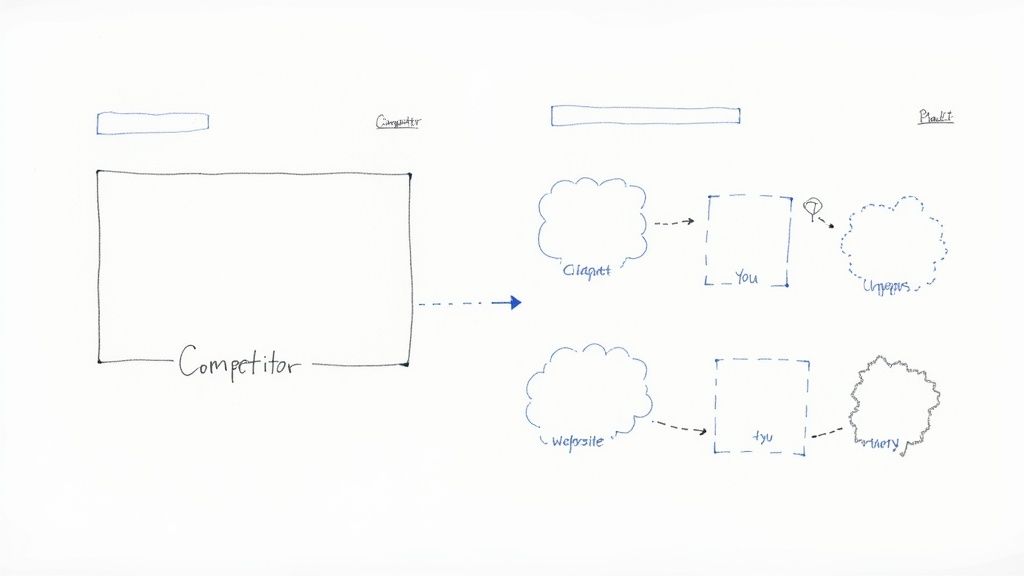
Think of it like this: your competitors have already done some of the hard work for you. They’ve charted a course and claimed territory on the search engine results page. Your job, with a content gap analysis, is to look at their map and find all the valuable spots they occupy that you don’t.
This isn’t about just pulling a random list of keywords. A really solid analysis uncovers entire categories of customer questions you aren't answering. It’s a core part of any real growth strategy because it turns your competitors' wins into your own actionable content plan.
A content gap analysis isn’t just about missing keywords; it’s about missing entire conversations. It reveals the questions your audience has that your competitors are answering, but you aren't.
Keyword Gaps vs. Topic Gaps
As you dig in, you'll find two main types of "gaps." Understanding the difference is key because it helps you build a much smarter content strategy that goes beyond just one-off articles.
Keyword Gaps: These are the specific, often longer search queries where a competitor shows up, but you don't. For instance, they might rank for "how to integrate project management software with slack," while you only have general articles. Pinpointing these is a huge part of effective long-tail keyword research.
Topic Gaps: This is the bigger picture. A topic gap means you're missing an entire subject area or cluster of related keywords. Imagine you sell email marketing software but have zero content on "email deliverability best practices"—that's a massive topic gap that needs to be filled.
To help clarify these distinctions, let's break down the core components of the analysis.
The Core Components of a Content Gap Analysis
This table outlines the essential pieces of a content gap analysis, showing what each part aims to achieve and the actions involved.
Component | Primary Goal | Key Action Examples |
|---|---|---|
Competitor Analysis | Identify who is winning the search traffic you want. | - List 3-5 direct and indirect search competitors. |
Keyword/Topic Mapping | See what content you already have and what it ranks for. | - Export all your ranking keywords from a tool like Ahrefs. |
Gap Identification | Pinpoint the high-value terms your competitors own. | - Use a gap analysis tool. |
Prioritization | Decide which gaps to fill first for maximum impact. | - Score keywords by search volume, difficulty, and relevance. |
Ultimately, each component works together to build a clear, data-driven roadmap for your content creation efforts.
Why This Process Is Non-Negotiable
Skipping a content gap analysis is like trying to navigate a new city without a map. You might be creating fantastic content, but if it doesn't line up with what your audience is actually looking for, you're just shouting into the void.
The missed opportunity here can be huge. For example, one study in the highly competitive auto sales space discovered over 700,000 lost keyword opportunities between just two major competitors. This translated to a potential loss of more than 100 million visits.
As you can see in SEOClarity’s analysis of how to close content gaps, even the biggest brands are constantly leaving traffic on the table. The "content you don't have" is almost always a massive, untapped source of growth just waiting to be claimed.
Laying the Groundwork for a Winning Analysis
A powerful SEO content gap analysis doesn't start with a tool; it starts with a plan. I’ve seen it countless times: people jump straight into keyword lists without a clear direction, only to get lost in a sea of data and waste hours on topics that don't matter.
This prep work is all about building a solid foundation. It ensures your analysis is focused, strategic, and actually tied to what you want to achieve.
Before you even think about your competitors, you need to define what a “win” looks like for your business. What are you trying to accomplish here? A vague goal like "more traffic" just isn't going to cut it. You need to get specific.
Are you trying to:
Boost organic traffic to your blog? If so, your analysis will zero in on high-volume informational keywords.
Generate more qualified leads? This means you'll be hunting for gaps around bottom-of-the-funnel, transactional keywords.
Build topical authority? For this, you need to find and fill entire topic clusters, not just a few random keywords.
A clear goal acts as your North Star, helping you instantly separate high-value opportunities from noisy distractions. It's what stops you from chasing keywords that bring tire-kickers instead of customers.
Identifying Your True SEO Competitors
Okay, so you have your goals. Next up is pinpointing your real competition. This is where a lot of people go wrong—they assume their business competitors are the same as their SEO competitors. They’re usually not.
Your business competitor is the company you go head-to-head with for sales. Your SEO competitor is any website that ranks for the keywords and topics you want to own. This could be a big industry publication, a niche blogger, or an affiliate review site. These aren't entities trying to sell your exact product, but they are absolutely capturing your target audience's attention.
Let's say you sell project management software. Your direct business rival is another software company, obviously. But in the search results, you might be up against:
A high-traffic blog like Zapier's writing about productivity.
A major publication like Forbes Advisor reviewing different software options.
A niche blogger who specializes in team management tutorials.
These are your search rivals. The easiest way to find them is to just Google a few of your most important target keywords. See who consistently shows up on the first page. Those are the domains you need to be analyzing.
I've found that analyzing domains with a similar or slightly higher authority usually reveals the most attainable opportunities. If you're looking to dig a bit deeper, you can learn more about how to find domain authority for these sites.
Assembling Your Analysis Toolkit
With your goals set and competitors identified, it’s time to grab your tools. You don't need a huge, expensive tech stack, but having the right combination of resources is key for pulling accurate data without pulling your hair out.
The right tools don't just give you data; they provide clarity. Your toolkit should help you move from a massive list of potential keywords to a short, actionable list of content ideas that align with your goals.
A solid toolkit usually mixes premium and free resources.
Premium SEO Platforms: Tools like Ahrefs, Semrush, or our own Viral SEO Content Gap Analyzer are built for this. They automate the heavy lifting of comparing your domain against competitors to find those keyword gaps in minutes.
Free Essential Resources: Never, ever overlook Google Search Console. It gives you a goldmine of data on what keywords your site already ranks for, helping you spot underperforming content that's ripe for a refresh.
By setting clear goals, identifying your actual search competitors, and choosing the right tools, you create a strategic framework. This preparation is what turns a content gap analysis from a reactive data-pull into a proactive, goal-driven strategy for real growth.
How to Perform Your Content Gap Audit
Alright, with the groundwork laid, it's time to roll up our sleeves and get into the data. A truly effective content gap audit isn't about finding a single magic report; it's about building a repeatable process. We're going to pull the right data, figure out what it's telling us, and turn those insights into real content ideas. This is where we shift from theory to a practical workflow.
First, we’ll pinpoint the exact keywords your competitors are ranking for that you’re completely missing. Then, we’ll turn the lens inward to audit your existing content, hunting for those underperforming pages that are just begging for an update.
The infographic below breaks down the three essential prep steps we just covered: setting your goals, finding your true competitors, and picking the right tools.
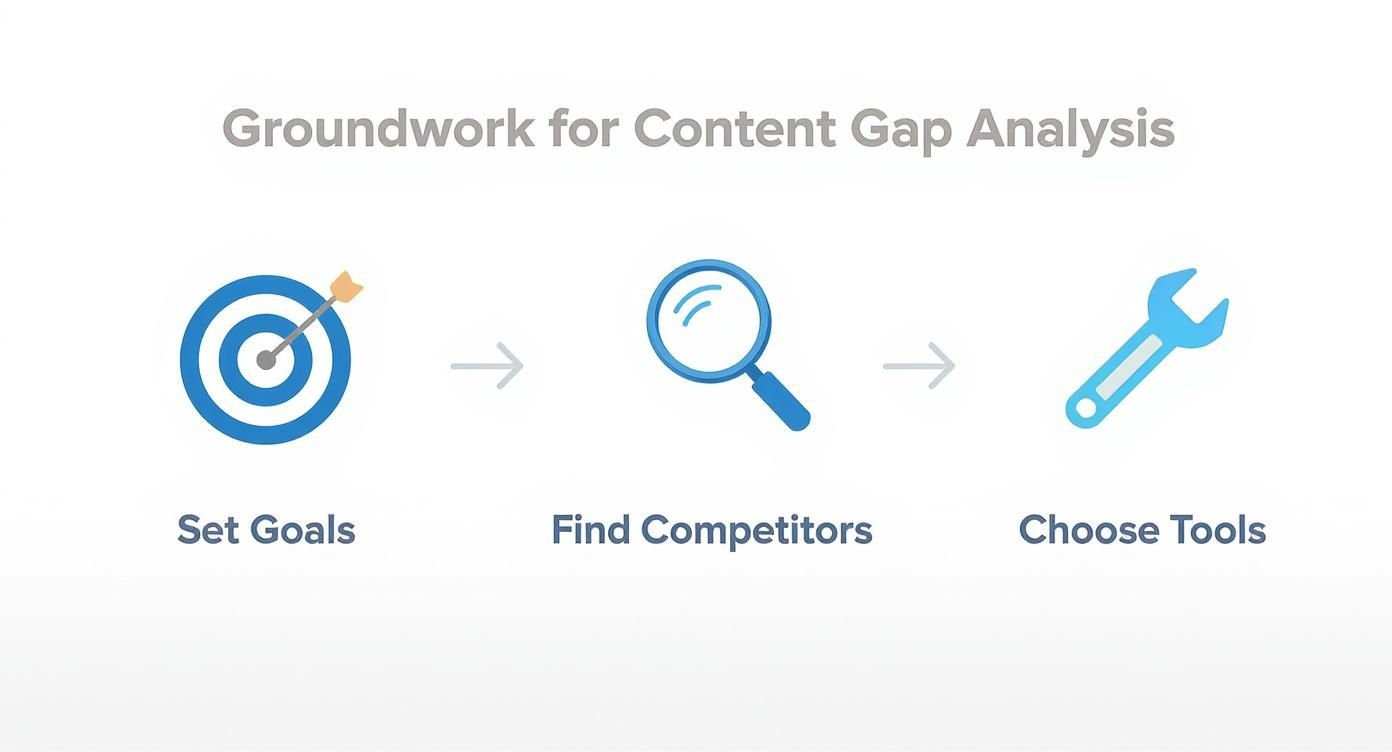
Think of this as your strategic blueprint. A methodical approach, starting with clear goals, is what separates a successful analysis from just a pile of data.
Executing a Keyword Gap Analysis
The most direct way to find what you’re missing is to run a keyword gap analysis. This is all about answering one simple question: "What keywords do my competitors rank for that I don't?" Tools like Ahrefs, Semrush, or our own Viral SEO Content Gap Analyzer were built for this exact job.
Let's imagine you run an e-commerce site selling high-end running shoes. Your SEO competitors are likely a mix of big-box retailers and specialized running blogs.
Here’s how you’d tackle it:
Plug your domain into the tool.
Add the domains of 2-4 of your top competitors.
Run the report to see what the tool spits out.
Be warned: the initial export can be a firehose of information, often showing thousands of keywords. The real work is in the filtering. Your mission is to slice and dice this list until you have a manageable set of keywords that are both relevant to your business and actually attainable.
A raw keyword export is just noise. The value comes from filtering that data through the lens of your business goals. Prioritize keywords that signal commercial intent and align with the products you actually sell.
A great starting point is to filter for keywords where your competitors are ranking in the top 10, but your site is way back on page 5 or beyond (or not ranked at all). This immediately shows you your biggest blind spots. From there, you can layer on other filters to refine your list.
Keyword Difficulty (KD): I always start by looking for keywords with a lower difficulty score. These are your low-hanging fruit.
Search Volume: Make sure there's enough demand. A minimum monthly search volume (say, 100+) is a good baseline.
Intent Modifiers: Filter for terms that match your goals. Words like "best," "review," or "how to" are powerful signals of user intent.
The screenshot from Ahrefs' Content Gap tool below shows you exactly what this setup looks like. You're literally pitting your domain against your rivals to unearth all the keyword opportunities they've captured and you haven't.
This is ground zero for your analysis—the place where you start generating that raw list of keyword gaps.
Auditing Your Existing Content Performance
While finding totally new keywords is great, some of your biggest wins are hiding in plain sight—within the content you’ve already published. An internal content audit is all about finding those pages that are underperforming. Maybe they’re stuck on page two of Google, or perhaps their traffic has slowly dwindled over time. These are goldmines for a content refresh.
Your best friend for this task is Google Search Console (GSC). It gives you the unvarnished truth about how your pages are actually performing in search, straight from the source.
Head over to the "Performance" report in GSC. I like to look for pages with a ton of impressions but a disappointingly low click-through rate (CTR). This is a classic sign that your title tag or meta description isn't compelling enough, or that the content itself isn't quite what searchers were expecting.
This process involves exporting your data from GSC to get a full list of your pages, their URLs, and key metrics like organic traffic. For a great example of how this works in a real-world setting, check out how to perform a content gap analysis on Shopify, where this workflow is applied specifically to e-commerce.
Once you’ve tagged a few underperforming pages, the real detective work begins. You need to figure out why they aren't ranking higher. A great tactic is to re-run your keyword gap analysis, but this time, compare your specific page URL against the URLs of the top-ranking competitors for its main target keyword. This will reveal the subtopics, questions, and specific phrases your content is missing, giving you a crystal-clear roadmap for your update.
Turning Data into an Actionable Strategy
You've run the analysis. Now you're staring at a spreadsheet filled with thousands of potential keywords. Honestly, this is where most strategies die. A massive data dump isn’t a plan; it’s a recipe for paralysis.
The real magic of a seo content gap analysis happens now. It's time to shift from data collector to strategist, turning that raw information into a focused roadmap. It's not about covering every single gap—it's about finding the ones that will actually move the needle for your business.
Segmenting Your Findings by User Intent
The first and most critical filter to apply is user intent. Let's be real: not all keywords have the same value. Someone searching "what is project management" is in a completely different headspace than someone Googling "best project management software for small teams."
I always start by bucketing keywords into the main types of search intent:
Informational Intent: These are the "what," "how," and "why" questions. People are looking for answers and education. This is your top-of-funnel (ToFu) content that builds trust and introduces your brand.
Commercial Investigation: Here, users are actively comparing solutions. You'll see keywords with modifiers like "best," "review," "vs," or "alternative." This is where your middle-of-funnel (MoFu) content shines.
Transactional Intent: The user has their wallet out (figuratively). Searches include terms like "pricing," "free trial," or your competitors' brand names. This is your bottom-of-funnel (BoFu) content that directly drives conversions.
Simply tagging each keyword with its intent helps you align content ideas with business goals. Need more leads this quarter? Hit the commercial and transactional gaps hard. Building long-term authority? Focus on those juicy informational topics.
Creating a Prioritization Matrix
With your keywords segmented, you need a system to decide what to tackle first. I’m a big fan of using a simple prioritization matrix to take the guesswork out of it. This helps you objectively evaluate each opportunity instead of just chasing the keywords with the highest search volume.
The whole point of a prioritization matrix is to replace gut feelings with a data-informed process. It forces you to look at each opportunity based on what truly matters: its potential impact, its relevance to your business, and your ability to realistically win the ranking.
Here’s how to build a simple but effective scoring system.
Opportunity Prioritization Framework
This framework helps you score potential keywords to find the true "sweet spot" opportunities—those with high relevance, manageable difficulty, and solid search volume.
Keyword/Topic | Monthly Search Volume | Relevance Score (1-10) | Difficulty Score (1-10) | Final Priority Score |
|---|---|---|---|---|
best crm for startups | 2,400 | 9 | 7 | Score |
how to calculate customer LTV | 1,200 | 7 | 4 | Score |
project management software | 40,500 | 10 | 9 | Score |
saas marketing plan template | 800 | 8 | 3 | Score |
To calculate the Final Priority Score, a simple formula like (Relevance Score) + (10 - Difficulty Score) can work wonders. This method prioritizes topics that are highly relevant and less competitive, which are often the quickest wins.
Transforming Your Shortlist into Content Ideas
Okay, now you have a prioritized list of your best shots. The next step is to translate those keywords into actual content pieces. For example, a high-priority keyword like "saas marketing plan template" isn't just a signal to write a blog post. It's a clear call to create a downloadable template that perfectly matches what the user wants.
When planning, think beyond a one-to-one keyword-to-page relationship. A great piece of content can rank for dozens of related queries. Understanding how many keywords to target per page is crucial for creating efficient, high-impact articles that cast a wide net.
After identifying these strategic gaps, you need to follow through with solid execution. For instance, putting proven tactics into practice, like these 10 SEO tips for SaaS companies, is what brings the strategy to life.
This entire process takes you from a messy, overwhelming spreadsheet to a clear, strategic content plan that’s built for impact.
Building Your Content Roadmap and Measuring Results
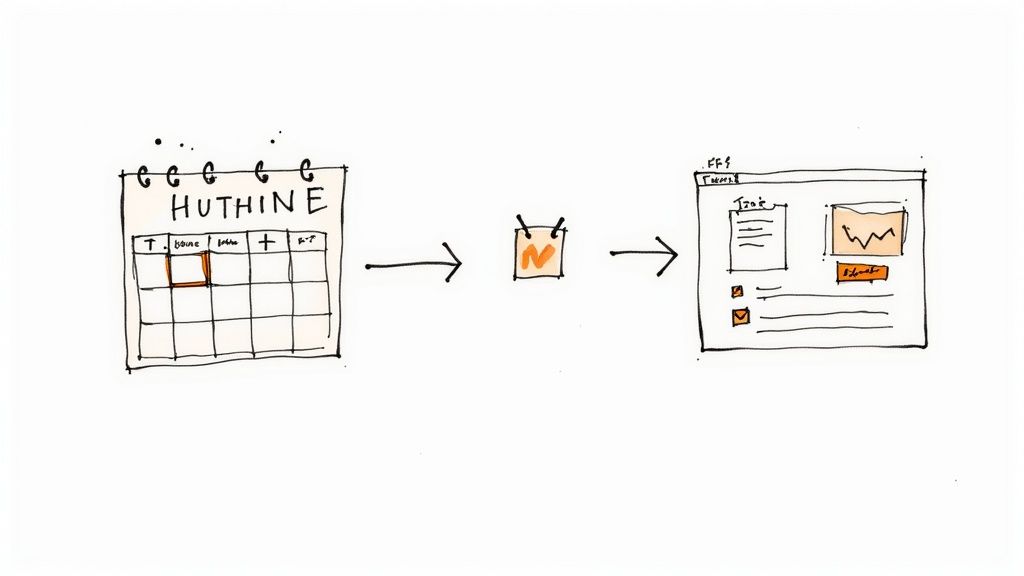
Alright, you've done the hard work of digging through the data and now you’ve got a prioritized list of content opportunities. This is where the rubber meets the road. An seo content gap analysis is just a theoretical exercise until you turn those insights into action. It's time to build a real content plan and a workflow that actually closes those gaps.
Think of this not just as a to-do list, but as your strategic roadmap. It details how you'll systematically conquer each identified topic, making sure every single piece of content has a clear purpose from day one.
From Gaps to Content Production
First things first, how are you going to fill each gap? It's tempting to think every opportunity needs a brand new, 2,000-word blog post, but that’s not always the most efficient move. You really have three main paths to choose from.
Create New Content: This is the most straightforward option for topics you haven’t touched at all. It’s your chance to build the definitive resource from the ground up and perfectly match search intent right out of the gate.
Update Existing Content: Honestly, some of your biggest and fastest wins will come from beefing up pages you already have. Find an article that's underperforming, enrich it with the new angles and keywords from your analysis, and watch it climb the rankings. It's often far less work than starting from scratch.
Build Topic Clusters: If you've stumbled upon a massive topic gap, don't just think in terms of a single article. Go bigger. Plan a full topic cluster—a comprehensive pillar page that acts as a hub, linking out to several more detailed cluster posts. This approach screams expertise to Google and gives users a reason to stick around on your site.
Once you’ve picked your lane, the next critical step is creating a detailed content brief. A solid brief is the essential link between your strategy and your writer's keyboard. It's not a keyword dump; it's a blueprint for a successful piece of content.
A great content brief is your secret weapon against bland, generic content. Arm your writer with everything they need to create something that not only ranks but actually helps your audience. Whatever you do, don't skip this.
Your brief should lay it all out: the target keyword, secondary keywords, the searcher's intent, audience profile, links to top-ranking competitors, and a suggested outline. This level of clarity ensures the final piece is perfectly aligned with your goals.
Tracking Progress and Proving ROI
Hitting "publish" isn't the end of the story. To prove all this effort was worthwhile, you absolutely have to measure the results. Tracking performance shows you what’s hitting the mark, what’s falling flat, and how to fine-tune your strategy going forward.
The key is to focus on a few Key Performance Indicators (KPIs) that tie directly back to the goals you set in the beginning. You can easily get lost in a sea of data, which is just as useless as having no data at all.
Stick to the metrics that matter most:
Organic Traffic: The most obvious one. Are more people finding your site from search engines?
Keyword Rankings: Keep an eye on the specific keywords you targeted. A good rank tracker will show you how your positions change over time.
Conversions: This is the money metric. It connects your SEO work directly to business outcomes. Are people signing up for demos, downloading guides, or buying your product?
You don't need a complicated setup. A simple dashboard in Google Analytics 4 or Google Data Studio can give you a clear visual on your progress. Track these core KPIs for the new and updated pages, and you'll have a clean, at-a-glance view of your return on investment.
Ultimately, this whole process is about driving real, measurable growth. To get a better sense of how all these pieces fit together, check out these proven strategies to increase blog traffic. This transforms your gap analysis from a one-off project into a continuous cycle of improvement, creating a predictable growth engine for your business.
Common Questions About Content Gap Analysis
Even with a solid process laid out, a content gap analysis always seems to kick up a few practical questions. Honestly, figuring out how to handle these common roadblocks is often what separates a stalled project from a successful, long-term strategy. Let's dig into some of the questions I hear most often.
How Often Should I Perform a Content Gap Analysis?
This definitely isn't a one-and-done task. The digital world just moves too fast—new competitors pop up, search trends change on a dime, and what your audience needs today might be different tomorrow. For most businesses, I recommend a full-blown, comprehensive analysis about once every 6 to 12 months.
That said, you should be doing smaller, more targeted "mini-audits" way more often. A good rhythm is a quick check-in every quarter. You could focus on a specific product line, a new feature you just launched, or a key topic cluster you're trying to own. This keeps your strategy nimble and lets you react quickly.
What If I Have Thousands of Keyword Gaps?
First off, don't panic. This is completely normal, especially if you're playing in a crowded or competitive space. Seeing a massive list isn't a sign you've failed; it's a sign of opportunity. The trick is to not get buried by the sheer volume of data.
This is exactly why that prioritization step we talked about is so crucial. You’re not trying to tackle every single keyword. Your mission is to find the top 10-20% of opportunities that will deliver 80% of the results.
An overwhelming keyword list is a filtering problem, not a content problem. Apply strict filters for business relevance, search intent, and realistic difficulty to shrink your list from thousands of possibilities down to a few dozen high-impact priorities.
Start getting aggressive with your filters. Get rid of anything with tiny search volume or keyword difficulty scores that are just out of your league for now. Most importantly, be ruthless about cutting any keyword that doesn't have a direct line back to what you actually sell.
Can I Do This Without Expensive Tools?
You absolutely can, but be prepared for some serious manual labor. Premium tools like Ahrefs, Semrush, or our own Viral SEO Content Gap Analyzer are built to automate the heavy lifting of comparing domains, which can save you dozens of hours.
If the budget is tight, you can definitely cobble together a manual analysis using free resources. It just takes more grit.
Google Search: Just start searching your core topics and see who consistently shows up on page one. Those are your competitors.
Competitor Site Maps: Go to their websites and look for their sitemaps (
/sitemap.xml). This gives you a raw list of all their content.Google Keyword Planner: As you find topics on their sites, you can pop them into Keyword Planner to get a rough idea of search volume.
Google Search Console: Dig into your own performance data here to find pages that are underperforming or could use a boost.
This DIY approach is more time-consuming and less precise, for sure. But it's a perfectly good starting point if you need to find the most obvious holes in your content strategy.
Should I Focus on New Content or Updating Old Content?
The real answer is a mix of both. But if you’re looking for the quickest wins, start with updating your old content. Taking an existing page that already has some authority, maybe a few backlinks, and giving it a serious facelift is often the fastest path to a rankings jump.
Use your gap analysis to find all the subtopics and long-tail keywords your underperforming pages are completely missing. By enriching these existing assets, you can often get big results with a lot less effort than creating something from scratch. Once you’ve picked all that low-hanging fruit, you can redirect your energy to creating brand new content to fill those bigger, more foundational gaps you found.
Ready to stop guessing and start targeting the exact content your audience wants? The Viral SEO Content Gap Analyzer surfaces your competitors' top-performing pages and keywords in a single click, turning hours of manual research into a clear, actionable content plan. Start your free trial and find your first content gap in minutes at https://getviralseo.com.
Blogs
More Blogs
From keyword goldmines to AI-driven content hacks—expert insights to help your blog posts dominate the first page.