Blog

Blog

A Modern SaaS Content Marketing Strategy

A Modern SaaS Content Marketing Strategy

Blog

A Modern SaaS Content Marketing Strategy

A SaaS content marketing strategy is your game plan for attracting, engaging, and keeping customers by creating genuinely useful content. It’s way more than just writing blog posts. It’s a systematic way to turn what you know into a reliable growth engine, focused on the numbers that actually matter—like trial sign-ups and customer retention—not just vanity metrics like traffic.

Building Your Foundation for SaaS Content

Before you write a single word, you have to grasp why a specialized content approach is the lifeblood of a growing SaaS company. This isn't just about getting eyeballs on your site; it's about building a machine that directly boosts your Monthly Recurring Revenue (MRR) and Customer Lifetime Value (CLV). A killer SaaS content strategy also actively fights one of the industry's biggest silent killers: churn.

Content can act as a strategic moat around your business. Just look at category leaders like HubSpot and Ahrefs. They don’t just sell software; they've made content a core part of their product. They educate their market so effectively that their blogs and free tools become go-to resources, building massive trust and driving down customer acquisition costs over time.

This mindset shift is everything. You have to stop seeing content as just another marketing task and start treating it as a fundamental piece of your product experience. It's there to pull in the right people, show them how to solve their problems, and turn them into loyal, long-term customers.

Content's Role in SaaS Growth

A well-planned strategy helps you move away from expensive, short-term tactics (like endlessly pouring money into ads) and toward building a long-term, compounding asset. Think of it like investing in digital real estate that only gets more valuable. Every high-quality article or guide you publish becomes a 24/7 salesperson for your brand.

This whole foundation rests on truly knowing your ideal customer. That's why any good SaaS content strategy kicks off with serious keyword research to figure out exactly what your audience is searching for online. Tools like Ahrefs or Semrush are fantastic, but you have to nail the fundamentals first. Understanding the keyword research best practices for startups is non-negotiable for pinpointing the exact problems your audience needs help solving.

How Content Directly Influences Key SaaS Metrics

Here's a quick look at how a smart content strategy translates into tangible business growth for a SaaS company.

SaaS Metric

Impact of Effective Content Strategy

Customer Acquisition Cost (CAC)

Organic traffic from helpful content is far more cost-effective in the long run than constantly paying for ads.

Customer Lifetime Value (CLV)

Educational content helps users master your product, so they get more value and stick around longer.

Churn Rate

A solid knowledge base and practical guides make onboarding smoother and help users succeed, which is key for retention.

When you consistently provide value through your content, the impact on your bottom line is direct and measurable.

When you solve a user's problem with a great blog post before they ever sign up, you've already started building a loyal relationship. You're not just a tool; you're a trusted advisor.

The Financial Impact of Retention

In a subscription business, cutting down on churn is one of the most powerful things you can do for your profitability. While average churn rates in the SaaS world hover between 5% and 7% annually, it's not uncommon for smaller companies to see rates as high as 20%.

The math is staggering: a mere 5% decrease in churn can boost your profits by up to 95%. This is where your content strategy becomes a powerful financial tool. It creates "stickier" customers who see ongoing value in your brand that goes far beyond the software itself.

Mapping Your Content to the SaaS Customer Journey

Let's be honest, the generic marketing funnel everyone talks about? It's a terrible fit for SaaS. The way people buy software is completely different. Your content needs to do more than just attract eyeballs; it has to create a seamless experience that guides someone from vaguely knowing they have a problem to becoming a die-hard fan of your product.

This means you need to be surgical. You have to map specific types of content to each stage of their journey with you.

We can boil this down to three critical stages: Acquisition, Activation, and Retention. Each one demands a totally different approach and content style. If you try a one-size-fits-all strategy, you're setting yourself up for failure. The real magic happens when you deliver the right piece of content at the exact moment a user needs it.

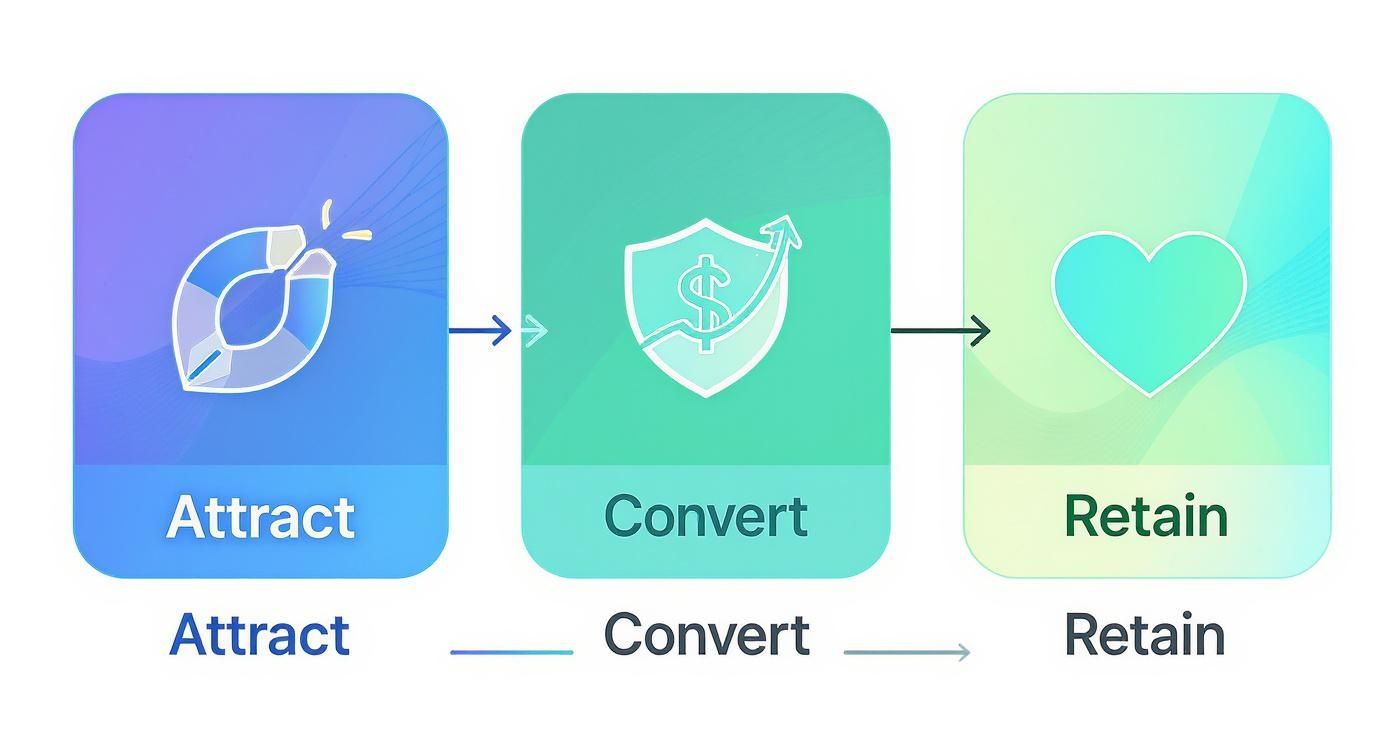
This flow chart gives you a bird's-eye view of how strategic content can move the needle on key SaaS metrics, pulling users from their first visit all the way to long-term loyalty.
Infographic about saas content marketing strategy

As you can see, content is the engine. It first attracts, then it converts, and finally, it builds the kind of loyalty that directly fuels business growth.

The Acquisition Stage: Attracting Your Ideal Customer

This is your top-of-funnel (TOFU) game. The whole point here is to get on the radar of potential users and get them to sign up for a free trial. At this point, your audience knows they have a problem, but they don't know your solution exists yet. They’re out there Googling for answers, not for your brand name.

Your content has to meet them on their turf. This means creating genuinely helpful, educational resources that tackle their pain points head-on, without a heavy-handed sales pitch. You're trying to build authority and trust by being the most helpful resource they find.

Think about the broad questions and common industry headaches your ideal customer has. Your goal is to become their go-to source for answers. This is where a sharp saas content marketing strategy really shines, because you're directly targeting the search queries of the people you want as customers.

Here are a few high-impact content ideas that work wonders at the acquisition stage:

  • In-depth blog posts: Go after the long-tail keywords your ideal customer profile (ICP) is searching for. For instance, a project management tool could write a killer guide on "How to Improve Team Collaboration Remotely." To dig up these golden opportunities, you can learn more about effective long-tail keyword research in our detailed guide.

  • Free tools and templates: People love freebies that make their lives easier. Simple calculators, checklists, or spreadsheet templates can be lead-generation magnets. They give a tangible taste of the value your product provides.

  • Original research and industry reports: Nothing screams "expert" like unique data. Survey your audience or analyze proprietary data to create a report. This stuff is a magnet for backlinks and media mentions, which will give your entire site's authority a serious boost.

The Activation Stage: Guiding Users to That "Aha!" Moment

The second a user signs up for a trial, a clock starts ticking. Loudly. The activation stage is, without a doubt, one of the most make-or-break parts of the entire SaaS journey.

Your content's one and only job here is to get that new user to their "aha!" moment—that magical point where they truly get how your product solves their problem.

Bad onboarding is a churn factory. If users can't figure out how to get value from your tool quickly, they'll just bounce. And they won't be back. Your content during this phase has to be contextual, timely, and hyper-focused on their success.

The goal isn't just to show users features; it's to help them achieve a specific outcome. Effective activation content bridges the gap between signing up and getting real value.

This content is usually delivered right inside your app or through a carefully crafted email sequence. It should feel less like a manual and more like a personal guide holding their hand through the first critical steps.

A few examples of powerful activation content:

  • Interactive onboarding guides: Use in-app tooltips, pop-ups, and checklists to literally walk users through the most important first actions.

  • Welcome email series: Drip out a sequence of emails that highlight key features, share pro tips, and link directly to relevant tutorials.

  • Short video tutorials: Create bite-sized, task-oriented videos showing exactly how to get something done in your software. No fluff.

The Retention Stage: Becoming Absolutely Indispensable

It costs a fortune to acquire a new customer, but keeping one is pure profit. The retention stage isn't a one-time event; it's an ongoing mission to deliver so much value that your product becomes indispensable to their workflow.

Here, your content's role shifts to helping customers become power users. You want to help them master advanced features and achieve even bigger and better outcomes.

This is also where you build a real community and foster unshakable brand loyalty. By continuously educating your users, you not only slash churn but also naturally open the door for upsells and cross-sells.

Retention content should focus on deep-dive strategies and community engagement.

  • Advanced webinars: Host live sessions with your product experts on sophisticated use cases or new feature walkthroughs.

  • A comprehensive knowledge base: Build a ridiculously detailed and easily searchable library of how-to guides that can answer any question a user could possibly dream up.

  • Customer success stories: Nothing sells like social proof. Showcase how your existing customers are crushing their goals using your platform. This provides both inspiration and practical ideas for everyone else.

Creating Content That Converts and Retains
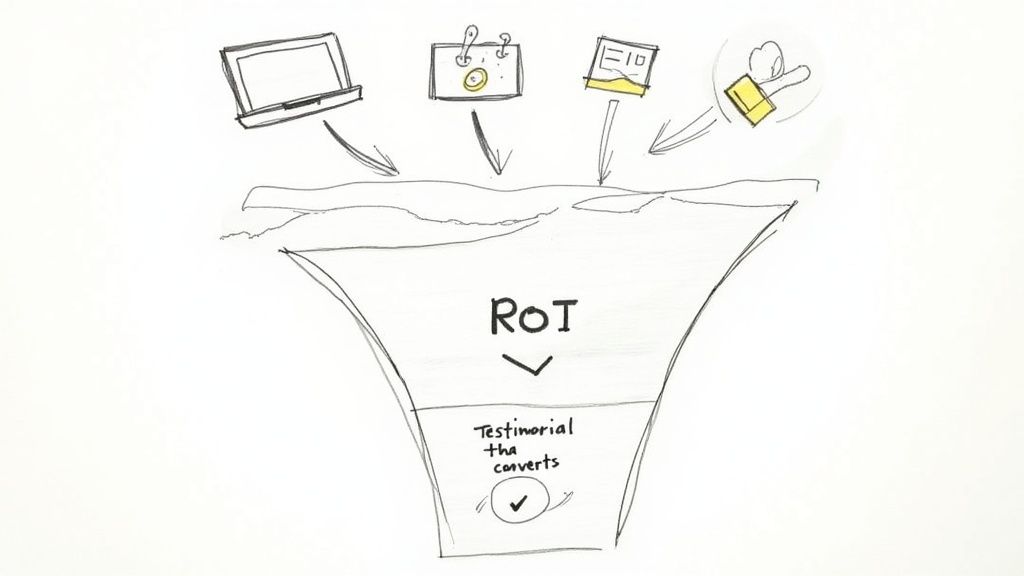
A customer success story being crafted on a laptop, showing a graph with upward trends.

Alright, it's time to shift our focus from just getting traffic to creating content that actually does the heavy lifting. In a crowded SaaS market, the best content doesn't just explain what you do—it proves it. This is where your strategy moves beyond attracting eyeballs and starts turning visitors into loyal customers.

Let’s be real: your prospects are savvy. They’ve heard lofty promises before. They aren't looking for claims; they're looking for cold, hard evidence. That’s why content showcasing tangible results isn't just a "nice-to-have" anymore. It's the core of a modern SaaS content marketing strategy.

Crafting Case Studies That Actually Sell

Forget those dry, cookie-cutter customer stories from a decade ago. A well-crafted case study is your secret weapon for conversion because it moves the conversation from what your product can do to what it has already done for a real business. It's the ultimate form of social proof, making your ideal customer think, "If they did it for them, they can do it for me."

Don’t just take my word for it. Research shows a staggering 70% of B2B marketers see case studies as the most effective content for closing deals. This just goes to show how much trust and proven value matter. For a deeper look at what makes SaaS buyers tick, these SaaS content marketing statistics are worth a read.

To build a case study that truly connects, you need to tell a compelling story.

  • Set the Scene: Start by painting a clear picture of the specific problems your customer was facing before they found you. Use their own words. Quantify the pain, like, "Our team was burning 10 hours a week on manual data entry."

  • The "Aha!" Moment: Briefly touch on how they discovered your solution and what pushed them to give it a shot. This helps other prospects see themselves in that same journey.

  • Your Solution in Action: Get specific. Detail exactly how your customer used your product to tackle their problem. Zero in on the 2-3 key features that delivered the biggest impact.

  • The Big Payoff: This is your grand finale. Showcase the measurable results. We’re talking hard numbers, percentages, and powerful quotes that scream ROI. For instance, "In the first quarter, we cut our reporting time by 80% and boosted lead quality by 35%."

The best case studies aren't really about your product's features. They're about your customer's success. Position your customer as the hero of the story and your product as the indispensable tool that helped them win.

Becoming the Go-To Expert with Thought Leadership

While case studies provide the proof, thought leadership builds the authority that gets you on their radar in the first place. This isn’t about writing thinly veiled sales pitches. It’s about sharing a unique, genuinely helpful perspective on your industry that gets your audience thinking differently about their own work.

When you do it right, thought leadership positions your brand as a trusted advisor, not just another vendor. This is the kind of content that gets shared in company Slack channels and influences decisions long before anyone even thinks about booking a demo.

The goal is to become synonymous with expertise in your niche. If you’re a cybersecurity SaaS, that could mean publishing original research on new threats. If you run a financial planning tool, maybe you create the definitive guide to a new regulation. It's all about building your reputation by consistently delivering high-value, non-promotional insights. If you need some guidance on keyword strategy for these in-depth pieces, our article on how many keywords to focus on per page is a great resource.

Here are a few formats that work incredibly well for thought leadership:

  • Opinionated Articles: Take a strong, data-supported stance on a hot industry topic.

  • Original Data Reports: Survey your users or analyze your own data to uncover insights nobody else has.

  • Expert Roundups & Interviews: Bring in other respected voices from your industry to create a powerhouse resource and expand your reach.

  • Webinars and Live Events: Host discussions on advanced topics that go way beyond the 101-level stuff.

By combining the hard proof of case studies with the trusted authority of thought leadership, you create an unstoppable content engine. One convinces with logic and data, while the other builds the deep-seated trust that makes the sale feel natural. This one-two punch doesn't just attract and convert; it builds a loyal audience that will stick with you for the long haul.

Building Your Content Distribution Flywheel
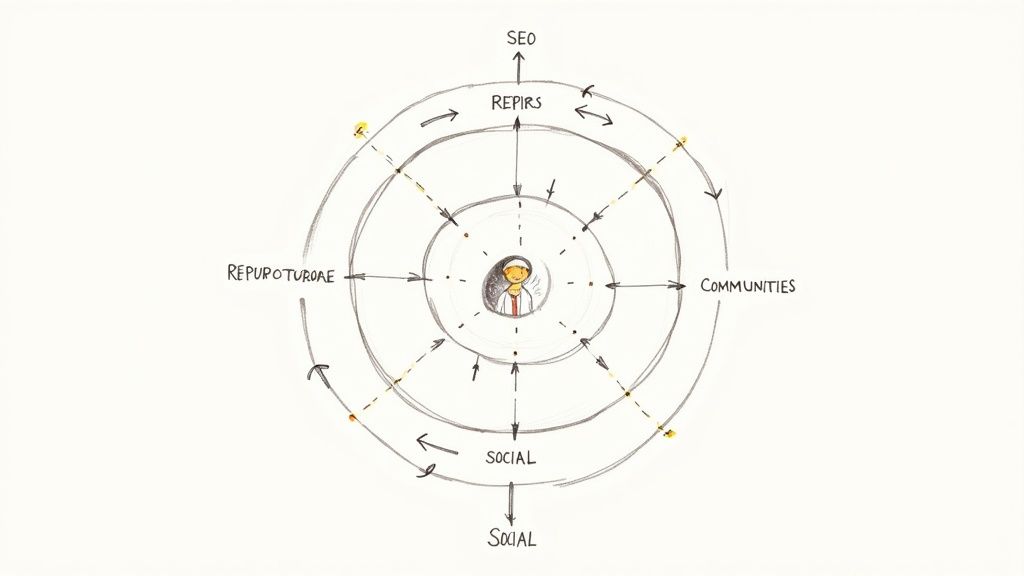
A flywheel graphic showing the compounding effects of content distribution.

Hitting “publish” on a new article feels great, but it’s the starting line, not the finish. A brilliant piece of content that nobody sees is a wasted effort. This is where we stop the “publish and pray” cycle and start building something with real momentum: a content distribution flywheel.

The idea is to create a growth loop that feeds itself. You strategically share your content, which boosts your SEO. Better SEO brings in more organic traffic, which builds your authority. And that authority makes every future piece of content easier to promote. It's a powerful cycle that pulls in ideal customers without you having to constantly feed it with a huge ad budget.

This requires a big mental shift. Most marketing teams spend 80% of their time on content creation and a mere 20% on getting it out there. To get the flywheel spinning, you have to flip that ratio.

Identifying and Dominating Niche Topics

The flywheel starts moving when you become the go-to expert on one specific topic. Forget trying to be everything to everyone. Your goal is to own a small, valuable niche and then expand from there. This is where all that keyword research you did earlier really comes into play.

You’re not just chasing keywords; you’re mapping out the problems your ideal customer is trying to solve. The strategy here is to build a "content hub" or "pillar page" around a central topic, then surround it with more specific "cluster" articles that all link back to the main page. This structure screams expertise to search engines.

A major signal of expertise for Google is your Domain Authority (DA). When you truly dominate a topic, you start earning backlinks from other respected sites, and that’s a huge factor in your DA score. If you want to get a better handle on this metric, our guide on how to find domain authority breaks down exactly what it is and why it's so critical for SEO.

By focusing all your initial energy on one well-defined topic, you concentrate your SEO power, making it much easier to rank and give the flywheel its first solid push.

The Art of Content Repurposing

The secret to being everywhere isn't creating dozens of brand-new pieces of content every week. It's about taking one high-value "pillar" asset and atomizing it—breaking it down into smaller pieces designed for different channels.

This is how your saas content marketing strategy becomes incredibly efficient. One fantastic webinar can fuel an entire month's worth of content.

Think of your pillar content as a large stone. Repurposing is the act of chipping away at that stone to create smaller, perfectly formed sculptures, each designed for a specific gallery (or platform).

Here’s a real-world example of how you could repurpose a single webinar:

  • The Blog Post: Turn the key talking points into a detailed, SEO-friendly article. You can even embed the full webinar video right in the post.

  • Video Clips: Chop the webinar into 5-7 short, punchy clips (1-3 minutes long) that highlight the best tips. These are perfect for LinkedIn and YouTube Shorts.

  • Tweet Thread: Distill the main takeaways into a compelling Twitter thread. Pull some visuals from the webinar slides to make it pop.

  • Infographic: Design a sharp visual that summarizes the core concepts or data points. Infographics are great for Pinterest and for breaking up the text in your main blog post.

  • Email Newsletter: Send a dedicated email to your subscribers with the webinar recording and a few juicy highlights to get them interested.

  • Quote Graphics: Pull the most memorable lines and turn them into shareable images for Instagram and LinkedIn.

This approach squeezes every last drop of value out of your initial effort, making sure your message finds your audience no matter where they hang out.

Leveraging Communities for Initial Traction

When your flywheel is brand new, it needs a strong push to get going. Online communities are one of the absolute best places to find that initial momentum. I'm not talking about spamming links; this is about genuinely engaging with your target audience.

Find the Slack channels, Reddit subreddits, and Facebook groups where your ideal customers are already having conversations. Once you’re in, don't just drop a link and disappear.

  1. Listen first. Get a feel for the community’s rules, culture, and the questions people ask over and over.

  2. Provide value. Jump in and answer questions. Offer helpful advice without even mentioning your content. Build a reputation for being a helpful expert.

  3. Share strategically. When a relevant conversation pops up, you can naturally drop in a link to your article as a resource that provides an even deeper answer.

This method builds trust and drives highly qualified early traffic to your content. It’s the perfect push to get your flywheel spinning on its own.

Using AI and Analytics to Sharpen Your Strategy

Let's be honest: gut feelings don't scale. If you're still relying on guesswork to guide your content, you're falling behind. A truly effective SaaS content marketing strategy is built on a data-first mindset, using analytics and AI to constantly refine your entire game plan.

It’s about moving past vanity metrics like page views and digging into the data that actually impacts your bottom line. The real questions you need to answer are about performance. Which articles are influencing trial sign-ups? What content do users read right before they upgrade to a paid plan? The answers are in the data, and they can turn your content from a cost center into a predictable revenue driver.

Moving Beyond Surface-Level Metrics

The first step is to get real about what you're tracking. A big traffic spike feels great, but it doesn’t pay the bills. Your focus needs to be on connecting content performance directly to business outcomes.

Here are the metrics I'd obsess over:

  • Content-Influenced Pipeline: Track how many leads or trials engaged with your content before converting. This shows the real-world impact of your articles on generating qualified interest.

  • Trial-to-Paid Conversion Rate by Content: Dig into which specific articles attract users who are more likely to become paying customers. You might find a low-traffic post that brings in your highest-quality sign-ups.

  • User Engagement Within the Product: What knowledge base articles or tutorials are your most active customers reading? This insight is gold for boosting retention and spotting your power users.

A documented strategy is your North Star. We've seen that SaaS marketers with a formal content plan achieve a 33% higher ROI than those without one. That clarity makes measurement and optimization so much easier.

This data-driven approach takes the guesswork out of your editorial calendar. Instead of debating which blog post idea is best, you can look at the numbers and see which topics have a history of driving conversions. Then you just double down on what works.

Integrating AI to Augment Your Team

AI is no longer some far-off concept—it's a practical toolkit for making your content efforts smarter and more efficient. And it's being adopted fast, with a staggering 92% of large marketing teams now using AI in their content development process.

Think of AI as a performance enhancer, not a replacement for creativity. It automates the tedious, repetitive tasks and serves up data-backed insights, freeing up your team to focus on high-level strategy and crafting truly exceptional content.

And if you want to get ahead of the curve, it’s time to start thinking about mastering AI search optimization. Ensuring your content gets cited and surfaced in AI-powered answer engines is quickly becoming a critical skill.

Practical AI Applications in SaaS Content Marketing

Let's look at how modern AI tools can enhance each stage of your content workflow. It's not just about writing faster; it's about being more strategic every step of the way.

Practical AI Applications in SaaS Content Marketing

Content Stage

Practical AI Application

Example Tool Category

Topic Ideation

Analyze competitor content at scale to find high-traffic, low-competition keywords and topic gaps you can own.

SEO & Content Intelligence Platforms

Content Creation

Generate detailed outlines, draft initial sections, or rephrase paragraphs for clarity and tone, speeding up the writing process.

AI Writing Assistants

SEO Optimization

Audit on-page elements, suggest internal linking opportunities, and ensure your content aligns with search intent for target keywords.

Content Optimization Tools

Personalization

Recommend relevant articles to users based on their in-app behavior or previous content consumption, creating a tailored journey.

Marketing Automation Platforms

By weaving these tools into your process, you’re not just creating content faster. You're creating smarter content that is far more likely to rank, connect with your audience, and drive the business results you're after. This tech-augmented approach is the key to building a SaaS content marketing strategy that actually scales.

Answering Your Toughest SaaS Content Questions

Even the best-laid plans hit a snag. When you're deep in the trenches, running a SaaS content marketing strategy, it's totally normal for specific challenges to pop up. Let's walk through some of the most common hurdles I see SaaS marketers face and get you some clear, actionable answers.

How Do I Actually Measure the ROI of My Content Strategy?

This is the big one—the question that always comes from the leadership team. You need to forget vanity metrics like page views or social shares. The real measure of content ROI in SaaS is how it directly impacts revenue. It's that simple.

Your main goal is to draw a straight line from someone consuming your content to them becoming a customer. Using your analytics tools (like Google Analytics with goal tracking or a more integrated platform like HubSpot), you have to trace the user's path. Did a visitor read three of your blog posts before signing up for a free trial? Boom. That's a content-influenced conversion.

To get really granular, you should be tracking these KPIs:

  • Content-Influenced Pipeline: How many demo requests, trial sign-ups, or downloads happened right after a user engaged with your content? The key is attributing these sign-ups back to the specific articles or guides they read.

  • Customer Lifetime Value (CLV) by Acquisition Channel: This is incredibly revealing. Compare the CLV of users who found you through organic content versus those who clicked a paid ad. You'll often find that people who come to you through helpful content are better educated on your value and stick around much longer.

  • Cost Per Acquisition (CPA) from Content: It takes time to calculate, but tracking the total cost of producing your content against the number of customers it generates will prove its long-term cost-effectiveness.

The most powerful ROI story you can tell sounds like this: "Our content efforts generated $X in new pipeline last quarter by influencing Y trial sign-ups. Even better, their CLV is Z% higher than our paid channels." That's a conversation that gets you more budget.

We're an Early-Stage SaaS. What Content Should We Create First?

When you're an early-stage startup, every minute and every dollar counts. You can't afford to spend months creating top-of-funnel content that might pay off a year from now. You have to focus on what drives decisions today.

This means prioritizing content for the bottom and middle of your funnel (BOFU and MOFU). This is the content that proves your product's value and helps convert prospects who are already solution-aware. They're in the evaluation phase, and your job is to win their trust.

Your first few content projects should be:

  1. Powerful Case Studies: Get your first handful of happy customers and turn their success into compelling stories. Focus on tangible results—the actual numbers—and sprinkle in direct quotes. A strong case study is the ultimate proof that your product isn't just smoke and mirrors.

  2. Detailed Comparison Pages: I guarantee your prospects are searching for "Your Product vs. Competitor X." You need to own that conversation. Create honest, in-depth comparison pages that highlight your unique strengths and control the narrative before a third-party review site does it for you.

  3. A Robust Knowledge Base: This is secretly a sales tool and a retention tool. A great knowledge base helps prospects understand your features during their trial and supports new customers during onboarding, which is absolutely critical for crushing early-stage churn.

Once you have this conversion-focused foundation in place, then you can start investing in top-of-funnel (TOFU) blog content to attract a wider audience.

How Often Should We Be Publishing New Content?

This question trips a lot of teams up because they start chasing a magic number. But here's the truth: the answer isn't about frequency; it's about quality and consistency.

It is far, far more effective to publish one deeply researched, 2,000-word pillar post per week than five thin, 500-word posts that barely scratch the surface. For most SaaS businesses, aiming for 1-2 high-value articles per week is an excellent and, more importantly, sustainable target.

This rhythm gives your team enough time for proper research, writing, SEO optimization, and promotion. Don't forget the 50/50 rule: spend just as much time promoting your content as you did creating it. Your goal isn't just to add another URL to your sitemap; it's to create the absolute best resource on the internet for a specific, valuable topic.

A consistent schedule also trains both search engines and your audience to expect fresh content from you, which builds incredible momentum over time. Never sacrifice quality just to hit an arbitrary publishing quota.

Should Our Content Strategy Focus on SEO or Social Media?

For pretty much any B2B SaaS company out there, the answer is crystal clear: SEO has to be the primary engine of your content marketing strategy.

Here’s the simple reason why: SEO delivers compounding, long-term returns. A well-ranked article can become an asset that brings you a steady stream of qualified users for years. These are people actively searching for solutions to problems your software solves—they have high buying intent. This is how you build a sustainable, predictable growth channel.

Social media, on the other hand, is a fantastic distribution and engagement channel. It's perfect for:

  • Amplifying your SEO content: Share your blog posts, case studies, and reports to get them in front of a whole new audience.

  • Building your brand: Jump into relevant industry conversations and show off your company's personality and expertise.

  • Gathering customer insights: Pay attention to what your audience is talking about. It’s a goldmine for new content ideas.

Think of it this way: SEO is the V8 engine that powers your car forward, mile after mile. Social media is the turbo boost you use strategically to accelerate and get noticed. Build your core strategy on the reliable power of SEO, then use social media to support and enhance those efforts.

Ready to stop guessing and start building a content strategy that drives predictable growth? With Viral SEO, you can uncover your competitors' top-performing content, find high-intent topic opportunities, and optimize every page for maximum impact. Start your free plan today and see the difference a data-driven workflow can make.

A SaaS content marketing strategy is your game plan for attracting, engaging, and keeping customers by creating genuinely useful content. It’s way more than just writing blog posts. It’s a systematic way to turn what you know into a reliable growth engine, focused on the numbers that actually matter—like trial sign-ups and customer retention—not just vanity metrics like traffic.

Building Your Foundation for SaaS Content

Before you write a single word, you have to grasp why a specialized content approach is the lifeblood of a growing SaaS company. This isn't just about getting eyeballs on your site; it's about building a machine that directly boosts your Monthly Recurring Revenue (MRR) and Customer Lifetime Value (CLV). A killer SaaS content strategy also actively fights one of the industry's biggest silent killers: churn.

Content can act as a strategic moat around your business. Just look at category leaders like HubSpot and Ahrefs. They don’t just sell software; they've made content a core part of their product. They educate their market so effectively that their blogs and free tools become go-to resources, building massive trust and driving down customer acquisition costs over time.

This mindset shift is everything. You have to stop seeing content as just another marketing task and start treating it as a fundamental piece of your product experience. It's there to pull in the right people, show them how to solve their problems, and turn them into loyal, long-term customers.

Content's Role in SaaS Growth

A well-planned strategy helps you move away from expensive, short-term tactics (like endlessly pouring money into ads) and toward building a long-term, compounding asset. Think of it like investing in digital real estate that only gets more valuable. Every high-quality article or guide you publish becomes a 24/7 salesperson for your brand.

This whole foundation rests on truly knowing your ideal customer. That's why any good SaaS content strategy kicks off with serious keyword research to figure out exactly what your audience is searching for online. Tools like Ahrefs or Semrush are fantastic, but you have to nail the fundamentals first. Understanding the keyword research best practices for startups is non-negotiable for pinpointing the exact problems your audience needs help solving.

How Content Directly Influences Key SaaS Metrics

Here's a quick look at how a smart content strategy translates into tangible business growth for a SaaS company.

SaaS Metric

Impact of Effective Content Strategy

Customer Acquisition Cost (CAC)

Organic traffic from helpful content is far more cost-effective in the long run than constantly paying for ads.

Customer Lifetime Value (CLV)

Educational content helps users master your product, so they get more value and stick around longer.

Churn Rate

A solid knowledge base and practical guides make onboarding smoother and help users succeed, which is key for retention.

When you consistently provide value through your content, the impact on your bottom line is direct and measurable.

When you solve a user's problem with a great blog post before they ever sign up, you've already started building a loyal relationship. You're not just a tool; you're a trusted advisor.

The Financial Impact of Retention

In a subscription business, cutting down on churn is one of the most powerful things you can do for your profitability. While average churn rates in the SaaS world hover between 5% and 7% annually, it's not uncommon for smaller companies to see rates as high as 20%.

The math is staggering: a mere 5% decrease in churn can boost your profits by up to 95%. This is where your content strategy becomes a powerful financial tool. It creates "stickier" customers who see ongoing value in your brand that goes far beyond the software itself.

Mapping Your Content to the SaaS Customer Journey

Let's be honest, the generic marketing funnel everyone talks about? It's a terrible fit for SaaS. The way people buy software is completely different. Your content needs to do more than just attract eyeballs; it has to create a seamless experience that guides someone from vaguely knowing they have a problem to becoming a die-hard fan of your product.

This means you need to be surgical. You have to map specific types of content to each stage of their journey with you.

We can boil this down to three critical stages: Acquisition, Activation, and Retention. Each one demands a totally different approach and content style. If you try a one-size-fits-all strategy, you're setting yourself up for failure. The real magic happens when you deliver the right piece of content at the exact moment a user needs it.

This flow chart gives you a bird's-eye view of how strategic content can move the needle on key SaaS metrics, pulling users from their first visit all the way to long-term loyalty.

Infographic about saas content marketing strategy

As you can see, content is the engine. It first attracts, then it converts, and finally, it builds the kind of loyalty that directly fuels business growth.

The Acquisition Stage: Attracting Your Ideal Customer

This is your top-of-funnel (TOFU) game. The whole point here is to get on the radar of potential users and get them to sign up for a free trial. At this point, your audience knows they have a problem, but they don't know your solution exists yet. They’re out there Googling for answers, not for your brand name.

Your content has to meet them on their turf. This means creating genuinely helpful, educational resources that tackle their pain points head-on, without a heavy-handed sales pitch. You're trying to build authority and trust by being the most helpful resource they find.

Think about the broad questions and common industry headaches your ideal customer has. Your goal is to become their go-to source for answers. This is where a sharp saas content marketing strategy really shines, because you're directly targeting the search queries of the people you want as customers.

Here are a few high-impact content ideas that work wonders at the acquisition stage:

  • In-depth blog posts: Go after the long-tail keywords your ideal customer profile (ICP) is searching for. For instance, a project management tool could write a killer guide on "How to Improve Team Collaboration Remotely." To dig up these golden opportunities, you can learn more about effective long-tail keyword research in our detailed guide.

  • Free tools and templates: People love freebies that make their lives easier. Simple calculators, checklists, or spreadsheet templates can be lead-generation magnets. They give a tangible taste of the value your product provides.

  • Original research and industry reports: Nothing screams "expert" like unique data. Survey your audience or analyze proprietary data to create a report. This stuff is a magnet for backlinks and media mentions, which will give your entire site's authority a serious boost.

The Activation Stage: Guiding Users to That "Aha!" Moment

The second a user signs up for a trial, a clock starts ticking. Loudly. The activation stage is, without a doubt, one of the most make-or-break parts of the entire SaaS journey.

Your content's one and only job here is to get that new user to their "aha!" moment—that magical point where they truly get how your product solves their problem.

Bad onboarding is a churn factory. If users can't figure out how to get value from your tool quickly, they'll just bounce. And they won't be back. Your content during this phase has to be contextual, timely, and hyper-focused on their success.

The goal isn't just to show users features; it's to help them achieve a specific outcome. Effective activation content bridges the gap between signing up and getting real value.

This content is usually delivered right inside your app or through a carefully crafted email sequence. It should feel less like a manual and more like a personal guide holding their hand through the first critical steps.

A few examples of powerful activation content:

  • Interactive onboarding guides: Use in-app tooltips, pop-ups, and checklists to literally walk users through the most important first actions.

  • Welcome email series: Drip out a sequence of emails that highlight key features, share pro tips, and link directly to relevant tutorials.

  • Short video tutorials: Create bite-sized, task-oriented videos showing exactly how to get something done in your software. No fluff.

The Retention Stage: Becoming Absolutely Indispensable

It costs a fortune to acquire a new customer, but keeping one is pure profit. The retention stage isn't a one-time event; it's an ongoing mission to deliver so much value that your product becomes indispensable to their workflow.

Here, your content's role shifts to helping customers become power users. You want to help them master advanced features and achieve even bigger and better outcomes.

This is also where you build a real community and foster unshakable brand loyalty. By continuously educating your users, you not only slash churn but also naturally open the door for upsells and cross-sells.

Retention content should focus on deep-dive strategies and community engagement.

  • Advanced webinars: Host live sessions with your product experts on sophisticated use cases or new feature walkthroughs.

  • A comprehensive knowledge base: Build a ridiculously detailed and easily searchable library of how-to guides that can answer any question a user could possibly dream up.

  • Customer success stories: Nothing sells like social proof. Showcase how your existing customers are crushing their goals using your platform. This provides both inspiration and practical ideas for everyone else.

Creating Content That Converts and Retains

A customer success story being crafted on a laptop, showing a graph with upward trends.

Alright, it's time to shift our focus from just getting traffic to creating content that actually does the heavy lifting. In a crowded SaaS market, the best content doesn't just explain what you do—it proves it. This is where your strategy moves beyond attracting eyeballs and starts turning visitors into loyal customers.

Let’s be real: your prospects are savvy. They’ve heard lofty promises before. They aren't looking for claims; they're looking for cold, hard evidence. That’s why content showcasing tangible results isn't just a "nice-to-have" anymore. It's the core of a modern SaaS content marketing strategy.

Crafting Case Studies That Actually Sell

Forget those dry, cookie-cutter customer stories from a decade ago. A well-crafted case study is your secret weapon for conversion because it moves the conversation from what your product can do to what it has already done for a real business. It's the ultimate form of social proof, making your ideal customer think, "If they did it for them, they can do it for me."

Don’t just take my word for it. Research shows a staggering 70% of B2B marketers see case studies as the most effective content for closing deals. This just goes to show how much trust and proven value matter. For a deeper look at what makes SaaS buyers tick, these SaaS content marketing statistics are worth a read.

To build a case study that truly connects, you need to tell a compelling story.

  • Set the Scene: Start by painting a clear picture of the specific problems your customer was facing before they found you. Use their own words. Quantify the pain, like, "Our team was burning 10 hours a week on manual data entry."

  • The "Aha!" Moment: Briefly touch on how they discovered your solution and what pushed them to give it a shot. This helps other prospects see themselves in that same journey.

  • Your Solution in Action: Get specific. Detail exactly how your customer used your product to tackle their problem. Zero in on the 2-3 key features that delivered the biggest impact.

  • The Big Payoff: This is your grand finale. Showcase the measurable results. We’re talking hard numbers, percentages, and powerful quotes that scream ROI. For instance, "In the first quarter, we cut our reporting time by 80% and boosted lead quality by 35%."

The best case studies aren't really about your product's features. They're about your customer's success. Position your customer as the hero of the story and your product as the indispensable tool that helped them win.

Becoming the Go-To Expert with Thought Leadership

While case studies provide the proof, thought leadership builds the authority that gets you on their radar in the first place. This isn’t about writing thinly veiled sales pitches. It’s about sharing a unique, genuinely helpful perspective on your industry that gets your audience thinking differently about their own work.

When you do it right, thought leadership positions your brand as a trusted advisor, not just another vendor. This is the kind of content that gets shared in company Slack channels and influences decisions long before anyone even thinks about booking a demo.

The goal is to become synonymous with expertise in your niche. If you’re a cybersecurity SaaS, that could mean publishing original research on new threats. If you run a financial planning tool, maybe you create the definitive guide to a new regulation. It's all about building your reputation by consistently delivering high-value, non-promotional insights. If you need some guidance on keyword strategy for these in-depth pieces, our article on how many keywords to focus on per page is a great resource.

Here are a few formats that work incredibly well for thought leadership:

  • Opinionated Articles: Take a strong, data-supported stance on a hot industry topic.

  • Original Data Reports: Survey your users or analyze your own data to uncover insights nobody else has.

  • Expert Roundups & Interviews: Bring in other respected voices from your industry to create a powerhouse resource and expand your reach.

  • Webinars and Live Events: Host discussions on advanced topics that go way beyond the 101-level stuff.

By combining the hard proof of case studies with the trusted authority of thought leadership, you create an unstoppable content engine. One convinces with logic and data, while the other builds the deep-seated trust that makes the sale feel natural. This one-two punch doesn't just attract and convert; it builds a loyal audience that will stick with you for the long haul.

Building Your Content Distribution Flywheel

A flywheel graphic showing the compounding effects of content distribution.

Hitting “publish” on a new article feels great, but it’s the starting line, not the finish. A brilliant piece of content that nobody sees is a wasted effort. This is where we stop the “publish and pray” cycle and start building something with real momentum: a content distribution flywheel.

The idea is to create a growth loop that feeds itself. You strategically share your content, which boosts your SEO. Better SEO brings in more organic traffic, which builds your authority. And that authority makes every future piece of content easier to promote. It's a powerful cycle that pulls in ideal customers without you having to constantly feed it with a huge ad budget.

This requires a big mental shift. Most marketing teams spend 80% of their time on content creation and a mere 20% on getting it out there. To get the flywheel spinning, you have to flip that ratio.

Identifying and Dominating Niche Topics

The flywheel starts moving when you become the go-to expert on one specific topic. Forget trying to be everything to everyone. Your goal is to own a small, valuable niche and then expand from there. This is where all that keyword research you did earlier really comes into play.

You’re not just chasing keywords; you’re mapping out the problems your ideal customer is trying to solve. The strategy here is to build a "content hub" or "pillar page" around a central topic, then surround it with more specific "cluster" articles that all link back to the main page. This structure screams expertise to search engines.

A major signal of expertise for Google is your Domain Authority (DA). When you truly dominate a topic, you start earning backlinks from other respected sites, and that’s a huge factor in your DA score. If you want to get a better handle on this metric, our guide on how to find domain authority breaks down exactly what it is and why it's so critical for SEO.

By focusing all your initial energy on one well-defined topic, you concentrate your SEO power, making it much easier to rank and give the flywheel its first solid push.

The Art of Content Repurposing

The secret to being everywhere isn't creating dozens of brand-new pieces of content every week. It's about taking one high-value "pillar" asset and atomizing it—breaking it down into smaller pieces designed for different channels.

This is how your saas content marketing strategy becomes incredibly efficient. One fantastic webinar can fuel an entire month's worth of content.

Think of your pillar content as a large stone. Repurposing is the act of chipping away at that stone to create smaller, perfectly formed sculptures, each designed for a specific gallery (or platform).

Here’s a real-world example of how you could repurpose a single webinar:

  • The Blog Post: Turn the key talking points into a detailed, SEO-friendly article. You can even embed the full webinar video right in the post.

  • Video Clips: Chop the webinar into 5-7 short, punchy clips (1-3 minutes long) that highlight the best tips. These are perfect for LinkedIn and YouTube Shorts.

  • Tweet Thread: Distill the main takeaways into a compelling Twitter thread. Pull some visuals from the webinar slides to make it pop.

  • Infographic: Design a sharp visual that summarizes the core concepts or data points. Infographics are great for Pinterest and for breaking up the text in your main blog post.

  • Email Newsletter: Send a dedicated email to your subscribers with the webinar recording and a few juicy highlights to get them interested.

  • Quote Graphics: Pull the most memorable lines and turn them into shareable images for Instagram and LinkedIn.

This approach squeezes every last drop of value out of your initial effort, making sure your message finds your audience no matter where they hang out.

Leveraging Communities for Initial Traction

When your flywheel is brand new, it needs a strong push to get going. Online communities are one of the absolute best places to find that initial momentum. I'm not talking about spamming links; this is about genuinely engaging with your target audience.

Find the Slack channels, Reddit subreddits, and Facebook groups where your ideal customers are already having conversations. Once you’re in, don't just drop a link and disappear.

  1. Listen first. Get a feel for the community’s rules, culture, and the questions people ask over and over.

  2. Provide value. Jump in and answer questions. Offer helpful advice without even mentioning your content. Build a reputation for being a helpful expert.

  3. Share strategically. When a relevant conversation pops up, you can naturally drop in a link to your article as a resource that provides an even deeper answer.

This method builds trust and drives highly qualified early traffic to your content. It’s the perfect push to get your flywheel spinning on its own.

Using AI and Analytics to Sharpen Your Strategy

Let's be honest: gut feelings don't scale. If you're still relying on guesswork to guide your content, you're falling behind. A truly effective SaaS content marketing strategy is built on a data-first mindset, using analytics and AI to constantly refine your entire game plan.

It’s about moving past vanity metrics like page views and digging into the data that actually impacts your bottom line. The real questions you need to answer are about performance. Which articles are influencing trial sign-ups? What content do users read right before they upgrade to a paid plan? The answers are in the data, and they can turn your content from a cost center into a predictable revenue driver.

Moving Beyond Surface-Level Metrics

The first step is to get real about what you're tracking. A big traffic spike feels great, but it doesn’t pay the bills. Your focus needs to be on connecting content performance directly to business outcomes.

Here are the metrics I'd obsess over:

  • Content-Influenced Pipeline: Track how many leads or trials engaged with your content before converting. This shows the real-world impact of your articles on generating qualified interest.

  • Trial-to-Paid Conversion Rate by Content: Dig into which specific articles attract users who are more likely to become paying customers. You might find a low-traffic post that brings in your highest-quality sign-ups.

  • User Engagement Within the Product: What knowledge base articles or tutorials are your most active customers reading? This insight is gold for boosting retention and spotting your power users.

A documented strategy is your North Star. We've seen that SaaS marketers with a formal content plan achieve a 33% higher ROI than those without one. That clarity makes measurement and optimization so much easier.

This data-driven approach takes the guesswork out of your editorial calendar. Instead of debating which blog post idea is best, you can look at the numbers and see which topics have a history of driving conversions. Then you just double down on what works.

Integrating AI to Augment Your Team

AI is no longer some far-off concept—it's a practical toolkit for making your content efforts smarter and more efficient. And it's being adopted fast, with a staggering 92% of large marketing teams now using AI in their content development process.

Think of AI as a performance enhancer, not a replacement for creativity. It automates the tedious, repetitive tasks and serves up data-backed insights, freeing up your team to focus on high-level strategy and crafting truly exceptional content.

And if you want to get ahead of the curve, it’s time to start thinking about mastering AI search optimization. Ensuring your content gets cited and surfaced in AI-powered answer engines is quickly becoming a critical skill.

Practical AI Applications in SaaS Content Marketing

Let's look at how modern AI tools can enhance each stage of your content workflow. It's not just about writing faster; it's about being more strategic every step of the way.

Practical AI Applications in SaaS Content Marketing

Content Stage

Practical AI Application

Example Tool Category

Topic Ideation

Analyze competitor content at scale to find high-traffic, low-competition keywords and topic gaps you can own.

SEO & Content Intelligence Platforms

Content Creation

Generate detailed outlines, draft initial sections, or rephrase paragraphs for clarity and tone, speeding up the writing process.

AI Writing Assistants

SEO Optimization

Audit on-page elements, suggest internal linking opportunities, and ensure your content aligns with search intent for target keywords.

Content Optimization Tools

Personalization

Recommend relevant articles to users based on their in-app behavior or previous content consumption, creating a tailored journey.

Marketing Automation Platforms

By weaving these tools into your process, you’re not just creating content faster. You're creating smarter content that is far more likely to rank, connect with your audience, and drive the business results you're after. This tech-augmented approach is the key to building a SaaS content marketing strategy that actually scales.

Answering Your Toughest SaaS Content Questions

Even the best-laid plans hit a snag. When you're deep in the trenches, running a SaaS content marketing strategy, it's totally normal for specific challenges to pop up. Let's walk through some of the most common hurdles I see SaaS marketers face and get you some clear, actionable answers.

How Do I Actually Measure the ROI of My Content Strategy?

This is the big one—the question that always comes from the leadership team. You need to forget vanity metrics like page views or social shares. The real measure of content ROI in SaaS is how it directly impacts revenue. It's that simple.

Your main goal is to draw a straight line from someone consuming your content to them becoming a customer. Using your analytics tools (like Google Analytics with goal tracking or a more integrated platform like HubSpot), you have to trace the user's path. Did a visitor read three of your blog posts before signing up for a free trial? Boom. That's a content-influenced conversion.

To get really granular, you should be tracking these KPIs:

  • Content-Influenced Pipeline: How many demo requests, trial sign-ups, or downloads happened right after a user engaged with your content? The key is attributing these sign-ups back to the specific articles or guides they read.

  • Customer Lifetime Value (CLV) by Acquisition Channel: This is incredibly revealing. Compare the CLV of users who found you through organic content versus those who clicked a paid ad. You'll often find that people who come to you through helpful content are better educated on your value and stick around much longer.

  • Cost Per Acquisition (CPA) from Content: It takes time to calculate, but tracking the total cost of producing your content against the number of customers it generates will prove its long-term cost-effectiveness.

The most powerful ROI story you can tell sounds like this: "Our content efforts generated $X in new pipeline last quarter by influencing Y trial sign-ups. Even better, their CLV is Z% higher than our paid channels." That's a conversation that gets you more budget.

We're an Early-Stage SaaS. What Content Should We Create First?

When you're an early-stage startup, every minute and every dollar counts. You can't afford to spend months creating top-of-funnel content that might pay off a year from now. You have to focus on what drives decisions today.

This means prioritizing content for the bottom and middle of your funnel (BOFU and MOFU). This is the content that proves your product's value and helps convert prospects who are already solution-aware. They're in the evaluation phase, and your job is to win their trust.

Your first few content projects should be:

  1. Powerful Case Studies: Get your first handful of happy customers and turn their success into compelling stories. Focus on tangible results—the actual numbers—and sprinkle in direct quotes. A strong case study is the ultimate proof that your product isn't just smoke and mirrors.

  2. Detailed Comparison Pages: I guarantee your prospects are searching for "Your Product vs. Competitor X." You need to own that conversation. Create honest, in-depth comparison pages that highlight your unique strengths and control the narrative before a third-party review site does it for you.

  3. A Robust Knowledge Base: This is secretly a sales tool and a retention tool. A great knowledge base helps prospects understand your features during their trial and supports new customers during onboarding, which is absolutely critical for crushing early-stage churn.

Once you have this conversion-focused foundation in place, then you can start investing in top-of-funnel (TOFU) blog content to attract a wider audience.

How Often Should We Be Publishing New Content?

This question trips a lot of teams up because they start chasing a magic number. But here's the truth: the answer isn't about frequency; it's about quality and consistency.

It is far, far more effective to publish one deeply researched, 2,000-word pillar post per week than five thin, 500-word posts that barely scratch the surface. For most SaaS businesses, aiming for 1-2 high-value articles per week is an excellent and, more importantly, sustainable target.

This rhythm gives your team enough time for proper research, writing, SEO optimization, and promotion. Don't forget the 50/50 rule: spend just as much time promoting your content as you did creating it. Your goal isn't just to add another URL to your sitemap; it's to create the absolute best resource on the internet for a specific, valuable topic.

A consistent schedule also trains both search engines and your audience to expect fresh content from you, which builds incredible momentum over time. Never sacrifice quality just to hit an arbitrary publishing quota.

Should Our Content Strategy Focus on SEO or Social Media?

For pretty much any B2B SaaS company out there, the answer is crystal clear: SEO has to be the primary engine of your content marketing strategy.

Here’s the simple reason why: SEO delivers compounding, long-term returns. A well-ranked article can become an asset that brings you a steady stream of qualified users for years. These are people actively searching for solutions to problems your software solves—they have high buying intent. This is how you build a sustainable, predictable growth channel.

Social media, on the other hand, is a fantastic distribution and engagement channel. It's perfect for:

  • Amplifying your SEO content: Share your blog posts, case studies, and reports to get them in front of a whole new audience.

  • Building your brand: Jump into relevant industry conversations and show off your company's personality and expertise.

  • Gathering customer insights: Pay attention to what your audience is talking about. It’s a goldmine for new content ideas.

Think of it this way: SEO is the V8 engine that powers your car forward, mile after mile. Social media is the turbo boost you use strategically to accelerate and get noticed. Build your core strategy on the reliable power of SEO, then use social media to support and enhance those efforts.

Ready to stop guessing and start building a content strategy that drives predictable growth? With Viral SEO, you can uncover your competitors' top-performing content, find high-intent topic opportunities, and optimize every page for maximum impact. Start your free plan today and see the difference a data-driven workflow can make.