Programmatic Advertising: The Beginner's Guide That Actually Makes Sense
Every time you visit a website and see a banner ad, something remarkable happens in the background.
In less than 100 milliseconds, an automated auction takes place. Dozens of companies bid against each other for the right to show you that exact ad. The winner is chosen. The ad loads. You scroll past it without thinking.
That entire process is called programmatic advertising. And it now accounts for 91.5% of all digital display ad spending worldwide.
If you are new to digital marketing, the words DSP, SSP, RTB, and DMP probably sound like someone fell asleep on a keyboard. This guide will change that. By the end, you will understand how programmatic advertising works, why it matters, what the different types are, how to get started, and what mistakes to avoid.
No jargon avalanche. No confusing diagrams. Just clear explanations and practical steps.

What Is Programmatic Advertising?
Programmatic advertising is the automated buying and selling of online ad space using software and data.
Before programmatic, buying ads was a manual process. An advertiser would call a publisher, negotiate a price, sign a contract, and wait weeks to see the ad go live. It was slow, expensive, and inefficient.
Programmatic changed everything. Now, the entire process happens automatically, in real time, using algorithms that analyze data and make buying decisions faster than any human could.
Think of it this way: traditional ad buying is like going to a car dealer, negotiating for hours, and waiting for paperwork. Programmatic advertising is like using an app that instantly finds the best car at the best price and buys it in a fraction of a second.
The result is faster campaigns, better targeting, less waste, and more measurable results.
Why Programmatic Matters Right Now
Here is a number that puts everything in context: the global programmatic advertising market reached $725 billion in 2026, up from $614 billion the year before. That is an 18% year-over-year increase. By 2028, the market is projected to cross $1 trillion.
More importantly: 91.5% of all digital display advertising is now bought programmatically. Not most. Not a lot. Nearly all of it.
If you are spending money on digital display ads and not using programmatic tools, you are operating like it is 2010. And if you are a marketer who does not understand how programmatic works, you are missing knowledge that your competitors almost certainly have.
The good news: it is not as complicated as the industry wants you to think. Let's break it down.
The Key Players: Who Does What
Five main types of technology are involved in every programmatic ad transaction. You need to understand each one.
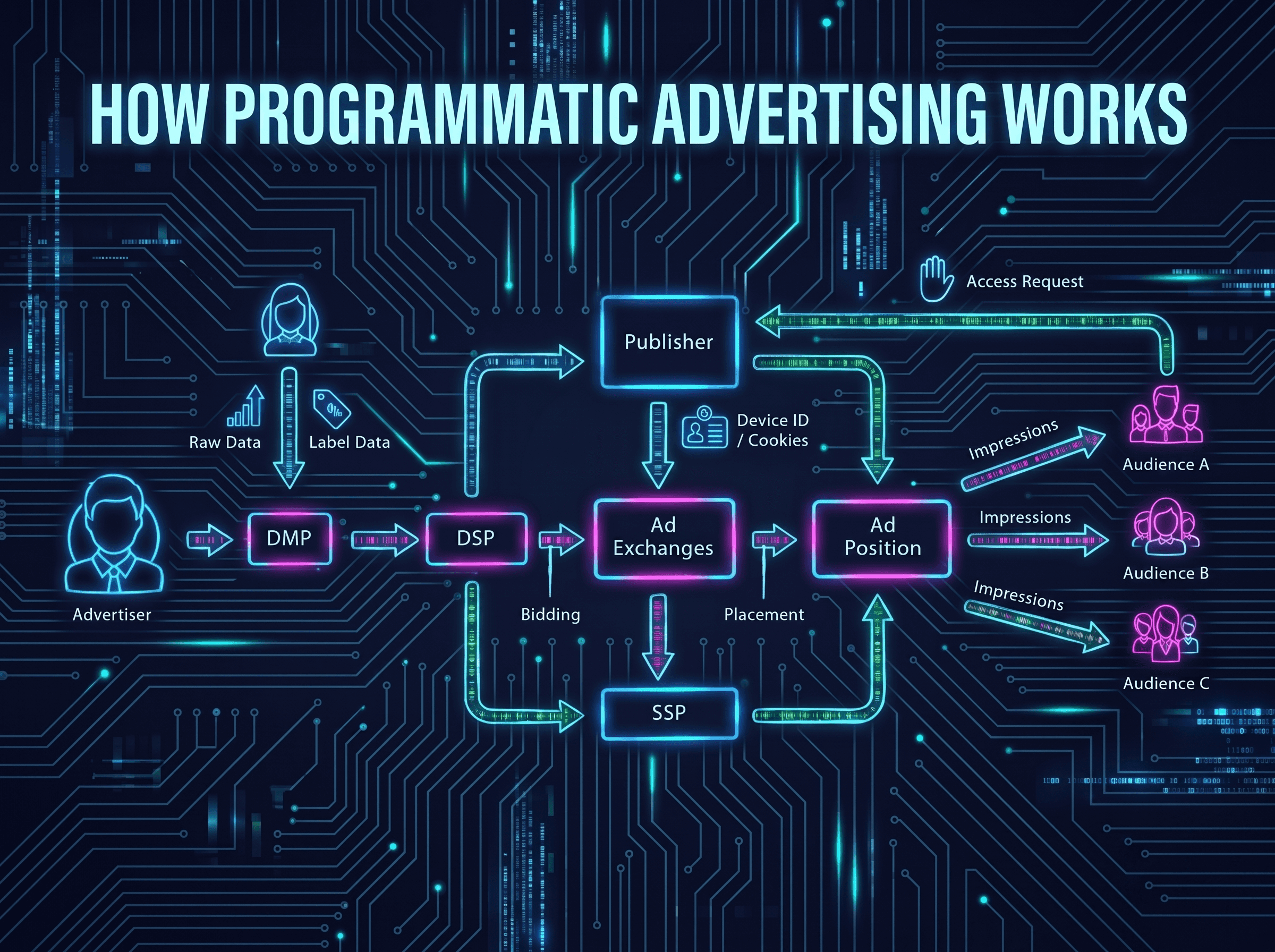
DSP (Demand-Side Platform)
This is the tool advertisers use to buy ad space. A DSP lets you set your budget, define your target audience, choose your ad formats, and let the software bid on ad space across thousands of websites and apps automatically.
Think of the DSP as the buyer's agent. It works on your behalf to find the right audience at the right price.
Major DSPs include Google Display and Video 360 (DV360), The Trade Desk, and Amazon DSP. Google DV360 holds about 28% of the DSP market by spend. The Trade Desk has been growing fast, reaching 22% market share in 2026.
SSP (Supply-Side Platform)
This is the tool publishers (website owners, app developers, streaming services) use to sell their ad space. The SSP connects publisher inventory to multiple ad exchanges and DSPs, helping publishers get the best possible price for every impression.
Think of the SSP as the seller's agent. It works on the publisher's behalf to maximize revenue.
Ad Exchange
The ad exchange is the marketplace where DSPs and SSPs connect. It is where the auction actually happens. Multiple advertisers bid simultaneously for each available impression, and the highest bidder wins the right to show their ad.
DMP (Data Management Platform)
A DMP is a database that stores and organizes audience data. It collects information about users from many sources, helps advertisers understand who their customers are, and powers the targeting that makes programmatic so much more effective than traditional display advertising.
DMPs are becoming less central as the industry moves away from third-party cookies, but the underlying concept of organized audience data remains essential.
Ad Server
The ad server stores the actual ads and delivers them when a bid is won. It tracks impressions, clicks, and conversions. It is the final piece that makes sure the right ad loads in the right place.
How a Programmatic Auction Works (The Simple Version)
Here is what happens every time someone loads a webpage with programmatic advertising:
A person visits a website. In that instant, the publisher's SSP sends information about the page and the visitor (location, device type, browsing context) to the ad exchange.
The ad exchange sends this information to every connected DSP simultaneously.
Every DSP analyzes the data and decides how much to bid. This decision takes into account the advertiser's campaign settings, budget, target audience, and how valuable this particular visitor looks based on available data.
Each DSP submits its bid. The whole process takes less than 100 milliseconds.
The highest bid wins. The winner's ad is served to the page. The visitor sees it.
The advertiser pays the winning bid. Data on whether the visitor clicked or converted is fed back into the system to improve future bids.
All of that happens before the page finishes loading. Every time. On millions of pages simultaneously.
The Four Types of Programmatic Buying
Not all programmatic advertising works the same way. There are four main buying models, and they involve different levels of control, cost, and inventory quality.
1. Real-Time Bidding (RTB) / Open Auction
RTB is the most common form. It makes up 62% of all programmatic transactions.
In an open auction, any advertiser can bid on any available impression. The highest bidder wins. There are no prior deals or commitments.
RTB gives you access to the widest range of inventory at generally lower prices. The tradeoff: less control over exactly where your ads appear, and higher exposure to ad fraud and brand safety issues. This is where most beginners start because it is the most accessible entry point.
2. Private Marketplace (PMP)
A PMP is an invitation-only auction. A publisher invites a select group of advertisers to bid on their inventory before it goes to the open market.
PMPs give advertisers access to premium inventory (major news sites, high-quality apps) with better brand safety and transparency. Publishers get better prices. Advertisers get better placements. Everyone benefits compared to the open auction. PMP deals now represent 28% of all programmatic transactions and are growing fast.
3. Programmatic Guaranteed (PG)
In a PG deal, the advertiser and publisher agree in advance on a fixed price, a guaranteed number of impressions, and specific placement. The actual buying still happens through programmatic technology, but the terms are locked in beforehand.
This is programmatic at its most premium. You know exactly where your ad will appear, how many people will see it, and what you will pay. PG deals account for about 10% of programmatic transactions and tend to involve big brand budgets and high-profile placements.
4. Preferred Deals
A preferred deal sits between PMP and PG. The advertiser gets a first look at a publisher's inventory at a pre-negotiated price before it goes to the PMP or open auction. They can choose to buy or pass. No guaranteed volume.
What Targeting Options Programmatic Gives You
This is where programmatic advertising becomes genuinely powerful. The targeting options available go far beyond anything traditional advertising could offer.
Behavioral targeting: Show ads to people based on their past online behavior. Someone who has been researching running shoes for two weeks is a warm prospect for a running brand. Behavioral audience segments represent about 48% of programmatic targeting spend.
Contextual targeting: Show ads based on the content of the page being viewed, not the identity of the viewer. Someone reading a recipe article is probably interested in food products. Contextual targeting has made a major comeback as privacy regulations restrict behavioral tracking.
Demographic targeting: Target by age, gender, income level, parental status, and similar attributes.
Geographic targeting: Target by country, city, neighborhood, or radius around a specific location. Location-based programmatic targeting has improved footfall attribution by 18 to 32% in retail studies.
Retargeting: Show ads to people who previously visited your website or interacted with your content. These are warm audiences who already know you exist. Retargeting campaigns consistently outperform cold audience campaigns on conversion rate.
Lookalike targeting: Find new users who have similar characteristics to your existing customers. Lookalike modeling usage increased three times year-over-year in e-commerce programmatic.
First-party data targeting: Use your own customer data, such as your email list or CRM, to target existing customers across the web. As third-party cookies disappear, this has become the most valuable targeting method. First-party data usage has increased 40 to 70% since cookie deprecation announcements.
The Formats: Where Programmatic Ads Appear
Programmatic is not just banner ads on websites. It runs across a growing range of formats and environments.
Display: The classic banner ad. Rectangular images or graphics on web pages and apps. Still a major format, though click-through rates are low (typically 0.05 to 0.12%).
Video: Pre-roll, mid-roll, and outstream video ads. The fastest-growing and highest-engagement format. Video represents about 50% of all programmatic spend. Programmatic video ad spend grew at 18.6% recently.
Connected TV (CTV): Ads served to people watching streaming content on smart TVs, Roku, Apple TV, and similar devices. Programmatic CTV ad spend in the US reached $33.5 billion in 2026, a 28% year-over-year increase. CTV video completion rates average 92 to 97%, compared to much lower rates on desktop and mobile.
Digital Out-of-Home (DOOH): Digital billboards and screens in public spaces. Yes, even those highway billboards and mall displays can now be bought programmatically. DOOH programmatic spending has grown over 400% since 2019.
Native advertising: Ads that match the look and feel of the surrounding content. They look like editorial content rather than traditional ads. Native programmatic ads account for 15 to 20% of budgets.
Audio: Programmatic ads served in music streaming services, podcasts, and digital radio. Programmatic audio ad spending has grown over 200% since 2020.
In-app mobile: Ads inside smartphone apps. Mobile accounts for 71% of all programmatic ad spend and over 70% of all programmatic impressions.
The Numbers on Performance
Programmatic advertising delivers real results. Here is what the data shows.
AI-optimized programmatic ads see around 28% higher click-through rates and 17% better ROI on average compared to non-optimized campaigns. Conversion rates for programmatic CTV ads are 25% higher than traditional linear TV. Retail media programmatic campaigns deliver return on ad spend (ROAS) of 3 to 8 times depending on the category. Private marketplace deals consistently outperform open auction campaigns on viewability and brand safety metrics.
And on the organizational side: 64% of enterprise advertisers now manage at least one DSP in-house, up from 41% in 2023. The shift to in-house programmatic management is accelerating because brands are realizing that keeping campaign data and optimization in-house produces better results and lower costs over time.
The Problems You Need to Know About
Programmatic advertising is powerful. It is also imperfect. Being honest about the problems is what separates experienced practitioners from beginners who get burned.
Ad Fraud
This is the biggest problem in programmatic. Global ad fraud losses are estimated at $100 to $120 billion annually. That represents 8 to 15% of all global digital ad spend exposed to invalid traffic. Around 20% of ad traffic in open programmatic environments involves non-human traffic: bots visiting pages, fake clicks, and fabricated impressions.
What you can do: Use brand safety and fraud verification tools like Integral Ad Science (IAS) or DoubleVerify. These tools can reduce invalid traffic by 60 to 90%. Favor private marketplace deals over open auction buying, because PMP inventory has far lower fraud rates. Buy from curated supply rather than the broadest open exchange inventory.
Brand Safety
Programmatic can place your ad next to content that damages your brand. An airline ad appearing next to a plane crash story. A children's toy brand appearing on an adult website. These situations happen in open auction buying without brand safety controls in place.
What you can do: Set category exclusions to block specific types of content. Use keyword blocking to avoid appearing near sensitive topics. Work with brand safety vendors. Accept that aggressive keyword blocking will reduce your available inventory, and that is acceptable.
However: Do not over-block. Research shows that news environments generate 24% higher brand lift, but 41% of advertisers block news content entirely through keyword blocking out of excessive caution. This costs advertisers an estimated 2.4 billion euros in missed reach across Europe alone. Be strategic, not paranoid.
Supply Chain Complexity
The programmatic supply chain has many layers between advertiser and publisher. Each layer takes a fee. Studies suggest 15% of all programmatic ad spend is lost to non-transparent fees in the supply chain.
What you can do: Practice Supply Path Optimization (SPO). This means auditing your supply chain to understand which SSPs and paths to publishers are most efficient. Reduce the number of intermediaries between your DSP and the publishers you actually want to reach. Demand transparency from your technology partners about where your money goes.
The Cookie Deprecation Challenge
Third-party cookies, which tracked users across websites and powered much of programmatic targeting, are being phased out across browsers. This is changing how audience targeting works.
What you can do: Invest in first-party data. Build your email list. Use your CRM data for targeting. Explore contextual targeting, which does not rely on individual user tracking. Look into clean rooms, which let you match first-party data with partners without sharing raw personal data. Brands that unify CRM and ad data see 30 to 50% better attribution accuracy.
Getting Started: A Practical First Steps Plan
You do not need a massive budget or a specialist agency to start with programmatic. Here is a realistic path forward.
Step 1: Define your goal before touching any platform.
What do you actually want? Brand awareness (lots of people seeing your ad)? Lead generation (people clicking and filling in a form)? Direct sales (people buying on your website)? Your goal determines everything: which format you use, how you bid, how you measure success.
Step 2: Start with Google Display Network or Meta Advantage+.
Before you graduate to a full DSP like The Trade Desk or DV360, learn on more accessible tools. Google Display campaigns and Meta's Advantage+ are both programmatic in nature. They use automated bidding and audience targeting. They have lower minimum budgets and simpler interfaces. Use these to learn what targeting works for your audience before moving to more complex platforms.
Step 3: Set a test budget of $500 to $2,000.
You need enough data to draw conclusions. Too small a budget and the numbers are not meaningful. Start here, run for at least 2 to 4 weeks, and focus on learning rather than immediate ROI.
Step 4: Build your audiences before you launch.
Install your tracking pixel (from Google or Meta) on your website now. Start building retargeting audiences. Even if you are not ready to run ads yet, letting the pixel collect data means you will have meaningful audience sizes when you are ready.
Step 5: Set your brand safety controls before you spend a dollar.
Before your first campaign goes live, set category exclusions, sensitive content exclusions, and placement-level brand safety settings. It takes 15 minutes. Skipping this step is how advertisers end up with nightmare placement stories.
Step 6: Measure the right things.
Clicks and impressions are vanity metrics without context. The metrics that matter: cost per click, cost per conversion, viewability rate (what percentage of your ads were actually seen, not just loaded), conversion rate, and return on ad spend (ROAS) if you are an e-commerce brand. Set up conversion tracking before you launch. If you cannot measure it, you cannot improve it.
Programmatic Advertising in 2026: What Is Changing
The programmatic landscape is moving fast. Here are the trends that matter right now.
AI is taking over optimization. AI-powered programmatic tools now manage over 68% of all real-time bidding decisions globally. AI models continuously adjust bids, audiences, and creative based on performance data. The advertisers winning now are the ones who understand how to set up AI-powered campaigns correctly, not the ones trying to manually manage every bid.
CTV is the fastest-growing channel. As more people cut their cable subscriptions and move to streaming services, the CTV advertising opportunity is exploding. Netflix, Disney+, and other streaming platforms have scaled their ad-supported tiers to over 200 million combined subscribers. Programmatic CTV now offers the brand impact of television combined with the targeting precision of digital.
Retail media is the new frontier. Amazon, Walmart, Instacart, and other retailers are offering programmatic ad products powered by their first-party shopping data. Retail media programmatic spend grew 41.7% in 2024 and is projected to grow another 29.3% in 2025. The targeting is extremely precise because it is based on actual purchase behavior, not just browsing.
Contextual targeting is coming back strongly. As behavioral tracking becomes harder due to privacy regulations, contextual targeting (matching your ad to the content context rather than the individual user) is growing fast. The contextual advertising market is forecast to surpass $562 billion by 2030. This is actually a positive development for quality publishers and for advertisers who want a privacy-safe approach.
First-party data is the new competitive advantage. The advertisers with strong first-party data, large email lists, active customer databases, and loyalty program members will have a structural advantage in the cookieless world. Building that asset now is one of the highest-leverage things any marketer can do.
The Glossary You Actually Need
CPM (Cost Per Mille): What you pay per 1,000 ad impressions. The standard pricing unit for display and video programmatic campaigns.
CPC (Cost Per Click): What you pay each time someone clicks your ad.
CTR (Click-Through Rate): The percentage of people who see your ad and click it. Average display CTR in programmatic is 0.05 to 0.12%.
Viewability: Whether your ad was actually seen by a human (not just loaded on a page nobody scrolled to). Industry standard is that an ad must be at least 50% visible for at least one second to count as viewable.
Frequency capping: A setting that limits how many times any single user sees your ad. Without frequency capping, you will show the same ad to the same person 40 times, which annoys them and wastes budget.
Whitelist / Blocklist: Lists of websites you either approve (whitelist) or ban (blocklist) for your ad placements.
Floor price: The minimum price a publisher will accept for their ad inventory. Bids below the floor are rejected.
IVT (Invalid Traffic): Fake traffic from bots or fraudulent sources. Around 20% of open programmatic traffic is IVT.
The Bottom Line
Programmatic advertising is not the future of digital advertising. It is the present. 91.5% of all digital display ads are already bought this way.
Understanding how it works is no longer optional for anyone who manages digital marketing budgets. Whether you are spending $5,000 a month or $5 million, the same fundamental principles apply: buy the right impression, for the right person, at the right time, for the right price.
The technology is more accessible than ever. The entry points are lower. The data is better. The results, when the campaigns are set up properly, are measurably superior to manual ad buying.
Start with a clear goal. Start with a modest budget. Set your brand safety controls. Measure what matters. Learn from the data. Scale what works.
That is programmatic advertising in practice. Everything else is just vocabulary.
Blogs
More Blogs
From keyword goldmines to AI-driven content hacks—expert insights to help your blog posts dominate the first page.