Blog

Blog

One Page Website SEO Your Guide to Higher Rankings

One Page Website SEO Your Guide to Higher Rankings

Blog

One Page Website SEO Your Guide to Higher Rankings

Let's get straight to it: SEO for a one-page website is a different kind of beast. With a typical site, you have multiple pages—and multiple shots—to target different keywords. On a single-page site, you've got just one URL to make your case to Google. This means we have to be smarter and more focused.

The Unique SEO Puzzle of One-Page Websites

The beauty of a one-page website is its simplicity. It’s a clean, linear path designed to get a visitor to do one thing. But that strength is also its biggest SEO weakness. Your entire business, all your services, and your whole story are packed into a single URL, so every choice you make counts.

Grappling with Content Depth

On a multi-page website, it's easy. You want to talk about "Service A"? You create a page for it. "Service B"? It gets its own page, too. Each page targets a different set of keywords and builds its own authority.

A one-page site doesn't have that luxury. You have to create thematic relevance and depth all within one document. If you don't structure your content just right, search engines might see your site as "thin" and not authoritative enough to rank for anything meaningful.

This is exactly why a quick search for "one page website seo" pulls up a ton of guides focused on solving this very problem.

See how the top results are all about guides and overcoming challenges? That's a clear signal that Google gets it—this is a tricky subject.

To really nail this, you have to think differently. Below is a quick comparison table that lays out the strategic shifts you'll need to make.

One Page SEO vs Traditional SEO Key Differences

SEO Element

Traditional Multi-Page Strategy

One Page Strategy Adjustment

Keyword Targeting

Target different keyword clusters on separate pages.

Focus on one primary keyword theme with related long-tail variations within sections.

Content Structure

Information is organized across multiple URLs (e.g., /services, /about, /contact).

Use a single, long-scrolling page with distinct div sections to create a logical flow.

Internal Linking

Link between relevant pages to pass authority and help crawlers.

Use jump links (anchor links) to navigate between sections, mimicking site navigation.

Backlink Strategy

Build links to various pages, including the homepage, blog posts, and service pages.

Concentrate all link-building efforts on the single URL to maximize its authority.

Ultimately, the goal is to create the experience of a multi-page site on a single page, both for users and for search engine crawlers.

Concentrated Authority and High Stakes

Here's the upside: every single optimization you make and every backlink you earn points to that one URL. This can create a powerhouse of concentrated authority. The downside? There's absolutely no room for error.

Consider this: over 53% of all website traffic comes from organic search. With Google commanding a 92.58% market share, playing by its rules is the only way to win. Plus, SEO leads have a fantastic conversion rate of 14.6%, which is huge when your entire site is built to drive a single, focused action. If you're curious, you can find more data on how search impacts business growth.

The mindset shift you need for one-page SEO is this: you’re not trying to rank for a bunch of different things. You’re aiming to be the absolute, undisputed best answer for your one primary niche. It's about depth, not breadth.

Building a Strong Content and Keyword Foundation

When you're working with a one-page site, your content structure isn't just important—it's everything. You don't have the luxury of separate pages, so you need to think of your single page as a story with distinct, thematically rich chapters. Each section needs to function like its own mini-page, built to grab a visitor's attention and answer a specific question.

It all starts with picking one, powerful primary keyword. This is the big idea, the central theme of your entire page. For a local business, that might be something like "artisan sourdough bakery Chicago." From here on out, every single piece of content you create must support and expand on this core topic.

Mapping Your Mini-Pages

Think of each section on your page as a standalone piece of your story, each one targeting a specific user intent related to your main keyword. The trick is to structure this properly in the code. You'll want to use HTML section tags (like <section>) and give each one a unique ID. These IDs are what let you create those smooth-scrolling anchor links in your navigation menu (e.g., yoursite.com/#catering).

This setup does two things brilliantly. First, it creates a seamless experience for your visitors, letting them jump right to the information they need. Second, it helps search engines understand the different "chapters" of your site, signaling that even with just one URL, your content is deep, organized, and valuable.

This visual really captures the strategic shift you need to make when tackling one-page SEO.
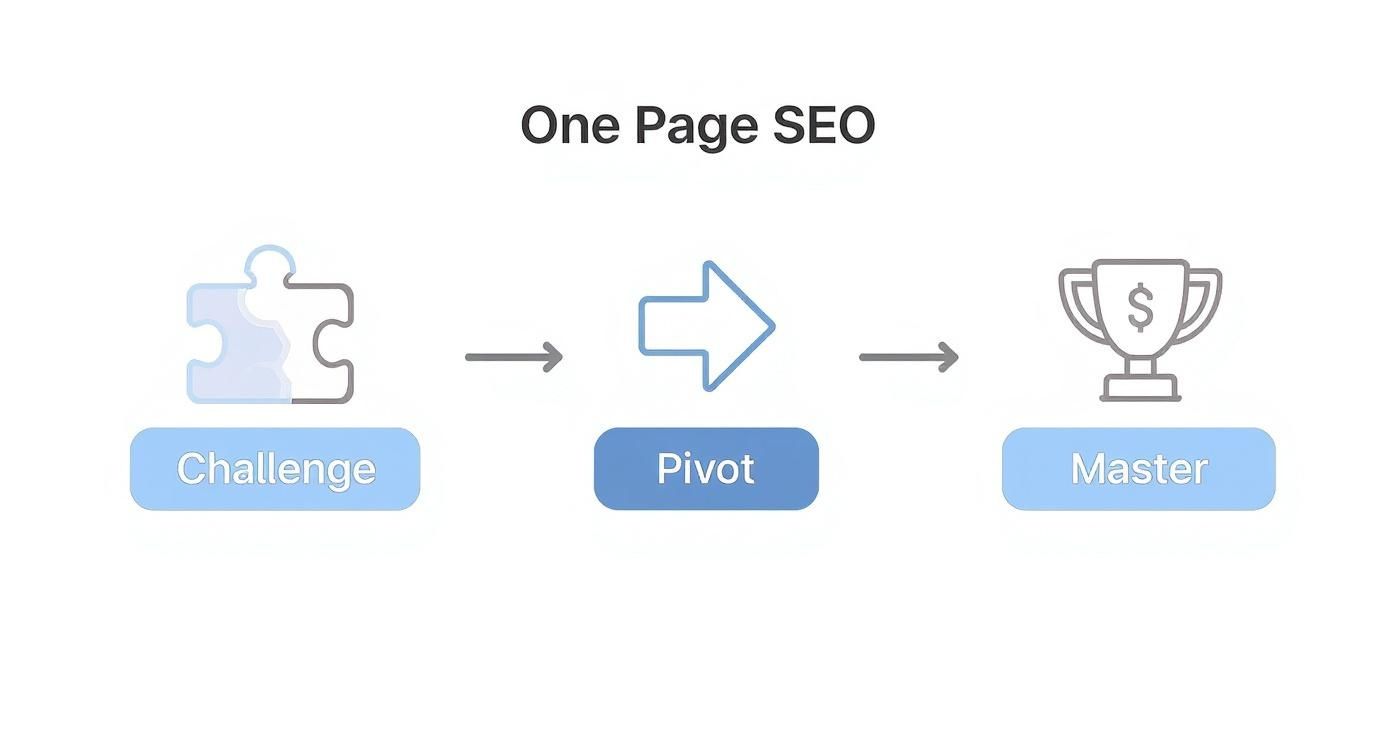
Infographic about one page website seo

As the infographic suggests, success here isn't about just applying the old SEO playbook. It's about adapting your strategy to focus on depth over breadth.

Weaving in Long-Tail Keywords

Okay, so you've got your primary keyword locked in. Now it's time to flesh out each section with long-tail keywords and related terms. These are the more specific, conversational phrases that people use when they're closer to making a decision.

Let's stick with our bakery example to see how this works in practice:

  • Primary Keyword: "artisan sourdough bakery Chicago"

  • Section 1: About Us (id="about")

    • H2 Heading: Our Story: Handcrafting Chicago’s Best Sourdough

    • Keywords: "family-owned bakery Chicago," "traditional bread making," "organic ingredients bakery"

  • Section 2: Our Breads (id="menu")

    • H2 Heading: Explore Our Daily Selection of Breads and Pastries

    • Keywords: "sourdough bread menu," "freshly baked croissants Chicago," "daily bread specials"

  • Section 3: Catering Services (id="catering")

    • H2 Heading: Artisan Bread Catering for Your Next Event

    • Keywords: "bakery catering Chicago," "corporate breakfast catering," "fresh bread for events"

Structuring your content this way shows search engines that your page is a genuinely comprehensive resource for your main topic. Finding these longer phrases is all about digging into long-tail keyword research. If you need a good place to start, our guide on effective long-tail keyword research can walk you through the process.

By treating each content block as a mini-page with its own targeted sub-topic, you create a rich semantic core. This approach is essential for demonstrating authority and relevance without the benefit of multiple URLs.

Ultimately, the goal is to make your single page the definitive resource for its niche. Every section, every heading, and every keyword you choose should all work together to tell a cohesive and powerful story—one that resonates with both your audience and search engines.

Mastering Your On-Page and Technical SEO

When your whole business lives on a single URL, you have to treat every on-page element and line of code like prime real estate. Getting the on-page and technical details right for your one page website seo isn't just a good idea—it's absolutely essential if you want to show up in search results. Think of this as the foundational work you can't afford to skip.
A person checking a list of technical SEO elements on a digital screen

It all starts with your title tag and meta description. These are, without a doubt, the most important pieces of on-page SEO you have. You get one chance to pitch your entire site to Google and searchers, so your message has to be clear, compelling, and built around your primary keyword.

Crafting Your Title and Meta Description

Your title tag needs to nail your main offering and location (if you're a local business), while the meta description is your short-form ad copy that convinces people to click.

Here's what I mean:

  • Bad Title: "J's Coffee | Best Beans and Pastries"

  • Good Title: "J's Artisan Coffee Shop | Downtown Smallville"

  • Bad Meta: "We sell coffee, tea, and other drinks. We also have food. Come visit us today!"

  • Good Meta: "Experience the best coffee in Downtown Smallville. We serve handcrafted espresso drinks, fresh pastries, and offer a cozy spot to work or relax. Visit J's today!"

Getting this right is crucial. Given that Google rewrites 76% of titles it sees in search results, a strong, well-structured title is your best bet for keeping control of your message.

On a one-page website, your title and meta description don’t just represent a page; they represent your entire brand in the search results. Make every single character count.

Implementing Structured Data

Think of structured data, or Schema markup, as your secret weapon. It’s a layer of code you add to your site that gives search engines context about your content. This is a huge opportunity, especially when you consider that about 23% of websites don't use any structured data at all. Implementing it gives you an instant leg up.

For a one-page site, you can actually use several types of Schema to define your different content sections:

  • LocalBusiness: A must-have for telling Google your business name, address, phone number (NAP), and hours.

  • FAQPage: Got an FAQ section? Mark it up with this Schema to help you earn rich snippets that answer questions directly in the search results.

  • Service: Use this to clearly define your services section and detail what you actually offer.

By implementing these, you’re helping Google understand that your single page is a rich, comprehensive resource. This dramatically increases your chances of standing out. To see how keywords fit into this whole puzzle, you can check out our guide on https://getviralseo.com/articles/seo-how-many-keywords-per-page.

Prioritizing Site Performance

Finally, let's talk speed and mobile-friendliness. Your site absolutely has to be fast. Google has over 200 ranking factors, and page speed is a big one. Optimizing your one-page site for performance is non-negotiable for both the user experience and your rankings.

Simple things like compressing all your images and using browser caching can make a world of difference. Since a one-page site often has to load more content and visuals at once, these technical optimizations are table stakes. For a deeper dive, this is a great resource on How to Improve Website Loading Speed.

Building Links for a Single Page Website

Link building for a one-page site is a different ballgame. You don't have a stable of blog posts or dozens of service pages to attract links naturally. Instead, you have to be laser-focused, channeling all that link equity into a single URL. The name of the game is quality, not quantity, and it all starts by making specific parts of your page irresistible to other websites.
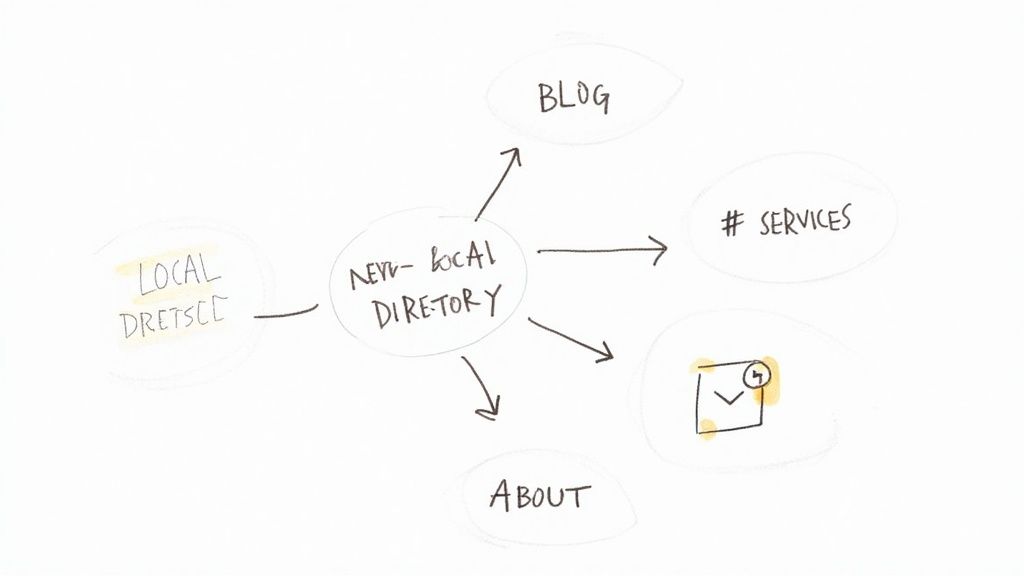
A visual representation of interconnected nodes, symbolizing a strong link-building network for a single website.

The trick is to create something truly exceptional within one of your content sections. Forget about generic filler content. We're talking about a "linkable asset"—a unique piece of content so valuable that other people in your industry will want to share it. Think of it as a magnet for backlinks.

Creating Your Linkable Asset

First things first, you need to brainstorm what this standout piece of content could be. This asset will be the centerpiece of your outreach, giving other sites a genuine reason to link back to you.

Here are a few ideas I've seen work wonders:

  • Interactive Tool: If you’re a financial advisor, a simple retirement savings calculator embedded right in your "Services" section is incredibly useful and highly linkable.

  • Unique Data: A local marketing agency could survey area businesses to create an infographic on "The State of Small Business Marketing in Chicago." People love to link to fresh data.

  • In-Depth Guide: A personal trainer could design a detailed, visual guide to "Perfecting Your Kettlebell Swing," complete with custom graphics and short video clips, all housed within their main training section.

This targeted approach transforms your link-building from a spammy numbers game into a strategic mission. It also helps you build the kind of authority that actually moves the needle in search rankings.

Executing Targeted Outreach

Once your linkable asset is live, it's time to get it in front of the right people. Your goal is to reach out to relevant industry blogs, resource pages, and maybe even local directories. But here's the key: you aren't just begging for a link. You're offering their audience something genuinely valuable.

And here’s a pro tip: use anchor links to send people directly to the relevant section. So, instead of asking for a link to yoursite.com, you’d ask for a link to yoursite.com/#calculator. This creates a much better experience for the user and gives Google a crystal-clear signal about what that specific part of your page covers.

By building links to specific page sections using anchor links, you can diversify your backlink profile. This mimics the natural linking patterns of a multi-page site, making your one page website seo strategy far more powerful.

The Power of Local and Niche Citations

If you're a local business, this is non-negotiable. Building citations is a cornerstone of any link strategy. Getting your business listed on platforms like Yelp, industry-specific directories, and your local Chamber of Commerce website is a fantastic way to score high-quality, relevant backlinks.

Just make sure your business name, address, and phone number (NAP) are perfectly consistent everywhere. Most directories have a field for your website URL, giving you a straightforward way to build foundational authority.

The impact of consistent link-building adds up. On average, top-ranking pages on Google have 3.8 times more backlinks than pages on the lower half of the first page. Keep in mind that a new link typically starts to influence rankings after about 3.1 months. If you want to dive into the numbers, you can discover more SEO statistics that highlight this trend.

This just proves why patience and a long-term plan are so critical for growing your site's authority. If you're curious where your site currently stands, our guide on how to find domain authority can help you get a baseline.

Flipping the switch and launching your one-page site is a great feeling, but it’s not the finish line. Honestly, it’s just the starting gun. The real work—and where you see serious results with one page website seo—begins when you start digging into the data to see what’s actually working.

If you’re not tracking your performance, you’re just guessing.

The two tools you absolutely cannot live without are Google Analytics and Google Search Console. Get these set up from day one. They are your windows into how people find your site and what they do once they land on it.

To really get a handle on your site's SEO progress, you need to be watching your essential website KPIs. For a compact, single-page site, a few specific metrics tell you almost everything you need to know.

https://www.youtube.com/embed/UuE37-MM1ws

What to Actually Watch in Your Analytics

It's easy to get overwhelmed by all the charts and numbers. Don't. For a one-page site, you just need to zero in on a handful of key performance indicators that truly matter.

Here's a look at the data that gives you actionable insights.

Key Performance Indicators for One Page SEO

Metric

Tool

What It Tells You

Keyword Rankings

Google Search Console

Are you climbing or falling for your target keywords? This is your most direct SEO report card.

Scroll Depth

Google Analytics (w/ Event Tracking)

How far down the page are people actually going? If they aren't reaching your CTA, that’s a problem.

Time on Page

Google Analytics

A higher number usually means your content is engaging. A low number can signal a disconnect or a slow-loading page.

Impressions & CTR

Google Search Console

Impressions show how often you appear in search. CTR tells you how many people are actually clicking.

Referral Traffic

Google Analytics

Who is sending traffic your way? This helps you see which backlinks or off-site content are most effective.

By focusing on these metrics, you move beyond just counting visitors and start understanding their behavior, which is where the real optimization happens.

The goal isn't just to get traffic; it's to understand user behavior on your single page. If 80% of users never scroll past your hero section, you know exactly where to start making improvements.

Pushing Past the Basics for Long-Term Growth

Once you’ve got your tracking in place and understand your baseline, it’s time to layer on some smarter tactics. SEO is a long game, a constant cycle of testing, learning, and tweaking.

Treat Your Google Business Profile Like a Second Homepage

If you have a local angle, your Google Business Profile is an absolute goldmine. For many potential customers, it is your business's first impression, and it can drive a surprising amount of traffic and leads all on its own.

  • Keep it fresh. Add new photos of your team, your work, or your products regularly.

  • Lean into reviews. Actively ask your happy customers to leave a review, and make sure you reply to every single one—good or bad.

  • Answer questions before they're asked. Use the Q&A feature to address common queries. Think of it as a mini-FAQ right on the search results page.

Build Authority with Off-Site Content

Your one-page website needs to stay sharp and focused on conversion. That means no blog, no resource library, no clutter. But that doesn’t mean you can’t create that kind of content somewhere else.

Think about publishing deep-dive articles on a platform like Medium or writing guest posts for well-known blogs in your industry. This lets you explore related topics and target a wider range of keywords without bloating your main site.

Every piece you publish is an opportunity to link back to your one-pager, which builds high-quality backlinks and funnels interested readers directly to your core offer. It's the perfect way to have your cake and eat it too—building broad topical authority while keeping your website a lean, mean, conversion-focused machine.

Got Questions About One-Page SEO? Let's Clear Things Up.

Diving into SEO for a one-page website can feel a little counterintuitive, especially if you're used to the traditional, multi-page approach. It’s a different ballgame entirely, so it's completely normal to have some questions floating around.

Let's tackle some of the most common ones I hear from clients and in workshops. My goal is to give you straight answers so you can move forward with confidence.

Can a One-Page Website Actually Rank Well on Google?

Yes, it absolutely can. But—and this is a big but—it has to be done with surgical precision.

Single-page sites really shine when they're targeting a very specific, niche keyword. Think about search terms where the user needs one thing and one thing only, like "24-hour emergency glass repair" or "luxury picnic setup Los Angeles."

Your success comes down to making sure every single element—your content sections, your technical SEO, and your backlinks—is perfectly aligned with that one core topic. You won't be ranking for dozens of different keywords, but you can absolutely dominate the one that matters most.

How Do You Handle Multiple Keywords on Just One Page?

Great question. You can’t just throw a bunch of keywords at the wall and hope they stick. The trick is to think in terms of topics and sub-topics.

You'll pick one primary keyword to be the star of the show. This is what you'll build your page title and your main H1 heading around.

Then, you weave in long-tail keywords and related search terms within the different sections of your page, especially in the subheadings (your H2s and H3s). For instance, if your main keyword is "local catering service," you could have a section with an H2 that says "Our Custom Wedding Catering Packages." This naturally lets you target a related, more specific search query without looking like you're keyword stuffing.

The whole idea isn't to rank for a bunch of disconnected terms. It's to show Google that your single page is the ultimate, most complete resource for one central theme and all its logical variations.

Are Single-Page Websites Just Bad for SEO?

They're not inherently "bad," but they do come with a unique set of challenges. You can't create separate pages for different keyword groups, which is a major limitation. It also means you have fewer content assets to attract backlinks to.

But here’s the upside: for a business with a single, clear-cut service or product, a one-page site offers an incredibly smooth and focused user experience. And we all know how much Google values that. When done right, their simplicity can lead to fantastic user engagement and higher conversion rates, which are powerful ranking signals in their own right.

Ready to stop guessing and start ranking? The Viral SEO Content Gap Analyzer uncovers the exact topics your competitors are winning with, so you can build a smarter content strategy that drives real traffic. Start making data-driven decisions at https://getviralseo.com.

Let's get straight to it: SEO for a one-page website is a different kind of beast. With a typical site, you have multiple pages—and multiple shots—to target different keywords. On a single-page site, you've got just one URL to make your case to Google. This means we have to be smarter and more focused.

The Unique SEO Puzzle of One-Page Websites

The beauty of a one-page website is its simplicity. It’s a clean, linear path designed to get a visitor to do one thing. But that strength is also its biggest SEO weakness. Your entire business, all your services, and your whole story are packed into a single URL, so every choice you make counts.

Grappling with Content Depth

On a multi-page website, it's easy. You want to talk about "Service A"? You create a page for it. "Service B"? It gets its own page, too. Each page targets a different set of keywords and builds its own authority.

A one-page site doesn't have that luxury. You have to create thematic relevance and depth all within one document. If you don't structure your content just right, search engines might see your site as "thin" and not authoritative enough to rank for anything meaningful.

This is exactly why a quick search for "one page website seo" pulls up a ton of guides focused on solving this very problem.

See how the top results are all about guides and overcoming challenges? That's a clear signal that Google gets it—this is a tricky subject.

To really nail this, you have to think differently. Below is a quick comparison table that lays out the strategic shifts you'll need to make.

One Page SEO vs Traditional SEO Key Differences

SEO Element

Traditional Multi-Page Strategy

One Page Strategy Adjustment

Keyword Targeting

Target different keyword clusters on separate pages.

Focus on one primary keyword theme with related long-tail variations within sections.

Content Structure

Information is organized across multiple URLs (e.g., /services, /about, /contact).

Use a single, long-scrolling page with distinct div sections to create a logical flow.

Internal Linking

Link between relevant pages to pass authority and help crawlers.

Use jump links (anchor links) to navigate between sections, mimicking site navigation.

Backlink Strategy

Build links to various pages, including the homepage, blog posts, and service pages.

Concentrate all link-building efforts on the single URL to maximize its authority.

Ultimately, the goal is to create the experience of a multi-page site on a single page, both for users and for search engine crawlers.

Concentrated Authority and High Stakes

Here's the upside: every single optimization you make and every backlink you earn points to that one URL. This can create a powerhouse of concentrated authority. The downside? There's absolutely no room for error.

Consider this: over 53% of all website traffic comes from organic search. With Google commanding a 92.58% market share, playing by its rules is the only way to win. Plus, SEO leads have a fantastic conversion rate of 14.6%, which is huge when your entire site is built to drive a single, focused action. If you're curious, you can find more data on how search impacts business growth.

The mindset shift you need for one-page SEO is this: you’re not trying to rank for a bunch of different things. You’re aiming to be the absolute, undisputed best answer for your one primary niche. It's about depth, not breadth.

Building a Strong Content and Keyword Foundation

When you're working with a one-page site, your content structure isn't just important—it's everything. You don't have the luxury of separate pages, so you need to think of your single page as a story with distinct, thematically rich chapters. Each section needs to function like its own mini-page, built to grab a visitor's attention and answer a specific question.

It all starts with picking one, powerful primary keyword. This is the big idea, the central theme of your entire page. For a local business, that might be something like "artisan sourdough bakery Chicago." From here on out, every single piece of content you create must support and expand on this core topic.

Mapping Your Mini-Pages

Think of each section on your page as a standalone piece of your story, each one targeting a specific user intent related to your main keyword. The trick is to structure this properly in the code. You'll want to use HTML section tags (like <section>) and give each one a unique ID. These IDs are what let you create those smooth-scrolling anchor links in your navigation menu (e.g., yoursite.com/#catering).

This setup does two things brilliantly. First, it creates a seamless experience for your visitors, letting them jump right to the information they need. Second, it helps search engines understand the different "chapters" of your site, signaling that even with just one URL, your content is deep, organized, and valuable.

This visual really captures the strategic shift you need to make when tackling one-page SEO.

Infographic about one page website seo

As the infographic suggests, success here isn't about just applying the old SEO playbook. It's about adapting your strategy to focus on depth over breadth.

Weaving in Long-Tail Keywords

Okay, so you've got your primary keyword locked in. Now it's time to flesh out each section with long-tail keywords and related terms. These are the more specific, conversational phrases that people use when they're closer to making a decision.

Let's stick with our bakery example to see how this works in practice:

  • Primary Keyword: "artisan sourdough bakery Chicago"

  • Section 1: About Us (id="about")

    • H2 Heading: Our Story: Handcrafting Chicago’s Best Sourdough

    • Keywords: "family-owned bakery Chicago," "traditional bread making," "organic ingredients bakery"

  • Section 2: Our Breads (id="menu")

    • H2 Heading: Explore Our Daily Selection of Breads and Pastries

    • Keywords: "sourdough bread menu," "freshly baked croissants Chicago," "daily bread specials"

  • Section 3: Catering Services (id="catering")

    • H2 Heading: Artisan Bread Catering for Your Next Event

    • Keywords: "bakery catering Chicago," "corporate breakfast catering," "fresh bread for events"

Structuring your content this way shows search engines that your page is a genuinely comprehensive resource for your main topic. Finding these longer phrases is all about digging into long-tail keyword research. If you need a good place to start, our guide on effective long-tail keyword research can walk you through the process.

By treating each content block as a mini-page with its own targeted sub-topic, you create a rich semantic core. This approach is essential for demonstrating authority and relevance without the benefit of multiple URLs.

Ultimately, the goal is to make your single page the definitive resource for its niche. Every section, every heading, and every keyword you choose should all work together to tell a cohesive and powerful story—one that resonates with both your audience and search engines.

Mastering Your On-Page and Technical SEO

When your whole business lives on a single URL, you have to treat every on-page element and line of code like prime real estate. Getting the on-page and technical details right for your one page website seo isn't just a good idea—it's absolutely essential if you want to show up in search results. Think of this as the foundational work you can't afford to skip.

A person checking a list of technical SEO elements on a digital screen

It all starts with your title tag and meta description. These are, without a doubt, the most important pieces of on-page SEO you have. You get one chance to pitch your entire site to Google and searchers, so your message has to be clear, compelling, and built around your primary keyword.

Crafting Your Title and Meta Description

Your title tag needs to nail your main offering and location (if you're a local business), while the meta description is your short-form ad copy that convinces people to click.

Here's what I mean:

  • Bad Title: "J's Coffee | Best Beans and Pastries"

  • Good Title: "J's Artisan Coffee Shop | Downtown Smallville"

  • Bad Meta: "We sell coffee, tea, and other drinks. We also have food. Come visit us today!"

  • Good Meta: "Experience the best coffee in Downtown Smallville. We serve handcrafted espresso drinks, fresh pastries, and offer a cozy spot to work or relax. Visit J's today!"

Getting this right is crucial. Given that Google rewrites 76% of titles it sees in search results, a strong, well-structured title is your best bet for keeping control of your message.

On a one-page website, your title and meta description don’t just represent a page; they represent your entire brand in the search results. Make every single character count.

Implementing Structured Data

Think of structured data, or Schema markup, as your secret weapon. It’s a layer of code you add to your site that gives search engines context about your content. This is a huge opportunity, especially when you consider that about 23% of websites don't use any structured data at all. Implementing it gives you an instant leg up.

For a one-page site, you can actually use several types of Schema to define your different content sections:

  • LocalBusiness: A must-have for telling Google your business name, address, phone number (NAP), and hours.

  • FAQPage: Got an FAQ section? Mark it up with this Schema to help you earn rich snippets that answer questions directly in the search results.

  • Service: Use this to clearly define your services section and detail what you actually offer.

By implementing these, you’re helping Google understand that your single page is a rich, comprehensive resource. This dramatically increases your chances of standing out. To see how keywords fit into this whole puzzle, you can check out our guide on https://getviralseo.com/articles/seo-how-many-keywords-per-page.

Prioritizing Site Performance

Finally, let's talk speed and mobile-friendliness. Your site absolutely has to be fast. Google has over 200 ranking factors, and page speed is a big one. Optimizing your one-page site for performance is non-negotiable for both the user experience and your rankings.

Simple things like compressing all your images and using browser caching can make a world of difference. Since a one-page site often has to load more content and visuals at once, these technical optimizations are table stakes. For a deeper dive, this is a great resource on How to Improve Website Loading Speed.

Building Links for a Single Page Website

Link building for a one-page site is a different ballgame. You don't have a stable of blog posts or dozens of service pages to attract links naturally. Instead, you have to be laser-focused, channeling all that link equity into a single URL. The name of the game is quality, not quantity, and it all starts by making specific parts of your page irresistible to other websites.

A visual representation of interconnected nodes, symbolizing a strong link-building network for a single website.

The trick is to create something truly exceptional within one of your content sections. Forget about generic filler content. We're talking about a "linkable asset"—a unique piece of content so valuable that other people in your industry will want to share it. Think of it as a magnet for backlinks.

Creating Your Linkable Asset

First things first, you need to brainstorm what this standout piece of content could be. This asset will be the centerpiece of your outreach, giving other sites a genuine reason to link back to you.

Here are a few ideas I've seen work wonders:

  • Interactive Tool: If you’re a financial advisor, a simple retirement savings calculator embedded right in your "Services" section is incredibly useful and highly linkable.

  • Unique Data: A local marketing agency could survey area businesses to create an infographic on "The State of Small Business Marketing in Chicago." People love to link to fresh data.

  • In-Depth Guide: A personal trainer could design a detailed, visual guide to "Perfecting Your Kettlebell Swing," complete with custom graphics and short video clips, all housed within their main training section.

This targeted approach transforms your link-building from a spammy numbers game into a strategic mission. It also helps you build the kind of authority that actually moves the needle in search rankings.

Executing Targeted Outreach

Once your linkable asset is live, it's time to get it in front of the right people. Your goal is to reach out to relevant industry blogs, resource pages, and maybe even local directories. But here's the key: you aren't just begging for a link. You're offering their audience something genuinely valuable.

And here’s a pro tip: use anchor links to send people directly to the relevant section. So, instead of asking for a link to yoursite.com, you’d ask for a link to yoursite.com/#calculator. This creates a much better experience for the user and gives Google a crystal-clear signal about what that specific part of your page covers.

By building links to specific page sections using anchor links, you can diversify your backlink profile. This mimics the natural linking patterns of a multi-page site, making your one page website seo strategy far more powerful.

The Power of Local and Niche Citations

If you're a local business, this is non-negotiable. Building citations is a cornerstone of any link strategy. Getting your business listed on platforms like Yelp, industry-specific directories, and your local Chamber of Commerce website is a fantastic way to score high-quality, relevant backlinks.

Just make sure your business name, address, and phone number (NAP) are perfectly consistent everywhere. Most directories have a field for your website URL, giving you a straightforward way to build foundational authority.

The impact of consistent link-building adds up. On average, top-ranking pages on Google have 3.8 times more backlinks than pages on the lower half of the first page. Keep in mind that a new link typically starts to influence rankings after about 3.1 months. If you want to dive into the numbers, you can discover more SEO statistics that highlight this trend.

This just proves why patience and a long-term plan are so critical for growing your site's authority. If you're curious where your site currently stands, our guide on how to find domain authority can help you get a baseline.

Flipping the switch and launching your one-page site is a great feeling, but it’s not the finish line. Honestly, it’s just the starting gun. The real work—and where you see serious results with one page website seo—begins when you start digging into the data to see what’s actually working.

If you’re not tracking your performance, you’re just guessing.

The two tools you absolutely cannot live without are Google Analytics and Google Search Console. Get these set up from day one. They are your windows into how people find your site and what they do once they land on it.

To really get a handle on your site's SEO progress, you need to be watching your essential website KPIs. For a compact, single-page site, a few specific metrics tell you almost everything you need to know.

https://www.youtube.com/embed/UuE37-MM1ws

What to Actually Watch in Your Analytics

It's easy to get overwhelmed by all the charts and numbers. Don't. For a one-page site, you just need to zero in on a handful of key performance indicators that truly matter.

Here's a look at the data that gives you actionable insights.

Key Performance Indicators for One Page SEO

Metric

Tool

What It Tells You

Keyword Rankings

Google Search Console

Are you climbing or falling for your target keywords? This is your most direct SEO report card.

Scroll Depth

Google Analytics (w/ Event Tracking)

How far down the page are people actually going? If they aren't reaching your CTA, that’s a problem.

Time on Page

Google Analytics

A higher number usually means your content is engaging. A low number can signal a disconnect or a slow-loading page.

Impressions & CTR

Google Search Console

Impressions show how often you appear in search. CTR tells you how many people are actually clicking.

Referral Traffic

Google Analytics

Who is sending traffic your way? This helps you see which backlinks or off-site content are most effective.

By focusing on these metrics, you move beyond just counting visitors and start understanding their behavior, which is where the real optimization happens.

The goal isn't just to get traffic; it's to understand user behavior on your single page. If 80% of users never scroll past your hero section, you know exactly where to start making improvements.

Pushing Past the Basics for Long-Term Growth

Once you’ve got your tracking in place and understand your baseline, it’s time to layer on some smarter tactics. SEO is a long game, a constant cycle of testing, learning, and tweaking.

Treat Your Google Business Profile Like a Second Homepage

If you have a local angle, your Google Business Profile is an absolute goldmine. For many potential customers, it is your business's first impression, and it can drive a surprising amount of traffic and leads all on its own.

  • Keep it fresh. Add new photos of your team, your work, or your products regularly.

  • Lean into reviews. Actively ask your happy customers to leave a review, and make sure you reply to every single one—good or bad.

  • Answer questions before they're asked. Use the Q&A feature to address common queries. Think of it as a mini-FAQ right on the search results page.

Build Authority with Off-Site Content

Your one-page website needs to stay sharp and focused on conversion. That means no blog, no resource library, no clutter. But that doesn’t mean you can’t create that kind of content somewhere else.

Think about publishing deep-dive articles on a platform like Medium or writing guest posts for well-known blogs in your industry. This lets you explore related topics and target a wider range of keywords without bloating your main site.

Every piece you publish is an opportunity to link back to your one-pager, which builds high-quality backlinks and funnels interested readers directly to your core offer. It's the perfect way to have your cake and eat it too—building broad topical authority while keeping your website a lean, mean, conversion-focused machine.

Got Questions About One-Page SEO? Let's Clear Things Up.

Diving into SEO for a one-page website can feel a little counterintuitive, especially if you're used to the traditional, multi-page approach. It’s a different ballgame entirely, so it's completely normal to have some questions floating around.

Let's tackle some of the most common ones I hear from clients and in workshops. My goal is to give you straight answers so you can move forward with confidence.

Can a One-Page Website Actually Rank Well on Google?

Yes, it absolutely can. But—and this is a big but—it has to be done with surgical precision.

Single-page sites really shine when they're targeting a very specific, niche keyword. Think about search terms where the user needs one thing and one thing only, like "24-hour emergency glass repair" or "luxury picnic setup Los Angeles."

Your success comes down to making sure every single element—your content sections, your technical SEO, and your backlinks—is perfectly aligned with that one core topic. You won't be ranking for dozens of different keywords, but you can absolutely dominate the one that matters most.

How Do You Handle Multiple Keywords on Just One Page?

Great question. You can’t just throw a bunch of keywords at the wall and hope they stick. The trick is to think in terms of topics and sub-topics.

You'll pick one primary keyword to be the star of the show. This is what you'll build your page title and your main H1 heading around.

Then, you weave in long-tail keywords and related search terms within the different sections of your page, especially in the subheadings (your H2s and H3s). For instance, if your main keyword is "local catering service," you could have a section with an H2 that says "Our Custom Wedding Catering Packages." This naturally lets you target a related, more specific search query without looking like you're keyword stuffing.

The whole idea isn't to rank for a bunch of disconnected terms. It's to show Google that your single page is the ultimate, most complete resource for one central theme and all its logical variations.

Are Single-Page Websites Just Bad for SEO?

They're not inherently "bad," but they do come with a unique set of challenges. You can't create separate pages for different keyword groups, which is a major limitation. It also means you have fewer content assets to attract backlinks to.

But here’s the upside: for a business with a single, clear-cut service or product, a one-page site offers an incredibly smooth and focused user experience. And we all know how much Google values that. When done right, their simplicity can lead to fantastic user engagement and higher conversion rates, which are powerful ranking signals in their own right.

Ready to stop guessing and start ranking? The Viral SEO Content Gap Analyzer uncovers the exact topics your competitors are winning with, so you can build a smarter content strategy that drives real traffic. Start making data-driven decisions at https://getviralseo.com.