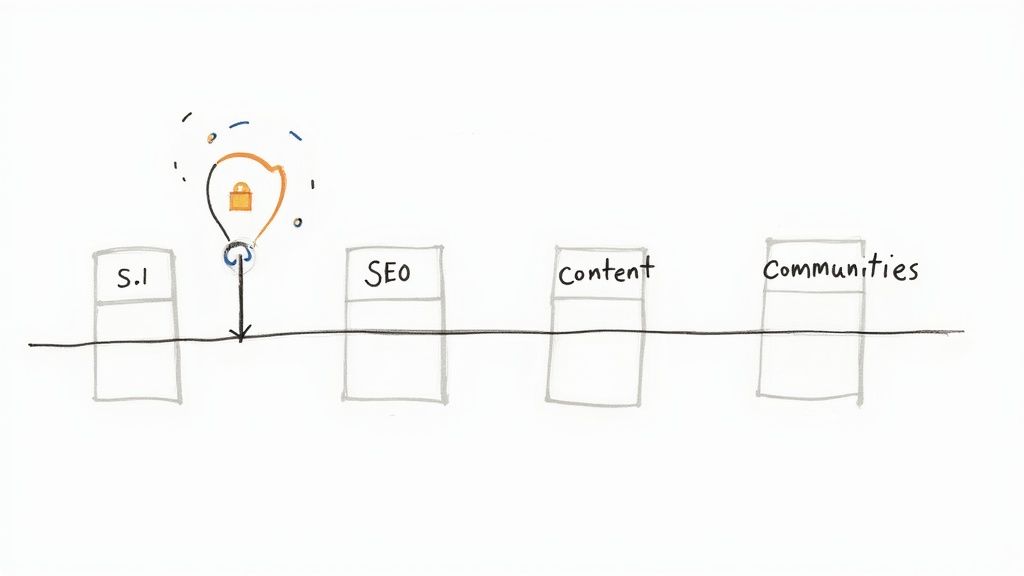
Getting traffic without a budget? It's not just possible; it's simpler than you might think. The best ways to promote your website for free boil down to a few core strategies: mastering Search Engine Optimization (SEO), creating content people actually want to share, and getting involved in online communities where your audience hangs out. These three pillars are your blueprint for sustainable, long-term growth.
Building Your Foundation for Free Website Promotion
Promoting a website with no marketing budget isn't a pipe dream—it’s how countless successful online brands got their start. For a moment, let's push aside the thought of expensive ad campaigns and complicated funnels. Real, lasting traffic comes from building a solid foundation that pulls visitors in naturally.
The whole approach is about creating value first. Instead of paying to interrupt people, you’re going to earn their attention. It’s a powerful shift in thinking, and it’s one that will pay off for years to come.
Understanding the Core Pillars of Free Promotion
Before we get into the nuts and bolts, it's crucial to understand the 'why' behind these tactics. The most effective free promotion strategies are all connected and built on three fundamental ideas:
Search Engine Optimization (SEO): This is all about making your website more visible on search engines like Google. When someone searches for something in your niche, you want your site showing up near the top. Simple as that.
High-Value Content Creation: Think of your content as a magnet. It’s what draws people in, builds trust, and makes them want to tell others about your website.
Community Engagement: Your target audience is already gathered in online forums, on social media, and in niche communities. By becoming a helpful, active member, you open a direct line to them.
Why Organic Search Is Your Greatest Asset
Out of all the free methods available, SEO gives you the best return on your time. While a viral social media post can give you a quick traffic spike, organic search delivers a steady, consistent stream of people who are actively looking for what you have to offer.
The data backs this up in a big way. Consider this: approximately 94% of all clicks on Google's search results go to organic listings, not the paid ads at the top.
Even more telling, 61% of B2B marketers say organic search brings in more leads than all their other channels combined. This just goes to show how critical it is to get your SEO right from the very beginning. If you're curious, you can learn more about organic versus paid search statistics and use that data to shape your strategy.
This guide will walk you through the actionable steps you need to take to master these foundational pillars, turning your website into a traffic-generating machine—all without spending a cent.
Mastering SEO to Attract Organic Visitors

When it comes to getting a steady stream of high-intent visitors without touching your wallet, nothing beats Search Engine Optimization (SEO). It's all about making sure you pop up when people are actively looking for the exact solutions you offer. Honestly, it's one of the best ways to promote your website for free.
It might sound complicated, but at its heart, SEO is pretty straightforward: figure out what your audience wants, then make it ridiculously easy for search engines like Google to find your content and serve it up to them.
This strategy is a game-changer because it taps into the two biggest sources of free traffic. The numbers don't lie: direct traffic accounts for 58% of visits, and organic search pulls in another 29%. And with Google dominating over 91% of all searches, getting your site optimized for it isn't just a good idea—it's essential for getting that free, targeted traffic.
Finding What Your Audience Is Searching For
Your first move is to get inside your audience's head. We call this keyword research, but it’s really about uncovering the exact words and phrases people use when they’re searching for answers.
Luckily, you don't need a big budget for this. Free tools are your best friend here. A basic Google account gets you access to Keyword Planner, and tools like Ubersuggest or AnswerThePublic are fantastic for digging up search terms in your niche.
Your goal? Hunt for long-tail keywords. These are the longer, more specific phrases that show real intent—think "gluten-free birthday cakes in Brooklyn" instead of just "cakes." They're less competitive and attract people who are much closer to making a decision.
For example, I once worked with a local bakery that was getting buried by big-name competitors. We discovered through keyword research that people were constantly searching for specific dietary options in their area. We created a single page optimized around "gluten-free birthday cakes near me," and within weeks, they were at the top of local results, driving foot traffic from customers ready to buy.
Optimizing Your On-Page Elements
Once you've got your keywords, it's time to signal to Google what your content is about. This is where on-page SEO comes in. It's not about tricking the system; it's about making small but vital tweaks to your page's structure.
I always tell people to start by focusing on these three areas:
Title Tags: This is your page's headline in the search results. Make it catchy, clear, and include your primary keyword naturally.
Meta Descriptions: That little snippet of text under the title. It doesn't directly affect your ranking, but a great one convinces people to click on your link instead of someone else's.
Headers (H1, H2, H3): Use these to organize your content. Your main title should be an H1, with sub-topics broken down by H2s and H3s. Weave your keywords in where they make sense. If you're wondering about the right balance, our guide on https://getviralseo.com/articles/seo-how-many-keywords-per-page is a great resource.
To help you get started, here’s a quick-reference table of the most impactful, no-cost SEO actions you can take today.
Core SEO Actions for Free Promotion
SEO Action | Primary Goal | Free Tools to Use |
|---|---|---|
Keyword Research | Discover what your audience is searching for. | Google Keyword Planner, AnswerThePublic, Google Trends |
On-Page Optimization | Signal content relevance to search engines. | Your website's CMS (e.g., WordPress with Yoast) |
Technical SEO Audit | Ensure your site is fast and mobile-friendly. | Google PageSpeed Insights, Google Search Console |
Content Creation | Provide valuable answers to user queries. | Google Docs, Grammarly (free version) |
These actions form the bedrock of any successful SEO strategy. Start here, and you'll be building a solid foundation for long-term organic growth.
Don't Forget the Technical Basics
A perfectly written page won't do you any good if the site itself has technical problems. Two things are non-negotiable in today's world: site speed and mobile-friendliness.
Your site has to load fast. Period. Use Google's PageSpeed Insights to get a free performance report and follow its advice. And since most people are searching on their phones, you absolutely must ensure your website works flawlessly on a smaller screen.
While mastering Google is a must, keep an eye on how search behavior is changing. It's fascinating to see how younger generations use platforms like TikTok as search engines, opening up entirely new channels for discovery.
Creating Content That People Want to Share
If you want to promote your site without spending a dime, your content has to do the heavy lifting. Exceptional content is the real engine behind free promotion. It's the currency you use to earn social shares, backlinks, and an audience that actually wants to hear from you.
This isn’t about just churning out blog posts. It’s about creating assets that solve a real, nagging problem for your audience so effectively that they feel compelled to share it.
Your goal is to build the go-to resource in your niche. When you create something truly definitive, promotion almost takes care of itself.
Identify and Fill a Content Gap
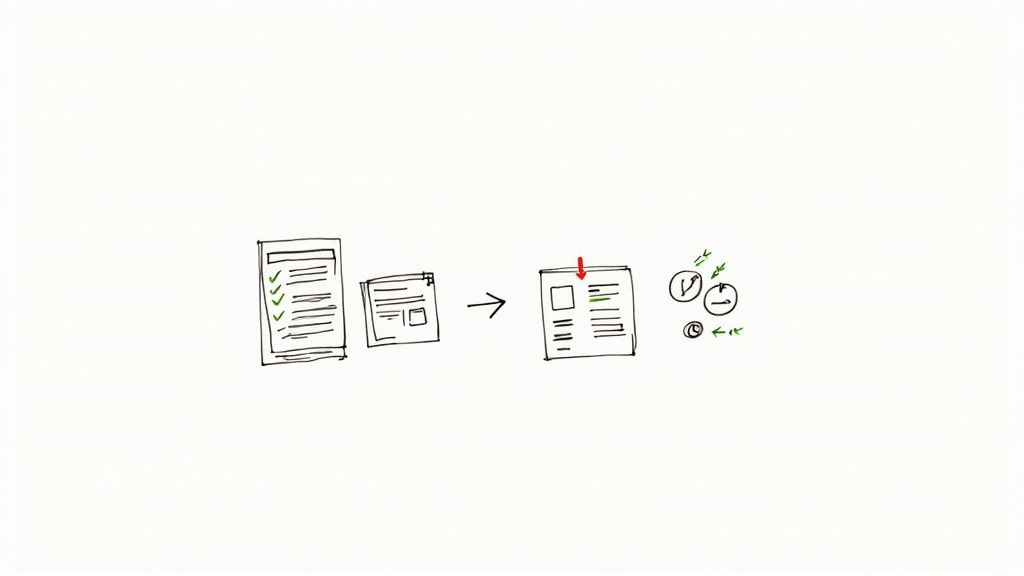
The best place to start is by finding a "content gap." Take a hard look at what your competitors are writing about and ask yourself: what’s missing? Is their guide from three years ago? Does it gloss over the important details? Could you present the information in a much more useful way, like a template or a checklist?
That's your opening. When you create the resource that you wish existed, you instantly position yourself as an authority. For content that keeps pulling in traffic long after you hit publish, it’s worth mastering your evergreen content strategy for long-term success. This is how you make sure your hard work pays off for years, not just days.
Once you’ve spotted a gap, zero in on creating one of these high-value content types:
Ultimate Guides: A massive, all-in-one resource that covers a topic so thoroughly your readers won't need to look anywhere else.
Actionable Checklists: Break down a complicated process into simple, follow-along steps. People love these because they’re practical and save a ton of time.
Original Infographics: Turn data or a complex idea into a visually stunning, easy-to-scan format. These are pure gold for sharing on platforms like Twitter and Pinterest.
A small SaaS company I know noticed all their competitors had blog posts about "how to do X," but nobody offered a simple checklist. They designed a one-page PDF and gave it away for free. It became their single most-shared piece of content and drove thousands of new email subscribers.
Maximize Your Reach Through Repurposing
You just poured hours—maybe days—into creating a killer piece of content. Don't let it just sit there. You need to squeeze every last drop of value out of it, and that’s where content repurposing comes in.
The idea is simple: take one core asset and slice and dice it into multiple formats for different platforms. This is one of the smartest ways to promote your website for free because you're getting your message in front of more people in the formats they already love. You should already have a good idea of what people are looking for from your https://getviralseo.com/articles/long-tail-keyword-research, which makes this even easier.
Here's a simple framework I use all the time:
Start with a pillar "Ultimate Guide" post. This is your big, comprehensive asset packed with info.
Pull out key stats for an infographic. Find the most compelling data points and turn them into a shareable graphic.
Break it down into a Twitter thread. Turn the main takeaways into a series of 10-15 punchy tweets.
Script a quick video. Use the post's outline to create a 2-3 minute video for YouTube or TikTok summarizing the core concepts.
This strategy multiplies your reach without forcing you to constantly reinvent the wheel.
Tapping into Online Communities and Social Media
While SEO and content marketing are fantastic long-term strategies, sometimes you need to get in front of people right now. The good news is, your ideal audience is probably already gathered in various corners of the internet, talking about the very problems your website solves. Your job is to find them and join the conversation—not as a pushy salesperson, but as a helpful expert.
This is one of my favorite free website promotion tactics because it taps into existing, highly engaged groups of people. The secret is to shift your entire mindset from "promotion" to "participation."
Find Where Your Audience Actually Hangs Out
Before you can start sharing your wisdom, you need to pinpoint these digital hangouts. Don’t just guess. You need to do a bit of detective work to find active communities where your expertise will be genuinely valued. Your goal is to become a familiar, trusted name in these circles.
Here are the best places to start your search:
Reddit: This place is a goldmine. Search for subreddits related to your niche (like r/saas, r/content_marketing, or r/solopreneur). Look for threads where people are asking questions you are uniquely qualified to answer.
Facebook Groups: Many niches have incredibly active private groups. Look up keywords related to your field and request to join the ones that have high engagement and, importantly, strict "no-spam" rules. Those are usually the highest quality.
LinkedIn Groups: An absolute must for B2B. Find groups centered around specific industries, job titles, or professional skills where you can offer your insights.
Niche Forums: Don't sleep on old-school forums! For super-specific topics like software development, personal finance, or even niche hobbies, these can be treasure troves of highly targeted users.
Master the Art of Value-First Engagement
Once you've found a few promising communities, your initial goal is simple: be helpful. Seriously, fight every urge to drop a link to your latest blog post on day one. That’s the quickest way to get ignored or, worse, kicked out.
Instead, take some time to be a fly on the wall. Learn the community's culture and read the rules. Then, start jumping in to answer questions and offer thoughtful advice. You're trying to build a reputation as someone who knows their stuff and genuinely wants to see others succeed.
For example, I once watched the founder of a new project management tool become a go-to expert in a LinkedIn group for startup operators. He never pitched his product. He just consistently offered brilliant, actionable advice on productivity and team management. After a few months, people started asking him what tool he used. This naturally sent a steady stream of high-quality, targeted traffic right to his website.
This approach builds rock-solid trust and authority. So, when you eventually do share a link to one of your resources, it isn't seen as spam. It’s seen as a helpful piece of content from a trusted source. You've gone from being just another marketer to a valuable member of the community. The traffic will follow.
Building Authority with Guest Posting
Getting backlinks from other respected websites is one of the most powerful things you can do for your SEO. Think of every backlink as a vote of confidence—another site is essentially telling Google that your content is worth checking out. And one of the best ways to earn these votes without spending a dime is through guest posting.
The idea is simple: you write an article for someone else's website in your industry. It's a classic win-win situation. They get great, relevant content for free, and you get to tap into their audience, build your reputation as an expert, and, most importantly, get a valuable link pointing back to your site.
Finding the Right Guest Post Opportunities
First things first, you need to find blogs and online publications in your niche that actually accept guest articles. The goal isn't just to find any website. You want sites that your target audience already reads and that have a good reputation themselves.
A few targeted Google searches are the perfect place to start.
Try using search strings like these:
"your industry" + "write for us""your topic" + "guest post""your keyword" + "contributor guidelines"
These queries will bring up the exact pages where websites outline their guest posting rules. As you start putting together a list of potential targets, it's a good idea to gauge their influence. Our guide on how to find the domain authority of a website is a great resource for figuring out which opportunities will give you the most bang for your buck.
Crafting a Pitch That Gets a Response
Okay, you've got your list of dream sites. Now it's time to reach out. Be warned: a generic, copy-and-paste email is a surefire way to end up in the trash folder. A pitch that actually works shows you've done your homework and you genuinely want to provide value to their audience, not just score a link for yourself.
I’ve seen this simple pitch structure work countless times:
Start with a personal touch. Address the editor by name. Mention a recent article of theirs you actually read and liked. This immediately shows you’re a real person and a fan of their work, not just a spammer.
Briefly introduce yourself. Who are you, and what makes you qualified to write about this topic? Keep it short and sweet.
Pitch 2-3 specific article ideas. Don't just say, "I can write about marketing." Propose concrete, compelling headlines that would be a perfect fit for their blog. Add a sentence or two explaining what each article would cover and why their readers would love it.
Showcase your writing. Link to a couple of your best published pieces. This gives them immediate proof that you can deliver quality content.
The secret is making it incredibly easy for the editor to say "yes." When you come to them with well-researched, tailored ideas, you've already done most of the heavy lifting for them.
This changes the entire dynamic. You're no longer just asking for a favor; you're making a collaborative offer to create something awesome for their audience. That’s the foundation of every great guest posting relationship.
Keeping and Converting the Traffic You Earn
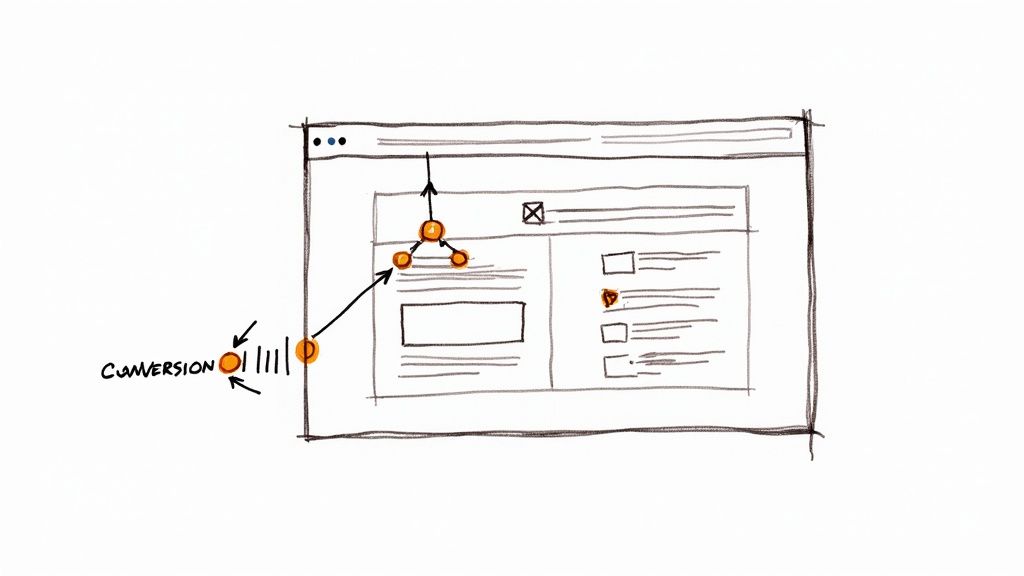
Getting someone to click through to your website is a huge win. But what happens next? If they land on a confusing, clunky page and immediately hit the "back" button, all that promotional effort was for nothing.
This is where user experience (UX) comes in. You don’t need to spend a fortune on a complete redesign. A few smart, no-cost adjustments can make a world of difference in keeping people on your site and guiding them where you want them to go.
Make Your Website a Breeze to Navigate
Have you ever walked into a massive store with no signs or aisles? It’s frustrating. That’s exactly how visitors feel on a site with poor navigation. Your menu needs to be simple, logical, and instantly make sense.
A new visitor should land on any page and immediately understand where they are and how to find what they need. Don't reinvent the wheel here—stick to what people know. Make sure your logo links back to the homepage and that your "About" and "Contact" pages are easy to find.
The goal is to eliminate friction. Every confusing moment or unnecessary click is a reason for someone to give up and leave. Think of your navigation as your site's most powerful conversion tool.
Break Up That Wall of Text
Let's be honest: nobody wants to read a giant, unbroken block of text on a screen. How your content looks is just as important as what it says. You can make your pages far more engaging with some simple formatting.
Here’s what I focus on:
Short paragraphs: Stick to 1-3 sentences max. This creates breathing room and makes the content feel way more approachable.
Clear headings: Use H2s and H3s to break up the page. This lets people scan and jump straight to the sections that interest them most.
Visuals are your friend: Use relevant images, bulleted lists, and blockquotes to break the monotony of text and add visual interest.
Use Free Tools to See What Visitors Really Do
Stop guessing what people want and start watching. Free tools like heatmaps are perfect for this. They give you a visual report of where people click, move their mouse, and how far they scroll down a page. Suddenly, you can see which parts of your site are grabbing attention and which are being completely ignored.
This data is gold for onsite promotion. High bounce rates are a killer—for example, the average for shopping sites is around 45.68%. One case study I saw was brilliant: a company used heatmaps, spotted a confusing area on a key page, and added some clearer info. The result? A 10% increase in their in-game purchases. Small tweaks, big impact. If you want to dive deeper, you can explore more website traffic statistics to see just how powerful these changes can be.
By focusing on your site's experience, you make sure the free traffic you worked so hard to get sticks around, turning into loyal readers, subscribers, and customers.
Ready to stop guessing and start seeing what works? Viral SEO’s content tools help you analyze your competitors' top pages and optimize your own content with data-backed insights, ensuring every visitor you attract has an experience that converts. Get started for free at https://getviralseo.com.
Blogs
More Blogs
From keyword goldmines to AI-driven content hacks—expert insights to help your blog posts dominate the first page.