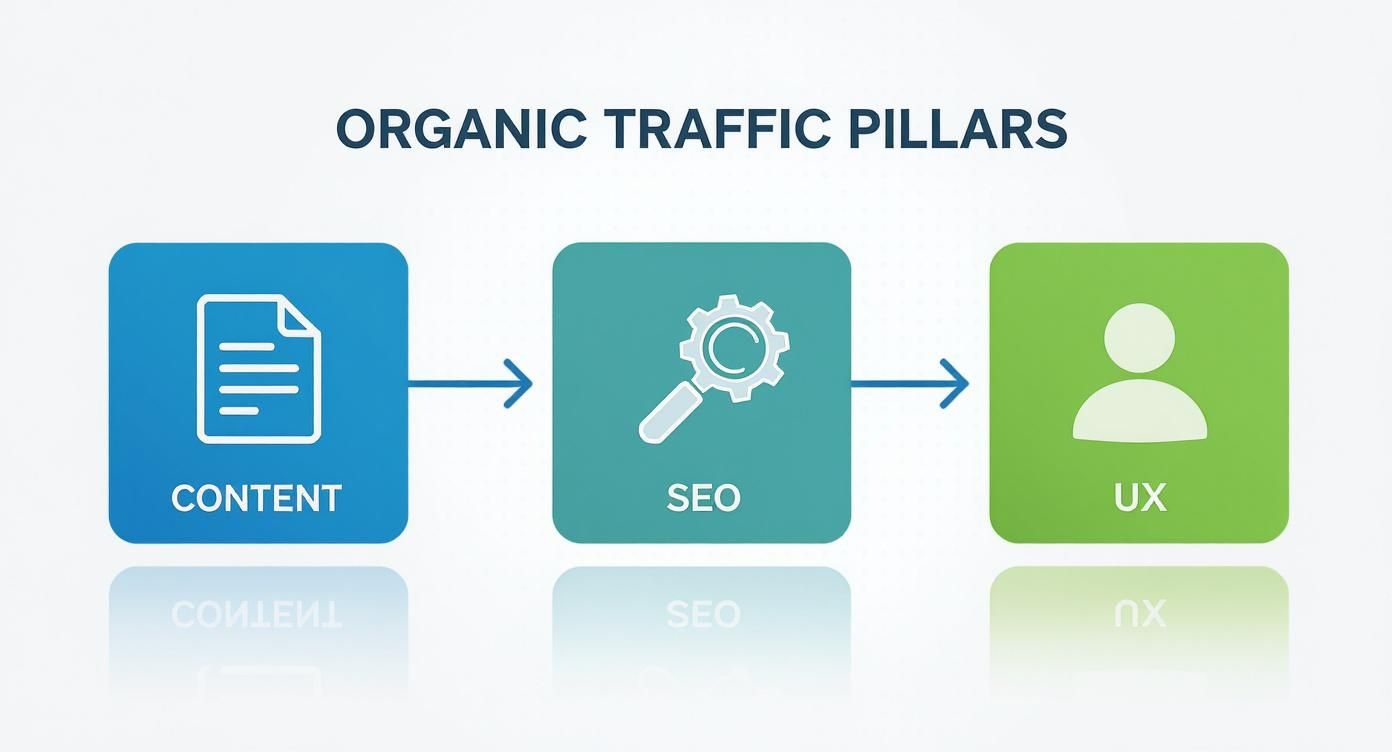
To really move the needle on organic traffic today, you need a strategy that’s both modern and holistic. I've found it boils down to three core areas: creating genuinely helpful content, nailing your technical SEO foundation, and delivering a user experience that keeps people coming back. The old-school tricks are dead; success now is all about attracting the right visitors by giving them exactly what they’re looking for.
Thriving in the New Era of Organic Search
The game has changed. Seriously. The tactics that were gold just a few years ago are collecting dust now. Search engines are smarter, and people's expectations are way higher. You can't just stuff keywords or chase backlinks anymore. You need a cohesive strategy where every part of your online presence works together.
And it’s not just the strategies that have changed—the search results page itself is a whole new beast. We're seeing more zero-click searches and AI-generated answers than ever before. Think about it: a staggering 60% of all queries are now zero-click searches, where people find their answer without ever leaving Google. On top of that, AI Overviews are showing up in 13% of searches, which can definitely take a bite out of click-through rates.
Despite all this, organic search still drives an incredible 53% of all website traffic. It remains the most crucial channel for sustainable growth. If you want to dive deeper into these shifts, we've covered them extensively in our post on the 2025 organic traffic crisis.
The biggest shift I've seen is moving from a volume-based mindset to a value-based one. Your goal isn't just to rank; it's to be the absolute best and most helpful answer for the person searching.
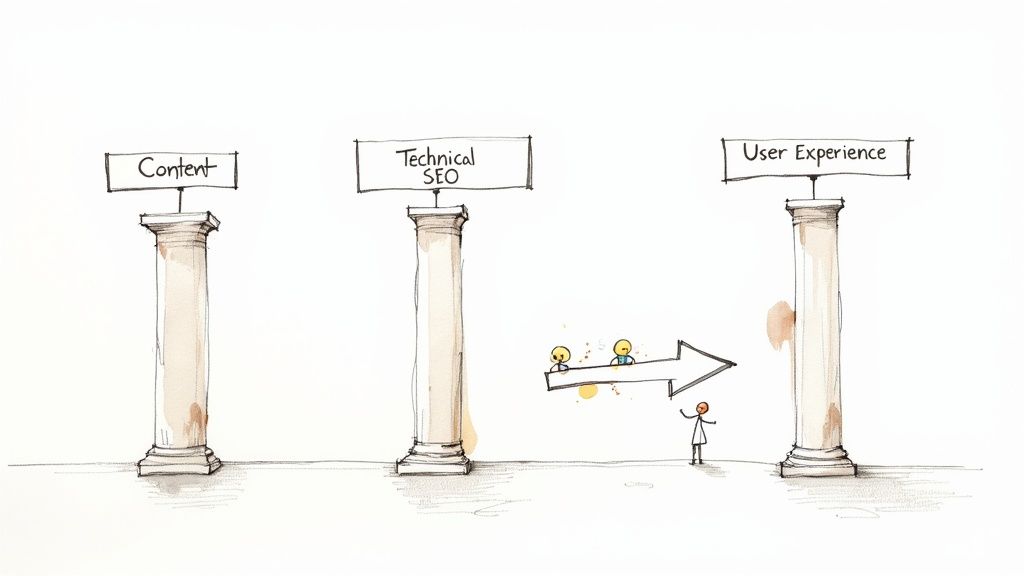
This updated approach really hinges on a unified effort across those three essential pillars I mentioned. Let’s lay them out clearly.
Here's a quick look at the core pillars we'll be breaking down. Think of this as your strategic roadmap for boosting organic traffic.
Pillar | Primary Goal | Key Action |
|---|---|---|
Content Strategy | To create the most helpful and relevant content for your target audience. | Conduct deep keyword research and map content to the user's journey. |
Technical SEO | To ensure search engines can easily crawl, index, and understand your site. | Optimize site speed, mobile-friendliness, and structured data. |
User Experience (UX) | To provide a seamless, intuitive, and satisfying on-site experience. | Improve site navigation, readability, and overall design. |
Each pillar supports the others, and letting one slide will hold back your entire effort. The infographic below visualizes how these pieces fit together to create a powerful engine for sustainable growth.
Throughout this guide, we're going to break down actionable steps for mastering each of these areas. I’ll give you a clear framework for how to increase organic traffic and see results that actually last.
Finding Keywords That Fuel Your Business Growth
Great SEO isn’t about just picking keywords; it's about getting inside your audience's head to figure out what they’re actually searching for. The real goal is to attract visitors who have a genuine need for what you offer, not just chase vanity traffic that looks good in a report but does nothing for your bottom line.
This all comes down to searcher intent—the "why" behind every search. Someone typing "what is CRM" is just starting their journey. They’re in a completely different headspace than someone searching for "best CRM for small business," who is much closer to making a decision. You have to create content that meets them exactly where they are.
Uncovering High-Intent Keywords
Forget trying to rank for broad, hyper-competitive terms right out of the gate. The smart money is on finding the opportunities your competitors are sleeping on. These are often long-tail keywords—those longer, more specific phrases that have lower search volume but much higher conversion rates.
Think about it: a new project management tool isn't going to rank for "project management software" anytime soon. But what about "asynchronous collaboration tools for remote teams"? That's a specific problem for a specific audience that their product can solve. For a deeper look at this approach, check out our guide on https://getviralseo.com/articles/long-tail-keyword-research.
The real magic happens when you stop obsessing over search volume and start analyzing keywords for their business value. A keyword with 50 searches a month that brings in five solid leads is infinitely more valuable than one with 5,000 searches that generates nothing.
Analyzing Competitor Gaps
One of the quickest ways to build a powerful keyword list is to see what's already working for your competition. Using a tool like Viral SEO’s Content Gap Analyzer, you can peek at your rivals' top pages and see exactly which keywords are driving meaningful traffic in your space.
Your job is to look for the weak spots. Are the top-ranking articles outdated? Do they only partially answer the user's question? These are your strategic openings. To really find the terms that move the needle, you have to learn how to do keyword research like a growth hacker. Once you spot those gaps, you can create a piece of content that's ten times better and swoop in to claim that traffic.
Creating Content That People and Search Engines Actually Want to Read
Okay, so you've got your keywords. Now comes the hard part—and where most SEO strategies die a slow death. You need to create content that’s genuinely worthy of that top spot on Google. This isn't just about plugging in phrases; it's about crafting the best possible resource for someone searching for that term.
Exceptional content is the real engine behind any successful push for more organic traffic. It has to satisfy Google's algorithms and the very real, very human needs of your audience.
The secret sauce is learning how to create engaging content that captivates audiences. It's a mindset shift. You're not just matching a keyword; you're aiming to provide the most complete, helpful, and easy-to-understand answer on the internet. Do that consistently, and you'll build something called topical authority. That’s when Google starts seeing you as a genuine expert in your niche.
Build Authority Using Content Clusters
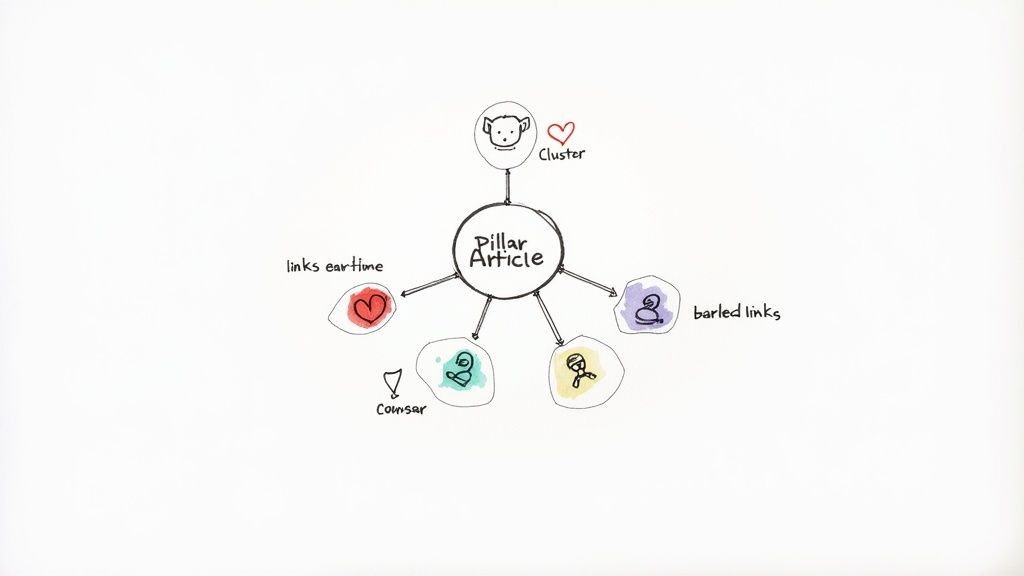
Stop thinking in terms of one-off blog posts. The real wins come from building content clusters. This strategy involves creating a single, comprehensive "pillar" page on a big topic and then supporting it with several "cluster" pages that explore related subtopics in more detail.
Imagine a marketing software company. Their main pillar page could be a massive guide on "Content Marketing Strategy." From there, they'd create smaller, focused posts that all link back to that central pillar.
Pillar Page: The Ultimate Guide to Content Marketing Strategy
Cluster Post: How to Create a Content Calendar for Your Team
Cluster Post: 10 Smart Ways to Repurpose Your Best Blog Content
Cluster Post: A No-Nonsense Guide to Measuring Content Marketing ROI
This structure does two powerful things. First, it sends a clear signal to search engines that you've covered a subject from every angle. Second, it creates an amazing experience for your visitors, letting them easily go down the rabbit hole on a topic they care about. Plus, all those internal links from the cluster posts back to the pillar page help distribute SEO authority across your site.
If you’re worried about how to handle keywords across these pages, it's worth taking a look at how many keywords per page is the sweet spot.
My biggest breakthrough came when I stopped thinking about individual articles and started building comprehensive resource hubs. The goal is to make your site the final click for anyone researching that topic.
How to Structure Content for Readers and Rankings
The way you format your content is just as crucial as what you write. Nobody likes hitting a wall of text. People scan. They want answers fast. Your content has to be built for this reality.
This is where smart formatting becomes your best friend.
Use clear H2 and H3 headings to break your article into logical sections. Keep your paragraphs short and punchy—two or three sentences, max. Lean on bullet points and numbered lists to make key takeaways pop and complex ideas feel simple.
Don't underestimate the impact of this. The numbers don't lie. The #1 result on Google now gets a massive 39.8% click-through rate (CTR). On top of that, just moving up a single spot in the rankings can increase your CTR by 2.8%. It's also telling that the average first-page result contains around 1,447 words—Google clearly rewards depth and comprehensiveness.
When you create in-depth, well-structured content, you’re playing the game exactly how Google wants you to play it. Every small improvement in your rankings can lead to a significant jump in traffic.
Get Your Technical and On-Page SEO in Order
Creating amazing content is a huge first step, but honestly, it’s only half the battle. If search engines can't crawl, index, and make sense of your pages, even the most brilliant article will just get lost in the digital void. This is where getting your technical and on-page SEO right becomes non-negotiable if you're serious about boosting organic traffic.
I like to think of a website as a house. Your content is all the beautiful furniture and decor that makes it unique. But technical SEO is the foundation, the plumbing, and the electrical wiring—without it, the house just doesn't work. Then you have on-page SEO, which is like putting clear labels on every room so visitors (and search engines) know exactly where they are and what everything is for.
It's easy to get these two mixed up, so let's quickly clarify what each one handles.
On-Page vs. Technical SEO Key Differences
This table breaks down the core responsibilities. Think of on-page as what you do on the page and technical as what you do to the site's backend to make sure those pages can be found in the first place.
SEO Element | On-Page SEO Focus (Content Level) | Technical SEO Focus (Site Level) |
|---|---|---|
Primary Goal | Make individual pages incredibly clear and relevant for a target keyword. | Ensure the entire website is crawlable, fast, and secure for search engines. |
Key Actions | Crafting title tags, meta descriptions, headings, and internal links. | Improving site speed, mobile-friendliness, and implementing schema markup. |
See the difference? One is about optimizing the content, while the other is about optimizing the container. You absolutely need both.
Nail Your On-Page Elements to Earn Clicks
Your on-page SEO is your first, and often best, chance to make a great impression right there on the search results page. The goal isn't just to rank—it's to convince a real person to actually click your link over all the others.
This all starts with your title tag and meta description. These are the headline and short summary that show up in Google's results. Your title tag has to be compelling and must include your primary keyword. Think of your meta description as a mini-advertisement for your page, dangling a clear benefit to entice that click.
Another small but impactful detail is using clean, descriptive URLs. A URL like yourdomain.com/blog/increase-organic-traffic is far more helpful to a user (and to Google) than something like yourdomain.com/p?id=123. It gives everyone a clear signal about the page's content before they even visit.
Shore Up Your Technical Foundation
A solid technical foundation ensures there are no hidden roadblocks preventing Google from properly assessing your site. I've seen countless sites with great content go nowhere because of simple technical issues. The three biggest factors to focus on are site speed, mobile experience, and security.
Site Speed: In 2024, nobody waits. If your site takes more than a few seconds to load, you're losing visitors and potential customers. Use free tools like Google's PageSpeed Insights to find and squash issues like oversized images or clunky code.
Mobile Experience: This isn't a "nice-to-have" anymore. Google now uses mobile-first indexing, meaning it primarily looks at the mobile version of your site for ranking signals. Your site has to be flawless on a smartphone, period.
Security (HTTPS): Having an SSL certificate (the thing that gives you an
httpsURL) is an absolute must. It encrypts user data, builds trust, and is a confirmed, albeit small, ranking signal.
A quick technical audit is one of the highest-leverage activities you can do. I've seen clients get noticeable ranking improvements in just a few weeks by simply fixing a handful of broken links or submitting a clean XML sitemap through Google Search Console.
One of the more advanced, but powerful, technical tactics is implementing schema markup, also known as structured data. This is extra code you add to your pages that helps search engines understand the context of your content. In return, you can earn "rich snippets"—like star ratings or FAQ dropdowns in the search results—that make your listing pop and can dramatically improve click-through rates.
Building Authority with Modern Link Building
If your content and technical SEO are the foundation of your house, then backlinks are the powerful endorsements that turn it into a landmark. In the online world, a backlink is essentially a vote of confidence. When another reputable website links to you, it’s signaling to Google that your content is trustworthy and valuable.
We’ve come a long way from the days of chasing hundreds of spammy, low-quality links. The game has changed, and today, it's all about quality over quantity. I've seen a single, editorially-placed link from a major industry publication drive more ranking momentum than 100 links from irrelevant blog directories.
This means we need to stop thinking about link building and start thinking about link earning. You have to create something that gives other websites a genuine reason to feature your work.
Create Assets Worth Linking To
The only sustainable way to get high-quality backlinks is to produce content so exceptional that people can't help but link to it. These are what we call "link-worthy assets," and they can become evergreen authority magnets for your site.
Here are a few types of assets that consistently pull in great links:
Original Research & Data: Run a survey in your niche or analyze some unique data you have access to. When you publish your findings, you become the primary source. Before you know it, other blogs and news sites will be linking back to you every time they quote your stats.
The Ultimate Guide: Your mission here is to create the single most comprehensive resource on a topic. When someone is researching that subject, your guide should be the last thing they ever need to click on. That makes it an incredibly easy and authoritative resource for others to cite.
Free Tools & Templates: Think about a simple calculator, a downloadable checklist, or a useful template that solves a real problem for your audience. These practical resources are gold—people love to share things that make their lives or jobs easier, and they attract links for years.
The core idea is to be the source, not just another echo. Originality is what attracts the kind of authentic, high-authority links that will actually move the needle on your organic traffic.
The Role of Strategic Outreach
Of course, creating a masterpiece is only half the battle; you have to make sure the right people see it. This is where smart, personalized outreach comes into play. Ditch the generic email templates you can find online—modern outreach is about building genuine connections.
Start by identifying bloggers, journalists, and website owners who have already covered similar topics or linked to your competitors. Craft a short, personal email showing them your resource and explaining exactly why it would be valuable for their audience.
It's also critical to know who you're pitching. A site's Domain Authority (DA) score gives you a quick snapshot of its backlink strength. To get a better handle on this, check out our guide on how to find domain authority. Focusing your energy on relevant sites with strong authority ensures your outreach efforts deliver links that truly make an impact.
Tying Organic Traffic to Your Bottom Line
Let's be real—every SEO effort has to answer to one thing: business growth. We can celebrate high rankings and a flood of clicks all day, but what really matters is whether that traffic turns into revenue. This is where we separate the vanity metrics from the genuine value and see how organic search can truly move the needle.
Think about it. Someone who finds you through a search engine isn't just aimlessly browsing. They're actively looking for an answer or a solution, which means they’re already halfway to becoming a qualified lead or a paying customer. Their intent is high, and that's a huge advantage.
The data backs this up in a big way.
Organic search isn't just another traffic channel; for many, it's the primary business driver. In the B2B world, it's responsible for a massive 44.6% of all revenue—that's more than every other digital channel combined.
What I love most about organic traffic is its staying power. Paid ads are like renting an audience; the moment you stop paying, the traffic disappears. A solid organic presence, on the other hand, is an asset you own. It keeps working for you long after the initial investment.
With organic search driving 53% of all website visits globally, and being roughly five times more cost-effective than paid ads over the long haul, the case is pretty clear. If you want to dig deeper into the numbers, check out this in-depth analysis of organic traffic trends. Investing here isn't just a marketing tactic; it's a direct investment in predictable, sustainable growth.
Your Top Questions About Organic Traffic, Answered
When you're trying to grow your organic traffic, you're bound to have questions. Everyone does. I've heard them all over the years, so let's get straight to the most common ones that pop up.
How Long Does SEO Take to Show Results?
This is the big one, isn't it? The honest-to-goodness answer is, "it depends." SEO is a marathon, not a sprint. You're building a long-term asset, and that takes time.
Typically, you can expect to see some initial signs of life—a little bump in rankings or a small uptick in traffic—within 3 to 6 months. But for the kind of meaningful, needle-moving results that really impact your business, you're usually looking at a 6 to 12-month timeline. This all hinges on factors like your site's current authority, how fierce the competition is, and how consistently you execute your plan.
The real secret is consistency. A steady rhythm of publishing great content, fixing technical issues, and earning links will beat short, intense bursts of effort every single time. Patience isn't just a virtue in SEO; it's a requirement.
What Are the Best SEO Tools for Beginners?
Diving into SEO doesn't mean you have to spend a fortune on tools. In fact, some of the most powerful ones are free and should be your first stop.
Here's where I'd start:
Google Search Console: This is your direct line to Google. It's totally free and absolutely essential. It shows you how Google views your site, what keywords you're ranking for, and any technical problems that need fixing. Don't skip this one.
Google Analytics: Another free powerhouse, this tool tells you what people do after they arrive on your site. It bridges the gap between getting traffic and understanding if that traffic is actually helping you meet your goals.
A free keyword tool: You need a way to find topic ideas. A tool like Viral SEO’s Essential plan is perfect for getting started without having to open your wallet.
These three tools give you a solid foundation to build a smart, data-driven SEO strategy.
Ready to stop guessing and start growing? Viral SEO provides the clarity and tools you need to surface high-impact content ideas, optimize your pages, and accelerate your organic growth. Get started for free at https://getviralseo.com.
Blogs
More Blogs
From keyword goldmines to AI-driven content hacks—expert insights to help your blog posts dominate the first page.