
Finding trending keywords isn't about one magic tool. It's about combining powerful trend-spotting platforms, genuine social listening, and a bit of clever competitor analysis. This three-pronged attack helps you jump on rising opportunities before they get crowded, giving your content a serious head start.
The Modern Approach to Keyword Research

Let’s be honest: the old-school rules of keyword research are broken. In a world where AI and viral trends change search behavior overnight, just hunting for high-volume keywords is a losing game. What worked last year is probably obsolete today. The real play has shifted from chasing overcrowded, competitive terms to identifying emerging topics that are just starting to take off.
Why Your Strategy Must Adapt
Think about it—entire keyword categories pop up now that didn't even exist a year ago. We've watched AI and new user habits completely reshape what people look for online. Right now, some of the most-searched categories globally are:
AI and chatbot queries like "best AI for coding" or "ChatGPT alternatives"
Entertainment trends tied to platforms like ‘TikTok’ and ‘YouTube’ shorts
Wellness and lifestyle keywords such as ‘healthy meal prep’ and ‘at-home fitness routines’
This constant flux means you have to stay on your toes. A set-it-and-forget-it keyword strategy just won't cut it anymore.
The real goal isn’t just to find keywords; it's to understand the momentum behind them. A keyword with 1,000 monthly searches and a flat trend line is far less valuable than one with 500 searches that’s growing 50% month-over-month. That growth is where the real opportunity is hiding.
From Static Lists to Dynamic Opportunities
The new way of thinking is less about creating a fixed spreadsheet of targets and more about building a system for continuous discovery. It’s a proactive mindset. You’re trying to anticipate what your audience will be searching for next week, not just pulling a report on what they searched for last month.
This means looking beyond the usual keyword tools and diving into the real-time conversations happening across the internet. The raw, unfiltered language people use on social media and forums is a goldmine for the long-tail keywords that are about to hit the mainstream.
To give you a better idea of the ground we'll cover, here’s a quick look at the core strategies for finding these trending keywords.
Core Strategies for Finding Trending Keywords
Strategy Pillar | Primary Goal | Key Tools & Platforms |
|---|---|---|
Data-Driven Trend Spotting | Identify breakout topics and queries with measurable upward momentum. | Google Trends, Exploding Topics, SEO tool "trending" features |
Real-Time Social Listening | Uncover raw, unfiltered conversations and emerging slang before they hit search engines. | Reddit, X (formerly Twitter), TikTok, Quora, industry-specific forums |
Competitor & Content Analysis | Reverse-engineer what’s working for others to find gaps and predict future trends. |
Ultimately, getting good at this is a mix of data analysis and gut feeling. You learn to recognize the patterns. To really dig in and master this skill, check out this proven guide on how to find trending topics across different platforms. It lays out a solid framework for spotting these opportunities and acting on them before your competition even knows what’s happening.
Using Trend Spotting Tools and Platforms
When you're trying to figure out how to find trending keywords, data-driven tools are your secret weapon. They take the guesswork out of the equation and give you the hard numbers behind what people are actually searching for. Tools like Google Trends, Exploding Topics, and even the trend reports tucked inside platforms like Ahrefs or Semrush are brilliant for spotting momentum before everyone else catches on.
What makes these tools so valuable isn't just the raw search volume numbers. It's how they show you the trajectory of a keyword over time. That's the real difference between a keyword that's merely popular and one that's truly trending.
Think about it: a keyword with 5,000 monthly searches that's been flat for a year is far less exciting than a term with only 500 searches that has shot up 1,000% in the last three months. That upward curve is where the real opportunity is hiding.
Interpreting Trend Data
Let's run through a real-world example. Say you're marketing productivity software and you keep hearing buzz about "AI productivity tools." You need to know if this is just a flash in the pan or a genuine trend worth building content around.
Your first port of call should be Google Trends. Simply pop in the search term, and you can instantly visualize its search interest over the last 12 months or even longer. You're not looking for a quick, temporary spike; you want to see a sustained, upward slope.
Here’s exactly what that looks like for "AI productivity tools," pulled directly from the source.
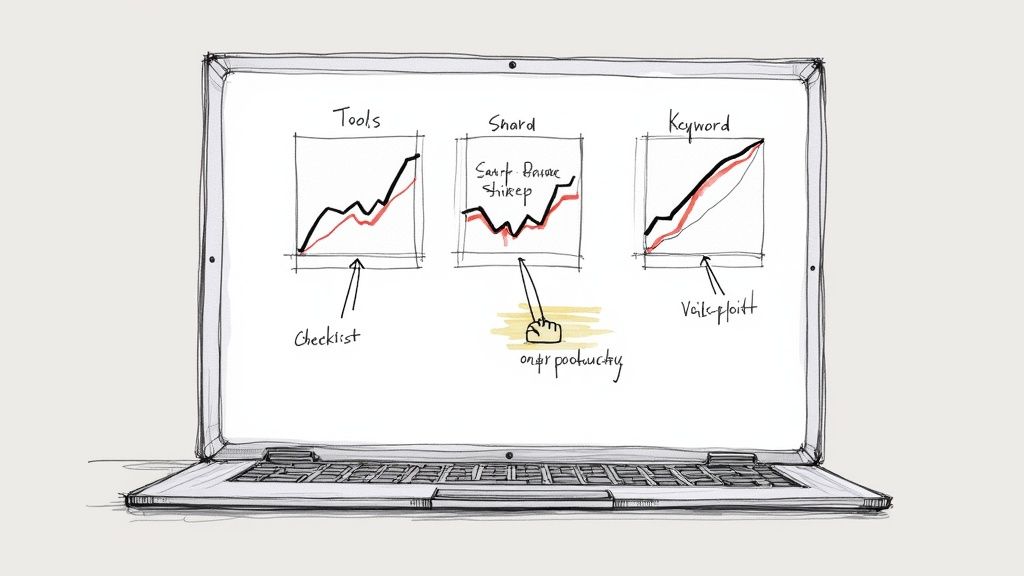
As you can see, that graph shows a sharp and consistent climb. This is your green light, confirming it's not a fleeting fad but a topic with serious momentum.
But don't stop there. Scroll down in Google Trends to the "related queries" section—it's an absolute goldmine for content ideas. Keep an eye out for two specific types:
Rising Queries: These are the terms with the biggest recent jump in search frequency. They often clue you into the exact phrasing and sub-topics your audience is using.
Breakout Queries: This is the jackpot. These terms have grown by more than 5,000%. Finding a "breakout" query means you've stumbled upon an explosive new area of interest, often with very little competition.
Moving Beyond Basic Trend Graphs
While Google Trends is fantastic for that initial high-level validation, other tools add crucial layers of detail. Exploding Topics, for instance, is built specifically to surface topics before they go mainstream. It conveniently sorts trends by category, which makes it incredibly easy to find undiscovered opportunities in your niche.
Don't just look at the trend line of a single keyword. Compare multiple related terms against each other. For our scenario, you might compare "AI productivity tools" vs. "automation software" vs. "smart assistants" to see which concept is capturing the most mindshare and growing the fastest.
The big SEO suites like Semrush and Ahrefs also have powerful features for this. When you look up a keyword, they often show a trend graph right next to classic metrics like search volume and keyword difficulty. This lets you assess a trend's full potential in one go. You might see that a keyword is not only on the rise but also has a manageable difficulty score—the perfect combination for a new content target. Fusing these data points together is how you make smart, strategic decisions instead of just chasing the latest buzzword.
Tapping into Social Media and Community Conversations
Long before a keyword ever shows up in Google Trends, it starts as a simple conversation. These conversations are happening right now on social media and in online communities like Reddit, X (what used to be Twitter), and countless niche forums. This is where new ideas, frustrations, and even slang are born.
By listening in on these raw, unfiltered discussions, you get a direct line to the exact language your audience uses. You find the real words they type when they're trying to solve a problem, long before that phrase becomes a high-volume, hyper-competitive keyword.
This is how you uncover the "why" behind a search. Instead of just seeing a report that "quiet luxury" is trending, you'll find the Reddit threads where people are debating its definition or asking for specific product recommendations. Those conversations are a goldmine for long-tail keywords and content ideas that most data tools completely miss.
Think back to major global events. When the COVID-19 pandemic began in March 2020, the term “COVID 19” saw a global search surge of an unbelievable 3650% month-over-month. Related phrases like “Coronavirus tips” jumped by 2650%. But before those searches hit Google at scale, people were asking urgent questions and sharing information in real-time on social platforms.
Digging for Gold in Niche Reddit Communities
Reddit is one of the best places you can possibly start. The platform is a massive collection of "subreddits"—highly specific communities dedicated to just about any topic imaginable, from skincare obsessions to enterprise SaaS. Your first job is to find the subreddits where your ideal customers hang out.
Once you're in, start looking for patterns and recurring themes:
Common Questions: Are people constantly asking for "dupes" of a popular product? Or maybe they're looking for "alternatives" to a well-known software.
Shared Frustrations: Do you keep seeing posts where users complain about the same industry problem or a gap in the market? That's a massive signal of a deep pain point.
New Jargon: Is a new acronym or slang term starting to pop up in discussions? This is often the first whisper of a future search trend.
Don't just scroll endlessly. Get smart with Reddit's search filters. You can search within a specific subreddit for phrases like "any recommendations," "how do you," or "what's the best" to instantly find posts where people are actively looking for solutions you can provide.
Using Social Platforms for Real-Time Trend Spotting
While Reddit is fantastic for deep, nuanced insights, platforms like X and TikTok are your go-to for what's happening right now. Their fast-paced nature gives you a real-time pulse on what's capturing public attention at this very moment.
On X, for example, you can get incredibly specific with advanced search commands. Try searching for your_keyword ? -filter:links. This little trick will show you tweets that contain your keyword and also ask a question, all while filtering out most of the promotional noise. It's a simple but powerful way to find the exact questions real people are asking about your topic.
The key is to think like an anthropologist, not just a marketer. Pay attention to the sentiment, the specific words people use to describe their problems, and the solutions they’re already discussing. This qualitative insight is what allows you to create content that truly resonates.
If you’re focused on visual platforms, you can find targeted strategies for finding trending hashtags on Instagram to broaden your discovery process. When you combine deep community listening with this kind of real-time social monitoring, you create a powerful system for spotting emerging keywords before they ever land on an SEO tool's radar.
Digging into Competitor Content for Hidden Clues
Your competitors' best-performing articles are more than just content—they're a treasure map. They show you exactly what's clicking with your shared audience right now. This isn't about stealing their ideas; it's about reverse-engineering their success to spot the trends they've already capitalized on.
I like to start by plugging a few key competitors into a tool like Ahrefs or Semrush. The goal is to find pages or posts published in the last 6-12 months that are just taking off, gaining a ton of traffic and new backlinks out of nowhere. A sudden spike for a new piece of content is a massive flashing sign that they've hit on an emerging search trend.
For instance, imagine you're in the project management software space. You see a competitor publish an article on "AI for team collaboration," and within weeks, it’s ranking for a bunch of new keywords. The real clue isn't just the article; it's the surging interest in AI-powered tools for teamwork. That’s your trend.
Deconstructing Their Wins
Once you’ve found a successful post, it's time to put on your detective hat and figure out why it's winning. Go beyond the main keyword and look at the whole topic cluster they’re targeting. What specific questions are they answering in their subheadings?
What’s their angle? Did they frame it as a controversial debate, a deep-dive case study, or maybe a "pros and cons" list? The format itself can be part of the trend.
Which keyword variations are working? You'll often find they're ranking for long-tail keywords you never would have thought of.
Who is linking to them? Analyzing the backlink profile is huge. The sites linking out are often part of the same conversation, revealing other key players or related niches to explore.
A competitor with a ton of backlinks usually has high authority. It's always a good idea to know how to find domain authority for the major players in your space. This helps you understand how they rank so fast and lets you set more realistic goals for your own efforts.
The real secret is pattern recognition. When you see two or three competitors all start talking about the same thing at once, it's not a coincidence anymore. It's a confirmed trend. Your job is to find a fresher, more valuable way into that conversation.
Spotting Shifts in SERP Features
Finally, keep a close eye on the Search Engine Results Pages (SERPs) themselves. Google is constantly tweaking the layout to match what it thinks users want. If you suddenly see more video carousels, "People Also Ask" sections, or forum results popping up for a query, that's a signal. It tells you how people prefer to learn about that topic.
Let's say video results are suddenly all over page one for a keyword you’re tracking. That’s a huge hint. The trend might be less about the topic and more about the format. This insight is gold because it tells you to create a YouTube tutorial instead of another blog post, letting you jump on the trend before everyone else catches on.
How to Validate and Prioritize Trending Keywords
Okay, so you've spotted a few keywords that seem to be on the rise. That's the easy part. The real work begins now: figuring out which ones are genuine opportunities and which are just flashes in the pan. This validation process is what separates a smart, repeatable content strategy from just getting lucky once in a while.
Before you go any further, take a step back and ask one crucial question: does this topic actually matter to my audience? A trending keyword that has nothing to do with your business or the problems you solve is just noise. It's a distraction, not an opportunity.
This decision tree gives you a simple framework for deciding if a competitor's hot new content piece is something you should even bother analyzing.
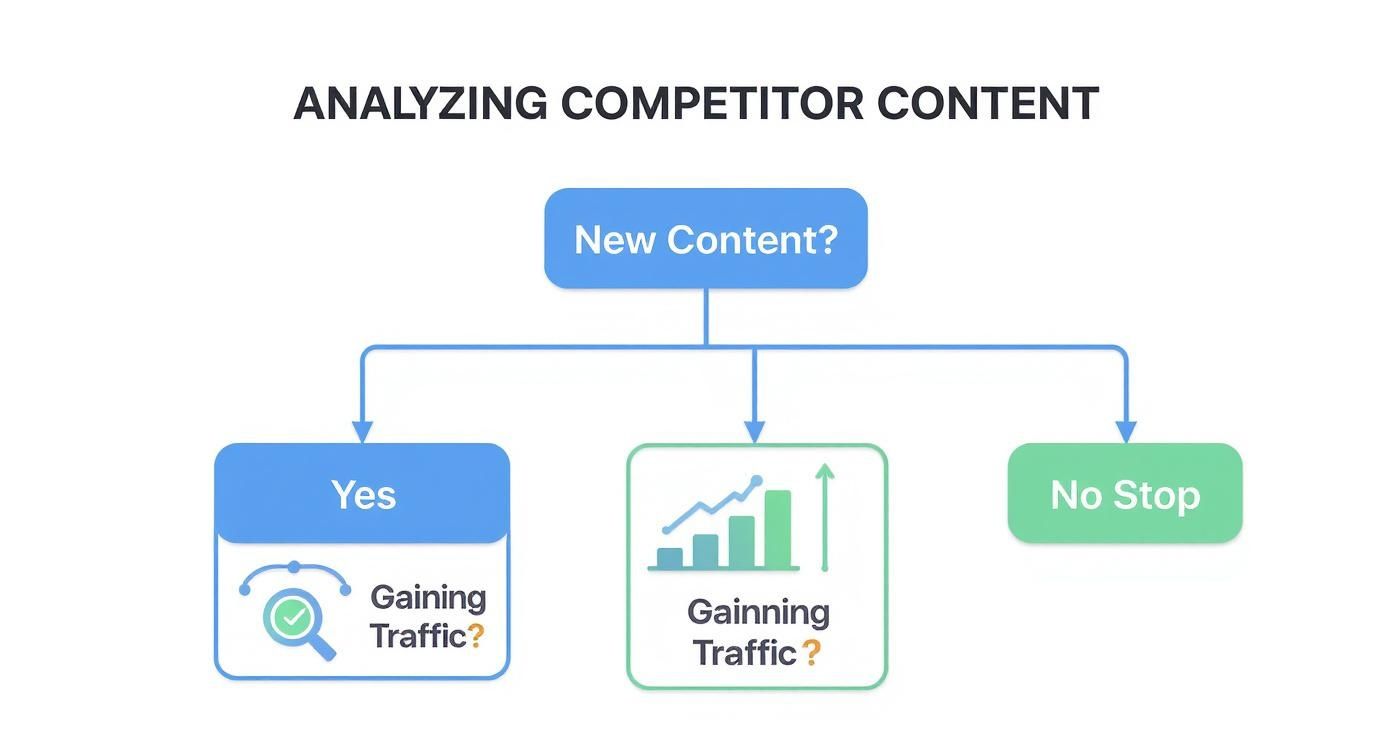
The big idea here is to zero in on competitor content that is both fresh and already getting traction. Everything else is a distraction you can safely ignore.
Figure Out the Commercial Intent and Traffic Potential
Once you've confirmed a trend is relevant, it's time to size up the prize. A tool like Google Keyword Planner is your best friend here. Even though it's built for advertisers, it's a goldmine for SEO. The suggested bid ranges are a great proxy for commercial intent—a high cost-per-click (CPC) usually means that traffic converts.
Don't stop there. Use its forecasting features to get a sense of scale. You can plug in a list of your potential trending keywords and get a rough estimate of the clicks and impressions you might see. This helps you move from a gut feeling of "this seems popular" to a data-backed projection like, "this could realistically drive X amount of traffic."
Chasing the main "head" term of a new trend is a classic mistake. I’ve found much more success by focusing on the long-tail keywords that pop up around it. They almost always have higher intent, less competition, and tell you exactly what people are trying to achieve.
Prioritize Long-Tail Keyword Variations
People are getting much more specific with their searches. We've seen the average search query length grow from 4.2 words in 2023 to 4.6 words in 2025. This isn't just a random statistic; it shows a clear shift toward more conversational and detailed searches. Just look at the explosive 4200% year-over-year growth of a phrase like “how to use AI legally.”
For content creators, this is great news. Instead of throwing all your resources at a single, super-competitive term, you can create hyper-targeted content that serves very specific needs.
Here’s a practical way to tackle this:
Solve a Niche Problem: Go after keywords that signal a clear user pain point. Think "best AI tool for summarizing research papers" instead of the generic "AI tools."
Answer Direct Questions: Look for the "how-to," "why," and "what is" questions that naturally bubble up as a trend gains steam.
Create Comparison Content: Capture people in the final stages of their decision-making with content like "[Trending Tool A] vs [Trending Tool B]."
Focusing on these longer, more descriptive phrases helps you rank faster and attract an audience that's much more likely to be interested in what you have to say. It also mirrors how trends evolve—a broad wave of initial interest splinters into dozens of specific user needs. If you're wondering how to strike the right balance, our guide on how many keywords to target per page can help you build out your strategy.
Got Questions? I've Got Answers.
Even with a solid game plan, you're bound to run into a few tricky situations when hunting for trending keywords. Let's tackle some of the most common questions that come up in the real world.
How Can I Tell if a Keyword Is a Fad or a Sustainable Trend?
Ah, the million-dollar question. It's easy to get burned by chasing a keyword that's hot today and gone tomorrow. The difference often comes down to momentum versus staying power.
A fad is like a firework—it explodes with a huge, sudden spike and then fizzles out just as fast. Think of a viral meme or a one-week internet challenge. A real, sustainable trend, on the other hand, builds more gradually. When you look at its performance over a 12-month period in a tool like Google Trends, you’ll see a steady, upward climb, not just a single, dramatic peak.
To be sure you're betting on the right horse, look for these clues:
A Consistent Climb: Is the graph showing a steady upward slope, or is it just one sharp, isolated spike? Real trends have legs.
The Ecosystem: Is the topic showing up elsewhere? Look for chatter on social media, mentions in industry news, or new products popping up. A genuine trend doesn't exist in a vacuum.
Evolving Searches: Pay close attention to the "Related Queries" in Google Trends. As a topic matures, you'll see people start searching for more specific, long-tail variations. This is a great sign that user interest is getting deeper, not disappearing.
A fad is an event; a trend is a behavioral shift. Fads are driven by novelty, while trends tap into a deeper change in what people need or care about. Focus on the trends for any real, long-term SEO impact.
What’s the Best Free Tool for Finding Trending Keywords?
If you're looking for the most bang for your buck (as in, zero bucks), Google Trends is the clear winner. It's the most direct line you can get into what people are searching for, right from the source.
It’s completely free, and the historical data is what makes it so powerful for telling a real trend from a fleeting fad. You can even drill down into regional interest, spot "breakout" queries before they go mainstream, and compare multiple trends side-by-side. While paid tools definitely offer more granular data, Google Trends is the non-negotiable starting point for anyone serious about this stuff.
How Often Should I Look for New Trending Keywords?
This really depends on the speed of your industry. There's no one-size-fits-all answer.
If you're in a fast-paced field like technology, fashion, or digital marketing, things change in the blink of an eye. I'd recommend doing a monthly review to keep your content calendar from getting stale and to pounce on new opportunities as they emerge.
For more stable industries, like manufacturing or law, a quarterly analysis is probably plenty. It's enough to catch the major shifts without getting lost in the minor noise. The most important thing is to make it a habit. Set a recurring reminder in your calendar to go through your process. Consistency is what keeps you from falling behind what your audience is actually looking for.
Ready to stop guessing and start finding the keywords that actually drive growth? The Content Gap Analyzer from Viral SEO uncovers your competitors' top-performing content, showing you the exact topics and trends that are already working. Start your free plan on getviralseo.com and build a smarter content strategy today.
Blogs
More Blogs
From keyword goldmines to AI-driven content hacks—expert insights to help your blog posts dominate the first page.