
Blog

Blog

how to do competitor analysis in seo: Complete Guide to SEO

how to do competitor analysis in seo: Complete Guide to SEO

Blog

how to do competitor analysis in seo: Complete Guide to SEO

Competitor analysis in SEO isn't about blindly copying what your rivals do. It's about making smarter, data-backed decisions for your own strategy. By digging into what’s working for them—their top keywords, their best content—you can find gaps, avoid their mistakes, and uncover brand-new opportunities for growth.

Why Competitor Analysis Is Your SEO Secret Weapon
A person using a magnifying glass to look at a bar chart, representing SEO analysis.

Before we jump into the "how," let's talk about the "why." A solid competitor analysis is the difference between guessing what might work and knowing what already does. When you systematically break down what your rivals are up to, you turn a mountain of raw data into a clear roadmap, letting you move from a reactive position to a proactive one.

This isn't just about figuring out who sells the same stuff you do. A proper analysis means understanding the different kinds of competitors you're up against to get the full picture of the search landscape.

  • Direct Competitors: These are the obvious ones. They offer the same product or service to the same people you do. Think of them as your classic business rivals who are also chasing the same search terms.

  • Indirect SEO Competitors: This is where it gets interesting. These are sites or publications that solve the same problem for your audience, even if they aren't selling anything. A popular industry blog, for example, could be a huge SEO competitor for those valuable informational keywords.

The Strategic Value of Looking Sideways

The whole point here is to build a resilient SEO strategy that delivers real results. Analyzing the competition helps you pinpoint their most successful pages, understand which keywords are actually driving traffic, and see what on-page tactics are clicking with both users and search engines. Armed with that intel, you can create content that's not just better, but truly comprehensive.

The core benefit of competitor analysis is clarity. It shows you exactly where the bar is set in your niche and gives you a proven blueprint for what it takes to rank, earn links, and drive traffic.

To truly get a handle on your competitive landscape, you need to break down their strategy into its core components. This table outlines the key areas I always focus on and the strategic value each one provides.

Core Pillars of SEO Competitor Analysis

Analysis Area

What to Look For

Strategic Value

Top-Performing Content

Pages driving the most organic traffic and ranking for high-value keywords.

Reveals the topics, formats, and angles that resonate most with your target audience.

Keyword Gaps

High-volume, relevant keywords they rank for that you don't.

Identifies immediate opportunities for new content creation to capture "low-hanging fruit" traffic.

On-Page SEO Tactics

Use of headings, internal linking, structured data, and content structure.

Provides a template for what Google expects to see for a given topic, helping you optimize your own pages.

Backlink Profile

Who is linking to them and why? Look at referring domain authority and link types.

Uncovers link-building opportunities and potential partners for your own outreach campaigns.

Traffic Signals

Estimated traffic volume, top traffic sources, and user engagement metrics.

Benchmarks your performance and helps you understand their overall audience acquisition strategy.

By dissecting these pillars, you move beyond simple keyword tracking and start to understand the why behind their success, which is where the real insights live.

The Stakes Are Higher Than Ever

In today's world, ignoring this process is just not an option. Google commands an incredible 90.48% of the overall search engine market. With the #1 organic result scooping up roughly 27.6% of all clicks, the fight for visibility is fierce.

When you consider that organic search drives about 44.6% of revenue across major industries, it's clear that your ability to analyze competitors directly impacts the bottom line. You can find more details on these and other key SEO statistics and trends.

This kind of intelligence lets you make calculated decisions and invest your time and budget where they’ll have the biggest impact. You can sidestep costly mistakes by learning from others' blunders and double down on proven strategies that get you closer to your goals, ultimately building a powerful and sustainable way to attract new customers.

How to Find Who You're Really Competing Against in SEO

One of the biggest mistakes I see people make is confusing their business competitors with their SEO competitors. The company with the brick-and-mortar shop down the street might be a total ghost online. In the world of search, your real rivals are the websites that consistently grab the top spots for the keywords and topics your audience is searching for.

These are your keyword competitors, and they can be anyone. Seriously. It could be a massive industry publication, a solo blogger who's an expert in your niche, or an affiliate site that does nothing but review products like yours. Getting this first step right—identifying the right players—is the bedrock of a competitor analysis that actually works.

Look Beyond Your Brand Rivals

First things first, you need to adjust your thinking. Stop listing the companies you compete with for sales and start thinking like Google. Who is taking up the digital shelf space you want? That's your new target list.

The best way to start is with a handful of "seed" keywords. These are the broad, foundational terms that describe what you offer. If you run an email marketing platform, you might start with terms like:

  • "email marketing software"

  • "how to build an email list"

  • "newsletter templates"

Pop these into a good SEO tool like Semrush or Ahrefs, and you'll instantly see which domains are winning on the search engine results pages (SERPs).

For instance, running an "Organic Research" report in Semrush gives you a clear picture of who is ranking for the terms that matter.

This isn't guesswork. It's a data-driven list of your actual SEO competitors, showing you exactly who you need to start analyzing.

Sizing Up the Competition

Once you have that raw list of domains, it's time to sort them out. Not all competitors are the same, and knowing who you're up against helps you build a smarter strategy. You'll usually find they fall into a few key buckets:

  • Direct Competitors: These are the obvious ones—businesses with a similar product or service that are also killing it in search.

  • Informational Competitors: Think big media sites, industry blogs, or publications (like a Forbes or HubSpot). They aren't selling what you sell, but they're ranking for valuable informational keywords that attract your audience.

  • Affiliate and Review Sites: These sites make their money by recommending products. They often create incredibly detailed content that ranks for high-intent commercial keywords.

Here's why this matters: Your strategy for outranking a niche blogger writing about "best project management tips" is totally different from how you'd take on a direct software competitor for "project management tool." The blogger tells you about content quality and what searchers want to learn, while the direct competitor gives you intel on product features and market positioning.

This level of analysis is no longer a "nice-to-have." The global SEO market was valued at a whopping $82.3 billion in 2023 and is on track to reach $143.9 billion by 2030. Tools like Semrush and Ahrefs make this possible by tracking a mind-boggling amount of data—we're talking a combined 78 trillion backlinks and over 53 billion keywords. You can learn about the competitive intelligence landscape and the tools that make this deep dive possible.

By sorting your competitors into these groups, you get a much clearer picture of the battlefield. It ensures your analysis is sharp, focused, and aimed where it can do the most good.

Finding Keyword Opportunities and Content Gaps

This is where the real detective work begins. Once you’ve figured out who your true SEO competitors are, it's time to dissect their content strategy piece by piece. We want to know exactly what's driving their success so we can find proven topics and keywords that already connect with our shared audience.

Instead of just guessing what might work, you’re using their success as a data-driven map. By digging into their top-ranking keywords and best-performing pages, you can build a content plan based on real opportunities, not just a hunch. This is the core of smart competitor analysis.

Screenshot of Ahrefs' Site Explorer showing organic keywords and traffic for a competitor's domain.

Tools like Ahrefs or Semrush make this first look pretty easy, showing you which terms are sending the most traffic their way.

Uncovering Striking Distance Keywords

A brilliant place to start your hunt is with "striking distance" keywords. These are the terms your competitors are ranking for, but not at the very top—think positions 5 through 20.

The fact that they're on page one or two proves the keyword has value. But their weaker ranking is a clear signal that you can create something better and leapfrog them in the SERPs. Look for terms with decent search volume and obvious intent that fits what you offer. This simple filter helps you ignore the vanity metrics and focus on keywords that can actually move the needle.

Pro Tip: Keep an eye out for keywords that trigger SERP features like Featured Snippets or People Also Ask boxes. Winning these spots can give you massive visibility, even if you don't hold the #1 organic ranking.

The Power of Content Gap Analysis

The real gold is found during the content gap analysis. This is where you methodically compare your website's keyword profile against two or three of your top competitors. The goal? To find valuable keywords they rank for that you haven't even touched yet.

For instance, say you sell project management software. A content gap analysis might show that your biggest competitor ranks for "how to create a project timeline," but you have zero content on the topic. That’s a proven content idea, handed to you on a silver platter.

You’re essentially reverse-engineering a successful content strategy, giving you a ready-made list of topics with built-in demand. The Viral SEO Content Gap Analyzer is built for exactly this, helping you find these opportunities in just a few clicks.

Filtering and Prioritizing Your Opportunities

Okay, so you've got this big, raw list of keyword and content gaps. Now what? You need to turn it into an actionable plan. Not all opportunities are created equal—some are quick wins, while others are massive projects.

I've always found it helpful to sort these opportunities into a simple framework. This makes it much easier to decide what to tackle first.

A Simple Framework for Prioritizing Content Gaps

Use this framework to categorize the content opportunities you find, helping you decide what to tackle first based on effort and potential return.

Opportunity Type

Description

Actionable Next Step

Quick Wins

Keywords where you already have a relevant page ranking on page 2 or 3.

Optimize the existing page with better on-page SEO, more depth, and fresh internal links.

New Content

High-intent keywords your competitors rank for that you don't have content for at all.

Create a new, comprehensive blog post or landing page specifically targeting this keyword cluster.

Long-Term Projects

Broad, high-competition "head" terms that require significant authority and content.

Plan a topic cluster around the main term, building out supporting content over several months.

This kind of framework helps you strike a nice balance between building short-term momentum and pursuing long-term strategic goals. If you want to get better at spotting high-intent keywords that are often less competitive, check out our guide on long-tail keyword research.

For those who want to get really advanced, learning how to scrape web page content using Puppeteer can be a game-changer for gathering competitor data at scale.

By the end of this process, you should have a prioritized list of proven content ideas ready to slot right into your content calendar. You're no longer throwing spaghetti at the wall; you're making calculated moves based on solid competitive intelligence.

Analyzing Your Competitors' Backlink Profiles

A network diagram showing interconnected nodes, representing a backlink profile.

While amazing content is your ticket to the SEO game, it’s a site’s authority—built on a foundation of quality backlinks—that often decides who wins. Think of backlinks as votes of confidence from other websites. They signal to search engines that your content is credible, trustworthy, and valuable.

When you analyze your competitors' backlink profiles, you're essentially reverse-engineering their success. It's not just about who links to them, but figuring out why. This insight is the key to building a repeatable link-building strategy that closes the authority gap and helps you climb the SERPs.

Find Their Most Authoritative Referring Domains

Your first move is to uncover the most powerful domains sending links to your top competitors. Just about any SEO tool can pull a list of their referring domains. The trick is to sort that list by a key authority metric, like Domain Rating (DR) or Authority Score (AS).

This simple action immediately highlights the "kingmakers" in your niche—the high-authority blogs, news outlets, and industry publications whose links move the needle. But don't just skim this list. Dig in.

  • Are there a few industry blogs linking to all of your competitors but not you? That’s your outreach priority list right there.

  • Do you see links from major news publications or university websites? That's a strong hint they're running digital PR campaigns or creating original, research-backed content.

Building a target list of these high-value domains gives your link-building a clear focus, shifting you from a "spray and pray" approach to a deliberate, strategic one.

Identify What Content Actually Earns Links

Next up, you need to figure out what kind of content is attracting all these valuable links. This is where you connect the dots between their content strategy and their off-page authority.

Run a "best pages by links" report in your tool of choice. This will show you which specific URLs have racked up the most backlinks. In my experience, you'll almost always see clear patterns emerge.

The goal is to spot the repeatable formulas that work in your industry. If your top three competitors all have an original research report that has earned over 100 links, that's a massive clue about what kind of content gets rewarded.

Keep an eye out for these common link magnets:

  • Original Research & Data: Unique studies and data-driven reports are incredibly effective because they become a primary source for other writers and journalists.

  • Free Tools & Calculators: Interactive resources that solve a real problem for your audience tend to attract links organically over the long haul.

  • Comprehensive "Ultimate" Guides: Deep-dive articles that cover a topic more thoroughly than anyone else naturally become the go-to resource people link to.

By pinpointing these trends, you can start shaping your own content calendar to create assets that are designed to earn links from day one.

Benchmark Your Authority and Set Clear Targets

Finally, you need to know where you stand. Comparing your site’s overall authority score to your competitors' provides a reality check and helps you set meaningful goals.

If your main rival has a Domain Rating of 75 and you're sitting at a 35, you know there's a serious gap to close. This isn't meant to be discouraging; it's clarifying. It tells you that a passive approach to link building simply won’t cut it if you want to compete for high-value keywords. For more on this, our guide explains how to find and understand domain authority.

Use this benchmark to set achievable targets. For instance, your goal might be to increase your DR by 10 points in the next six months by acquiring links from 20 new, relevant domains with a DR of 50 or higher. This transforms a vague goal like "get more backlinks" into a concrete, actionable plan. A proper backlink analysis isn't just an audit—it's the blueprint for building your site's credibility for years to come.

Auditing On-Page SEO and User Experience

Getting top rankings isn't just a game of keywords and backlinks. It’s about delivering a far better on-page experience. Once you’ve pinpointed which competitor pages are crushing it, it's time to put on your detective hat and manually audit them. This isn't just about ticking boxes; it's about setting a clear quality benchmark for your own content.

The goal here is to deconstruct the entire user journey on their winning pages. We need to go beyond a simple title tag check and really understand what makes their content click with both users and Google. These are the subtle signals that scream "high-quality" and "authoritative."

Deconstructing Content Structure and Headings

First, let's look at the skeleton of their content. How is it structured? Pay close attention to their heading hierarchy (H1s, H2s, H3s). Are they used logically to break a complex topic into bite-sized, digestible chunks? A well-organized article isn't just easier for people to scan; it’s also a clear roadmap for search engine crawlers.

Next up is their internal linking strategy. This is where you can often find some real strategic gold. How do they connect the dots between their own pages?

  • Contextual Links: Do they weave links naturally into the text to point users toward related, helpful content?

  • Pillar and Cluster Model: Are they linking up to a central "pillar" page or fanning out to more specific "cluster" posts? This is a huge signal of topical authority.

  • Anchor Text: Look at the words they use for their links. Is it descriptive and keyword-rich (e.g., "how to build an email list") or generic and useless ("click here")?

A savvy internal linking setup is a powerhouse for boosting user engagement and spreading link authority throughout a site.

Assessing Rich Media and SERP Feature Ownership

In today's visual-first world, a wall of text is a death sentence. Check out how your competitors are using rich media to make their content more engaging. Are their best pages filled with:

  • Custom infographics that break down complicated data?

  • Helpful embedded videos that provide a visual walkthrough?

  • High-quality, original images that have descriptive alt text?

These elements almost always correlate with higher rankings because they keep people on the page longer. That's a direct signal to Google that your content is genuinely valuable.

Here's a pro tip: Always check for SERP feature ownership. If a competitor consistently nabs the Featured Snippet or fills out the People Also Ask box for a keyword, that’s a massive clue. Google is literally showing you the exact kind of structured, answer-first content it wants to rank for that topic.

Evaluating User Experience Signals

Finally, zoom out and look at the overall user experience (UX). While you don't have access to their private analytics, you can easily spot the public-facing signals that matter. Page speed is a big one. Any page that takes longer than 2.5 seconds to load is losing people. You can use Google's own PageSpeed Insights tool to get a quick performance score for any competitor URL.

Also, pull up their site on your phone. With over 60% of searches now happening on mobile, a clunky, hard-to-navigate mobile experience is a major liability. A superior user experience is one of the most powerful, if indirect, ranking factors you can influence.

By digging into these on-page elements, you go from simply knowing what your competitors rank for to understanding the mechanics of how they do it. The number of keywords you target is just one piece of the puzzle; for a deeper look, you can explore our guide on how many keywords per page is ideal for SEO. This audit gives you a tangible checklist to create content that’s simply better.

Turning Competitive Data Into an Action Plan

So, you've done the hard work. You've dug into keyword gaps, audited backlink profiles, and picked apart your competitors' on-page strategies. But all that data is just noise until you shape it into a concrete SEO plan. This is where the real work begins—transforming that raw intelligence into a prioritized roadmap that dictates your next moves.

The first step is to get organized. Don't just stare at a massive spreadsheet and hope for inspiration. Start sorting your findings by the potential impact versus the effort required. For instance, building out a brand new, 10-part content cluster for a high-value keyword? That’s high-impact, but it's also a high-effort undertaking. On the flip side, optimizing a page that's already sitting on page two is a classic high-impact, low-effort "quick win."

Prioritizing Your SEO Initiatives

This simple impact-versus-effort framework is your best friend. It cuts through the overwhelm and helps you focus your resources where they’ll make the biggest difference, fast.

Here’s how I like to break it down:

  • Quick Wins: These are the low-hanging fruit. Think updating stale meta descriptions, adding a few strategic internal links to a new post, or refreshing a slightly outdated article with new stats. They don’t take a ton of time but can deliver noticeable results surprisingly quickly.

  • Major Projects: This is the big-picture stuff. We're talking about creating new cornerstone content, launching a dedicated link-building campaign for a money page, or overhauling a section of your site's technical SEO. These initiatives require serious planning and resources.

This whole process is about finding a balance between fixing what's broken, optimizing what's working, and building what's missing.
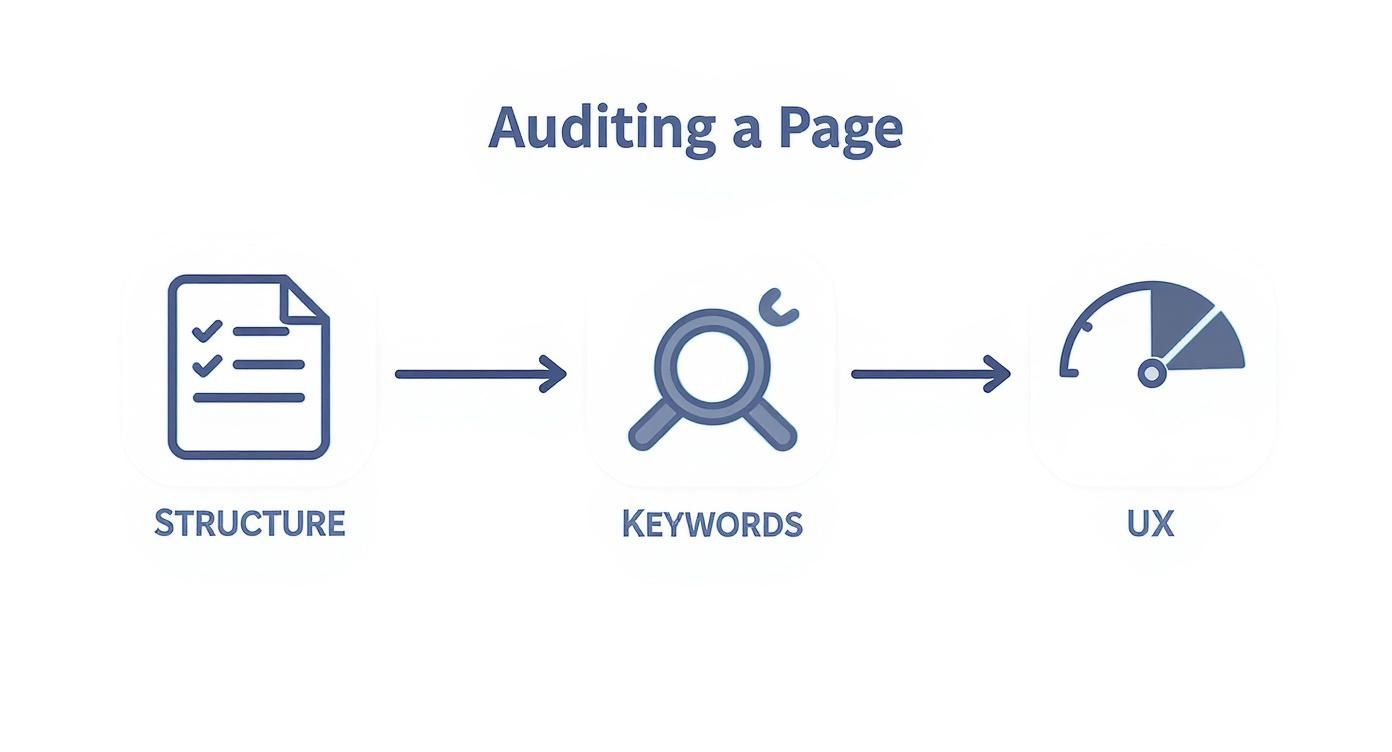
Infographic about how to do competitor analysis in seo

As you can see, a successful on-page strategy isn’t just about keywords. It demands a holistic approach that equally addresses technical structure, content relevance, and user experience.

Setting Clear Goals and KPIs

Once your priorities are straight, you need to define what success actually looks like. A vague goal like "increase traffic" isn't going to cut it. You need to set specific, measurable key performance indicators (KPIs) for every single initiative.

Your action plan should be a living document, not a static report. It's the bridge between what you've learned about your competitors and what you will do tomorrow to beat them.

For example, if you're creating a new piece of content, a solid goal would be to rank in the top 10 for its main target keyword within three months. Launching a backlink campaign? A good KPI might be to acquire 15 high-quality links from domains with an authority score above 50 in the next quarter.

This level of detail holds you accountable and makes it easy to see what's working and what isn't. To get a head start, checking out the best free competitor analysis tools can give you the data you need to build this plan without breaking the bank.

It’s also worth noting how much AI has changed the game here. Today, an incredible 86% of SEO professionals are using AI tools in their work, with 65% of businesses already reporting better results because of it. Modern workflows now use AI to monitor competitors on a deeper level—tracking patterns in their topical authority, link velocity, and which SERP features they own, moving way beyond simple keyword tracking.

Got Questions? We've Got Answers

When you start digging into a competitor analysis workflow, a few questions always seem to pop up. Let's run through some of the most common ones I hear from clients and in workshops.

What are the best competitor analysis tools?

Honestly, there's no single "best" tool, but most pros build their toolkit around one primary platform and a few specialists. For the heavy lifting—keyword research, backlink analysis, and finding top pages—you can't go wrong with industry workhorses like Ahrefs or Semrush. They give you the most comprehensive view.

But for more specific jobs, you might want to add a couple of others to your arsenal:

  • SpyFu: This one is fantastic if you want to get historical on a competitor. It’s great for seeing how their keyword strategy has evolved over time, especially with paid ads.

  • Similarweb: I use this when I need a broader picture of traffic. It gives you a solid estimate of where their visitors are coming from beyond just organic search, like direct, social, and referral traffic.

Ultimately, the right stack comes down to your budget and what you’re trying to achieve.

How often should I be doing a competitor analysis?

This is definitely not a "set it and forget it" task. For the full, deep-dive analysis—where you’re pulling all their keywords, dissecting on-page elements, and auditing their link profile—I recommend a quarterly cadence. This timing is the sweet spot; it's frequent enough to catch important shifts without creating a ton of busy work.

That said, you should be keeping a closer eye on things more frequently. A quick monthly check-in on your top 3 competitors can be a game-changer. See what new content they’ve published and which keywords are moving for them. It helps you stay nimble.

Can I actually do this without paying for expensive tools?

Yes, you absolutely can. Premium tools make the process faster and more efficient, no doubt. But you can uncover a goldmine of information for free if you're willing to put in a little elbow grease.

Your most powerful free tool is Google itself. Simply searching your target keywords in an incognito window will show you exactly who you’re up against.

From there, you can use free resources like Google Keyword Planner or Ahrefs' free Webmaster Tools to get real data. It’s more manual, for sure, but the core principles of understanding how to do competitor analysis in seo are the same. It's all about being systematic.

Ready to stop guessing and start outmaneuvering the competition? Viral SEO gives you a simple, powerful workflow to find what’s working for them and build a plan to do it better.

Start Your Free Plan with Viral SEO

Competitor analysis in SEO isn't about blindly copying what your rivals do. It's about making smarter, data-backed decisions for your own strategy. By digging into what’s working for them—their top keywords, their best content—you can find gaps, avoid their mistakes, and uncover brand-new opportunities for growth.

Why Competitor Analysis Is Your SEO Secret Weapon

A person using a magnifying glass to look at a bar chart, representing SEO analysis.

Before we jump into the "how," let's talk about the "why." A solid competitor analysis is the difference between guessing what might work and knowing what already does. When you systematically break down what your rivals are up to, you turn a mountain of raw data into a clear roadmap, letting you move from a reactive position to a proactive one.

This isn't just about figuring out who sells the same stuff you do. A proper analysis means understanding the different kinds of competitors you're up against to get the full picture of the search landscape.

  • Direct Competitors: These are the obvious ones. They offer the same product or service to the same people you do. Think of them as your classic business rivals who are also chasing the same search terms.

  • Indirect SEO Competitors: This is where it gets interesting. These are sites or publications that solve the same problem for your audience, even if they aren't selling anything. A popular industry blog, for example, could be a huge SEO competitor for those valuable informational keywords.

The Strategic Value of Looking Sideways

The whole point here is to build a resilient SEO strategy that delivers real results. Analyzing the competition helps you pinpoint their most successful pages, understand which keywords are actually driving traffic, and see what on-page tactics are clicking with both users and search engines. Armed with that intel, you can create content that's not just better, but truly comprehensive.

The core benefit of competitor analysis is clarity. It shows you exactly where the bar is set in your niche and gives you a proven blueprint for what it takes to rank, earn links, and drive traffic.

To truly get a handle on your competitive landscape, you need to break down their strategy into its core components. This table outlines the key areas I always focus on and the strategic value each one provides.

Core Pillars of SEO Competitor Analysis

Analysis Area

What to Look For

Strategic Value

Top-Performing Content

Pages driving the most organic traffic and ranking for high-value keywords.

Reveals the topics, formats, and angles that resonate most with your target audience.

Keyword Gaps

High-volume, relevant keywords they rank for that you don't.

Identifies immediate opportunities for new content creation to capture "low-hanging fruit" traffic.

On-Page SEO Tactics

Use of headings, internal linking, structured data, and content structure.

Provides a template for what Google expects to see for a given topic, helping you optimize your own pages.

Backlink Profile

Who is linking to them and why? Look at referring domain authority and link types.

Uncovers link-building opportunities and potential partners for your own outreach campaigns.

Traffic Signals

Estimated traffic volume, top traffic sources, and user engagement metrics.

Benchmarks your performance and helps you understand their overall audience acquisition strategy.

By dissecting these pillars, you move beyond simple keyword tracking and start to understand the why behind their success, which is where the real insights live.

The Stakes Are Higher Than Ever

In today's world, ignoring this process is just not an option. Google commands an incredible 90.48% of the overall search engine market. With the #1 organic result scooping up roughly 27.6% of all clicks, the fight for visibility is fierce.

When you consider that organic search drives about 44.6% of revenue across major industries, it's clear that your ability to analyze competitors directly impacts the bottom line. You can find more details on these and other key SEO statistics and trends.

This kind of intelligence lets you make calculated decisions and invest your time and budget where they’ll have the biggest impact. You can sidestep costly mistakes by learning from others' blunders and double down on proven strategies that get you closer to your goals, ultimately building a powerful and sustainable way to attract new customers.

How to Find Who You're Really Competing Against in SEO

One of the biggest mistakes I see people make is confusing their business competitors with their SEO competitors. The company with the brick-and-mortar shop down the street might be a total ghost online. In the world of search, your real rivals are the websites that consistently grab the top spots for the keywords and topics your audience is searching for.

These are your keyword competitors, and they can be anyone. Seriously. It could be a massive industry publication, a solo blogger who's an expert in your niche, or an affiliate site that does nothing but review products like yours. Getting this first step right—identifying the right players—is the bedrock of a competitor analysis that actually works.

Look Beyond Your Brand Rivals

First things first, you need to adjust your thinking. Stop listing the companies you compete with for sales and start thinking like Google. Who is taking up the digital shelf space you want? That's your new target list.

The best way to start is with a handful of "seed" keywords. These are the broad, foundational terms that describe what you offer. If you run an email marketing platform, you might start with terms like:

  • "email marketing software"

  • "how to build an email list"

  • "newsletter templates"

Pop these into a good SEO tool like Semrush or Ahrefs, and you'll instantly see which domains are winning on the search engine results pages (SERPs).

For instance, running an "Organic Research" report in Semrush gives you a clear picture of who is ranking for the terms that matter.

This isn't guesswork. It's a data-driven list of your actual SEO competitors, showing you exactly who you need to start analyzing.

Sizing Up the Competition

Once you have that raw list of domains, it's time to sort them out. Not all competitors are the same, and knowing who you're up against helps you build a smarter strategy. You'll usually find they fall into a few key buckets:

  • Direct Competitors: These are the obvious ones—businesses with a similar product or service that are also killing it in search.

  • Informational Competitors: Think big media sites, industry blogs, or publications (like a Forbes or HubSpot). They aren't selling what you sell, but they're ranking for valuable informational keywords that attract your audience.

  • Affiliate and Review Sites: These sites make their money by recommending products. They often create incredibly detailed content that ranks for high-intent commercial keywords.

Here's why this matters: Your strategy for outranking a niche blogger writing about "best project management tips" is totally different from how you'd take on a direct software competitor for "project management tool." The blogger tells you about content quality and what searchers want to learn, while the direct competitor gives you intel on product features and market positioning.

This level of analysis is no longer a "nice-to-have." The global SEO market was valued at a whopping $82.3 billion in 2023 and is on track to reach $143.9 billion by 2030. Tools like Semrush and Ahrefs make this possible by tracking a mind-boggling amount of data—we're talking a combined 78 trillion backlinks and over 53 billion keywords. You can learn about the competitive intelligence landscape and the tools that make this deep dive possible.

By sorting your competitors into these groups, you get a much clearer picture of the battlefield. It ensures your analysis is sharp, focused, and aimed where it can do the most good.

Finding Keyword Opportunities and Content Gaps

This is where the real detective work begins. Once you’ve figured out who your true SEO competitors are, it's time to dissect their content strategy piece by piece. We want to know exactly what's driving their success so we can find proven topics and keywords that already connect with our shared audience.

Instead of just guessing what might work, you’re using their success as a data-driven map. By digging into their top-ranking keywords and best-performing pages, you can build a content plan based on real opportunities, not just a hunch. This is the core of smart competitor analysis.

Screenshot of Ahrefs' Site Explorer showing organic keywords and traffic for a competitor's domain.

Tools like Ahrefs or Semrush make this first look pretty easy, showing you which terms are sending the most traffic their way.

Uncovering Striking Distance Keywords

A brilliant place to start your hunt is with "striking distance" keywords. These are the terms your competitors are ranking for, but not at the very top—think positions 5 through 20.

The fact that they're on page one or two proves the keyword has value. But their weaker ranking is a clear signal that you can create something better and leapfrog them in the SERPs. Look for terms with decent search volume and obvious intent that fits what you offer. This simple filter helps you ignore the vanity metrics and focus on keywords that can actually move the needle.

Pro Tip: Keep an eye out for keywords that trigger SERP features like Featured Snippets or People Also Ask boxes. Winning these spots can give you massive visibility, even if you don't hold the #1 organic ranking.

The Power of Content Gap Analysis

The real gold is found during the content gap analysis. This is where you methodically compare your website's keyword profile against two or three of your top competitors. The goal? To find valuable keywords they rank for that you haven't even touched yet.

For instance, say you sell project management software. A content gap analysis might show that your biggest competitor ranks for "how to create a project timeline," but you have zero content on the topic. That’s a proven content idea, handed to you on a silver platter.

You’re essentially reverse-engineering a successful content strategy, giving you a ready-made list of topics with built-in demand. The Viral SEO Content Gap Analyzer is built for exactly this, helping you find these opportunities in just a few clicks.

Filtering and Prioritizing Your Opportunities

Okay, so you've got this big, raw list of keyword and content gaps. Now what? You need to turn it into an actionable plan. Not all opportunities are created equal—some are quick wins, while others are massive projects.

I've always found it helpful to sort these opportunities into a simple framework. This makes it much easier to decide what to tackle first.

A Simple Framework for Prioritizing Content Gaps

Use this framework to categorize the content opportunities you find, helping you decide what to tackle first based on effort and potential return.

Opportunity Type

Description

Actionable Next Step

Quick Wins

Keywords where you already have a relevant page ranking on page 2 or 3.

Optimize the existing page with better on-page SEO, more depth, and fresh internal links.

New Content

High-intent keywords your competitors rank for that you don't have content for at all.

Create a new, comprehensive blog post or landing page specifically targeting this keyword cluster.

Long-Term Projects

Broad, high-competition "head" terms that require significant authority and content.

Plan a topic cluster around the main term, building out supporting content over several months.

This kind of framework helps you strike a nice balance between building short-term momentum and pursuing long-term strategic goals. If you want to get better at spotting high-intent keywords that are often less competitive, check out our guide on long-tail keyword research.

For those who want to get really advanced, learning how to scrape web page content using Puppeteer can be a game-changer for gathering competitor data at scale.

By the end of this process, you should have a prioritized list of proven content ideas ready to slot right into your content calendar. You're no longer throwing spaghetti at the wall; you're making calculated moves based on solid competitive intelligence.

Analyzing Your Competitors' Backlink Profiles

A network diagram showing interconnected nodes, representing a backlink profile.

While amazing content is your ticket to the SEO game, it’s a site’s authority—built on a foundation of quality backlinks—that often decides who wins. Think of backlinks as votes of confidence from other websites. They signal to search engines that your content is credible, trustworthy, and valuable.

When you analyze your competitors' backlink profiles, you're essentially reverse-engineering their success. It's not just about who links to them, but figuring out why. This insight is the key to building a repeatable link-building strategy that closes the authority gap and helps you climb the SERPs.

Find Their Most Authoritative Referring Domains

Your first move is to uncover the most powerful domains sending links to your top competitors. Just about any SEO tool can pull a list of their referring domains. The trick is to sort that list by a key authority metric, like Domain Rating (DR) or Authority Score (AS).

This simple action immediately highlights the "kingmakers" in your niche—the high-authority blogs, news outlets, and industry publications whose links move the needle. But don't just skim this list. Dig in.

  • Are there a few industry blogs linking to all of your competitors but not you? That’s your outreach priority list right there.

  • Do you see links from major news publications or university websites? That's a strong hint they're running digital PR campaigns or creating original, research-backed content.

Building a target list of these high-value domains gives your link-building a clear focus, shifting you from a "spray and pray" approach to a deliberate, strategic one.

Identify What Content Actually Earns Links

Next up, you need to figure out what kind of content is attracting all these valuable links. This is where you connect the dots between their content strategy and their off-page authority.

Run a "best pages by links" report in your tool of choice. This will show you which specific URLs have racked up the most backlinks. In my experience, you'll almost always see clear patterns emerge.

The goal is to spot the repeatable formulas that work in your industry. If your top three competitors all have an original research report that has earned over 100 links, that's a massive clue about what kind of content gets rewarded.

Keep an eye out for these common link magnets:

  • Original Research & Data: Unique studies and data-driven reports are incredibly effective because they become a primary source for other writers and journalists.

  • Free Tools & Calculators: Interactive resources that solve a real problem for your audience tend to attract links organically over the long haul.

  • Comprehensive "Ultimate" Guides: Deep-dive articles that cover a topic more thoroughly than anyone else naturally become the go-to resource people link to.

By pinpointing these trends, you can start shaping your own content calendar to create assets that are designed to earn links from day one.

Benchmark Your Authority and Set Clear Targets

Finally, you need to know where you stand. Comparing your site’s overall authority score to your competitors' provides a reality check and helps you set meaningful goals.

If your main rival has a Domain Rating of 75 and you're sitting at a 35, you know there's a serious gap to close. This isn't meant to be discouraging; it's clarifying. It tells you that a passive approach to link building simply won’t cut it if you want to compete for high-value keywords. For more on this, our guide explains how to find and understand domain authority.

Use this benchmark to set achievable targets. For instance, your goal might be to increase your DR by 10 points in the next six months by acquiring links from 20 new, relevant domains with a DR of 50 or higher. This transforms a vague goal like "get more backlinks" into a concrete, actionable plan. A proper backlink analysis isn't just an audit—it's the blueprint for building your site's credibility for years to come.

Auditing On-Page SEO and User Experience

Getting top rankings isn't just a game of keywords and backlinks. It’s about delivering a far better on-page experience. Once you’ve pinpointed which competitor pages are crushing it, it's time to put on your detective hat and manually audit them. This isn't just about ticking boxes; it's about setting a clear quality benchmark for your own content.

The goal here is to deconstruct the entire user journey on their winning pages. We need to go beyond a simple title tag check and really understand what makes their content click with both users and Google. These are the subtle signals that scream "high-quality" and "authoritative."

Deconstructing Content Structure and Headings

First, let's look at the skeleton of their content. How is it structured? Pay close attention to their heading hierarchy (H1s, H2s, H3s). Are they used logically to break a complex topic into bite-sized, digestible chunks? A well-organized article isn't just easier for people to scan; it’s also a clear roadmap for search engine crawlers.

Next up is their internal linking strategy. This is where you can often find some real strategic gold. How do they connect the dots between their own pages?

  • Contextual Links: Do they weave links naturally into the text to point users toward related, helpful content?

  • Pillar and Cluster Model: Are they linking up to a central "pillar" page or fanning out to more specific "cluster" posts? This is a huge signal of topical authority.

  • Anchor Text: Look at the words they use for their links. Is it descriptive and keyword-rich (e.g., "how to build an email list") or generic and useless ("click here")?

A savvy internal linking setup is a powerhouse for boosting user engagement and spreading link authority throughout a site.

Assessing Rich Media and SERP Feature Ownership

In today's visual-first world, a wall of text is a death sentence. Check out how your competitors are using rich media to make their content more engaging. Are their best pages filled with:

  • Custom infographics that break down complicated data?

  • Helpful embedded videos that provide a visual walkthrough?

  • High-quality, original images that have descriptive alt text?

These elements almost always correlate with higher rankings because they keep people on the page longer. That's a direct signal to Google that your content is genuinely valuable.

Here's a pro tip: Always check for SERP feature ownership. If a competitor consistently nabs the Featured Snippet or fills out the People Also Ask box for a keyword, that’s a massive clue. Google is literally showing you the exact kind of structured, answer-first content it wants to rank for that topic.

Evaluating User Experience Signals

Finally, zoom out and look at the overall user experience (UX). While you don't have access to their private analytics, you can easily spot the public-facing signals that matter. Page speed is a big one. Any page that takes longer than 2.5 seconds to load is losing people. You can use Google's own PageSpeed Insights tool to get a quick performance score for any competitor URL.

Also, pull up their site on your phone. With over 60% of searches now happening on mobile, a clunky, hard-to-navigate mobile experience is a major liability. A superior user experience is one of the most powerful, if indirect, ranking factors you can influence.

By digging into these on-page elements, you go from simply knowing what your competitors rank for to understanding the mechanics of how they do it. The number of keywords you target is just one piece of the puzzle; for a deeper look, you can explore our guide on how many keywords per page is ideal for SEO. This audit gives you a tangible checklist to create content that’s simply better.

Turning Competitive Data Into an Action Plan

So, you've done the hard work. You've dug into keyword gaps, audited backlink profiles, and picked apart your competitors' on-page strategies. But all that data is just noise until you shape it into a concrete SEO plan. This is where the real work begins—transforming that raw intelligence into a prioritized roadmap that dictates your next moves.

The first step is to get organized. Don't just stare at a massive spreadsheet and hope for inspiration. Start sorting your findings by the potential impact versus the effort required. For instance, building out a brand new, 10-part content cluster for a high-value keyword? That’s high-impact, but it's also a high-effort undertaking. On the flip side, optimizing a page that's already sitting on page two is a classic high-impact, low-effort "quick win."

Prioritizing Your SEO Initiatives

This simple impact-versus-effort framework is your best friend. It cuts through the overwhelm and helps you focus your resources where they’ll make the biggest difference, fast.

Here’s how I like to break it down:

  • Quick Wins: These are the low-hanging fruit. Think updating stale meta descriptions, adding a few strategic internal links to a new post, or refreshing a slightly outdated article with new stats. They don’t take a ton of time but can deliver noticeable results surprisingly quickly.

  • Major Projects: This is the big-picture stuff. We're talking about creating new cornerstone content, launching a dedicated link-building campaign for a money page, or overhauling a section of your site's technical SEO. These initiatives require serious planning and resources.

This whole process is about finding a balance between fixing what's broken, optimizing what's working, and building what's missing.

Infographic about how to do competitor analysis in seo

As you can see, a successful on-page strategy isn’t just about keywords. It demands a holistic approach that equally addresses technical structure, content relevance, and user experience.

Setting Clear Goals and KPIs

Once your priorities are straight, you need to define what success actually looks like. A vague goal like "increase traffic" isn't going to cut it. You need to set specific, measurable key performance indicators (KPIs) for every single initiative.

Your action plan should be a living document, not a static report. It's the bridge between what you've learned about your competitors and what you will do tomorrow to beat them.

For example, if you're creating a new piece of content, a solid goal would be to rank in the top 10 for its main target keyword within three months. Launching a backlink campaign? A good KPI might be to acquire 15 high-quality links from domains with an authority score above 50 in the next quarter.

This level of detail holds you accountable and makes it easy to see what's working and what isn't. To get a head start, checking out the best free competitor analysis tools can give you the data you need to build this plan without breaking the bank.

It’s also worth noting how much AI has changed the game here. Today, an incredible 86% of SEO professionals are using AI tools in their work, with 65% of businesses already reporting better results because of it. Modern workflows now use AI to monitor competitors on a deeper level—tracking patterns in their topical authority, link velocity, and which SERP features they own, moving way beyond simple keyword tracking.

Got Questions? We've Got Answers

When you start digging into a competitor analysis workflow, a few questions always seem to pop up. Let's run through some of the most common ones I hear from clients and in workshops.

What are the best competitor analysis tools?

Honestly, there's no single "best" tool, but most pros build their toolkit around one primary platform and a few specialists. For the heavy lifting—keyword research, backlink analysis, and finding top pages—you can't go wrong with industry workhorses like Ahrefs or Semrush. They give you the most comprehensive view.

But for more specific jobs, you might want to add a couple of others to your arsenal:

  • SpyFu: This one is fantastic if you want to get historical on a competitor. It’s great for seeing how their keyword strategy has evolved over time, especially with paid ads.

  • Similarweb: I use this when I need a broader picture of traffic. It gives you a solid estimate of where their visitors are coming from beyond just organic search, like direct, social, and referral traffic.

Ultimately, the right stack comes down to your budget and what you’re trying to achieve.

How often should I be doing a competitor analysis?

This is definitely not a "set it and forget it" task. For the full, deep-dive analysis—where you’re pulling all their keywords, dissecting on-page elements, and auditing their link profile—I recommend a quarterly cadence. This timing is the sweet spot; it's frequent enough to catch important shifts without creating a ton of busy work.

That said, you should be keeping a closer eye on things more frequently. A quick monthly check-in on your top 3 competitors can be a game-changer. See what new content they’ve published and which keywords are moving for them. It helps you stay nimble.

Can I actually do this without paying for expensive tools?

Yes, you absolutely can. Premium tools make the process faster and more efficient, no doubt. But you can uncover a goldmine of information for free if you're willing to put in a little elbow grease.

Your most powerful free tool is Google itself. Simply searching your target keywords in an incognito window will show you exactly who you’re up against.

From there, you can use free resources like Google Keyword Planner or Ahrefs' free Webmaster Tools to get real data. It’s more manual, for sure, but the core principles of understanding how to do competitor analysis in seo are the same. It's all about being systematic.

Ready to stop guessing and start outmaneuvering the competition? Viral SEO gives you a simple, powerful workflow to find what’s working for them and build a plan to do it better.

Start Your Free Plan with Viral SEO