
Blog

Blog

How to Build a Keyword List That Drives SEO Results

How to Build a Keyword List That Drives SEO Results

Blog

How to Build a Keyword List That Drives SEO Results

It's easy to get lost in spreadsheets and SEO tools, but a truly great keyword list always starts with strategy. Before you even think about search volume or keyword difficulty, you have to define your business goals, get inside your ideal customer's head, and brainstorm the core "seed" keywords that connect the two.

This foundational work is what separates a list of random phrases from a genuine roadmap for attracting the right traffic.

Establishing Your Keyword Research Foundation

I've seen it a hundred times: people dive straight into a tool like Ahrefs or Semrush, export a massive list of keywords, and then wonder why they aren't getting results. The problem is they skipped the most critical part.

Think about it this way—every search query is a person with a problem to solve or a question that needs an answer. Your job isn't just to rank; it's to be the best answer for that person. To do that, you first have to know who you're talking to and what you want them to do next.

Stacked notebooks showing SEO keyword research framework with business goals, audience, buyer personas, and seed keywords

Define Your Goals and Audience

First things first: what's the point of all this? Seriously, ask yourself what the primary goal of your content is. Are you trying to generate leads? Drive e-commerce sales? Build brand awareness through helpful content? The answer dramatically changes the kinds of keywords you should be targeting.

Once you know your "why," it's time to figure out your "who." Get into the details of your ideal customer by sketching out some simple buyer personas. Don't just stick to demographics; dig deeper.

  • Pain Points: What real-world challenges are they facing that you can solve?

  • Goals: What are they actually trying to accomplish in their job or life?

  • Watering Holes: Where do they hang out online? Think niche forums, specific subreddits, LinkedIn groups, or industry blogs.

  • Language: How do they talk about their problems? A developer searching for "API integration" uses very different language than a small business owner looking up "how to connect my apps."

Brainstorm Your Initial Seed Keywords

With a clear picture of your audience in mind, you can start brainstorming a list of "seed" keywords. These aren't long, complicated phrases. They're the broad, foundational topics directly related to what you sell or do.

Just think about the main categories on your website or the core problems you solve. If you run a project management software company, your seed keywords are probably things like "project management tools," "team collaboration," or "task tracking software." Simple, right?

These initial terms are your starting point for everything that comes next. Getting this foundation right is crucial, and it all comes down to knowing how to choose the best keywords for SEO.

You'll eventually look at monthly search volumes to see how popular these topics are and start grouping terms that have similar user intent.

This table breaks down these foundational elements into a simple reference.

Core Keyword Strategy Components

Component

Objective

Example

Business Goals

To align keyword targets with desired business outcomes.

Goal: Increase trial sign-ups for a SaaS product.

Buyer Personas

To understand the user behind the search query, including their pain points and language.

Persona: "Marketing Manager Mary," who needs to improve team workflow.

Seed Keywords

To identify the broad, core topics that form the basis for keyword expansion.

Seed Keywords: "marketing workflow," "content calendar," "team collaboration."

These three pillars give your research direction and purpose, ensuring you don't waste time chasing keywords that won't actually help your business grow.

From here, you'll take these seed keywords and plug them into your tool of choice to begin the expansion process. You’ll be looking for related terms, questions people are asking, and what your competitors are ranking for.

It's also a good idea to start paying attention to the authority of the domains already ranking. Our guide on how to find domain authority can help you size up the competition early on. Remember, these seed keywords aren't your final list—they're just the launchpad.

3. Expand Your List with Advanced Research Methods

Alright, you’ve got your seed list. Now, the real fun begins. This is where we move beyond the obvious and start digging for the hundreds of keyword opportunities your audience is actively searching for, but your competitors might be missing.

Think of it as digital eavesdropping—and the best place to start is by looking at who’s already getting all the attention.

See What’s Working for Your Competitors

A solid competitor analysis in marketing is one of the fastest ways to find proven keywords. You’re essentially finding out what’s already driving traffic for others in your space.

Tools like Ahrefs’ "Content Gap" or Semrush's "Keyword Gap" feature are perfect for this. Just pop in your domain and a few of your top competitors. The tool will spit out a list of valuable keywords they rank for that you currently don't. This isn't about blindly copying them; it's about spotting proven topics and angles you haven't considered yet.

Mine the SERP for Hidden Gold

Forget tools for a second. The Google search results page itself is an absolute goldmine, practically handing you keyword ideas on a silver platter. Google is constantly trying to guess what searchers want next, and you can use that to your advantage.

Magnifying glass examining search results page showing People Also Ask and Related Searches sections

Keep your eyes peeled for these features every time you search:

  • People Also Ask (PAA): That little box of questions is pure gold. Each question is a potential blog post, a FAQ section, or a subheading for an existing article.

  • Related Searches: Scroll all the way down. The list at the bottom shows you what people searched for next. These are fantastic for finding related topics and long-tail variations.

  • Autocomplete: Start typing a seed keyword into the search bar and just... stop. Google’s suggestions are a direct look into the most popular searches happening right now.

Pro Tip: When you click on a "People Also Ask" question, the box expands with even more related questions. You can go down a rabbit hole here and easily walk away with dozens of highly specific, intent-driven keyword ideas straight from the source.

Tune Into Real Customer Conversations

Finally, it’s time to step away from the SEO tools and listen to actual humans. Where does your audience hang out online? Forums like Reddit and Quora are fantastic for this.

Go to a relevant subreddit (like r/PPC for marketing folks) and search for your seed keywords. Pay attention to the exact language people use. What problems are they trying to solve? What questions keep popping up?

This is where you discover the nuance—the real pain points that never show up in a keyword tool's search volume column. These conversational phrases make for incredible long-tail keywords. We actually dive deep into this strategy in our guide to long-tail keyword research.

When you combine this kind of human intelligence with hard data from your tools, you create a keyword list that doesn't just rank—it resonates.

How to Prioritize Your Keyword List for Real Impact

So you’ve got a massive list of keywords. Great! But right now, it's just a raw dump of data full of potential and, let's be honest, a lot of noise. A spreadsheet with thousands of terms is practically useless until you start chipping away to find the gold—the keywords that will actually drive meaningful results for your business.

This is where the real strategy begins. We're looking for that perfect intersection of search volume, realistic competition, and, most importantly, the right user intent. Get this mix right, and you're golden. Get it wrong, and you'll spend months creating content that either never ranks or attracts visitors who bounce immediately.

First Things First: Decode User Search Intent

Before you get hypnotized by high search volume numbers, you have to nail down the why behind every query. Search intent is simply the user's primary goal. It's the difference between someone looking for information and someone ready to pull out their credit card. Slicing up your keyword list by intent is the most critical filtering step you'll take.

  • Informational Intent: These people want answers. Think "how to," "what is," or "why." A classic example is "how to build a keyword list from scratch." This is your bread and butter for top-of-funnel blog content that builds authority.

  • Navigational Intent: The user is just trying to get to a specific website. For instance, "Viral SEO login." You don't have to do much here; you'll naturally rank for your own brand terms.

  • Commercial Intent: Here, users are in research mode, weighing their options before making a purchase. You'll see keywords with modifiers like "best," "review," or "vs." Something like "best keyword research tools for startups" fits perfectly here.

  • Transactional Intent: This is it—the moment of truth. The user is ready to act. These keywords are laser-focused and often include terms like "buy," "pricing," or "free trial." An example would be "Viral SEO pro plan pricing."

By organizing your list this way, you can start mapping keywords directly to different stages of the customer journey. It ensures you're creating content that meets people exactly where they are, from curious prospect to paying customer.

Find the Sweet Spot: Balancing Volume, Difficulty, and Relevance

With your keywords neatly sorted by intent, it’s time to layer on the numbers. The goal here isn't just to chase the biggest search volume. It's about finding a strategic balance between a few key metrics.

To get a feel for what’s currently buzzing, you can look at emerging search trends. For example, there's been a huge spike in searches for terms like “AI chatbot integration” and “conversational AI technology.” Keeping an eye on monthly search volume (MSV) helps you align your content with what people are actively looking for right now. Tools like Google Keyword Planner or Google Trends are fantastic (and free) starting points for this data.

Here’s a glimpse of what you'll see in Google's Keyword Planner. It gives you a quick-and-dirty look at average monthly searches and the general level of competition.

This snapshot is invaluable for making initial cuts and deciding which keywords are even worth a second look.

To truly narrow down your list, it's helpful to organize these metrics in a way that allows for quick comparison. A prioritization matrix can be a lifesaver here.

Keyword Prioritization Matrix

Metric

What It Tells You

Why It Matters

Tool Example

Search Intent

The why behind the search (informational, commercial, etc.).

Aligns content with the user's goal, leading to better engagement and conversions.

Manual Review, Semrush

Search Volume

How many times a keyword is searched per month, on average.

Gauges the potential traffic you could get from ranking for the term.

Ahrefs, Google Keyword Planner

Keyword Difficulty

An estimate of how hard it is to rank on the first page of Google.

Helps you find realistic targets you can actually rank for with your site's authority.

Moz, Semrush

Business Relevance

How closely the keyword aligns with your products or services.

Ensures the traffic you attract is qualified and likely to convert.

Your own expertise!

This framework forces you to think holistically about each keyword, moving beyond just one or two metrics to see the full picture.

Finally, the ultimate gut check is business relevance. A keyword can have stellar volume and low difficulty, but if it has nothing to do with what you sell, it's a complete waste of time. Always ask yourself, "If someone lands on our site from this keyword, will they find what they're looking for?"

If the answer is a hard "no," cut it loose. It’s far more effective to focus on a few highly relevant keywords per page than to try and shoehorn in dozens of unrelated terms. To dive deeper on this, check out our guide on how many keywords to target per page.

Organizing Keywords into Topic Clusters

Your prioritized keyword list is more than just a spreadsheet—it's the raw material for your entire content blueprint. The real magic happens when you stop thinking about keywords as isolated targets and start grouping them into topic clusters. This is how you show search engines you're a true authority, not just a one-hit-wonder for a single search query.

The model itself is beautifully simple. You have a central "pillar" page covering a broad topic, and then a series of more specific "cluster" articles that all link back to that main hub. It creates a seamless experience for your readers and a powerful internal linking structure that search engines love.

This framework helps visualize how to move from broad ideas to specific, high-opportunity keywords.
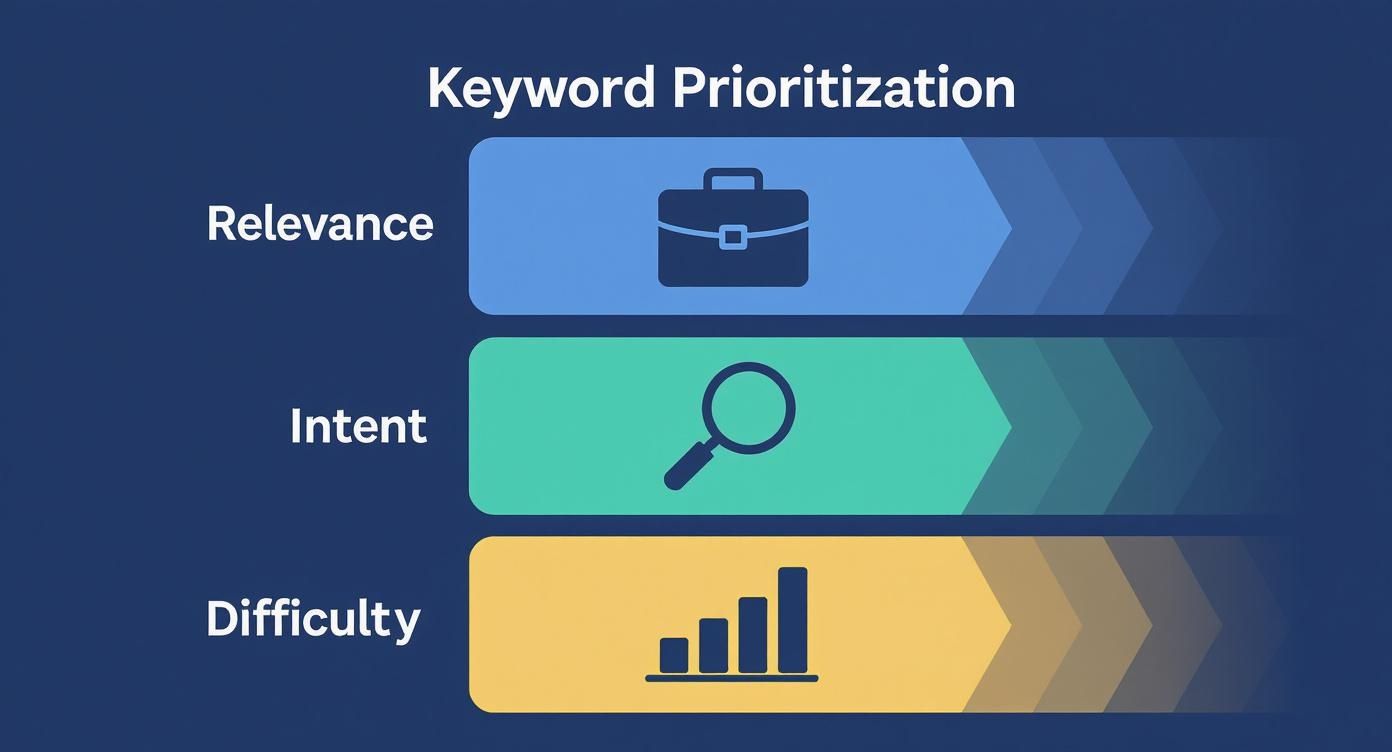
Keyword prioritization framework diagram showing relevance, intent, and difficulty factors with icons

As the diagram shows, you're essentially filtering down from what's relevant to your business, to what users are actually looking for, and finally to what you can realistically rank for.

Identifying Your Pillar and Cluster Topics

So, how do you pick your pillars? Look for the big, foundational keywords on your list—the ones that directly map to your core offerings. If you sell project management software, a perfect pillar topic would be "project management methodologies." It's a huge subject with dozens of sub-topics branching off it.

Those sub-topics become your cluster content. They're where you target the more specific, long-tail keywords and answer the detailed questions people have.

Let's stick with our example:

  • Pillar Topic: "Project Management Methodologies"

  • Cluster Content Examples:

    • "what is agile project management"

    • "kanban vs scrum differences"

    • "how to implement waterfall model"

    • "best tools for scrum masters"

Every one of those cluster articles would link back to the main pillar page. This sends a strong signal to Google that your "Project Management Methodologies" guide is the definitive resource, which helps it climb the ranks for those really competitive head terms.

Key Takeaway: The goal here isn't just to rank for a keyword; it's to own the conversation around a topic. By covering a subject from every angle, you build a web of content that satisfies all kinds of search intent, making your site the go-to resource.

Mapping Keywords to Your Content Plan

With your keywords all nicely grouped, the final step is to map them to an actual content plan. This is where you decide if a cluster of keywords justifies a brand new blog post, a dedicated landing page, or maybe just a new section on an existing page.

For example, a group of informational keywords around "how to build a keyword list" is a natural fit for a guide like the one you're reading now. On the other hand, commercial keywords like "best SEO content tools" would probably work better as a comparison-style landing page.

This process turns your raw data into a strategic roadmap. You're no longer just throwing content at the wall; you're building a library of strategic assets, where every single piece has a clear purpose and a specific audience in mind.

Putting Your Keyword Strategy to Work and Tracking What Matters

Having a perfectly organized keyword list is a great start, but it’s just a plan on paper. The real magic happens when you turn that research into content that actually gets in front of the right people. This is where your topic clusters become your battle plan.

The first move is to convert those clusters into solid content briefs. A good brief is a roadmap for your writer, not a straitjacket. It should clearly lay out the primary keyword, a few essential secondary keywords from the cluster, a target word count, and a basic outline. I always add a "SERP analysis" section, too. I'll drop in links to the top 3-5 ranking articles and jot down some notes on what they do well and where they fall short. This hands your writer a golden opportunity to create something that’s not just different, but better.

Keeping an Eye on Performance and Spotting New Gaps

Once your content goes live, your keyword list transforms from a research document into a performance tracker. Don’t just hit publish and walk away. You have to keep tabs on what’s working, what’s flopping, and where you should focus your energy next. This is where a tool like Google Search Console (GSC) becomes your best friend.

The Performance report in GSC is your source of truth. It tells you exactly which search queries are driving people to your pages. I pay special attention to keywords that are getting a ton of impressions but have a low click-through rate (CTR). That’s usually a massive red flag—and an opportunity. It often means your title tag or meta description isn't compelling enough to earn the click, even when you're showing up.

A keyword list is not a "set it and forget it" project. Think of it as a dynamic roadmap that you constantly refine based on real-world performance data and shifting market trends.

This constant cycle of review and refinement is non-negotiable because search trends are always in flux. For example, during its peak in 2020, searches for coronavirus-related keywords shot up by over 3,650%. That’s a dramatic shift that shows how quickly the world's focus can change. More recently, keywords like "YouTube" and "ChatGPT" pull in 1.4 billion and 618 million searches every month, respectively, proving that you have to stay current to stay relevant. You can discover more insights about keyword statistics on mycodelesswebsite.com.

The Metrics That Actually Drive Growth

It’s easy to get bogged down in data. To keep things simple and effective, I recommend focusing on a handful of key performance indicators (KPIs) that connect directly to your actual business goals.

Here's what I track:

  • Keyword Rankings: Use a reliable rank tracking tool to see how your most valuable keywords are performing. Are you moving up the SERPs, holding your ground, or starting to slip?

  • Organic Traffic Growth: Is the content built around your keyword clusters bringing more people to your site? Dive into Google Analytics and look at traffic on a page-by-page basis.

  • Conversions: This is the bottom line. Are the people finding you through your target keywords actually doing what you want them to do? Whether it's signing up for a trial, downloading an ebook, or making a purchase, this is the ultimate test of your strategy's success.

By consistently tracking these metrics, you create a powerful feedback loop. The data will point you to underperforming content that needs a refresh, help you find new "striking distance" keywords to target, and ultimately, prove the ROI of your entire content strategy. This cycle of creating, measuring, and iterating isn't just a task—it's the engine that powers real, sustainable SEO growth.

Got Questions About Building Your Keyword List?

Diving into keyword research always brings up a few questions. That's perfectly normal. Getting a handle on the best practices (and avoiding common mistakes) is what separates a decent strategy from a great one. Let's tackle some of the most common hurdles people run into.

Think of this as turning that pile of keyword data into a confident, results-driven plan.

How Often Should I Actually Update This Thing?

Your keyword list isn't a "set it and forget it" document. It needs to breathe. I recommend a major review every 6-12 months to zoom out, check your progress, and make sure everything still lines up with your bigger business goals.

But that doesn't mean you ignore it in the meantime. On a monthly basis, you should be keeping an eye on performance and sniffing out new opportunities. Sometimes, a more immediate refresh is necessary.

  • Industry Shifts: A new trend or technology just popped up in your niche.

  • New Product Launches: You’re rolling out new features or services that need SEO support.

  • Competitor Moves: A rival just started ranking for a goldmine keyword you completely overlooked.

Should I Go for High-Volume Keywords or Long-Tails?

The honest answer? A healthy strategy needs both. They serve two very different, but equally important, purposes.

High-volume "head" terms (like "project management") are great for big, top-of-funnel pillar pages that build brand awareness. The catch is they're almost always brutally competitive.

On the other hand, long-tail keywords—those longer, more specific phrases of three or more words—have way less search volume but much clearer intent. That specificity is why they often convert like crazy. A smart approach is to build momentum with long-tail keywords first. You'll gain traction, establish some topical authority, and then you can start punching up at the more competitive head terms.

Key Insight: Don't get blinded by big search volume numbers. It's always better to attract 10 visitors who are ready to buy than 1,000 casual browsers who will never become customers.

What's the Difference Between a Keyword and a Topic Cluster?

This is a huge one in modern SEO. A keyword is a specific phrase someone types into Google, like "how to make cold brew coffee." Simple enough.

A topic cluster is a whole content strategy. It's about creating a central "pillar" page covering a broad topic (e.g., "The Ultimate Guide to Coffee Brewing"). That main pillar is then linked to and from several "cluster" pages that explore related, more specific keywords in-depth (e.g., "best beans for cold brew," "french press vs aeropress," etc.). This structure signals your expertise to Google and helps you rank for a whole constellation of related terms.

Can I Do This Without Spending a Ton on Tools?

Absolutely. While the paid subscriptions for tools like Ahrefs and Semrush are fantastic, you can get surprisingly far with some powerful free options.

  1. Google Keyword Planner: The OG. It gives you search volume estimates and competition data straight from the source.

  2. The Google SERP Itself: Seriously, don't overlook this. Mine the "People Also Ask" boxes, check out the "Related Searches" at the bottom of the page, and pay attention to Google's autocomplete suggestions. It's a goldmine.

  3. AnswerThePublic: This tool is brilliant for uncovering question-based keywords. It visualizes all the "who, what, where, when, why" questions people are asking about your topics.

Combine these three, and you can build a seriously solid keyword list without opening your wallet.

Ready to stop guessing and start building a content strategy that actually drives growth? Viral SEO helps you find your competitors' top-performing keywords and organize your content plan with real data. Start your free plan today and see the difference.

It's easy to get lost in spreadsheets and SEO tools, but a truly great keyword list always starts with strategy. Before you even think about search volume or keyword difficulty, you have to define your business goals, get inside your ideal customer's head, and brainstorm the core "seed" keywords that connect the two.

This foundational work is what separates a list of random phrases from a genuine roadmap for attracting the right traffic.

Establishing Your Keyword Research Foundation

I've seen it a hundred times: people dive straight into a tool like Ahrefs or Semrush, export a massive list of keywords, and then wonder why they aren't getting results. The problem is they skipped the most critical part.

Think about it this way—every search query is a person with a problem to solve or a question that needs an answer. Your job isn't just to rank; it's to be the best answer for that person. To do that, you first have to know who you're talking to and what you want them to do next.

Stacked notebooks showing SEO keyword research framework with business goals, audience, buyer personas, and seed keywords

Define Your Goals and Audience

First things first: what's the point of all this? Seriously, ask yourself what the primary goal of your content is. Are you trying to generate leads? Drive e-commerce sales? Build brand awareness through helpful content? The answer dramatically changes the kinds of keywords you should be targeting.

Once you know your "why," it's time to figure out your "who." Get into the details of your ideal customer by sketching out some simple buyer personas. Don't just stick to demographics; dig deeper.

  • Pain Points: What real-world challenges are they facing that you can solve?

  • Goals: What are they actually trying to accomplish in their job or life?

  • Watering Holes: Where do they hang out online? Think niche forums, specific subreddits, LinkedIn groups, or industry blogs.

  • Language: How do they talk about their problems? A developer searching for "API integration" uses very different language than a small business owner looking up "how to connect my apps."

Brainstorm Your Initial Seed Keywords

With a clear picture of your audience in mind, you can start brainstorming a list of "seed" keywords. These aren't long, complicated phrases. They're the broad, foundational topics directly related to what you sell or do.

Just think about the main categories on your website or the core problems you solve. If you run a project management software company, your seed keywords are probably things like "project management tools," "team collaboration," or "task tracking software." Simple, right?

These initial terms are your starting point for everything that comes next. Getting this foundation right is crucial, and it all comes down to knowing how to choose the best keywords for SEO.

You'll eventually look at monthly search volumes to see how popular these topics are and start grouping terms that have similar user intent.

This table breaks down these foundational elements into a simple reference.

Core Keyword Strategy Components

Component

Objective

Example

Business Goals

To align keyword targets with desired business outcomes.

Goal: Increase trial sign-ups for a SaaS product.

Buyer Personas

To understand the user behind the search query, including their pain points and language.

Persona: "Marketing Manager Mary," who needs to improve team workflow.

Seed Keywords

To identify the broad, core topics that form the basis for keyword expansion.

Seed Keywords: "marketing workflow," "content calendar," "team collaboration."

These three pillars give your research direction and purpose, ensuring you don't waste time chasing keywords that won't actually help your business grow.

From here, you'll take these seed keywords and plug them into your tool of choice to begin the expansion process. You’ll be looking for related terms, questions people are asking, and what your competitors are ranking for.

It's also a good idea to start paying attention to the authority of the domains already ranking. Our guide on how to find domain authority can help you size up the competition early on. Remember, these seed keywords aren't your final list—they're just the launchpad.

3. Expand Your List with Advanced Research Methods

Alright, you’ve got your seed list. Now, the real fun begins. This is where we move beyond the obvious and start digging for the hundreds of keyword opportunities your audience is actively searching for, but your competitors might be missing.

Think of it as digital eavesdropping—and the best place to start is by looking at who’s already getting all the attention.

See What’s Working for Your Competitors

A solid competitor analysis in marketing is one of the fastest ways to find proven keywords. You’re essentially finding out what’s already driving traffic for others in your space.

Tools like Ahrefs’ "Content Gap" or Semrush's "Keyword Gap" feature are perfect for this. Just pop in your domain and a few of your top competitors. The tool will spit out a list of valuable keywords they rank for that you currently don't. This isn't about blindly copying them; it's about spotting proven topics and angles you haven't considered yet.

Mine the SERP for Hidden Gold

Forget tools for a second. The Google search results page itself is an absolute goldmine, practically handing you keyword ideas on a silver platter. Google is constantly trying to guess what searchers want next, and you can use that to your advantage.

Magnifying glass examining search results page showing People Also Ask and Related Searches sections

Keep your eyes peeled for these features every time you search:

  • People Also Ask (PAA): That little box of questions is pure gold. Each question is a potential blog post, a FAQ section, or a subheading for an existing article.

  • Related Searches: Scroll all the way down. The list at the bottom shows you what people searched for next. These are fantastic for finding related topics and long-tail variations.

  • Autocomplete: Start typing a seed keyword into the search bar and just... stop. Google’s suggestions are a direct look into the most popular searches happening right now.

Pro Tip: When you click on a "People Also Ask" question, the box expands with even more related questions. You can go down a rabbit hole here and easily walk away with dozens of highly specific, intent-driven keyword ideas straight from the source.

Tune Into Real Customer Conversations

Finally, it’s time to step away from the SEO tools and listen to actual humans. Where does your audience hang out online? Forums like Reddit and Quora are fantastic for this.

Go to a relevant subreddit (like r/PPC for marketing folks) and search for your seed keywords. Pay attention to the exact language people use. What problems are they trying to solve? What questions keep popping up?

This is where you discover the nuance—the real pain points that never show up in a keyword tool's search volume column. These conversational phrases make for incredible long-tail keywords. We actually dive deep into this strategy in our guide to long-tail keyword research.

When you combine this kind of human intelligence with hard data from your tools, you create a keyword list that doesn't just rank—it resonates.

How to Prioritize Your Keyword List for Real Impact

So you’ve got a massive list of keywords. Great! But right now, it's just a raw dump of data full of potential and, let's be honest, a lot of noise. A spreadsheet with thousands of terms is practically useless until you start chipping away to find the gold—the keywords that will actually drive meaningful results for your business.

This is where the real strategy begins. We're looking for that perfect intersection of search volume, realistic competition, and, most importantly, the right user intent. Get this mix right, and you're golden. Get it wrong, and you'll spend months creating content that either never ranks or attracts visitors who bounce immediately.

First Things First: Decode User Search Intent

Before you get hypnotized by high search volume numbers, you have to nail down the why behind every query. Search intent is simply the user's primary goal. It's the difference between someone looking for information and someone ready to pull out their credit card. Slicing up your keyword list by intent is the most critical filtering step you'll take.

  • Informational Intent: These people want answers. Think "how to," "what is," or "why." A classic example is "how to build a keyword list from scratch." This is your bread and butter for top-of-funnel blog content that builds authority.

  • Navigational Intent: The user is just trying to get to a specific website. For instance, "Viral SEO login." You don't have to do much here; you'll naturally rank for your own brand terms.

  • Commercial Intent: Here, users are in research mode, weighing their options before making a purchase. You'll see keywords with modifiers like "best," "review," or "vs." Something like "best keyword research tools for startups" fits perfectly here.

  • Transactional Intent: This is it—the moment of truth. The user is ready to act. These keywords are laser-focused and often include terms like "buy," "pricing," or "free trial." An example would be "Viral SEO pro plan pricing."

By organizing your list this way, you can start mapping keywords directly to different stages of the customer journey. It ensures you're creating content that meets people exactly where they are, from curious prospect to paying customer.

Find the Sweet Spot: Balancing Volume, Difficulty, and Relevance

With your keywords neatly sorted by intent, it’s time to layer on the numbers. The goal here isn't just to chase the biggest search volume. It's about finding a strategic balance between a few key metrics.

To get a feel for what’s currently buzzing, you can look at emerging search trends. For example, there's been a huge spike in searches for terms like “AI chatbot integration” and “conversational AI technology.” Keeping an eye on monthly search volume (MSV) helps you align your content with what people are actively looking for right now. Tools like Google Keyword Planner or Google Trends are fantastic (and free) starting points for this data.

Here’s a glimpse of what you'll see in Google's Keyword Planner. It gives you a quick-and-dirty look at average monthly searches and the general level of competition.

This snapshot is invaluable for making initial cuts and deciding which keywords are even worth a second look.

To truly narrow down your list, it's helpful to organize these metrics in a way that allows for quick comparison. A prioritization matrix can be a lifesaver here.

Keyword Prioritization Matrix

Metric

What It Tells You

Why It Matters

Tool Example

Search Intent

The why behind the search (informational, commercial, etc.).

Aligns content with the user's goal, leading to better engagement and conversions.

Manual Review, Semrush

Search Volume

How many times a keyword is searched per month, on average.

Gauges the potential traffic you could get from ranking for the term.

Ahrefs, Google Keyword Planner

Keyword Difficulty

An estimate of how hard it is to rank on the first page of Google.

Helps you find realistic targets you can actually rank for with your site's authority.

Moz, Semrush

Business Relevance

How closely the keyword aligns with your products or services.

Ensures the traffic you attract is qualified and likely to convert.

Your own expertise!

This framework forces you to think holistically about each keyword, moving beyond just one or two metrics to see the full picture.

Finally, the ultimate gut check is business relevance. A keyword can have stellar volume and low difficulty, but if it has nothing to do with what you sell, it's a complete waste of time. Always ask yourself, "If someone lands on our site from this keyword, will they find what they're looking for?"

If the answer is a hard "no," cut it loose. It’s far more effective to focus on a few highly relevant keywords per page than to try and shoehorn in dozens of unrelated terms. To dive deeper on this, check out our guide on how many keywords to target per page.

Organizing Keywords into Topic Clusters

Your prioritized keyword list is more than just a spreadsheet—it's the raw material for your entire content blueprint. The real magic happens when you stop thinking about keywords as isolated targets and start grouping them into topic clusters. This is how you show search engines you're a true authority, not just a one-hit-wonder for a single search query.

The model itself is beautifully simple. You have a central "pillar" page covering a broad topic, and then a series of more specific "cluster" articles that all link back to that main hub. It creates a seamless experience for your readers and a powerful internal linking structure that search engines love.

This framework helps visualize how to move from broad ideas to specific, high-opportunity keywords.

Keyword prioritization framework diagram showing relevance, intent, and difficulty factors with icons

As the diagram shows, you're essentially filtering down from what's relevant to your business, to what users are actually looking for, and finally to what you can realistically rank for.

Identifying Your Pillar and Cluster Topics

So, how do you pick your pillars? Look for the big, foundational keywords on your list—the ones that directly map to your core offerings. If you sell project management software, a perfect pillar topic would be "project management methodologies." It's a huge subject with dozens of sub-topics branching off it.

Those sub-topics become your cluster content. They're where you target the more specific, long-tail keywords and answer the detailed questions people have.

Let's stick with our example:

  • Pillar Topic: "Project Management Methodologies"

  • Cluster Content Examples:

    • "what is agile project management"

    • "kanban vs scrum differences"

    • "how to implement waterfall model"

    • "best tools for scrum masters"

Every one of those cluster articles would link back to the main pillar page. This sends a strong signal to Google that your "Project Management Methodologies" guide is the definitive resource, which helps it climb the ranks for those really competitive head terms.

Key Takeaway: The goal here isn't just to rank for a keyword; it's to own the conversation around a topic. By covering a subject from every angle, you build a web of content that satisfies all kinds of search intent, making your site the go-to resource.

Mapping Keywords to Your Content Plan

With your keywords all nicely grouped, the final step is to map them to an actual content plan. This is where you decide if a cluster of keywords justifies a brand new blog post, a dedicated landing page, or maybe just a new section on an existing page.

For example, a group of informational keywords around "how to build a keyword list" is a natural fit for a guide like the one you're reading now. On the other hand, commercial keywords like "best SEO content tools" would probably work better as a comparison-style landing page.

This process turns your raw data into a strategic roadmap. You're no longer just throwing content at the wall; you're building a library of strategic assets, where every single piece has a clear purpose and a specific audience in mind.

Putting Your Keyword Strategy to Work and Tracking What Matters

Having a perfectly organized keyword list is a great start, but it’s just a plan on paper. The real magic happens when you turn that research into content that actually gets in front of the right people. This is where your topic clusters become your battle plan.

The first move is to convert those clusters into solid content briefs. A good brief is a roadmap for your writer, not a straitjacket. It should clearly lay out the primary keyword, a few essential secondary keywords from the cluster, a target word count, and a basic outline. I always add a "SERP analysis" section, too. I'll drop in links to the top 3-5 ranking articles and jot down some notes on what they do well and where they fall short. This hands your writer a golden opportunity to create something that’s not just different, but better.

Keeping an Eye on Performance and Spotting New Gaps

Once your content goes live, your keyword list transforms from a research document into a performance tracker. Don’t just hit publish and walk away. You have to keep tabs on what’s working, what’s flopping, and where you should focus your energy next. This is where a tool like Google Search Console (GSC) becomes your best friend.

The Performance report in GSC is your source of truth. It tells you exactly which search queries are driving people to your pages. I pay special attention to keywords that are getting a ton of impressions but have a low click-through rate (CTR). That’s usually a massive red flag—and an opportunity. It often means your title tag or meta description isn't compelling enough to earn the click, even when you're showing up.

A keyword list is not a "set it and forget it" project. Think of it as a dynamic roadmap that you constantly refine based on real-world performance data and shifting market trends.

This constant cycle of review and refinement is non-negotiable because search trends are always in flux. For example, during its peak in 2020, searches for coronavirus-related keywords shot up by over 3,650%. That’s a dramatic shift that shows how quickly the world's focus can change. More recently, keywords like "YouTube" and "ChatGPT" pull in 1.4 billion and 618 million searches every month, respectively, proving that you have to stay current to stay relevant. You can discover more insights about keyword statistics on mycodelesswebsite.com.

The Metrics That Actually Drive Growth

It’s easy to get bogged down in data. To keep things simple and effective, I recommend focusing on a handful of key performance indicators (KPIs) that connect directly to your actual business goals.

Here's what I track:

  • Keyword Rankings: Use a reliable rank tracking tool to see how your most valuable keywords are performing. Are you moving up the SERPs, holding your ground, or starting to slip?

  • Organic Traffic Growth: Is the content built around your keyword clusters bringing more people to your site? Dive into Google Analytics and look at traffic on a page-by-page basis.

  • Conversions: This is the bottom line. Are the people finding you through your target keywords actually doing what you want them to do? Whether it's signing up for a trial, downloading an ebook, or making a purchase, this is the ultimate test of your strategy's success.

By consistently tracking these metrics, you create a powerful feedback loop. The data will point you to underperforming content that needs a refresh, help you find new "striking distance" keywords to target, and ultimately, prove the ROI of your entire content strategy. This cycle of creating, measuring, and iterating isn't just a task—it's the engine that powers real, sustainable SEO growth.

Got Questions About Building Your Keyword List?

Diving into keyword research always brings up a few questions. That's perfectly normal. Getting a handle on the best practices (and avoiding common mistakes) is what separates a decent strategy from a great one. Let's tackle some of the most common hurdles people run into.

Think of this as turning that pile of keyword data into a confident, results-driven plan.

How Often Should I Actually Update This Thing?

Your keyword list isn't a "set it and forget it" document. It needs to breathe. I recommend a major review every 6-12 months to zoom out, check your progress, and make sure everything still lines up with your bigger business goals.

But that doesn't mean you ignore it in the meantime. On a monthly basis, you should be keeping an eye on performance and sniffing out new opportunities. Sometimes, a more immediate refresh is necessary.

  • Industry Shifts: A new trend or technology just popped up in your niche.

  • New Product Launches: You’re rolling out new features or services that need SEO support.

  • Competitor Moves: A rival just started ranking for a goldmine keyword you completely overlooked.

Should I Go for High-Volume Keywords or Long-Tails?

The honest answer? A healthy strategy needs both. They serve two very different, but equally important, purposes.

High-volume "head" terms (like "project management") are great for big, top-of-funnel pillar pages that build brand awareness. The catch is they're almost always brutally competitive.

On the other hand, long-tail keywords—those longer, more specific phrases of three or more words—have way less search volume but much clearer intent. That specificity is why they often convert like crazy. A smart approach is to build momentum with long-tail keywords first. You'll gain traction, establish some topical authority, and then you can start punching up at the more competitive head terms.

Key Insight: Don't get blinded by big search volume numbers. It's always better to attract 10 visitors who are ready to buy than 1,000 casual browsers who will never become customers.

What's the Difference Between a Keyword and a Topic Cluster?

This is a huge one in modern SEO. A keyword is a specific phrase someone types into Google, like "how to make cold brew coffee." Simple enough.

A topic cluster is a whole content strategy. It's about creating a central "pillar" page covering a broad topic (e.g., "The Ultimate Guide to Coffee Brewing"). That main pillar is then linked to and from several "cluster" pages that explore related, more specific keywords in-depth (e.g., "best beans for cold brew," "french press vs aeropress," etc.). This structure signals your expertise to Google and helps you rank for a whole constellation of related terms.

Can I Do This Without Spending a Ton on Tools?

Absolutely. While the paid subscriptions for tools like Ahrefs and Semrush are fantastic, you can get surprisingly far with some powerful free options.

  1. Google Keyword Planner: The OG. It gives you search volume estimates and competition data straight from the source.

  2. The Google SERP Itself: Seriously, don't overlook this. Mine the "People Also Ask" boxes, check out the "Related Searches" at the bottom of the page, and pay attention to Google's autocomplete suggestions. It's a goldmine.

  3. AnswerThePublic: This tool is brilliant for uncovering question-based keywords. It visualizes all the "who, what, where, when, why" questions people are asking about your topics.

Combine these three, and you can build a seriously solid keyword list without opening your wallet.

Ready to stop guessing and start building a content strategy that actually drives growth? Viral SEO helps you find your competitors' top-performing keywords and organize your content plan with real data. Start your free plan today and see the difference.