TL;DR
H1 tags matter, but not the way old SEO checklists claim.
What Google actually said: Pages can rank with one H1, multiple H1s, or none at all. In September 2024, Google confirmed fixing headings won't change rankings. Multiple H1s won't get you penalized. Perfect heading order matters for accessibility, not rankings.
Why H1s still matter: They tell readers they're in the right place, help Google understand your page structure, support screen reader accessibility, and give AI systems (like Google AI Overviews) the structural cues they need to extract and cite your content.
Best practices: Use one clear H1 per page. Make it specific and descriptive ("International SEO Services for Established Businesses," not "Welcome to Our Services"). Align it with your title tag without copying it exactly. Keep it unique across your site. Never use H1s as decorative styling.
Myths to drop: Exact keywords in H1s don't boost rankings (a 2026 study found a weak negative correlation). H1 font size means nothing to Google. Tweaking your H1 won't rescue a poorly performing page. Weak content, not headings, is almost always the real problem.
Quick audit: Crawl your site with Screaming Frog (free), fix missing and duplicate H1s, rewrite vague ones, and check your heading hierarchy with the HeadingsMap extension.
——————————————————————————————————————————-
H1 Tags: The Complete SEO Guide That Tells You What Actually Matters
If you have used any SEO tool or plugin in the last decade, you have seen the warning.
"Missing H1 tag." "Multiple H1 tags detected." "H1 does not contain the target keyword."
These warnings feel urgent. They make H1 tags sound like a critical technical issue that is quietly destroying your rankings.
The reality is more complicated and more interesting than that.
H1 tags matter. They matter for content structure, for user experience, for accessibility, and as a signal to Google about what your page is about. But they do not work the way most SEO checklists suggest, and the rules around them have been repeatedly clarified by Google in ways that most guides have not caught up with.
This guide tells you the complete truth about H1 tags in 2026. What they are. How Google actually uses them. What the research says. What the best practice looks like. And which commonly repeated rules are myths that you should stop following.
What an H1 Tag Is

An H1 tag is an HTML element that marks the main heading of a webpage. It is the largest, most prominent heading on the page, and it signals to both humans and search engines what the page is fundamentally about.
In HTML, it looks like this:
html
The "H" stands for heading. The "1" means it is the first and most important level in the heading hierarchy. Below it are H2 tags for major sections, H3 tags for subsections within those, and H4 through H6 for deeper levels of hierarchy that most pages never need.
Think of the heading hierarchy like a book. The H1 is the book title. H2s are the chapter titles. H3s are the section headings within those chapters. Each level tells both the reader and the search engine how the content is organized.
The H1 is typically the first large heading a reader sees when they land on your page. On a blog post, it is usually the article title. On a product page, it is usually the product name. On a service page, it is the name of the service you offer.
How Google Actually Uses H1 Tags
Here is where most H1 guides get it wrong. They present H1 tags as a powerful direct ranking signal that you must optimize with precision. That is not what the evidence shows.
<cite index="55-1">H1s help structure content for people and accessibility tools, but they are not a ranking requirement and don't need keywords. Google has been explicit about this for years: pages can rank with one H1, multiple H1s, or no H1 at all.</cite>
Google's own SEO Fundamentals documentation says headings should "provide headings to help users navigate your pages." The emphasis is on usability, not formula. The guidance is about helping users understand the content, not about placing exact keywords in specific HTML elements.
<cite index="58-1">In July 2024 SEO Office Hours, Google's Gary Illyes confirmed that arranging headings in semantic order is helpful for accessibility, especially for users who rely on screen readers, but it doesn't significantly impact Google's ranking algorithms.</cite>
<cite index="61-1">In September 2024, Google agreed with the statement that the SEO improvement from fixing headings appears to be negligible today. Google confirmed: fixing headings won't change rankings.</cite>
This does not mean H1 tags are worthless. It means their value comes from a different place than most people assume. H1 tags help Google understand your page's structure and topic. They contribute to usability signals like engagement and time on page. They support accessibility, which becomes increasingly important as AI systems and screen readers rely on content structure. But they are not the powerful direct ranking lever that old-school SEO checklists made them out to be.
What matters for rankings is whether your content clearly explains the topic and satisfies search intent. The H1 is a useful signal in that broader picture, not the determining factor.
What a Good H1 Tag Actually Looks Like
Understanding that H1s are not magic ranking levers does not mean you should ignore them. A well-written H1 makes your page better for users and easier for Google to understand. That combination matters even if the impact is indirect.
Here is what a good H1 tag does:
It tells readers immediately what the page is about. The H1 is often the first thing a reader sees after clicking from a search result. It should confirm they are in the right place. If they searched for "how to remove rust from cast iron" and your H1 says "Welcome to Our Kitchen Blog," they will click back. If your H1 says "How to Remove Rust From Cast Iron in 5 Simple Steps," they stay.
It aligns with the title tag but does not copy it exactly. <cite index="60-1">Your H1 should closely align with your title tag. They do not need to be identical, but they should tell the same story.</cite> The title tag appears in search results. The H1 appears on the page. A user who clicks on your title tag is looking for confirmation that the page delivers what the title promised. Matching or near-matching language provides that confirmation.
It is descriptive, not vague. <cite index="57-1">"Welcome to our services" tells Google and the reader almost nothing. "International SEO Services for Established Businesses" tells them exactly where they are. The second version is better for rankings, better for user experience, and better for conversion.</cite>
It is unique across your site. Every page should have a unique H1 that distinguishes it from other pages. If multiple pages on your site use "About Us" as their H1, Google has a harder time determining which page to rank for which queries. Unique H1s reduce internal competition and give Google clearer signals about what each page covers.
It works as a standalone statement. <cite index="57-1">A useful test is to read only the H1 and ask whether you know what the page is about without reading anything else. If you hesitate, rewrite it.</cite>
The One H1 vs Multiple H1s Debate: Settled
This debate has gone on for years. Here is the definitive answer.
The technical position: HTML5 technically permits multiple H1 tags, especially when pages use sectioning elements like <article> or <section>. From a markup standards perspective, multiple H1s are not invalid code.
Google's position: <cite index="59-1">John Mueller, Google's Search Advocate, has confirmed that multiple H1s won't hurt your rankings. Google can handle multiple H1s and will not penalize you for them.</cite>
The practical recommendation: <cite index="60-1">Google can handle multiple H1s and will not penalize you for them, but multiple H1s are not a goal, and one clear H1 remains the cleaner, safer choice.</cite>
Why is one H1 still the better choice even though Google says multiple are fine?
Because one H1 provides a clearer signal about what the page is primarily about. Multiple H1s can blur the page's focus in ways that make the content harder for search engines, screen readers, and users to navigate.
<cite index="62-1">A missing H1 won't directly tank your rankings. Google falls back on other signals like the title tag, body content, and schema to work out the page's topic. But it's still a weakness. Sites that consistently skip H1s tend to underperform peers with clean heading hierarchies.</cite>
The practical rule for most websites: use exactly one H1 per page. Make it clear, descriptive, and specific. Then build your H2s and H3s beneath it in a logical hierarchy.
H1 Tags vs Title Tags: The Difference You Need to Know
These two elements are often confused. They serve different purposes and live in different places.
The title tag: Lives in the <head> section of your HTML. It does not appear on the visible page. It shows up as the clickable blue headline in Google search results and in your browser's tab. This is what searchers see before they click. It is the most important on-page SEO element for click-through rate and is a direct Google ranking signal.
The H1 tag: Lives in the <body> of your HTML. It appears on the visible page. It is what users see after they click. It is the page's main heading that readers encounter when they arrive.
How they should relate: They should communicate the same core topic but do not need to be identical. The title tag often includes extra context like your brand name or location because it serves as an advertisement in search results. The H1 can be slightly more detailed or conversational because it serves as an on-page heading for readers who have already arrived.
For example:
Title tag: How to Remove Rust From Cast Iron | Kitchen Tips by Brand Name H1: How to Remove Rust From Cast Iron in 5 Simple Steps
The topic is the same. The phrasing is adapted for its specific purpose.
One important distinction: <cite index="62-1">Most SEO professionals recommend aligning the H1 and title tag without making them identical copies. Alignment matters; an identical copy does not. The two tags can, and often should, differ slightly in wording so the title tag reads well in search results while the H1 reads well on the page.</cite>
The Full Heading Hierarchy: H1 Through H6
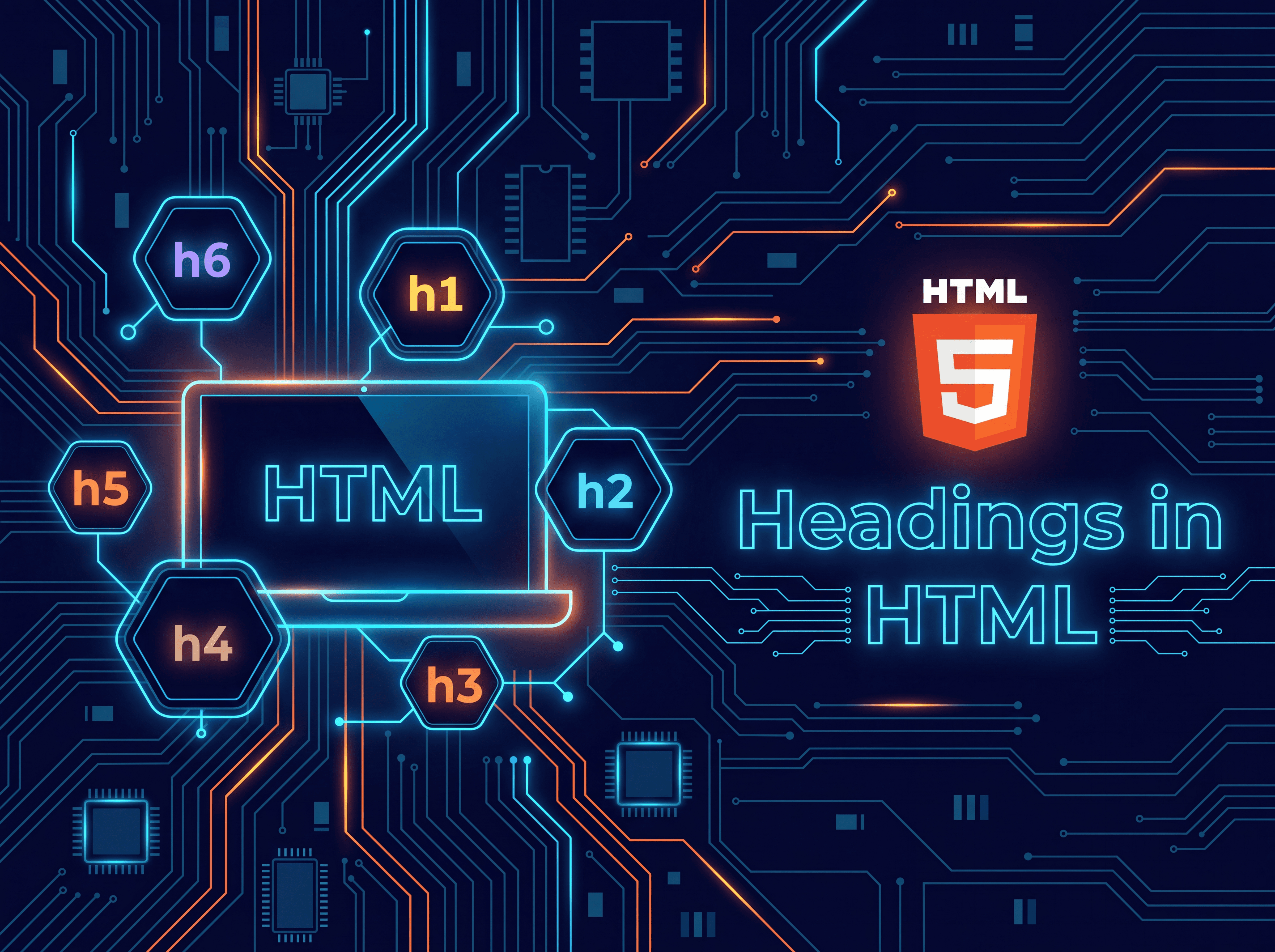
The H1 tag does not stand alone. It is the first level in a hierarchy of heading tags that structure the entire page.
H1: The main topic. One per page. Describes what the entire page is about.
H2: Major sections. Multiple H2s are expected on most pages. Each H2 should represent a distinct, meaningfully different section of the content. Think of H2s as the chapters under the H1's book title.
H3: Subsections within H2s. H3s break down the content within each H2 section. A step-by-step guide might use H2s for each phase and H3s for individual steps within those phases.
H4 through H6: Increasingly specific sub-levels that most content never needs. If your content requires H4s and H5s, consider whether the information would be better organized differently.
Does the order need to be perfect? <cite index="58-1">Google's Gary Illyes confirmed that arranging headings in semantic order is helpful for accessibility, especially for users who rely on screen readers, but it doesn't significantly impact Google's ranking algorithms.</cite>
So skipping from H2 to H4 will not get you penalized, but it will create a worse experience for screen reader users and can make your content harder to follow for everyone. The practical advice: keep the hierarchy logical because it serves your readers and your accessibility compliance, not because Google will rank you differently for perfect semantic structure.
H1 Tags and AI Search: Why Structure Matters More in 2026
Here is a genuinely new development that most H1 guides have not addressed yet.
Google AI Overviews and other AI-generated search summaries pull content from web pages to construct answers. These systems look for content that is clearly structured and easy to parse. When your page has a clear H1 that announces its topic, followed by well-organized H2s that break down distinct aspects of that topic, it is significantly easier for AI systems to extract accurate, useful information.
<cite index="59-1">Search features powered by large language models rely on structural cues. When your content is broken into logical, clearly labeled sections, it's easier for AI to understand what it's about and pull accurate summaries.</cite>
<cite index="57-1">Structuring your H2s around questions that mirror what people actually search for is increasingly valuable in 2026, particularly as AI-generated search summaries pull directly from well-structured content. If your heading hierarchy maps closely to how your audience thinks about the topic, you are more likely to appear in those features.</cite>
This gives heading structure a renewed practical importance that is separate from its traditional SEO impact. Even if perfect H1 placement is "negligible" for traditional rankings (as Google stated in 2024), it matters more than ever for AI-mediated discovery.
The practical implication: write H2s that look like questions your audience searches for. "How much does X cost?" "What is the difference between X and Y?" "Is X worth it?" These question-format headings mirror actual search queries and give AI systems clean, extractable answers for featured snippets and AI Overviews.
The Most Common H1 Mistakes
These are the H1 problems that show up most frequently in site audits. Some hurt rankings. Some hurt users. Most hurt both.
Missing H1 Tags
This is the most common problem on DIY-built websites and sites using generic templates. The page has visible text that looks like a heading but is styled with CSS to appear large rather than marked up with actual H1 HTML.
Google can usually figure out the page's topic from other signals, but missing H1s are a lost opportunity to communicate clearly. <cite index="62-1">Screen readers rely on the H1 as the top entry in their navigation outline, so leaving it out hurts both SEO and accessibility at once.</cite>
How to check: right-click any page and select "View Page Source." Search for <h1>. If you do not find it, the page has no H1 tag.
H1 Used as a Design Element
<cite index="59-1">People use H1s repeatedly throughout a page to style big, bold text like calls-to-action or quotes. H1s are not decorative. They are directional and structural signals.</cite>
If you are using H1 tags to make text large and bold rather than to mark the primary heading of the page, you are misusing the element. Use CSS to style text. Use HTML heading tags to mark up structure.
H1 That Does Not Match the Page's Content
The H1 sets an expectation. If the H1 says "The Ultimate Guide to Email Marketing" but the page content is a product showcase, users bounce, and Google sees a mismatch between the page's announced topic and its actual content.
The H1 must accurately represent what follows. Mismatches between the H1 and content create trust problems with both users and search engines.
Duplicate H1 Tags Across Multiple Pages
If several pages on your site share the same H1 ("Our Services," "Blog," "Contact"), Google has a harder time understanding which page to rank for which queries. Each page needs a unique H1 that distinguishes it from every other page on your domain.
H1 Text That Is Too Vague
"Welcome to Our Website." "Our Products." "Learn More." These communicate almost nothing. A good H1 should tell someone who has never visited your site exactly what the page is about. If you cannot tell from the H1 alone, the H1 needs rewriting.
H1 That Is Too Long
There is no official character limit for H1 tags. But H1s should be concise. They are headings, not paragraphs. If your H1 is longer than 60 to 70 characters, see if it can be tightened. Shorter, clearer headings work better for both users and the search systems that parse them.
The Myths That Need to Stop
SEO advice is full of rules about H1 tags that are either outdated or were never true. Here are the most common ones to stop following.
Myth: You must include your exact keyword in the H1 to rank.
<cite index="56-1">A 2026 case study analyzing the top 40 Google results for multiple keyword sets found a weak negative correlation between rank and the exact keyword phrase's presence in the H1 tag. Higher-ranking pages were slightly less likely to have the exact keyword phrase in the H1 tag.</cite>
This does not mean you should avoid your keyword in the H1. It means you should write a clear, descriptive heading that naturally includes relevant language. Forcing exact keyword phrases into H1s in unnatural ways does not help and may slightly hurt.
Myth: Multiple H1 tags will get you penalized.
<cite index="58-1">This clarification from Google aligns with John Mueller's previous statements that multiple H1 tags on a single page do not pose a problem for SEO. Mueller stressed that Google's systems can handle multiple H1 tags and should be used in a way that makes sense for the user experience.</cite>
One clear H1 is the best practice. But multiple H1s will not trigger a penalty.
Myth: The H1 must match the title tag exactly.
They should be aligned in topic. They do not need to be word-for-word identical. The title tag is optimized for search result clicks. The H1 is optimized for on-page clarity. Those are different jobs that benefit from slightly different language.
Myth: H1 font size or visual weight determines SEO value.
<cite index="62-1">Styling and font weight affect visual presentation only. What matters is the underlying HTML element, not the CSS sitting on top of it.</cite>
Google reads the HTML, not the visual style. An H1 styled to look small with CSS is still an H1. A paragraph of text styled to look large and bold with CSS is still a paragraph.
Myth: Fixing your H1 tags will rescue a poorly performing page.
<cite index="55-1">Heading tweaks alone won't rescue a poorly performing page. Headings support structure, not rankings, and tweaking your H1 tag alone won't significantly move the needle if the underlying content does not satisfy search intent.</cite>
If a page is not ranking, the problem is almost never the H1 tag. It is far more likely to be weak content, insufficient backlinks, poor search intent alignment, or technical issues. Fix those first.
How to Audit H1 Tags on Your Site
Here is a practical audit process that takes under an hour for most websites.
Step 1: Identify pages with missing H1 tags. Use Screaming Frog (free for up to 500 pages) or Ahrefs Webmaster Tools (free for your own domain). Both tools crawl your site and produce a report of pages with missing H1 tags. Every indexable page should have exactly one H1.
Step 2: Find pages with duplicate H1s. The same tools flag duplicate H1s. Any page sharing an H1 with another page needs a unique, distinguishing heading.
Step 3: Check H1 and title tag alignment. Export your crawl data and compare the H1 and title tag columns side by side. They should be topically aligned but can differ slightly in wording.
Step 4: Spot-check H1 quality. For your 10 most important pages, read only the H1. Ask: does this clearly communicate what the page is about? Is it specific and descriptive? Would a first-time visitor know immediately where they are?
Step 5: Verify your heading hierarchy on key pages. Use the HeadingsMap Chrome extension (free) to see your full heading structure displayed as an outline. Check that H2s and H3s follow logically from the H1 and build a coherent structure.
Step 6: Check for H1 misuse. Look for pages where H1 tags are used for non-heading elements like decorative text, pull quotes, or calls to action. Remove the H1 tag from those elements and style them with CSS instead.
H1 Tags on Specific Page Types
Best practice looks slightly different depending on what kind of page you are working on.
Blog posts and articles: The H1 is the article title. It should be editorial in tone while still being clear about the topic. Avoid clickbait H1s that promise something the article does not deliver. The H1 should be close to what appeared in the title tag that got the click.
Product pages: The H1 is the product name. Keep it clean and specific. "Men's Waterproof Hiking Boots Size 10 Wide" is better than "Check Out Our Amazing Boots." Include the most important identifying details for the product.
Service pages: The H1 names the service clearly. Be specific about who it is for and what it does. "Digital Marketing for Small Restaurants" beats "Our Marketing Services."
Category pages: The H1 names the category. "Running Shoes" or "Recipe Ideas for Beginners" both work. Avoid generic H1s like "Products" or "Blog Posts."
Homepage: The homepage H1 should state clearly what the business does and who it serves. Many homepages use overly clever brand statements as H1s. "Transform Your Business" tells nobody anything. "Cloud Accounting Software for Independent Contractors" tells people exactly what to expect.
Your H1 Action Plan
Here is what to do this week.
Day 1: Run a site crawl using Screaming Frog or Ahrefs Webmaster Tools. Export the list of pages with missing H1 tags. These are your immediate fixes.
Day 2: Check your five most important pages (homepage, top product or service pages, highest-traffic blog posts). Read only the H1. Is it specific? Does it match the page's content? Does it align with the title tag?
Day 3: Fix any H1 tags that are vague, missing, duplicated, or misaligned with their page's content. These changes are quick to make in almost any CMS.
Day 4: Review your H2 structure on your top three pages. Are H2s distinct from each other? Do they cover meaningfully different sections? Do any look like natural questions your audience searches for?
Day 5: Install the HeadingsMap Chrome extension. Visit your site's main pages and check the outline view. Does the hierarchy make logical sense? Fix anything that looks disordered.
That is a complete H1 audit and cleanup in five focused days. Most of the actual work is in the rewrites, not the diagnosis.
The Bottom Line
H1 tags are not the powerful secret ranking lever that old-school SEO checklists made them out to be. Google has said clearly that you can rank with one H1, multiple H1s, or no H1 at all. Fixing heading tags alone will not rescue a poorly performing page.
But H1 tags still matter. They communicate your page's topic to readers and search engines. They support accessibility for screen reader users. They provide structural cues that AI systems increasingly rely on to extract and summarize content. And they contribute to the kind of clear, well-organized page that Google rewards over time.
The goal is not H1 optimization. The goal is a clear, well-structured page where the H1 naturally and accurately announces the topic, the H2s organize the content into meaningful sections, and every heading tells a part of the same story the page is trying to tell.
Do that consistently across your site and your headings will be exactly what they should be: not a hack, but a foundation.
Blogs
More Blogs
From keyword goldmines to AI-driven content hacks—expert insights to help your blog posts dominate the first page.