GEO: How to Get Your Stuff Picked by AI (A No-Fluff Guide)
You type a question into ChatGPT. Or Perplexity. Or that little AI box at the top of Google.
You get an answer right there. Clean. Done. No clicking.
Now ask yourself: was your website one of the sources that answer came from?
If you don't know, that's a problem. And if the answer is "no," that's a bigger one.
This is what GEO is all about. GEO stands for Generative Engine Optimization. It's the new cousin of SEO. But it's not really about ranking pages anymore. It's about getting quoted.
Let's break it all down. No jargon. No fluff. Just what it is, why it matters, and what to actually do about it.
What GEO Actually Means
Old search worked like this: you type a question, Google hands you ten blue links, and you click around to find your answer.
New search works like this: you type a question, and an AI reads a bunch of pages for you, then writes you a short answer with a few sources linked at the bottom.
GEO is the work you do to make sure your page is one of those sources.
Think of it like this. SEO is trying to get a seat at a packed restaurant. GEO is trying to get the chef to mention your dish by name when a customer asks "what's good here?"
One Wikipedia summary puts it simply: GEO is about structuring digital content and managing online presence to improve visibility in responses generated by AI systems. Some people also call it AE
O (answer engine optimization) or AIO (AI optimization). Same idea, different label.
Why This Is a Big Deal Right Now
Here's the thing nobody can ignore anymore: people are skipping the click.
ChatGPT has well over 180 million people using it every month. Perplexity's traffic jumped over 800% in a year. Google itself now slaps an AI Overview on top of a huge chunk of searches.
Some predictions say regular search traffic could drop by half in the next couple of years as more people just ask AI directly instead of clicking through ten links.
That means the old game — "rank #1 on Google and the traffic flows in" — is starting to break down. Even if you rank #1, if the AI summarizes the answer and the user never scrolls down to your link, you got... nothing. No click. No visit. No sale.
So the new question every business has to ask is: when AI answers questions about my industry, my product, or my topic — does it mention me?
If you don't know, you're flying blind.
SEO vs GEO: What's Actually Different
Let's clear up the confusion, because GEO and SEO overlap a lot. They're not enemies. Think of SEO as the foundation and GEO as the new floor built on top of it.
Here's where they're the same:
Both want your content to be found
Both care about good keywords
Both want content that's actually useful and trustworthy
Both need a fast, clean, mobile-friendly website
Both reward sites that are seen as experts
Here's where they split:
SEO is about ranking a page. GEO is about getting a chunk of text picked, copied, and cited.
SEO cares about your title tag and meta description. GEO cares about whether one specific paragraph on your page is clear enough that an AI can lift it out and use it as the answer.
SEO wants you to match what people type into a search box. GEO wants you to match what people ask — which is longer, more conversational, and sounds like a real question. Nobody types "best running shoes flat feet" into ChatGPT. They type "I have flat feet, what running shoes should I actually buy?"
SEO tracks rankings and clicks. GEO tracks something weirder and harder to see: how often you get cited inside an AI answer, even if nobody clicks through.
Bottom line: you still need solid SEO. It's the floor. GEO is what you build on top of it for this new AI-search world.
How These AI Engines Actually Pick What to Show You
To win at GEO, you need to understand what's happening behind the curtain. It's actually pretty simple once you break it down. Most AI search tools work in three steps:
Step 1: Fetch. The AI grabs a handful of pages that seem related to the question. This part still works a lot like regular search — your page needs to be indexed and findable in the first place.
Step 2: Squeeze. The AI reads through those pages and pulls out the useful bits. It's looking for clear facts, clear definitions, clear numbers — stuff that's easy to lift out cleanly.
Step 3: Write. The AI stitches the best bits together into one smooth answer, in its own words, and (sometimes) drops a few links at the bottom for "sources."
So here's the big takeaway: your page doesn't need to be the best page overall. It needs to have the easiest-to-grab paragraph.
If your competitor buries the answer under three paragraphs of "Welcome to our blog! In today's post, we're so excited to talk about..." and you just say the answer in plain English in sentence one — guess who gets quoted?
The Research: What Actually Moves the Needle
A team of researchers (from Princeton, Georgia Tech, and a couple other big names) ran a real test. They threw 10,000 search queries at AI engines and tried a bunch of different writing tricks to see which ones got content cited more often.
The winners, according to the study, were:
Citing sources — backing up claims with links to credible places
Adding quotes — dropping in a real quote from an expert
Adding statistics — using actual numbers instead of vague words
These three tricks gave a 30-40% boost in how often the content got picked up by the AI. That's huge for such a small change.
Now, to be fair — some critics pushed back on this study. They pointed out it used simulated data and that some of these "GEO tricks" are just... good SEO and good writing that's been around forever. That's a fair point. Citing sources and using real numbers has always been good practice.
But here's the thing: it doesn't matter who invented it. If "add a stat, add a quote, add a source" boosts your odds of getting picked by AI by 30-40%, you should probably just do it. Free lunch.
One more wrinkle from the study: different topics respond to different tricks.
For science, history, and debate-style topics — using more technical, expert-sounding language helped.
For business and health topics — making the writing simpler and clearer helped more.
For legal and government topics — citing official sources mattered most.
For "explain this to me" type topics — expert quotes worked best.
For opinion and debate topics — solid statistics carried weight.
So there's no one-size-fits-all formula. But "be clear, back it up, and don't waste the reader's time" works almost everywhere.
What People on Reddit and Forums Are Actually Saying
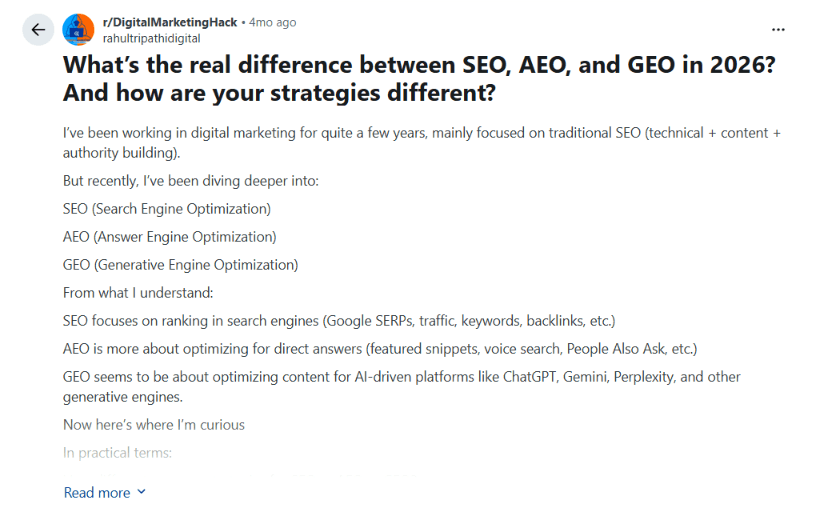
Strip away the marketing-speak and here's what regular folks doing this work keep repeating:
"AI doesn't rank pages — it rebuilds answers from pieces of pages." This came up again and again. One guide put it bluntly: generative engines don't rank pages, they extract and stitch together information from multiple sources into a single answer. Your job isn't to win a ranking battle. It's to make your sentence the easiest one to steal.
Position matters — a lot. Several writers pointed out that the first sentences of a page or section get way more weight than stuff buried at the bottom. If your golden nugget is in paragraph 7, it might never get seen by the AI at all, let alone quoted.
Reddit and Quora are training data goldmines. This one surprises a lot of people. AI models are trained partly on forum posts — Reddit threads, Quora answers, community discussions. That means showing up authentically in those spaces (not as spam, but as a genuinely helpful voice) can feed back into how AI talks about your brand or product.
"Query rewriting" expands your shot. AI tools often quietly rewrite a person's question several different ways behind the scenes before searching — "things to do in Austin," "best Austin attractions," "Austin activities for tourists" — all from one user question. So your content has more chances to get pulled in if you naturally cover different phrasings of the same topic, instead of obsessively repeating one exact keyword.
Brand mentions matter even without a link. People are noticing that AI tools sometimes mention a brand name in an answer with no link back to the website at all. That means your reputation across the whole internet — review sites, forums, news mentions — feeds the AI's idea of who's trustworthy, even on pages you don't own.
OK, So What Do You Actually Do? (The Practical Part)
Here's your action list. Doesn't matter if you run a blog, a Shopify store, a law firm, or a SaaS company — these apply.
1. Answer the question in the first sentence. Every time.
Stop burying the lede. If someone asks "how long does it take to learn guitar," your first sentence should basically be the answer: "Most people can play simple songs after about 3 months of regular practice."
Then you can explain, give context, tell your story. But the answer comes first. AI engines reward this hard, and so do impatient humans.
2. Write like you're answering a real question, out loud, to a friend.
Ditch "Top 10 Best Widgets for Every Need" and think "What widget should I buy if I have a small kitchen?" Real questions are longer and more natural. Your headers and content should sound like that too.
3. Add real numbers. Always.
"Many customers saw improvements" is invisible to an AI. "73% of customers reported faster results within 2 weeks" is a sentence an AI can grab and use. Numbers = citation bait.
4. Quote an actual expert (even if it's you).
A short quote — even one sentence — from someone with a title or credibility adds weight. "According to [Name], [Title], '...'" This is one of the cheapest, highest-impact tweaks you can make.
5. Link out to real, trustworthy sources.
Yes, sending people away from your page feels backwards. But citing solid sources signals to AI (and humans) that you did your homework. Don't be afraid of it.
6. Use headers, lists, and short paragraphs — but don't overdo it.
AI tools love content they can chop into pieces. A wall of text with no structure is hard to parse. But also don't turn everything into bullet soup — short, clear paragraphs work great too. The goal is easy to scan and easy to lift, not "looks like a PowerPoint."
7. Add a tight FAQ section near the bottom of long pages.
Short question, short direct answer. This format is basically tailor-made for AI engines, because it already looks like the Q&A format AI tools spit out.
8. Get mentioned where AI is trained — Reddit, Quora, review sites, forums.
This doesn't mean spamming links. It means showing up as a real, helpful voice in communities where your audience hangs out. Answer questions honestly. Mention your product when it's actually relevant, not every time. This builds the kind of organic mentions AI models pick up on.
9. Keep your facts the same everywhere.
If your "About" page says you've been in business since 2015, your LinkedIn says 2016, and a press release says 2014 — that's a credibility gap. AI cross-references info across the web. Keep your facts consistent across your site, social profiles, and any place you're mentioned.
10. Update old content. Don't just publish and forget.
Stale content with outdated stats and old screenshots signals "this might be wrong now." Go back to your best-performing pages every few months and refresh the numbers, examples, and dates.
11. Don't ignore the boring technical stuff.
Fast loading site. Mobile-friendly. HTTPS. No broken links. None of this is exciting, but if AI crawlers can't access or read your site properly, none of the writing tips above matter.
12. Track citations, not just clicks.
This is the hardest part because the tools are still catching up. But start checking: does ChatGPT or Perplexity mention your brand when you ask it questions in your niche? Does Google's AI Overview cite your page for your money keywords? Some analytics tools are starting to track "AI referral traffic" separately — keep an eye on that number even if it's small right now. Small today doesn't mean small in a year.
A Quick Reality Check
Don't throw your SEO playbook in the trash. GEO isn't a replacement — it's an add-on. A page with zero backlinks, slow load times, and thin content isn't going to suddenly get cited by AI just because you added one quote and a stat. The fundamentals still matter.
Also — nobody fully knows the "rules" yet, including the AI companies themselves. These models update constantly, and what gets cited today might not get cited next month. Anyone who tells you they've "cracked the algorithm" is selling something.
What you can control: write clearly, answer the actual question, back it up with real facts, and show up as a genuinely useful voice across the web — not just on your own site.
The One-Sentence Summary
If a robot had to read your page out loud to someone in 10 seconds and make them sound smart — would it be able to?
If yes, you're doing GEO right. If no, you know where to start.
Blogs
More Blogs
From keyword goldmines to AI-driven content hacks—expert insights to help your blog posts dominate the first page.