
Blog

Blog

Find Low Competition Keywords for SEO Wins

Find Low Competition Keywords for SEO Wins

Blog

Find Low Competition Keywords for SEO Wins

If you're trying to find low-competition keywords, the secret is to think specific. You want to hunt down long-tail phrases that have a low Keyword Difficulty (KD) score—a good rule of thumb is to aim for anything under 30.

So, instead of a broad, highly competitive term like "coffee beans," you’d have much better luck with something like "single origin coffee beans Seattle." This approach lets you attract people who are much closer to making a decision, helping you rank faster without having to fight against the huge, established websites.

Why Low-Competition Keywords Are Your SEO Game Changer
A person using a laptop to analyze charts and graphs, representing SEO keyword research.

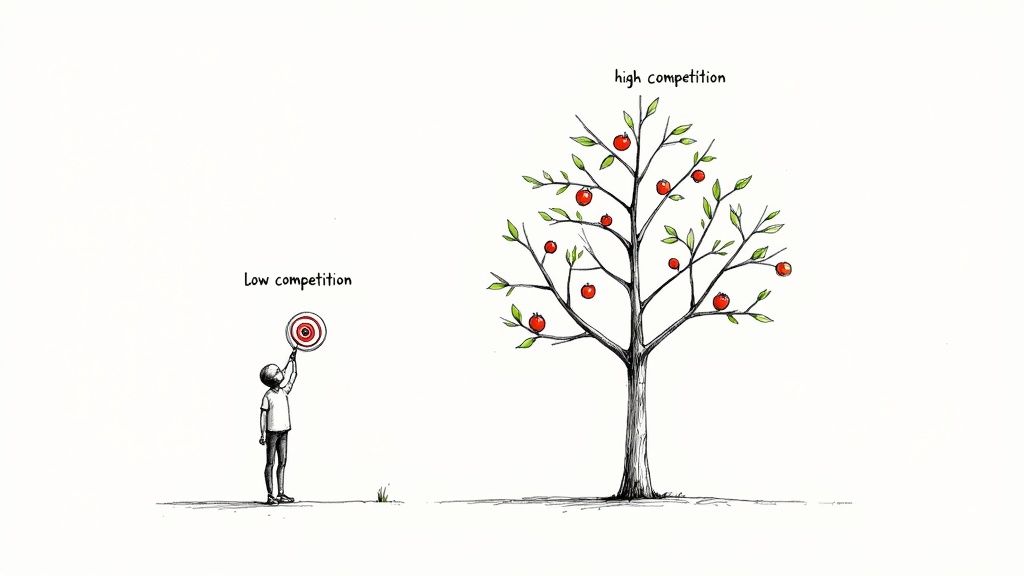
Stop trying to outmuscle industry giants for keywords you'll never win. The real smart play in SEO today is targeting low-competition, high-intent search terms. I've always called these the "low-hanging fruit" of SEO because they let you see real results without needing a massive budget or a domain that's been around for a decade.

When you shift your focus to these terms, you unlock some serious advantages:

  • You'll Rank Way Faster: With fewer sites clawing for the same phrase, your content has a legitimate shot at hitting the first page of Google in a matter of weeks, not years.

  • You Attract People Ready to Act: Someone searching for a super-specific, long-tail keyword knows exactly what they're looking for. The traffic you get is far more qualified and much more likely to convert.

  • You Build Authority Without the Grind: Consistently ranking for niche topics sends a strong signal to Google that you're an expert in your space. This builds topical authority, which actually makes it easier to rank for slightly more competitive terms down the road.

Understanding Keyword Difficulty

The whole strategy hinges on a metric called Keyword Difficulty (KD). Before you can really make this work, you need to understand what is keyword difficulty and how it shapes your entire plan. It’s basically a score, usually from 0 to 100, that predicts how tough it will be to rank on the first page for a specific keyword.

Most SEO tools will classify a KD score under 30 as low competition, while anything over 70 is a serious uphill battle. A term like "coffee beans" has a sky-high KD because thousands of authoritative sites are all competing for it.

To illustrate this, let's look at a few examples that show the difference in user intent and ranking potential.

High Competition vs Low Competition Keyword Examples

This table breaks down how a simple shift in keyword focus can completely change the game.

Keyword Type

Example Keyword

Typical Search Intent

Ranking Difficulty

High Competition

"Coffee"

Broad, informational, just browsing

Extremely High

Low Competition

"Best organic light roast coffee beans for pour over"

Specific, transactional, ready to buy

Low to Medium

High Competition

"Digital Marketing"

Researching a massive industry

Extremely High

Low Competition

"SEO content strategy for small e-commerce sites"

Actionable, looking for a specific solution

Low to Medium

See the difference? The low-competition keywords aren't just easier to rank for; they connect you with an audience that has a clear need.

This isn't about chasing less traffic; it's about connecting with the right visitors who are much further along in their buying journey.

Think about the mindset behind the search. "Coffee" is a casual browse. "Best organic light roast coffee beans for pour over" is someone with their credit card practically in hand. By targeting the second query, you're stepping into a focused conversation with a potential customer, not just yelling into a crowded stadium. This is how you build a sustainable SEO strategy that delivers real, measurable results, especially for smaller sites trying to gain a foothold.

Uncovering Hidden Keywords Your Competitors Miss

If you want to find keywords with low competition, you have to look where nobody else is looking. It's easy to get stuck in the same loop as everyone else, fighting over the exact same terms in Ahrefs or Semrush. But the real gold is hiding in plain sight, buried in the everyday language your audience uses.

This means getting out of your SEO tools and into the actual communities where your potential customers hang out. I'm talking about places like Reddit, Quora, and those old-school, niche industry forums. These platforms are absolute treasure troves of raw, unfiltered conversations.

Mine Online Communities for Keyword Gold

First things first, find the subreddits or forums that are laser-focused on your niche. For instance, if you're in the project management software space, you should be living in places like r/projectmanagement or specific forums for agile developers. The key here is not to look for keywords—you need to look for problems.

Keep an eye out for post titles that are basically questions in disguise:

  • "How do I...?"

  • "What's the best tool for...?"

  • "Does anyone know how to fix...?"

These aren't just questions; they're the exact phrases people are plugging into Google. The way they describe their pain points, the jargon they use, the frustration in their phrasing—that's your raw material for high-intent, low-competition keywords. A question like "How to manage scope creep with a small team" is infinitely more valuable than a generic term like "project management." You can then take these insights and use them for more targeted long tail keyword research.

Reverse-Engineer Customer Questions

Sometimes, the best keyword sources are right under your own roof. Dive into your customer support tickets, sales call transcripts, and live chat logs. Every single time a customer asks a question, they're essentially handing you a keyword on a silver platter.

Let's say a few different customers have asked, "Can your software integrate with Slack for notifications?" Boom. You've just stumbled upon a fantastic keyword: "project management software Slack integration." This is a super high-intent query from someone with a very specific need, and it’s almost certainly something your competitors have missed because it’s too niche for their broad-strokes content strategy.

Think like your customer, not just an SEO. The real goal is to pinpoint the unique, ultra-specific questions they ask right before they pull out their credit card. That’s how you find the terms nobody else is even thinking about.

Find the Gaps in Your Competitor's Content

Instead of just obsessing over what your competitors are ranking for, it's often more powerful to analyze what they've completely missed. Go read their top-performing blog posts and then scroll straight down to the comments section. What follow-up questions are people asking? What's confusing them? Those unanswered questions are your next content pieces.

This approach is especially great for finding what many call "zero-volume" or emerging keywords. It's shocking how much search activity happens in this overlooked territory. In fact, Google has said that about 15% of all daily searches are brand new queries that have never been searched before.

That constant stream of new questions creates a massive opportunity to become the go-to authority before your competition even realizes the keyword exists. As detailed in this post about low-volume terms on The Blogsmith, focusing on these hidden conversations allows you to get in on the ground floor and capture emerging traffic before it becomes competitive.

Using SEO Tools to Validate Your Keyword Ideas

https://www.youtube.com/embed/xsVTqzratPs

Okay, so you’ve done your homework. You’ve lurked in communities, listened to your audience, and now you have a solid list of potential keywords. That’s a great start, but an idea is just an idea until you back it up with hard data.

This is where we move from gut feelings to strategic decisions. It's time to fire up powerful SEO tools like Semrush or Ahrefs to see if these keywords are actually worth targeting. We’re not just looking for a high search volume; we need to dig into the metrics that really tell us what the competitive landscape looks like.

Decoding Key Keyword Metrics

When you pop a keyword into one of these tools, you'll get a whole dashboard of numbers thrown at you. It can feel a bit overwhelming, but you only need to focus on a few key metrics to separate the golden opportunities from the time-wasters.

Here’s what I always look at first:

  • Keyword Difficulty (KD): Think of this as your first filter. It’s a score, usually from 0-100, that estimates how tough it will be to crack the first page of Google. If you're hunting for low-competition keywords, a KD score below 30 is a fantastic place to start.

  • Search Volume: This one’s pretty straightforward—it’s an estimate of how many people search for that term each month. Don't get hypnotized by huge numbers, though. Sometimes, lower-volume keywords have much stronger purchase intent, making them incredibly valuable.

  • Cost Per Click (CPC): Even if you have no plans to run paid ads, CPC is a goldmine of information. A high CPC means businesses are willing to pay good money for that traffic. Why? Because it converts. It's a strong signal of commercial intent.

This simple workflow—moving from real conversations to data-backed keywords—is how you find topics you can actually rank for.
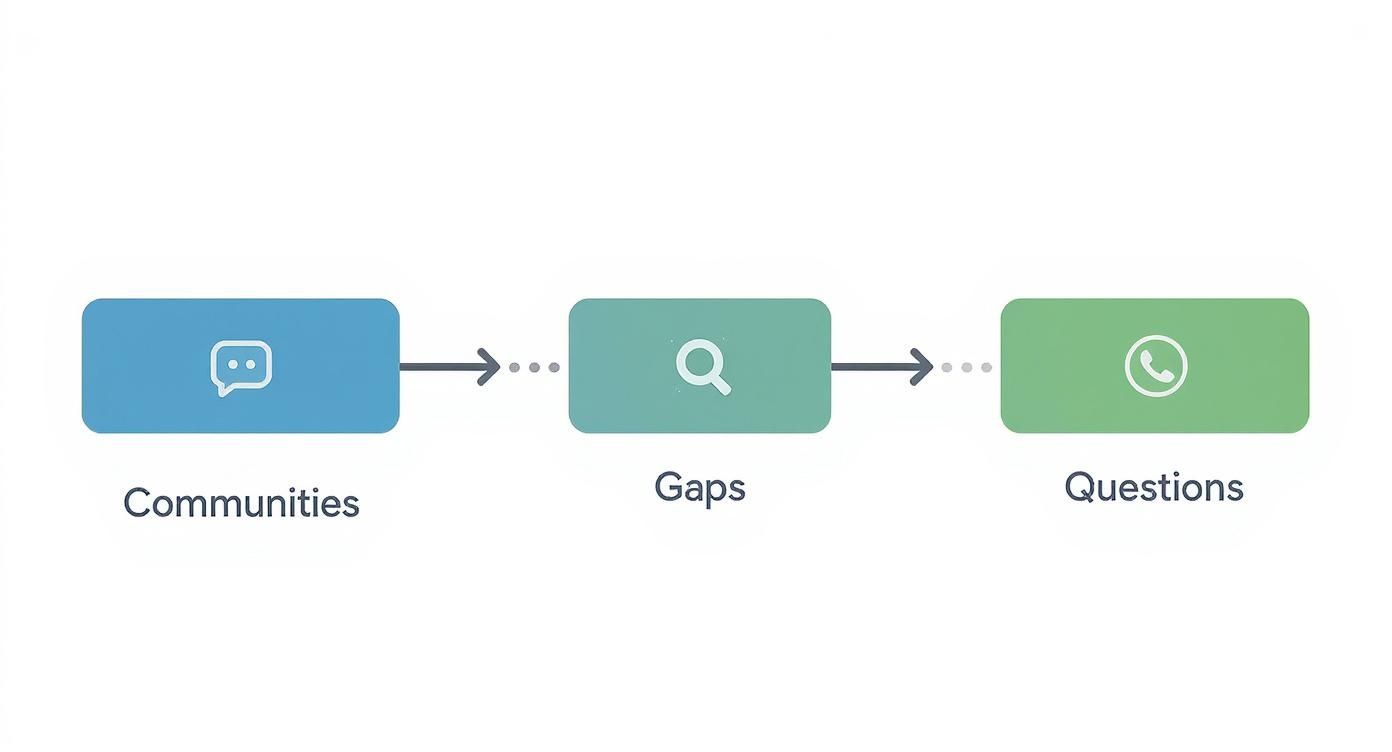
Infographic about find low competition keywords

As you can see, the process is repeatable. You start with real user conversations, find the gaps, and then use data to confirm you've struck gold.

Going Beyond the Numbers with SERP Analysis

A low KD score is a great sign, but it’s not the whole story. What if that keyword with a KD of 15 has SERPs dominated by giants like Forbes, Wikipedia, and The New York Times? That's a battle you probably won't win.

This is why you can’t skip manual SERP analysis. You have to look at the actual search results page with your own eyes.

A keyword's difficulty score is an algorithm's best guess. Your own analysis of the live search results is the ground truth. Never skip this step.

Go ahead, search for your keyword in Google. Look closely at the top 10 results. Are you seeing signs of weakness? I get excited when I see forums like Quora or Reddit, pages with user-generated content, or articles that are obviously outdated.

The presence of these weaker results means Google is struggling to find truly high-quality content for that query. That’s your invitation to create something better and swoop in.

Understanding the authority of the sites you're up against is also crucial. You can get a better handle on this by reading our guide on how to find domain authority, which will give you a clearer picture of the competition.

Looking ahead to 2024-2025, the real sweet spot in SEO continues to be that blend of low competition and decent search volume—the classic "low-hanging fruit." This is how you capture market share without getting into a fistfight with industry titans over keywords with a difficulty score over 80.

To build an even stronger workflow, it helps to combine insights from multiple platforms. If you're looking to explore solutions that integrate AI with your SEO efforts, check out these SEO AI tools. By pairing quantitative data with your own qualitative SERP analysis, you can be confident that every piece of content you create is aimed at a keyword you can realistically win.

Matching What People Actually Want: Decoding Search Intent
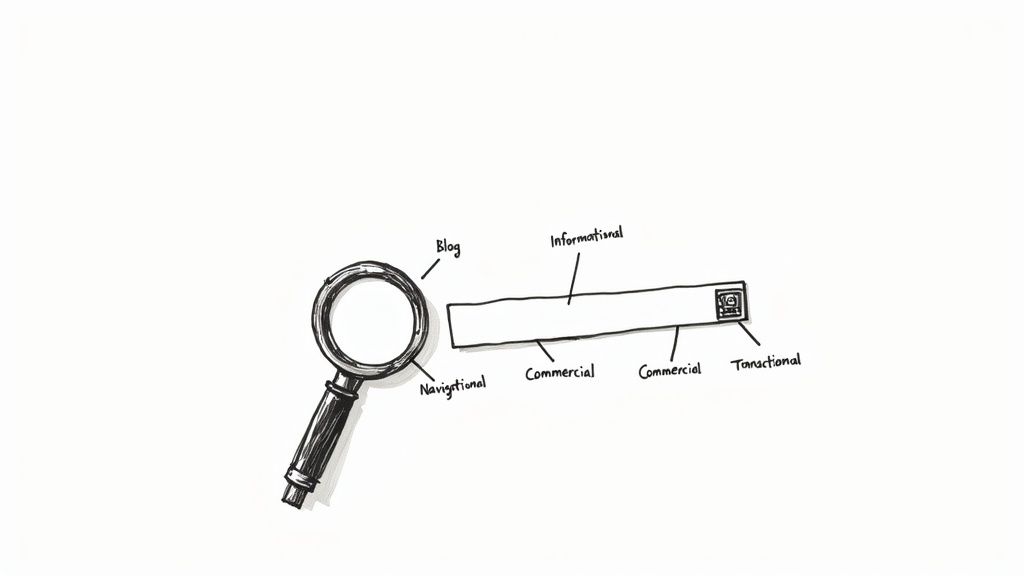
A magnifying glass hovering over different icons representing search intent types like information, navigation, and purchase.

Finding a keyword with a low competition score feels like striking gold, but it's only half the job. If your content doesn't line up with what the searcher is really looking for, you'll never rank. It doesn't matter if the difficulty score is a 1 or a 100.

This crucial piece of the puzzle is called search intent. It's the "why" behind every single query typed into Google.

Getting this right is what separates content that gets lost on page ten from content that rockets to the top. When you nail the intent, you're not just improving your ranking chances; you're also giving people what they want, which means higher engagement, lower bounce rates, and, ultimately, more conversions.

The Four Main Flavors of Search Intent

Every keyword you find fits into one of four main buckets. Figuring out which bucket your keyword belongs in is your first step toward creating content that both Google and your audience will love.

  • Informational Intent: The searcher is looking for information. Plain and simple. They want answers, tutorials, or explanations. Think "how to tie a tie" or "what is inflation."

  • Navigational Intent: The user already knows where they want to go and is just using Google as a shortcut. They might search for "YouTube" or "Viral SEO login."

  • Commercial Intent: This is the "kicking the tires" phase. The user is thinking about buying something and is comparing their options. You'll see searches like "best noise-cancelling headphones" or "Asana vs Trello review."

  • Transactional Intent: The wallet is out. The user is ready to make a purchase, right now. These queries are specific and often include trigger words like "buy," "deal," or "coupon," such as "buy Nike Air Max 90 size 11."

Your job is to play detective and reverse-engineer what Google already knows about a searcher's intent. The top-ranking pages are your cheat sheet—they show you exactly what kind of content is already winning.

How to Read the SERPs for Clues

Stop guessing what people want and let Google's search engine results page (the SERP) tell you the answer. It’s surprisingly straightforward.

Just type your target keyword into Google and take a hard look at the top 5-10 results. What do you see?

Are the results filled with in-depth blog posts and step-by-step guides? That’s a massive clue for informational intent. On the other hand, if you see a grid of product pages from online stores, you're looking at a transactional keyword.

This quick analysis is your roadmap for choosing the right content format. If the SERP is plastered with video results, a 2,000-word article probably isn't the right move. To truly find low competition keywords that you can actually rank for, your content has to match the format and intent that Google is already rewarding.

Alright, you've got your golden list of low-competition keywords. Now for the fun part: turning that research into content that actually gets seen. This is where the rubber meets the road, moving from strategy to creating a real, tangible asset for your business.
A person writing on a laptop with digital charts and SEO icons floating around them.

This isn’t about just dropping your keyword a few times and calling it a day. It’s about crafting a piece that genuinely satisfies the searcher's intent and clearly signals your expertise to Google.

This whole process kicks off before you even type the first sentence of your article. Your title tag and meta description are your first—and sometimes only—chance to make an impression in the search results. Think of them as your billboard on the SERP. A compelling, keyword-focused title can be the difference between getting the click and getting scrolled past. A high click-through rate is a massive signal to Google that you've got what people are looking for.

From Outline to Authority

Once someone clicks through, the structure of your content immediately shapes their experience. Nobody wants to hit a wall of text. Using clear, logical headings (your H2s and H3s) breaks up your content into scannable chunks. This makes it easy for readers to find what they need, but it also gives search engines a clear map of your article's hierarchy and main points.

Your real goal here is to build topical authority. The way you do that is by naturally weaving in related concepts and semantic terms.

Let’s say your main target is "cold brew coffee ratio." A truly authoritative piece won’t just talk about the ratio. It will naturally cover related subtopics people are thinking about, like:

  • The ideal grind size for cold brew

  • How long to let it steep

  • The best types of coffee beans

  • How water temperature changes the final taste

Covering these related ideas proves to Google that you’re not just a surface-level source; you’re an expert. As you flesh out your content, you’ll also want to consider the right balance of keywords. A common question is how many keywords per page is the sweet spot to achieve relevance without overdoing it.

Your mission is simple: create the single best, most helpful resource on the internet for that specific query. Don't just answer the question they typed in. Anticipate the next three questions they'll have and answer those, too.

On-Page SEO Checklist for Low-Competition Keywords

To make sure all your hard work pays off, it’s crucial to nail the on-page SEO fundamentals. These are the finishing touches that signal quality and relevance to search engines, helping you secure that top spot. This checklist covers the essentials for every piece of content you create.

On-Page Element

Action Item

Why It Matters

Title Tag

Include the primary keyword near the beginning. Keep it under 60 characters.

This is the first thing users and Google see. A strong title improves CTR and signals relevance.

Meta Description

Write a compelling, 155-160 character summary that includes the keyword.

It's your ad copy in the SERPs. A good description entices users to click on your result over others.

URL Slug

Make it short, descriptive, and include the primary keyword.

A clean URL is user-friendly and helps search engines understand the page topic at a glance.

Headings (H1, H2, H3)

Use one H1 with the primary keyword. Use H2s/H3s for subtopics with related keywords.

Headings create a logical structure for readers and help search engines understand the content's hierarchy.

Internal Links

Add 2-3 links to other relevant pages on your site using descriptive anchor text.

Internal links distribute link equity, keep users on your site longer, and help Google find your other pages.

Image Alt Text

Add descriptive alt text to all images, including the keyword where it makes sense.

Alt text improves accessibility and provides another contextual signal to search engines about your page's content.

Keyword Placement

Include the primary keyword in the first 100 words and naturally throughout the content.

Placing your keyword early confirms the page's topic to both users and search engines right away.

Getting these elements right for every single post creates a powerful, cumulative effect. It's a system for ensuring that every piece of content you publish has the best possible chance to rank and attract the right audience. Your goal isn't just to rank—it's to provide real value that turns a casual searcher into a loyal follower or customer.

Of course. Here is the rewritten section with a more natural, human-expert tone.

Your Low-Competition Keyword Questions, Answered

Once you start digging into low-competition keywords, a few questions always pop up. It's totally normal. Getting some clear answers right from the start can save you a ton of headaches and help you sidestep the usual mistakes people make when they find low competition keywords.

Let's clear the air on some of the most common ones I hear.

What’s a “Good” Keyword Difficulty Score, Really?

Most SEO tools will tell you that a Keyword Difficulty (KD) score below 30 is low competition. For the most part, that’s a decent rule of thumb. It’s usually the sweet spot where a smaller site can actually break into the first page without an army of backlinks.

But here’s the thing: that number is totally relative.

If you just launched your site yesterday, a KD of 25 might feel like trying to climb a mountain. On the other hand, if you’re running a site that’s been around for a few years, you might look at a KD of 40 and think, "Yeah, I can take that."

My advice? It all depends on your own site's authority. If you're new, start by hunting for keywords with a KD under 20. As you build up some credibility with Google, you can start aiming higher.

Should I Bother with Keywords That Have Zero Search Volume?

Yes, one hundred percent! Going after keywords that show up as "0" in your favorite tool can be a goldmine. It's one of my favorite under-the-radar tactics.

Think about it: these tools are great, but they’re not perfect. They often miss the real search volume for brand new phrases or super-specific long-tail questions.

Google has said that about 15% of all searches every single day are queries they've never seen before. That’s a massive opportunity. When you create content for one of these "zero volume" terms, you're getting in on the ground floor. You become the go-to answer before your competition even knows the keyword exists.

How Long Until I Actually Rank for One of These Keywords?

This is the million-dollar question, isn't it? While there's no magic number, the good news is that for genuinely low-competition terms, you can see movement way faster than you would with a more competitive keyword.

It’s not unheard of to see your new article pop up on the first few pages of Google within 4 to 8 weeks. Sometimes even faster.

Of course, a few things will speed up or slow down that timeline:

  • Your Site's Authority: A site with some history and trust will always get indexed and ranked faster.

  • Content Quality: If your article is hands-down the best resource on the topic, Google notices.

  • Technical Health: A clean, fast, mobile-friendly site just makes everything work better and faster.

The real secret is just staying consistent. Keep publishing great content aimed at these easy-to-win keywords, and you'll build the kind of momentum that makes ranking happen faster and faster.

Ready to stop guessing and start ranking? Viral SEO is built to help you find your competitors' top pages and uncover the low-competition topics that actually bring in traffic. Forget the complex spreadsheets and build a content plan that gets results. Check out the Content Gap Analyzer today at https://getviralseo.com.

If you're trying to find low-competition keywords, the secret is to think specific. You want to hunt down long-tail phrases that have a low Keyword Difficulty (KD) score—a good rule of thumb is to aim for anything under 30.

So, instead of a broad, highly competitive term like "coffee beans," you’d have much better luck with something like "single origin coffee beans Seattle." This approach lets you attract people who are much closer to making a decision, helping you rank faster without having to fight against the huge, established websites.

Why Low-Competition Keywords Are Your SEO Game Changer

A person using a laptop to analyze charts and graphs, representing SEO keyword research.

Stop trying to outmuscle industry giants for keywords you'll never win. The real smart play in SEO today is targeting low-competition, high-intent search terms. I've always called these the "low-hanging fruit" of SEO because they let you see real results without needing a massive budget or a domain that's been around for a decade.

When you shift your focus to these terms, you unlock some serious advantages:

  • You'll Rank Way Faster: With fewer sites clawing for the same phrase, your content has a legitimate shot at hitting the first page of Google in a matter of weeks, not years.

  • You Attract People Ready to Act: Someone searching for a super-specific, long-tail keyword knows exactly what they're looking for. The traffic you get is far more qualified and much more likely to convert.

  • You Build Authority Without the Grind: Consistently ranking for niche topics sends a strong signal to Google that you're an expert in your space. This builds topical authority, which actually makes it easier to rank for slightly more competitive terms down the road.

Understanding Keyword Difficulty

The whole strategy hinges on a metric called Keyword Difficulty (KD). Before you can really make this work, you need to understand what is keyword difficulty and how it shapes your entire plan. It’s basically a score, usually from 0 to 100, that predicts how tough it will be to rank on the first page for a specific keyword.

Most SEO tools will classify a KD score under 30 as low competition, while anything over 70 is a serious uphill battle. A term like "coffee beans" has a sky-high KD because thousands of authoritative sites are all competing for it.

To illustrate this, let's look at a few examples that show the difference in user intent and ranking potential.

High Competition vs Low Competition Keyword Examples

This table breaks down how a simple shift in keyword focus can completely change the game.

Keyword Type

Example Keyword

Typical Search Intent

Ranking Difficulty

High Competition

"Coffee"

Broad, informational, just browsing

Extremely High

Low Competition

"Best organic light roast coffee beans for pour over"

Specific, transactional, ready to buy

Low to Medium

High Competition

"Digital Marketing"

Researching a massive industry

Extremely High

Low Competition

"SEO content strategy for small e-commerce sites"

Actionable, looking for a specific solution

Low to Medium

See the difference? The low-competition keywords aren't just easier to rank for; they connect you with an audience that has a clear need.

This isn't about chasing less traffic; it's about connecting with the right visitors who are much further along in their buying journey.

Think about the mindset behind the search. "Coffee" is a casual browse. "Best organic light roast coffee beans for pour over" is someone with their credit card practically in hand. By targeting the second query, you're stepping into a focused conversation with a potential customer, not just yelling into a crowded stadium. This is how you build a sustainable SEO strategy that delivers real, measurable results, especially for smaller sites trying to gain a foothold.

Uncovering Hidden Keywords Your Competitors Miss

If you want to find keywords with low competition, you have to look where nobody else is looking. It's easy to get stuck in the same loop as everyone else, fighting over the exact same terms in Ahrefs or Semrush. But the real gold is hiding in plain sight, buried in the everyday language your audience uses.

This means getting out of your SEO tools and into the actual communities where your potential customers hang out. I'm talking about places like Reddit, Quora, and those old-school, niche industry forums. These platforms are absolute treasure troves of raw, unfiltered conversations.

Mine Online Communities for Keyword Gold

First things first, find the subreddits or forums that are laser-focused on your niche. For instance, if you're in the project management software space, you should be living in places like r/projectmanagement or specific forums for agile developers. The key here is not to look for keywords—you need to look for problems.

Keep an eye out for post titles that are basically questions in disguise:

  • "How do I...?"

  • "What's the best tool for...?"

  • "Does anyone know how to fix...?"

These aren't just questions; they're the exact phrases people are plugging into Google. The way they describe their pain points, the jargon they use, the frustration in their phrasing—that's your raw material for high-intent, low-competition keywords. A question like "How to manage scope creep with a small team" is infinitely more valuable than a generic term like "project management." You can then take these insights and use them for more targeted long tail keyword research.

Reverse-Engineer Customer Questions

Sometimes, the best keyword sources are right under your own roof. Dive into your customer support tickets, sales call transcripts, and live chat logs. Every single time a customer asks a question, they're essentially handing you a keyword on a silver platter.

Let's say a few different customers have asked, "Can your software integrate with Slack for notifications?" Boom. You've just stumbled upon a fantastic keyword: "project management software Slack integration." This is a super high-intent query from someone with a very specific need, and it’s almost certainly something your competitors have missed because it’s too niche for their broad-strokes content strategy.

Think like your customer, not just an SEO. The real goal is to pinpoint the unique, ultra-specific questions they ask right before they pull out their credit card. That’s how you find the terms nobody else is even thinking about.

Find the Gaps in Your Competitor's Content

Instead of just obsessing over what your competitors are ranking for, it's often more powerful to analyze what they've completely missed. Go read their top-performing blog posts and then scroll straight down to the comments section. What follow-up questions are people asking? What's confusing them? Those unanswered questions are your next content pieces.

This approach is especially great for finding what many call "zero-volume" or emerging keywords. It's shocking how much search activity happens in this overlooked territory. In fact, Google has said that about 15% of all daily searches are brand new queries that have never been searched before.

That constant stream of new questions creates a massive opportunity to become the go-to authority before your competition even realizes the keyword exists. As detailed in this post about low-volume terms on The Blogsmith, focusing on these hidden conversations allows you to get in on the ground floor and capture emerging traffic before it becomes competitive.

Using SEO Tools to Validate Your Keyword Ideas

https://www.youtube.com/embed/xsVTqzratPs

Okay, so you’ve done your homework. You’ve lurked in communities, listened to your audience, and now you have a solid list of potential keywords. That’s a great start, but an idea is just an idea until you back it up with hard data.

This is where we move from gut feelings to strategic decisions. It's time to fire up powerful SEO tools like Semrush or Ahrefs to see if these keywords are actually worth targeting. We’re not just looking for a high search volume; we need to dig into the metrics that really tell us what the competitive landscape looks like.

Decoding Key Keyword Metrics

When you pop a keyword into one of these tools, you'll get a whole dashboard of numbers thrown at you. It can feel a bit overwhelming, but you only need to focus on a few key metrics to separate the golden opportunities from the time-wasters.

Here’s what I always look at first:

  • Keyword Difficulty (KD): Think of this as your first filter. It’s a score, usually from 0-100, that estimates how tough it will be to crack the first page of Google. If you're hunting for low-competition keywords, a KD score below 30 is a fantastic place to start.

  • Search Volume: This one’s pretty straightforward—it’s an estimate of how many people search for that term each month. Don't get hypnotized by huge numbers, though. Sometimes, lower-volume keywords have much stronger purchase intent, making them incredibly valuable.

  • Cost Per Click (CPC): Even if you have no plans to run paid ads, CPC is a goldmine of information. A high CPC means businesses are willing to pay good money for that traffic. Why? Because it converts. It's a strong signal of commercial intent.

This simple workflow—moving from real conversations to data-backed keywords—is how you find topics you can actually rank for.

Infographic about find low competition keywords

As you can see, the process is repeatable. You start with real user conversations, find the gaps, and then use data to confirm you've struck gold.

Going Beyond the Numbers with SERP Analysis

A low KD score is a great sign, but it’s not the whole story. What if that keyword with a KD of 15 has SERPs dominated by giants like Forbes, Wikipedia, and The New York Times? That's a battle you probably won't win.

This is why you can’t skip manual SERP analysis. You have to look at the actual search results page with your own eyes.

A keyword's difficulty score is an algorithm's best guess. Your own analysis of the live search results is the ground truth. Never skip this step.

Go ahead, search for your keyword in Google. Look closely at the top 10 results. Are you seeing signs of weakness? I get excited when I see forums like Quora or Reddit, pages with user-generated content, or articles that are obviously outdated.

The presence of these weaker results means Google is struggling to find truly high-quality content for that query. That’s your invitation to create something better and swoop in.

Understanding the authority of the sites you're up against is also crucial. You can get a better handle on this by reading our guide on how to find domain authority, which will give you a clearer picture of the competition.

Looking ahead to 2024-2025, the real sweet spot in SEO continues to be that blend of low competition and decent search volume—the classic "low-hanging fruit." This is how you capture market share without getting into a fistfight with industry titans over keywords with a difficulty score over 80.

To build an even stronger workflow, it helps to combine insights from multiple platforms. If you're looking to explore solutions that integrate AI with your SEO efforts, check out these SEO AI tools. By pairing quantitative data with your own qualitative SERP analysis, you can be confident that every piece of content you create is aimed at a keyword you can realistically win.

Matching What People Actually Want: Decoding Search Intent

A magnifying glass hovering over different icons representing search intent types like information, navigation, and purchase.

Finding a keyword with a low competition score feels like striking gold, but it's only half the job. If your content doesn't line up with what the searcher is really looking for, you'll never rank. It doesn't matter if the difficulty score is a 1 or a 100.

This crucial piece of the puzzle is called search intent. It's the "why" behind every single query typed into Google.

Getting this right is what separates content that gets lost on page ten from content that rockets to the top. When you nail the intent, you're not just improving your ranking chances; you're also giving people what they want, which means higher engagement, lower bounce rates, and, ultimately, more conversions.

The Four Main Flavors of Search Intent

Every keyword you find fits into one of four main buckets. Figuring out which bucket your keyword belongs in is your first step toward creating content that both Google and your audience will love.

  • Informational Intent: The searcher is looking for information. Plain and simple. They want answers, tutorials, or explanations. Think "how to tie a tie" or "what is inflation."

  • Navigational Intent: The user already knows where they want to go and is just using Google as a shortcut. They might search for "YouTube" or "Viral SEO login."

  • Commercial Intent: This is the "kicking the tires" phase. The user is thinking about buying something and is comparing their options. You'll see searches like "best noise-cancelling headphones" or "Asana vs Trello review."

  • Transactional Intent: The wallet is out. The user is ready to make a purchase, right now. These queries are specific and often include trigger words like "buy," "deal," or "coupon," such as "buy Nike Air Max 90 size 11."

Your job is to play detective and reverse-engineer what Google already knows about a searcher's intent. The top-ranking pages are your cheat sheet—they show you exactly what kind of content is already winning.

How to Read the SERPs for Clues

Stop guessing what people want and let Google's search engine results page (the SERP) tell you the answer. It’s surprisingly straightforward.

Just type your target keyword into Google and take a hard look at the top 5-10 results. What do you see?

Are the results filled with in-depth blog posts and step-by-step guides? That’s a massive clue for informational intent. On the other hand, if you see a grid of product pages from online stores, you're looking at a transactional keyword.

This quick analysis is your roadmap for choosing the right content format. If the SERP is plastered with video results, a 2,000-word article probably isn't the right move. To truly find low competition keywords that you can actually rank for, your content has to match the format and intent that Google is already rewarding.

Alright, you've got your golden list of low-competition keywords. Now for the fun part: turning that research into content that actually gets seen. This is where the rubber meets the road, moving from strategy to creating a real, tangible asset for your business.

A person writing on a laptop with digital charts and SEO icons floating around them.

This isn’t about just dropping your keyword a few times and calling it a day. It’s about crafting a piece that genuinely satisfies the searcher's intent and clearly signals your expertise to Google.

This whole process kicks off before you even type the first sentence of your article. Your title tag and meta description are your first—and sometimes only—chance to make an impression in the search results. Think of them as your billboard on the SERP. A compelling, keyword-focused title can be the difference between getting the click and getting scrolled past. A high click-through rate is a massive signal to Google that you've got what people are looking for.

From Outline to Authority

Once someone clicks through, the structure of your content immediately shapes their experience. Nobody wants to hit a wall of text. Using clear, logical headings (your H2s and H3s) breaks up your content into scannable chunks. This makes it easy for readers to find what they need, but it also gives search engines a clear map of your article's hierarchy and main points.

Your real goal here is to build topical authority. The way you do that is by naturally weaving in related concepts and semantic terms.

Let’s say your main target is "cold brew coffee ratio." A truly authoritative piece won’t just talk about the ratio. It will naturally cover related subtopics people are thinking about, like:

  • The ideal grind size for cold brew

  • How long to let it steep

  • The best types of coffee beans

  • How water temperature changes the final taste

Covering these related ideas proves to Google that you’re not just a surface-level source; you’re an expert. As you flesh out your content, you’ll also want to consider the right balance of keywords. A common question is how many keywords per page is the sweet spot to achieve relevance without overdoing it.

Your mission is simple: create the single best, most helpful resource on the internet for that specific query. Don't just answer the question they typed in. Anticipate the next three questions they'll have and answer those, too.

On-Page SEO Checklist for Low-Competition Keywords

To make sure all your hard work pays off, it’s crucial to nail the on-page SEO fundamentals. These are the finishing touches that signal quality and relevance to search engines, helping you secure that top spot. This checklist covers the essentials for every piece of content you create.

On-Page Element

Action Item

Why It Matters

Title Tag

Include the primary keyword near the beginning. Keep it under 60 characters.

This is the first thing users and Google see. A strong title improves CTR and signals relevance.

Meta Description

Write a compelling, 155-160 character summary that includes the keyword.

It's your ad copy in the SERPs. A good description entices users to click on your result over others.

URL Slug

Make it short, descriptive, and include the primary keyword.

A clean URL is user-friendly and helps search engines understand the page topic at a glance.

Headings (H1, H2, H3)

Use one H1 with the primary keyword. Use H2s/H3s for subtopics with related keywords.

Headings create a logical structure for readers and help search engines understand the content's hierarchy.

Internal Links

Add 2-3 links to other relevant pages on your site using descriptive anchor text.

Internal links distribute link equity, keep users on your site longer, and help Google find your other pages.

Image Alt Text

Add descriptive alt text to all images, including the keyword where it makes sense.

Alt text improves accessibility and provides another contextual signal to search engines about your page's content.

Keyword Placement

Include the primary keyword in the first 100 words and naturally throughout the content.

Placing your keyword early confirms the page's topic to both users and search engines right away.

Getting these elements right for every single post creates a powerful, cumulative effect. It's a system for ensuring that every piece of content you publish has the best possible chance to rank and attract the right audience. Your goal isn't just to rank—it's to provide real value that turns a casual searcher into a loyal follower or customer.

Of course. Here is the rewritten section with a more natural, human-expert tone.

Your Low-Competition Keyword Questions, Answered

Once you start digging into low-competition keywords, a few questions always pop up. It's totally normal. Getting some clear answers right from the start can save you a ton of headaches and help you sidestep the usual mistakes people make when they find low competition keywords.

Let's clear the air on some of the most common ones I hear.

What’s a “Good” Keyword Difficulty Score, Really?

Most SEO tools will tell you that a Keyword Difficulty (KD) score below 30 is low competition. For the most part, that’s a decent rule of thumb. It’s usually the sweet spot where a smaller site can actually break into the first page without an army of backlinks.

But here’s the thing: that number is totally relative.

If you just launched your site yesterday, a KD of 25 might feel like trying to climb a mountain. On the other hand, if you’re running a site that’s been around for a few years, you might look at a KD of 40 and think, "Yeah, I can take that."

My advice? It all depends on your own site's authority. If you're new, start by hunting for keywords with a KD under 20. As you build up some credibility with Google, you can start aiming higher.

Should I Bother with Keywords That Have Zero Search Volume?

Yes, one hundred percent! Going after keywords that show up as "0" in your favorite tool can be a goldmine. It's one of my favorite under-the-radar tactics.

Think about it: these tools are great, but they’re not perfect. They often miss the real search volume for brand new phrases or super-specific long-tail questions.

Google has said that about 15% of all searches every single day are queries they've never seen before. That’s a massive opportunity. When you create content for one of these "zero volume" terms, you're getting in on the ground floor. You become the go-to answer before your competition even knows the keyword exists.

How Long Until I Actually Rank for One of These Keywords?

This is the million-dollar question, isn't it? While there's no magic number, the good news is that for genuinely low-competition terms, you can see movement way faster than you would with a more competitive keyword.

It’s not unheard of to see your new article pop up on the first few pages of Google within 4 to 8 weeks. Sometimes even faster.

Of course, a few things will speed up or slow down that timeline:

  • Your Site's Authority: A site with some history and trust will always get indexed and ranked faster.

  • Content Quality: If your article is hands-down the best resource on the topic, Google notices.

  • Technical Health: A clean, fast, mobile-friendly site just makes everything work better and faster.

The real secret is just staying consistent. Keep publishing great content aimed at these easy-to-win keywords, and you'll build the kind of momentum that makes ranking happen faster and faster.

Ready to stop guessing and start ranking? Viral SEO is built to help you find your competitors' top pages and uncover the low-competition topics that actually bring in traffic. Forget the complex spreadsheets and build a content plan that gets results. Check out the Content Gap Analyzer today at https://getviralseo.com.