Let's be honest, for a long time, content marketing felt a bit like throwing spaghetti at the wall to see what sticks. We'd rely on gut feelings and creative hunches, hoping something would resonate. Data-driven content marketing is the exact opposite of that. It’s a strategic approach that uses hard numbers—audience insights, performance metrics, and market research—to inform every single content decision you make.
Instead of guessing, you’re creating every article, video, or social post with a specific, measurable purpose. This is how you turn content from a simple creative expense into a predictable engine for business growth.
What Is Data-Driven Content Marketing

Think of it like a chef meticulously tasting and adjusting every ingredient to perfect a dish, rather than just blindly following a recipe. That’s the core of data-driven content marketing. It’s a philosophy that weaves data into the entire content lifecycle, from brainstorming and creation all the way through distribution and optimization.
This approach moves you from hoping your content connects to knowing it will. By digging into real user behavior, search trends, and performance data, you can answer critical questions before you ever write a single word. What topics are people actually searching for? Which format will grab their attention and hold it? Where should you promote your content to get the best bang for your buck?
The Shift from Guesswork to Precision
The old way of doing content often felt like shouting into the void. You'd hit "publish" and cross your fingers. A data-driven approach completely flips that script, using concrete evidence to make calculated decisions that directly support your business goals.
The whole idea is to swap out assumptions for actual insights. For instance, instead of assuming your audience wants snappy, short videos, you might discover through your analytics that they spend far more time on your in-depth, long-form guides. That single insight helps you invest your time and budget far more effectively, focusing on what delivers real value and drives results.
This strategy is built on a few core principles:
Audience-Centricity: Using real data to get a deep understanding of your audience’s needs, challenges, and preferences.
Performance Measurement: Setting and tracking key performance indicators (KPIs) to measure content effectiveness and prove its business impact.
Continuous Optimization: Regularly reviewing your data to see what’s working, what’s not, and how you can get better over time.
Data tells you what to create and where to focus your efforts. This frees up your storytelling, brand personality, and creativity to shine where they’ll have the most impact. It’s about being smarter, not just louder.
Ultimately, data-driven content marketing isn't about letting spreadsheets kill your creativity. It's about giving that creativity a clear direction. When you know why you’re creating something and who it’s for, your work becomes more resonant, effective, and profitable. Grasping this mindset is the first step before we get into the specific tactics and tools that make it all happen.
Why Data Is Your Most Valuable Asset
In the old days of marketing, we ran on a lot of educated guesses. We’d dream up content based on our gut feelings, launch it, and just hope it would connect with the right audience. Today, that approach is a fast track to burning through your budget with little to show for it. Data has completely changed the game, turning what was once guesswork into a reliable process for growth.
The slow fade of third-party cookies is making it even tougher to understand what people are doing online. You can't just follow users across the web anymore. This shift makes first-party data—the information you gather directly from your audience—an absolute necessity. It’s no longer a nice-to-have; it's the raw material you need to build real customer relationships.
Piecing Together the Customer Journey
The way people buy things now is incredibly scattered. A potential customer might see your brand across dozens, or even hundreds, of different digital touchpoints before they ever decide to buy. In fact, research shows a typical purchase journey can involve anywhere from 20 to 500 different interactions, from a quick glance at a social media post to reading a blog article to clicking a link in an email.
Without data, each of those interactions is just an isolated blip on the radar. You see a click here and a page view there, but there’s no way to connect them. Data is the thread that weaves this fragmented journey together, giving you a single, clear picture of how someone actually engages with your brand over time. That big-picture view is essential for delivering a message that feels consistent and makes sense, no matter where people find you.
From Assumptions to Certainty
A data-driven strategy lets you stop assuming and start knowing. Instead of guessing what your audience wants to read or watch, you can look at their actual behavior to figure out their real needs, pain points, and what truly interests them.
This clarity sharpens every part of your content plan:
Content Ideation: Data shows you the exact topics people are searching for and the questions they're asking. You can create content that genuinely solves their problems.
Format Selection: Your analytics can tell you if your audience loves long-form articles, quick video tutorials, or detailed case studies. This helps you put your resources into the formats that get the best engagement.
Channel Distribution: By seeing where your best traffic comes from, you can double down on the channels that actually deliver results instead of spreading yourself too thin.
Data doesn’t just tell you if your content is working; it tells you why it’s working. It gives you the concrete insights you need to tweak your strategy, improve performance, and consistently create content that hits the mark.
Proving Content ROI and Building Authority
One of the oldest struggles for content marketers is proving our work actually matters to the people holding the purse strings. Data is the hard evidence we need to show a real return on investment (ROI). By tracking metrics like lead generation, conversion rates, and customer lifetime value, you can draw a straight line from your content to the company's bottom line.
Beyond just proving value, consistently creating high-quality, data-informed content helps you build topical authority. When you become the go-to source on a subject your audience cares about, search engines reward you for it. Your rankings improve, and your brand’s reputation as a trusted expert grows stronger. It's important to understand how search engines see your site's credibility, which you can learn more about by exploring how to find your domain authority. This focus on building authority is at the very core of any successful data driven content marketing program.
At the end of the day, using data is about making smarter decisions that create real, sustainable growth for the business.
Tracking The Metrics That Actually Matter
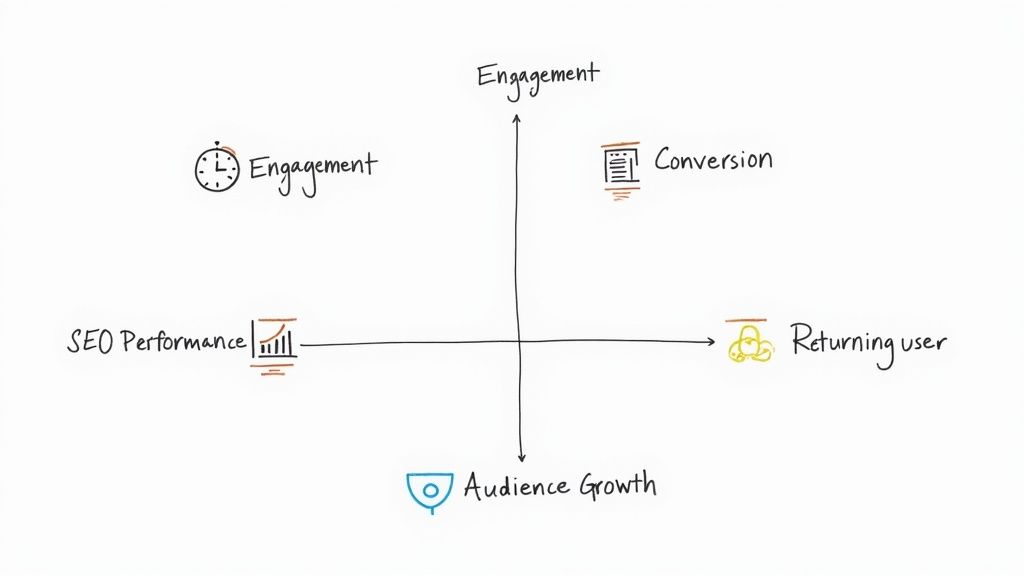
When you're running a data-driven content strategy, it’s incredibly easy to get lost in the numbers. You start chasing "vanity metrics"—things like social media likes or a spike in page views—that feel good but don't actually move the needle on your business goals.
The real game-changer is focusing on the key performance indicators (KPIs) that show a clear line between your content and how your audience behaves. These are the numbers that prove your content is doing its job.
To avoid getting overwhelmed, I always recommend bucketing your metrics into a few key areas. It helps clarify what each number is telling you and how it fits into the larger puzzle of your content's performance.
Engagement Metrics: Is Anyone Actually Listening?
Think of engagement as the first sign of life. These metrics tell you if your content is genuinely connecting with people, moving beyond a simple click to show they’re actually interacting with what you’ve built. When engagement is high, you know you’re on the right track.
A few key engagement KPIs to keep an eye on:
Time on Page: How long are people sticking around? A high average time on page for a blog post or guide is a fantastic signal that you've captured their attention and are giving them what they came for.
Scroll Depth: This one is brutally honest. It shows you how far down the page people are actually scrolling. If most of your visitors bail after seeing just the top 25% of your content, that's a red flag that your intro isn't pulling them in.
Bounce Rate: While not always a villain, a high bounce rate can mean there’s a mismatch between what someone expected to find and what your content delivered, causing them to hit the back button without a second thought.
Conversion Metrics: Show Me The Money
At the end of the day, content has to support the business. Conversion metrics are what connect the dots between someone reading your blog and taking an action that benefits your company. This is how you prove your content isn't just generating traffic—it's generating results.
These are the numbers that your leadership team really cares about:
Lead Quality: A lead is not just a lead. It's crucial to track which content pieces are bringing in marketing qualified leads (MQLs) or even better, sales qualified leads (SQLs). This helps you double down on creating content that attracts people who are ready to buy.
Form Submissions & Downloads: This is a direct measure of your content’s value proposition. When someone gives you their email in exchange for an ebook or a webinar spot, they’re telling you your content was compelling enough to be worth the trade.
Conversion Rate: This is the ultimate proof. It’s the percentage of visitors who complete a goal, like signing up for a trial or making a purchase. It’s one of the clearest indicators of your content’s ROI.
Understanding the full picture requires tracking the right performance indicators. You can dive deeper into identifying the essential digital marketing performance metrics to find what works for your specific strategy.
To make this easier, here's a quick breakdown of how to align your KPIs with your specific marketing goals.
Essential Content Marketing KPIs by Goal
Marketing Goal | Primary KPI | Secondary Metrics | What It Measures |
|---|---|---|---|
Increase Brand Awareness | Organic Traffic & Impressions | Social Media Reach, New Users, Branded Search Volume | Your content's visibility and ability to attract a new audience. |
Drive Audience Engagement | Time on Page & Scroll Depth | Comments, Shares, Bounce Rate | How deeply your audience is interacting and connecting with your content. |
Generate Leads | Conversion Rate (e.g., Form Fills) | Cost Per Lead (CPL), Lead Quality (MQLs/SQLs) | The effectiveness of your content in turning visitors into potential customers. |
Improve SEO Authority | Keyword Rankings | Backlinks Acquired, Domain Authority (DA) | Your content's performance in search engines and its authority in your niche. |
Boost Sales & Revenue | Customer Acquisition Cost (CAC) | Return on Investment (ROI), Sales Conversion Rate | The direct financial impact and profitability of your content marketing efforts. |
By aligning your metrics this way, you ensure that every number you track is tied to a meaningful business outcome, cutting through the noise to focus on what truly drives growth.
SEO Performance: Your Gateway To New Audiences
For most content strategies, organic search is the workhorse that brings in consistent, high-intent traffic. Your SEO metrics tell you how visible your content is on Google and how well it’s attracting people who are actively searching for the answers you provide.
A strong SEO performance isn't about tricking algorithms. It's the natural result of creating content that both search engines and humans genuinely love, building real authority and trust along the way.
The big three to monitor here are keyword rankings for your main topics, the total number of ranking keywords a single piece of content captures, and backlink velocity—the pace at which other credible sites are linking back to you. This data shows your content is gaining authority over time. If you want to get more tactical, you can learn more about how many keywords to target per page in our detailed guide.
How AI Is Supercharging Content Workflows
Artificial Intelligence has officially moved from a far-off concept to a practical partner in the content marketing world. When we talk about AI in a data-driven strategy, we're not just talking about writing articles faster. The real power is in making every single part of your workflow smarter and more precise.
Think of AI as a tireless analyst, one that can sift through massive datasets to find opportunities a human team might easily overlook. This lets marketing teams finally step away from the tedious manual data crunching. Instead of getting lost in spreadsheets for hours, you can use AI to instantly spot patterns in user behavior, find profitable content gaps, and even get a jump on emerging trends before they go mainstream.
From Data Overload to Actionable Insights
One of the biggest hurdles in data-driven content marketing is turning that ocean of information into clear, confident next steps. This is where AI truly shines. It can take thousands of data points from your analytics, CRM, and search console and boil them down into insights you can actually use.
Imagine a tool that doesn't just tell you which blog posts are performing best, but also tells you why. It could pinpoint that a certain conversational tone, a specific article structure, or a recurring theme is what really clicks with your most valuable audience segments.
This depth of analysis helps you:
Find Hidden Patterns: Uncover correlations you'd never spot on your own, like how a particular content format directly impacts conversion rates.
Predict Audience Behavior: Get a data-backed forecast of which topics are about to take off, based on historical performance and current market signals.
Automate Reporting: Generate clean, insightful reports automatically, freeing up your team to focus on creative strategy, not number-crunching.
This isn't just theory; it's happening right now. Over 80% of marketers are already using AI tools in their strategies. And it's paying off— 68% of marketing leaders report seeing a measurable ROI from their AI investments. You can dig deeper into these numbers with these content marketing statistics.
Amplifying Human Creativity, Not Replacing It
There's a common fear that AI is here to take over creative jobs. The reality is far more collaborative. AI works best as a co-pilot, handling the repetitive, analytical tasks that often bog down creative professionals. This frees up marketers to do what humans do best: think strategically, tell compelling stories, and build genuine connections with an audience.
For instance, an AI tool can spit out a hundred different headline ideas in seconds. A writer can then pick the most compelling one and pour their energy into crafting a knockout introduction. The AI handles the grunt work, while the human provides the strategic oversight and creative spark.
Take a look at this example from Typeface.ai, which shows how AI can spin up brand-specific marketing assets from a simple text prompt.
This shows just how much AI can streamline the creative process, turning a simple request into a visually consistent, on-brand asset in moments.
If you're looking to bring this kind of power to your own team, a good guide to the best AI content generators can help you find the right tools for your specific needs.
Personalization at Scale and Real-Time Optimization
Not long ago, delivering a truly personalized experience was a massive undertaking, something only the biggest companies could afford. AI completely changes the game, making it possible to tailor content for individual users in real time, no matter how large your audience is.
AI allows you to treat every visitor like a returning customer. By analyzing their on-site behavior, it can dynamically adjust the content they see, suggesting relevant articles, products, or resources that align with their immediate interests.
This dynamic personalization goes beyond your website. AI can help segment your email lists with incredible accuracy, so every subscriber gets messages that feel like they were written just for them. It can also optimize your ad campaigns on the fly, automatically shifting your budget toward the creative and messaging that are actually driving results.
This creates a continuous optimization loop, powered by AI, that ensures your content workflow is always learning, adapting, and improving.
Building Your Data-Driven Content Strategy
Alright, let's get practical. Moving from theory to action is where data-driven content marketing really starts to pay off. It’s all about building a repeatable system that turns raw insights into valuable content assets. Think of it less as a one-off campaign and more as a continuous cycle of learning, creating, and refining.
Building this content engine isn't random; it requires a clear, step-by-step process. Each stage naturally flows into the next, making sure the content you produce is strategically sound, laser-focused on your audience, and tied to real business results.
Let’s walk through the roadmap.
Start with Clear Business Objectives
Before you even dream of a blog topic or a keyword, stop and ask: why are we creating this content? What do we want people to do after they read, watch, or listen to it? Without this clarity, you're just adding to the noise online.
Your content's mission must be directly linked to your company's bigger goals. Are you trying to generate more qualified leads? Maybe you need to reduce customer churn or even break into a completely new market. Each of these goals requires a very different content playbook.
For instance, a goal to generate 50 marketing qualified leads (MQLs) per quarter demands a different approach than a goal to reduce customer support tickets by 15%. The first might lead you to create bottom-of-funnel comparison guides, while the second would point toward building out in-depth tutorials and help center articles.
Develop Data-Backed Audience Personas
You can't create content that truly connects if you're writing for a faceless crowd. It's time to move beyond vague demographics and build rich, data-backed personas that feel like real people. Who are they? What problems keep them up at night? And what finally motivates them to look for a solution like yours?
To paint a full picture, you need to pull data from a few key places:
Google Analytics: This is your treasure trove for understanding demographics, user interests, and how people actually behave on your site.
CRM Data: Look at your existing customers. What are their common job titles, industries, or company sizes? The patterns are right there.
Customer Surveys: Why guess? Just ask your audience directly about their biggest pain points, how they like to consume content, and where they hang out online.
Sales Team Feedback: Your sales team is on the front lines, hearing objections and tough questions every single day. Their insights are pure gold for understanding what prospects really care about.
This process helps you understand not just who your audience is, but what they need from you at every step of their journey.
Conduct Advanced Topic and Keyword Research
Now that you know your goals and your audience, you can find the exact topics and keywords that bridge the gap between them. This isn't just about chasing keywords with high search volume. It's about uncovering high-opportunity subjects where you can stand out and provide genuine value.
A really effective technique is building topic clusters. This involves creating a main "pillar" page on a broad topic, which is then supported by several "cluster" articles that dive deep into specific subtopics. This structure signals to search engines that you're a true authority on the subject.
As you research, focus on search intent. Is someone just looking for information ("what is..."), comparing their options ("product A vs. product B"), or are they ready to buy ("best price for...")? Your content has to match their intent.
A truly effective keyword strategy focuses on the user's underlying problem. By addressing the 'why' behind a search query, you create content that not only ranks but also builds lasting trust with your audience.
For those ready to level up, mastering the art of finding super-specific, high-intent queries is a game-changer. You can dive into a detailed guide on long-tail keyword research to learn advanced techniques for uncovering these hidden gems.
Perform a Content Audit and Gap Analysis
Good news—you probably don't have to start from an empty page. An audit of your existing content is the perfect way to see what's working, what's fallen flat, and where your biggest opportunities are hiding.
Go through your existing assets and sort them into a few buckets:
Keep and Optimize: These are your winners. Update them with fresh data or new visuals to give them a second life.
Consolidate: Got a few weak articles on the same topic? Combine them into one powerhouse guide.
Retire: Be honest. Some content is just outdated or irrelevant. Pruning it can actually help your brand and your SEO.
At the same time, do a gap analysis by mapping your content to the buyer's journey. You might find you have tons of top-of-funnel awareness posts but almost nothing for people in the consideration stage. That's a critical gap you need to fill.
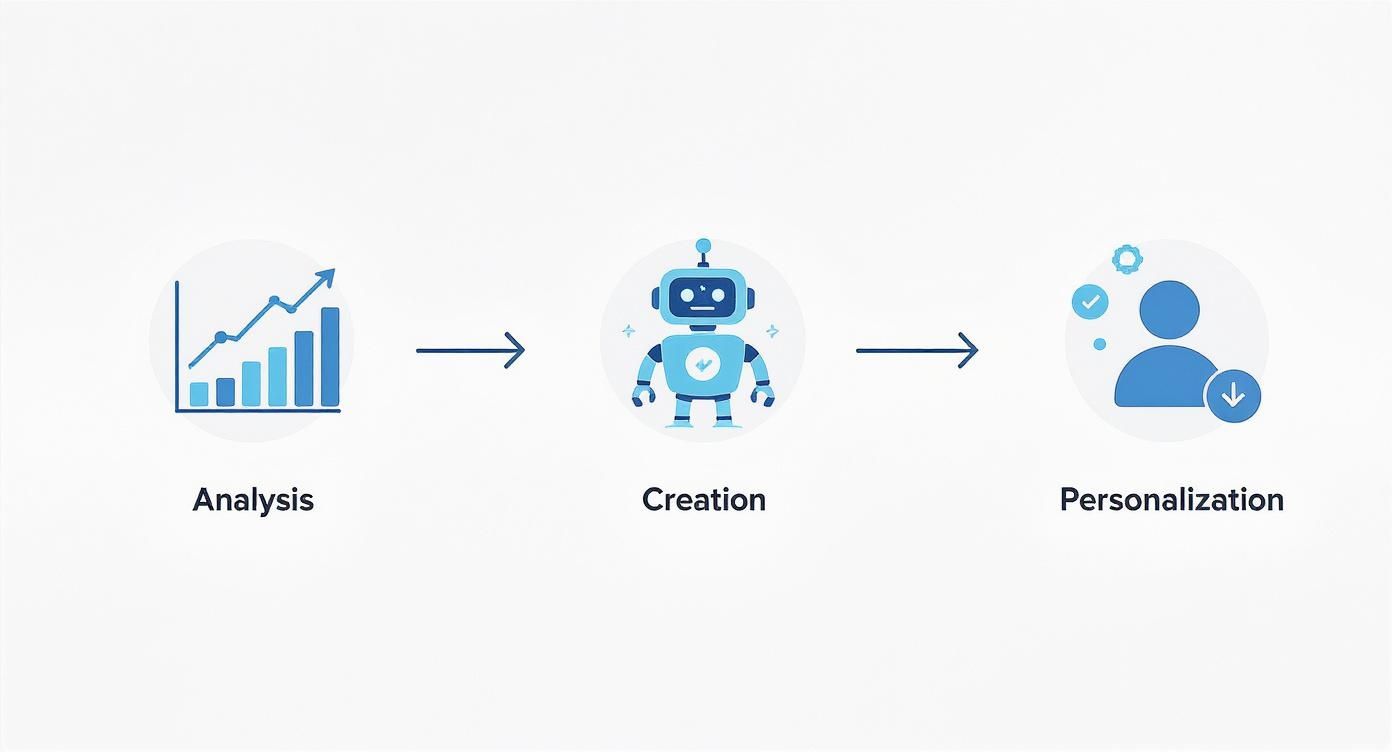
As this visual shows, solid data analysis is the foundation. It informs your content creation, which in turn allows for the kind of hyper-targeted personalization that gets the right message to the right person.
Analyze Performance and Iterate for Growth
Finally, remember that a data-driven strategy is never "done." Publishing your content is just the beginning of the feedback loop. Now it's time to track the KPIs you defined back in step one.
Keep a close eye on engagement, conversion rates, and SEO performance. Look for patterns. Which topics bring in the most leads? Which formats keep people glued to the page? Use these insights to refine your personas, adjust your content calendar, and double down on what’s clearly working.
This continuous cycle—create, measure, learn, and iterate—is the real engine behind sustainable, long-term growth.
Real-World Wins: Data-Driven Content in Action
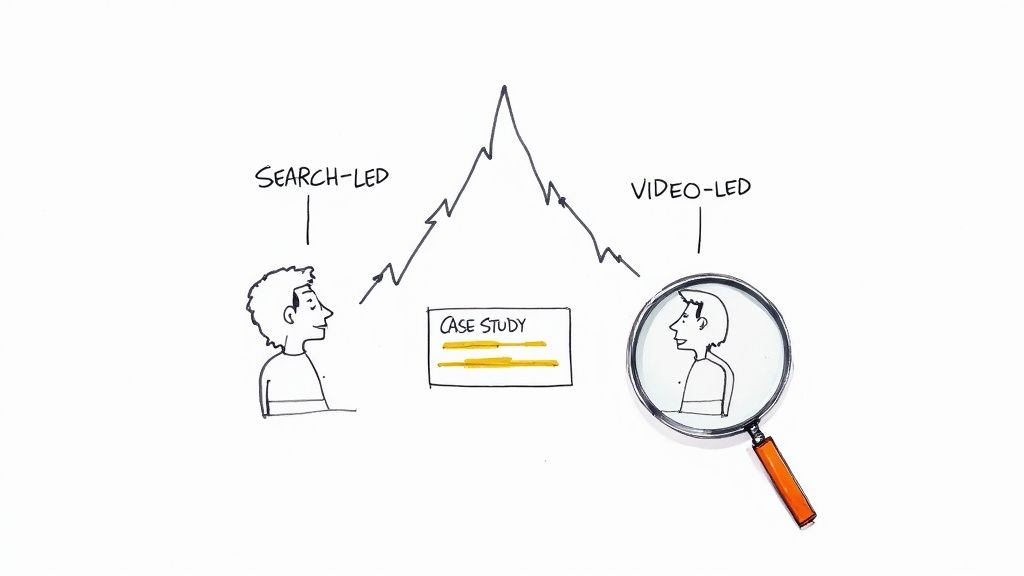
Theory is great, but seeing data-driven content marketing work in the wild is what really makes it all click. When you see how real companies use insights to turn their content from a creative shot in the dark into a reliable engine for growth, you start to understand its true power.
Let's break down how a couple of different businesses turned raw analytics into real-world success. Whether it's a B2B software company or a global online store, the core idea is always the same: listen to the data, then act.
The B2B SaaS Playbook: From Traffic to Qualified Leads
Picture a B2B software company with a common problem: their content was getting traffic, but not the right kind. They were writing good articles, but the leads coming through weren't ready to talk to a salesperson. Instead of just churning out more of the same, they hit pause and dug into their data.
What they found in Google Search Console was eye-opening. While their broad, top-of-funnel posts got plenty of views, the search queries that actually led to demo requests were incredibly specific. People were asking about competitor comparisons, tricky integrations, and niche use cases for their software.
That insight changed everything.
The Data: They zeroed in on search queries with high commercial intent, like "[competitor name] alternative" or "how to connect [their software] with [another tool]."
The Content: Armed with this knowledge, they built a series of deep-dive comparison pages, step-by-step integration guides, and detailed case studies that answered these very specific, bottom-of-funnel questions.
The Outcome: The results were staggering. Overall traffic only ticked up slightly, but marketing qualified leads (MQLs) shot up by over 60% in a single quarter. Better yet, the sales team reported these leads were already sold on the product and were much easier to close.
This is a perfect example of using data to hear what potential customers are asking right before they're ready to pull out their wallets. They stopped shouting at everyone and started having a conversation with the right people.
The E-commerce Playbook: Turning Video Views into Sales
Now, let’s look at an e-commerce brand selling high-end kitchen gadgets. They were pouring money into gorgeous, cinematic videos for their social media, but they had no idea if it was actually moving the needle on sales. The connection was missing until they took a hard look at their video analytics.
After digging into YouTube's audience retention graphs, they spotted a clear pattern. Viewers were constantly re-watching the exact same moments in their videos—the parts where a chef demonstrated a blender’s unique pulse feature or a stand mixer’s dough hook in action.
This little discovery sparked a major strategic shift.
The Data: They used video heatmaps and audience retention metrics to pinpoint the exact moments in their long-form videos that grabbed viewers' attention.
The Content: They chopped these high-engagement moments into short, snappy clips. These "feature highlight" videos were then used in targeted ad campaigns and placed directly on the relevant product pages.
The Outcome: This hyper-focused approach led to a 25% jump in add-to-cart rates for products that featured the clips. Their ad campaigns also saw a huge boost in click-throughs because they were showing people exactly what they’d already proven they wanted to see.
The evidence is all around us. Businesses that consistently blog see 55% more site visitors, and 58% of B2B marketers directly credit their content efforts for revenue growth. If you want to dive deeper, you can explore more about how this works in this statistical breakdown. These stories show that data isn't just for looking backward at performance; it's the key that unlocks what's possible next.
Frequently Asked Questions
Jumping into data-driven content can feel a little overwhelming at first. There are a lot of moving parts, and it’s natural to have questions. We’ve answered some of the most common ones we hear to help you get started on the right foot.
How Can a Small Business Start with a Limited Budget?
You don't need a huge budget or a fancy suite of enterprise software to get started. Honestly, some of the most valuable insights are hiding in plain sight, and you can access them for free.
Here’s where I’d recommend you begin:
Google Analytics: This is your home base. Look at your audience demographics to see who is visiting your site. Check which pages keep people around the longest and where your traffic is coming from. This tells you who you're talking to and what they already find interesting.
Google Search Console: Think of this as a direct line into your audience's mind. It shows you the exact phrases people typed into Google to find you, revealing what they really want to know. It’s an absolute goldmine for content ideas.
Customer Feedback: Just talk to people! Simple surveys, emails, or even a quick chat with your sales or support team can uncover customer pain points and questions. These are the perfect starting points for new content.
By tapping into these free resources, even a one-person shop can start making much smarter content decisions without spending an extra dime.
What Are the Most Common Mistakes to Avoid?
One of the biggest traps is chasing "vanity metrics." It's easy to get excited about a spike in social media likes or page views, but if those numbers don't translate into actual business goals—like generating qualified leads—they don't mean much.
Another classic mistake is collecting mountains of data without any real plan for it. Data is useless if it just sits in a dashboard.
The point isn't to just collect data; it's to use that data to create a better experience for your audience. Beat analysis paralysis by starting with one clear question you want to answer.
Finally, don't forget about qualitative data. The numbers tell you what is happening, but things like customer comments, survey answers, and feedback from your sales team tell you why. The most powerful strategies combine both.
How Long Does It Realistically Take to See Results?
This is the big one, isn't it? The honest answer is, it depends. A data-driven content strategy isn't like running a paid ad where you see traffic the next day. Think of it as building a valuable asset for your business over time.
You'll likely see early indicators—like more organic traffic and higher engagement—within the first 3-6 months. But for the real, bottom-line impact on things like leads and sales, you should plan for a timeline closer to 6-12 months of consistent work. It’s a marathon, not a sprint, but the payoff is worth it.
Ready to stop guessing and start growing? Viral SEO provides the tools you need to analyze content gaps, organize your ideas with real data, and build a content strategy that drives predictable organic growth. Explore Viral SEO and start your free plan today!
Blogs
More Blogs
From keyword goldmines to AI-driven content hacks—expert insights to help your blog posts dominate the first page.