A truly effective content strategy for SaaS is more than just a publishing schedule. It’s a growth engine built on three non-negotiable pillars: a razor-sharp understanding of your customer, product-led storytelling, and decisions backed by real data.
Forget churning out blog posts for the sake of it. We're talking about building a system where your software is the hero of every story you tell.
Building Your SaaS Content Foundation
So many SaaS content plans fall flat because they skip the most important part: the foundation. Too often, teams jump straight into keyword research and content calendars without knowing who they’re really talking to or what unique value they bring to the table.
This leads to content that might tick all the SEO boxes but feels hollow. It fails to connect with the very people who need your solution the most.
Before you even think about a headline, you need a framework. This is the behind-the-scenes work that makes sure your content isn't just more noise on the internet, but a strategic asset that attracts, educates, and converts your best-fit customers. To get started, it’s helpful to see how experts develop a robust SaaS content marketing strategy.
Define Your Ideal Customer Profile
Generic buyer personas won't cut it in SaaS. You need to get way more specific and build an Ideal Customer Profile (ICP). This isn't just a sketch of "Marketing Mary"; it's a detailed picture of the companies and the specific users inside them who get the most from your product and stick around the longest.
Start by digging into your own customer data. Who are your happiest, most successful users? Look for common threads:
Firmographics: Are they 10-person fintech startups or 500-employee healthcare enterprises?
User Roles: Is your champion a marketing manager, a CTO, or a founder? Who holds the budget?
Pain Points: What specific, nagging problems did your software actually solve for them? Go beyond "saves time" and get to the root of the workflow friction they eliminated.
Don't just ask customers about their problems. Ask them what a "magic wand" solution would look like. Their answer is often a goldmine, revealing the exact value proposition you need to hammer home in your content.
Once you’ve got the data, set up a few interviews with these top-tier customers. Ask open-ended questions about their daily grind, their biggest goals, and where they go online for advice. This kind of direct feedback is priceless.
Frame Your Product as the Hero
Product-led storytelling is the heartbeat of SaaS content that actually works. This doesn't mean every article is a hard sell. It means your content naturally shows how your software helps your customer win.
Instead of writing about high-level, abstract concepts, create content that frames your product as the answer to the real problems your ICP is googling at 10 PM. Every feature in your platform solves a problem. Your job is to connect that feature to a tangible benefit and then tie that benefit to a reader's real-world challenge.
To keep these core ideas front and center, I find a simple table helps focus the team's efforts.
Core Pillars of a SaaS Content Strategy
This table breaks down the essential components, their purpose, and the actions required to bring them to life.
Pillar | Objective | Key Activity |
|---|---|---|
ICP Understanding | To identify and deeply understand your most valuable customers. | Analyzing user data and conducting qualitative customer interviews. |
Product-Led Story | To position your software as the essential solution to problems. | Mapping content topics directly to product features and customer success stories. |
Data-Informed Plan | To base decisions on performance metrics, not assumptions. | Setting clear KPIs and regularly reviewing content performance against business goals. |
It's a straightforward way to ensure every piece of content you create is intentional and aligned with your business goals.
Map Content to the Customer Journey
Every article, guide, and video needs a job to do. Mapping your content ideas to the customer journey ensures you're creating a cohesive experience that guides people from "What is this?" to "I need this."
This means you stop thinking about just one keyword per page. Instead, think about the whole cluster of questions a person has at each stage of their buying process. Truly understanding how many keywords per page to target is about creating comprehensive resources that answer multiple related queries, which is exactly what a journey-aware strategy does.
With this approach, your blog stops being a random collection of posts and becomes a powerful, strategic funnel. Each piece of content is a deliberate step in a larger conversation, building trust and proving your value every step of the way.
Mapping Content to the SaaS Buyer Journey
A smart content strategy for SaaS is more than just publishing articles and hoping for the best. It’s about creating a deliberate path that guides someone from a vague "I have a problem" moment all the way to becoming a loyal fan of your product. Think of it as creating a series of signposts, with each piece of content perfectly placed to help them take the next step.
This is what that journey looks like in practice—it starts with understanding who you're talking to, positions your product as the solution, and uses data to keep getting better.
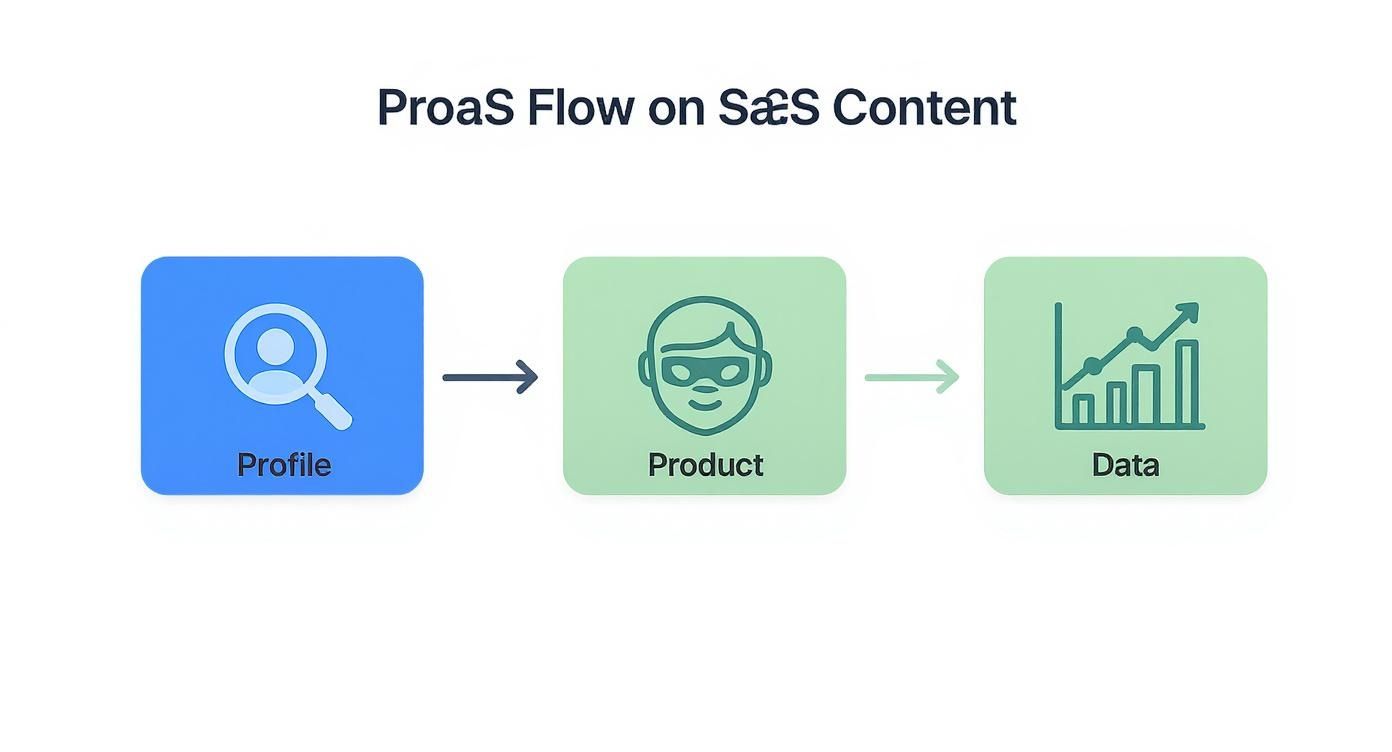
The real magic happens when you realize it’s a feedback loop: You start with the user's needs, frame your product as the hero that meets those needs, and then use data to sharpen your approach over time.
But simply having a strategy on paper isn't enough. While 96% of tech marketers say they have a content strategy, a shockingly low 29% feel it’s actually working well. That massive gap shows just how critical it is to build your content around the real-world customer journey.
Awareness: The Problem-Discovery Phase
Early on, your ideal customer isn't searching for your brand. They might not even know a tool like yours exists. They're just acutely aware of a problem and are turning to Google for answers. Your job here is to be the most helpful, insightful voice they find.
This is the time to cast a wide net with high-value educational content. Forget about your features for a moment and focus entirely on their pain points. What questions are keeping them up at night? Your content should answer those directly.
The best formats for this stage are all about education:
Problem-focused blog posts that dig into specific challenges or offer "how-to" guidance.
Data-rich reports or industry studies that position your brand as a credible authority.
Introductory guides and checklists that provide quick, actionable wins.
Your keyword strategy here should be laser-focused on informational queries, usually phrased as questions. This is where mastering long-tail keyword research gives you a serious edge, allowing you to connect with people who have a very specific, high-intent problem.
Consideration: Building Trust and Showcasing Value
Once someone can name their problem, their search changes. They've moved into the Consideration stage, where they're actively researching and comparing different ways to solve it. Now, your content needs to shift from simply educating them on the problem to showing them why your approach is the best one.
You can start talking about your product now, but the key is to do it in a way that continues to build trust. Ditch the hard sell. Instead, demonstrate your product's value in a helpful, almost non-promotional context.
Great content for the consideration stage includes:
In-depth comparison guides that honestly review your product alongside competitors.
Feature-focused tutorials and videos that show—not just tell—how your tool solves a frustrating pain point.
Live webinars or on-demand demos that give prospects a firsthand look at the value they can get.
A real-world example? A project management tool could create a guide comparing Agile vs. Scrum methodologies, subtly weaving in screenshots of how its features support both workflows flawlessly.
Decision: Sealing the Deal with Social Proof
By the time a prospect reaches the Decision stage, they're on the one-yard line. They've narrowed their options down to a shortlist (hopefully including you!) and are looking for that final nudge of confidence to make a purchase.
This is where social proof isn't just nice to have; it's essential. Generic lists of benefits fall flat. You need to tell a story of transformation, painting a vivid picture of what their own success will look like after they sign up.
The most powerful decision-stage content makes the prospect the hero of the story. It shows them someone just like them who overcame a familiar challenge using your product, making the potential for success feel tangible and achievable.
Content that closes deals is all about proof:
Detailed Case Studies: Go beyond surface-level results. Walk the reader through the customer's initial problem, the specific solution you implemented, and the hard, quantifiable numbers that prove it worked.
Customer Testimonials: Authentic video clips and direct quotes build an emotional connection that a features list never can.
Clear Pricing and ROI Calculators: Be transparent. Remove any final hesitation by making the financial value of your solution crystal clear.
Retention: Turning Customers into Advocates
The journey isn't over when the credit card is charged. In SaaS, the Retention stage is where profitability truly happens. Your content goal shifts from acquisition to success—helping your customers get so much value from your product that they can't imagine their workflow without it.
This is all about user enablement. The content you create should help them master advanced features, integrate your tool more deeply into their tech stack, and become true power users.
Focus your efforts here on:
Advanced "how-to" guides designed for seasoned users.
Product update announcements that clearly explain the value of new features.
A robust knowledge base or help center that empowers users to find their own answers quickly.
By mapping your content to these distinct stages, you create a cohesive experience that meets customers exactly where they are. You build trust and momentum with every interaction, turning what could be a simple blog into a powerful engine for SaaS growth.
Choosing High-Impact Content Channels and Formats
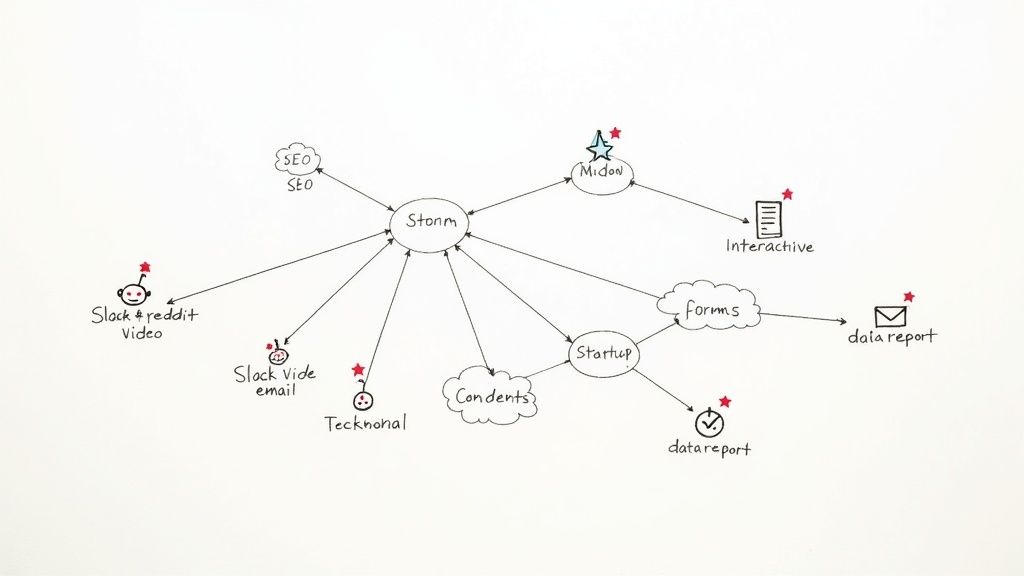
Here's a hard truth about SaaS content strategy: creating brilliant content is only half the battle. Distribution is everything. The old "if you build it, they will come" mindset is a surefire way to have your hard work gather digital dust.
You have to be deliberate about getting your content in front of the right eyeballs. That means meeting your Ideal Customer Profile (ICP) exactly where they already are—whether that's deep in a subreddit, a niche Slack community, or searching Google for answers.
Success comes from making smart, targeted bets, not from trying to be everywhere at once. Depth on a few key channels will always beat a shallow presence across dozens.
Prioritize Your Distribution Channels
Before you write a single word, you need a clear idea of how you'll promote it. The channel really dictates the format, tone, and even the topic you choose. For an early-stage SaaS, it’s all about finding the one or two channels that offer the highest leverage for your specific audience and resources.
This kind of precision is what separates the high-growth companies from everyone else. The top SaaS brands focus on quality over quantity, tailoring their content distribution to high-value channels that align perfectly with their ICP. To get a better sense of where things are headed, you can explore more insights on the evolution of content marketing strategies.
Let’s break down the most common channels for SaaS companies:
Search Engine Optimization (SEO): This is the ultimate long-term play. Think of it as building a durable asset that attracts high-intent prospects for months, or even years. The downside? It’s slow to start and wildly competitive.
Niche Online Communities: These are goldmines. I'm talking about Reddit (like r/sysadmin for an IT tool), industry-specific forums, or private Slack groups. They're amazing for direct feedback and building real relationships, but you have to genuinely participate—no link-dropping allowed.
Social Media Platforms: LinkedIn is a powerhouse for B2B SaaS, perfect for sharing case studies and thought leadership. Twitter (X) is fantastic for quick insights and jumping into conversations with industry influencers. The key is creating content native to the platform, not just spamming blog post links.
Email Marketing: Your email list is a channel you own completely. Use it to nurture leads with exclusive content, share product updates that add value, and drive traffic back to your most important pieces.
When you're just starting, pick one primary channel to master (like SEO) and one secondary channel for quick wins and community building (like a specific subreddit). Trying to do everything ensures you'll be great at nothing.
Match the Format to the Channel
Once you've zeroed in on your channels, the next step is choosing the content formats that will actually perform on them. A long-form blog post that’s perfect for SEO will fall completely flat as a LinkedIn update. The goal is to create something that feels natural and valuable within the context of each platform.
This isn’t about creating brand new content for every single channel. It's about intelligently remixing and repurposing your core ideas into different formats.
Channel and Format Pairing Examples
Channel | Primary Content Format | Why It Works |
|---|---|---|
Blog (SEO) | In-depth Guides & Tutorials | Captures high-intent search traffic from users actively looking for solutions. |
Short-form Videos & Text Posts | Designed for quick consumption during a work break, encouraging engagement and shares. | |
Niche Reddit Community | Text-based AMA (Ask Me Anything) | Builds credibility and trust by offering direct, unfiltered value to a knowledgeable audience. |
YouTube | Product Walkthroughs & How-To's | Visual learners can see the product in action, answering practical questions effectively. |
Let's say you write a comprehensive guide on "How to Automate Customer Onboarding" for your blog. That one piece can be repurposed into a dozen different assets. You could film a short video tutorial for YouTube, write a text-based post with key takeaways for LinkedIn, and design a shareable checklist for your email subscribers.
This approach maximizes the reach of your core ideas without tripling your workload. It ensures every piece of content is perfectly suited to the platform where it lives, turning your content strategy for SaaS from a theoretical plan into a practical growth engine.
Creating and Optimizing for Mobile-First Audiences

Let's be real. Your potential customer isn't sitting at a desk, carefully dissecting every word you've written. They're scrolling on their phone while waiting for coffee, in the five minutes between meetings, or during their commute. A desktop-first mindset is a relic of the past.
The shift to mobile isn't just a trend anymore; it's the reality for most users. If you're not building your content for them, you're actively choosing to give a bad experience to the majority of your audience. Any solid content strategy for SaaS has to be built from the ground up with the small screen in mind.
This is about more than just having a responsive website. Mobile-first thinking means completely rethinking how you structure and present information. It’s all about clarity, speed, and getting to the point for someone who has very little time and even less attention to spare.
Design for Scanners, Not Readers
On a phone, people don't read; they scan. They're hunting for answers, and your content’s structure has to make that hunt as easy as possible. Long, dense paragraphs are a mobile user’s worst nightmare.
Think of it as creating visual signposts. As someone scrolls, their eyes need places to land to quickly understand the gist of your article. This is where your formatting choices become a massive strategic advantage.
Embrace white space: Short paragraphs with plenty of space between them feel less intimidating and much easier to get through.
Use bold text: Make your key takeaways, stats, or important terms pop. This helps a scanner pull out the most important bits instantly.
Lean on lists: Bullet points are perfect for breaking down complex ideas into simple, digestible nuggets that work beautifully on a small screen.
With this approach, even someone who only skims your article for 30 seconds can walk away with a clear sense of its value. That’s how you capture attention in a world full of distractions.
The golden rule of mobile content is simple: assume your reader is in a hurry. Structure everything to deliver the core message as fast as possible, rewarding their limited attention with immediate value.
Make Performance and Page Speed a Priority
Mobile users have zero patience. A slow-loading page is the fastest way to lose someone forever. A delay of just a few seconds is often the difference between a new lead and a bounced visitor who will never come back.
Optimizing for speed isn't a "nice-to-have"; it's a critical part of your mobile-first strategy. This involves a few technical must-dos that dramatically affect the user experience.
Compress your images: Huge image files are the number one cause of slow load times. Use a tool to shrink them down without making them look terrible.
Keep page elements simple: Avoid heavy scripts, annoying pop-ups, and complex designs that can slow a mobile browser to a crawl.
Invest in a fast host: Your server is the foundation of your site's speed. This is not the place to cut corners.
The data backs this up. It's predicted that by 2025, a massive 72.6% of internet users will only use their smartphones to get online. That number should be a wake-up call. Failing to optimize for mobile means you're on track to alienate the vast majority of your future audience. You can dig deeper into the SaaS industry statistics and trends that are driving these changes. Every millisecond you shave off your load time is a direct investment in capturing this huge, mobile-only customer base.
Measuring Success and Proving Content ROI
https://www.youtube.com/embed/YISkNF1y384
Let's be honest: content marketing isn't an art project. It's a business driver. To keep your budget and earn respect from the C-suite, you have to speak their language, and that language is results.
Page views and social shares might give you a warm fuzzy feeling, but they don’t keep the lights on. The true test of a successful content strategy for SaaS is its direct, measurable impact on revenue.
This requires a fundamental shift in thinking. Stop chasing traffic volume and start focusing on traffic value. Are your blog posts actually leading to trial sign-ups? Do your whitepapers influence demo requests? That’s the data that matters.
Moving Beyond Vanity Metrics
The first thing you need to do is track the right Key Performance Indicators (KPIs). For any SaaS business, these are almost always tied to getting people to use the product and filling the sales pipeline. It’s time to stop reporting on impressions and start obsessing over the metrics that prove a prospect is getting closer to pulling out their credit card.
Your entire measurement framework should be built around bottom-of-the-funnel actions. These are the conversions that have a straight line to business growth.
Trial Sign-Ups: This is the clearest possible link between a piece of content and a user wanting to evaluate your product.
Demo Requests: This signals high intent. The reader is so interested they want a guided tour of your solution.
Content-Influenced Pipeline: This helps you track how many sales opportunities touched your content before becoming a qualified lead.
Customer Lifetime Value (CLV): Are customers who read your content stickier and more valuable over the long haul? This metric tells you.
When you focus on these numbers, you change the entire conversation. It’s no longer, "how many people saw our content?" Instead, it becomes, "how much revenue did our content generate?" This single change turns your team from a cost center into a documented growth engine.
Building a Simple Attribution Model
Attribution—the science of connecting a specific blog post to a specific conversion—can feel overwhelmingly complex. But it doesn't have to be.
You can get started with a simple model using tools you almost certainly already have, like Google Analytics. The immediate goal is just to see which content is assisting in conversions.
Set up goals in your analytics platform for those key actions, like a trial sign-up or a demo form submission. Then, start digging into the user paths. You'll quickly discover that prospects rarely convert on their first visit. They might read a top-of-funnel blog post, leave, and come back a week later to read a case study before finally signing up.
Your content rarely works in a vacuum. That educational blog post might not get the final click, but it plays a crucial role in building the trust and awareness that leads to a sale down the line. You have to acknowledge the entire journey.
A "first-touch" or "last-touch" attribution model is a fantastic starting point. First-touch gives all the credit to the very first piece of content a user saw, while last-touch gives it to the final piece they interacted with before converting. They aren't perfect, but they give you a clear, easy-to-understand way to start showing your content's value.
Key Metrics to Track and Report
When you present your results to stakeholders, keep it simple. Nobody wants to see a spreadsheet with 50 columns. Focus on a handful of high-impact metrics that tell a compelling story about how content is driving the business forward.
Here’s a simple way to think about what to track at each stage:
Stage | Primary Metric | What It Tells You |
|---|---|---|
Top-of-Funnel (ToFu) | New Organic Users | How effective your SEO is at bringing in a relevant new audience. |
Middle-of-Funnel (MoFu) | Newsletter Sign-Ups | How many casual visitors are willing to build a deeper relationship. |
Bottom-of-Funnel (BoFu) | Conversion Rate | The percentage of your readers who take a high-value action. |
Alongside these, you need to keep an eye on your website's overall authority, which is critical for long-term SEO success. If this is a new concept, it’s worth taking the time to learn how to find Domain Authority, as it's a powerful predictor of your content's ability to rank.
By tying your content efforts directly to tangible business outcomes, you build an undeniable case for continued investment. For a deeper look into connecting your work to the bottom line, check out some guides on how to measure marketing ROI. This data-driven approach is the bedrock of any content program that earns respect and a bigger budget.
Common SaaS Content Strategy Questions
Even the best-laid content plans run into a few common roadblocks. You start executing and suddenly, the practical questions start piling up. It's easy to get bogged down in the details.
Let's walk through some of the most frequent questions I hear from SaaS marketers in the trenches. These are the kinds of things that come up in Slack channels and marketing huddles, and getting them right can make all the difference.
How Often Should I Be Publishing New Content?
The honest answer? It depends. I know that's not what you want to hear, but it's the truth. Consistency beats frequency, every single time.
Pushing out one deeply researched, incredibly helpful article every week is far more valuable than publishing three thin, forgettable posts just to hit a quota. For most SaaS companies just getting started, a great target to aim for is one to two major content pieces per week.
Think about creating cornerstone content—those big, comprehensive guides—and then slicing them up into smaller pieces for other channels. This strategy lets you get the most mileage out of your hard work, giving you a ready supply of material for social media, email newsletters, and community discussions.
Should I Gate My Content?
Putting content behind a lead-gen form can be a powerful move, but you have to be strategic about it. Over-gating is a surefire way to kill your traffic and annoy potential customers. A solid rule of thumb I've always followed is to only gate content that feels like a tool or offers a massive shortcut.
Leave it open (Ungated): Blog posts, how-to tutorials, and general guides. The goal here is to cast a wide net, build trust, and become a go-to resource. Keep these free.
Put it behind a gate: High-value assets that you've poured significant resources into. Think original research reports, proprietary industry data, in-depth ebooks, or interactive templates.
Never gate something that answers a simple question someone could easily find on another site. Gating is for your truly unique, high-effort content—the kind of stuff that’s so valuable, someone is more than happy to give you their email to get it.
SEO or Social Media? Which One Matters More?
This isn't really an "either/or" situation. It’s more of a "what's right for us right now?" question.
For long-term, compounding growth, SEO is the undisputed king for SaaS. It’s how you build a durable asset that brings in high-intent prospects month after month, year after year.
But in the early days, social media and community building can give you that immediate feedback loop and drive your first wave of traffic. Here’s a balanced approach: Put 80% of your energy into the long-term SEO play (writing great blog content, building out pillar pages) and the other 20% into a short-term channel like LinkedIn or a niche community on Reddit or Slack.
Use that short-term channel to test out ideas, connect with your audience, and push those first visitors toward your bigger SEO pieces.
How Long Until I Actually See Results from This?
Content marketing is a long game, so patience is key. For a brand new SaaS blog with a low domain authority, you’re likely looking at 6 to 12 months before you start seeing meaningful, steady organic traffic. I know that can feel like an eternity.
The key is to not get discouraged in those early months. Instead, focus on the leading indicators that show you're on the right track:
Are your keyword rankings improving? Moving from page 10 to page 3 of Google is a huge win.
Are people signing up for your newsletter? This shows your content is resonating.
Is your content starting conversations? Getting shared and discussed on social or in communities is a great sign.
Tracking these small wins will help you prove that the strategy is working long before those big traffic and conversion numbers start lighting up your dashboard.
Ready to stop guessing and start building a data-driven content strategy? Viral SEO provides the tools you need to analyze competitors, find high-impact content gaps, and optimize your pages for predictable organic growth. Start making smarter content decisions today. Find out more at getviralseo.com.
Blogs
More Blogs
From keyword goldmines to AI-driven content hacks—expert insights to help your blog posts dominate the first page.