So, what exactly is content marketing ROI?
In simple terms, it’s the revenue you earn from your content measured against what you spent to create and share it. Think of it as the ultimate report card for your marketing—it cuts through the creative fluff and gives you a clear financial outcome that your boss or CEO can actually get behind.
Why Measuring Content Marketing ROI Matters
Let's be real. Your team can produce brilliant blog posts, killer videos, and social campaigns that get tons of buzz. The views are climbing, and the comments are glowing. But then the C-suite asks, "What are we actually getting for all this money?" Too often, the answer is a jumble of vanity metrics and fuzzy assurances.
This is where knowing your ROI changes everything.
Calculating your return isn't just a chore for the finance department; it’s the language that proves your team's creative work is directly tied to business goals. It’s the bridge that connects that amazing article you published to a brand-new paying customer. Without it, you’re basically flying blind, struggling to justify your budget or make smart decisions for the next campaign.
From Vague Metrics to Clear Value
It's time to move past surface-level numbers like "likes" or "page views." Sure, those metrics show that people are paying attention, but they don't tell the whole story. A truly successful content strategy has to show how it's impacting the company's bottom line.
When you start focusing on ROI, you can:
Justify Marketing Spend: You can walk into a budget meeting and confidently show that every dollar you're asking for is an investment that drives revenue, not just another line item on the expense sheet.
Optimize Your Strategy: Find out which content formats, topics, and channels are actually making you money. This lets you stop guessing and start doubling down on what truly works.
Secure Stakeholder Buy-In: Nothing gets support for new projects faster than presenting clear financial proof of your team's value.
Connect Content to Business Goals: You can finally draw a straight line from your marketing activities to critical goals like generating qualified leads and boosting overall revenue.
The real point of measuring content marketing ROI is to turn your content from a creative experiment into a predictable engine for growth. It’s about proving that every dollar you spend is actively helping the company succeed.
The Foundation of Strategic Content
Think of ROI as your strategic compass. It guides every single decision you make, from the topics you write about to the platforms you use to share your work. It helps you answer the tough questions, like, "Should we pour more money into video, or is our SEO blog the real workhorse?" With a clear picture of your returns, the answer comes from solid data, not a gut feeling.
Getting this calculation right is all about understanding what a "return" and an "investment" truly mean in the world of marketing today. The basic formula might look simple, but the real magic is in accurately tracking your costs and tying revenue back to specific pieces of content. This guide will walk you through it, so you can confidently prove your content's worth and turn your marketing team into a recognized profit center.
The Complete Formula for Calculating ROI
Figuring out the ROI of your content marketing can feel a bit like trying to nail Jell-O to a wall, but the core formula is surprisingly simple. At the end of the day, you’re just comparing what you gained against what you spent.
The classic formula looks like this:
((Return - Investment) / Investment) x 100 = Content Marketing ROI %
Let's make that real. Say you put $5,000 into a campaign that brought in $20,000 in new business. The calculation would be: (($20,000 - $5,000) / $5,000) x 100 = 300% ROI. What does that mean? For every dollar you invested, you got that dollar back plus three more. Simple, right?
The real trick isn't the math; it’s being brutally honest about what you count as a "return" and an "investment."
This is where your creative work—the blogs, videos, and guides—translates into the hard numbers your leadership team actually cares about.
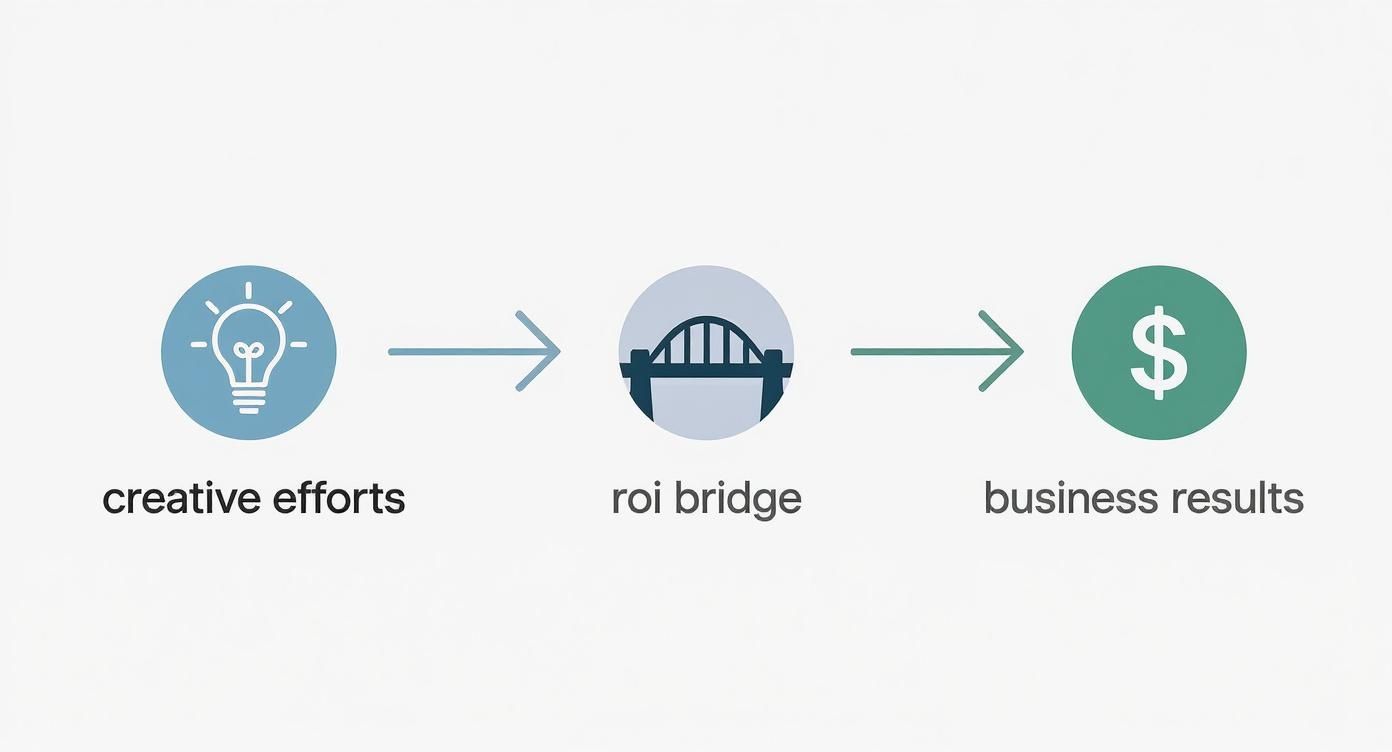
As you can see, ROI is the bridge connecting your team's effort to tangible business results.
H3: Cataloging Your Total Investment
First things first: you have to know exactly what you spent. An accurate ROI calculation demands you track every single cost, not just the obvious ones. Your total investment is the sum of all resources that went into creating, publishing, and promoting your content.
This includes things like:
Content Creation Costs: This isn't just about paying a freelance writer. It includes fees for designers, videographers, and even the prorated salaries of your in-house team members who touched the project.
Software and Tools: Don't overlook your tech stack. That means subscriptions for SEO tools like Ahrefs or Semrush, project management platforms, analytics software, and anything else that helps get the job done.
Ad Spend: If you put money behind your content with social media ads, search ads, or sponsored placements, that all goes into the investment bucket.
Add it all up. This total is the "I" in your ROI formula.
H3: Quantifying Your Total Return
This is where most marketers trip up. Your "return" is rarely just a single, clean sales number. A smart calculation looks at both the direct revenue your content generated and the financial value of all the other good stuff it produced along the way.
To truly understand your impact, your content marketing ROI calculation must account for both direct revenue and the long-term financial benefits that come from things like increased organic traffic and high-quality lead generation.
Here's how to think about the different pieces of your return:
Direct Sales from Content: This is the low-hanging fruit. By using UTM parameters and your CRM, you can easily trace which blog posts or downloads led straight to a sale.
Value of New Leads: Not every piece of content is designed to close a deal on the spot. To assign a dollar value to the leads it generated, you can use a simple formula: (Total Leads x Lead-to-Customer Rate x Average Customer Lifetime Value). This gives you a clear picture of the future revenue you've created.
Value of Organic Traffic: What would you have paid for that same traffic if you'd used paid ads? You can get a solid estimate by multiplying your organic traffic by your average cost-per-click (CPC) from a platform like Google Ads. This shows you how much money your SEO-driven content is saving the company.
If you want to go even deeper into these calculations, check out this excellent guide on how to effectively measure content marketing ROI.
To help you get started, here's a table breaking down the different variables you need to track for an accurate calculation.
Breaking Down Content Marketing Costs and Returns
Component | What to Include | Example |
|---|---|---|
INVESTMENT: | ||
Content Creation | Fees for freelancers, salaries for in-house staff (prorated), design costs. | $1,000 for a freelance writer, $250 for custom graphics. |
Tools & Software | Monthly/annual subscriptions for SEO, analytics, project management, etc. | $99/mo for an SEO tool, $49/mo for a social media scheduler. |
Promotion & Ads | Budget for paid social ads, PPC campaigns, sponsored content. | $500 for a LinkedIn ad campaign to promote an ebook. |
RETURN: | ||
Direct Revenue | Sales directly attributed to a piece of content via tracking links. | A customer clicks "buy" from a link in your blog post. |
Value of Leads | Potential revenue from new leads generated. | (100 leads x 10% conversion rate x $1,500 LTV) = $15,000. |
SEO Value | The "avoided cost" of what organic traffic would have cost via paid ads. | 1,000 organic visitors x $2.50 CPC = $2,500 in saved ad spend. |
Getting these numbers right is the most critical step. Once you have them, the rest is just simple math.
H3: A Practical Calculation Example
Let's walk through a scenario. Imagine a B2B SaaS company publishes a deep-dive guide to solve a major pain point for its target audience.
The Investment:
Freelance Writer Fee: $1,500
Custom Graphics: $500
Ad Spend (LinkedIn Promotion): $1,000
Team Time (Editing & Management): $500 (estimated from salary)
Total Investment = $3,500
The Return (over three months):
Direct Sales: The guide led directly to 5 new customers, each with a lifetime value of $2,000. (Total: $10,000)
Lead Value: It also captured 50 qualified leads. If their historical lead-to-customer rate is 10%, that's 5 more potential customers. (Potential Value: $10,000)
Total Return = $20,000
Now, let's plug those numbers back into our formula:
( ($20,000 - $3,500) / $3,500 ) x 100 = 471% ROI
That 471% tells a powerful story. For every dollar the company spent on this guide, they got back nearly five. This isn't just a hypothetical win; it's right in line with industry performance. A solid content strategy can absolutely deliver these kinds of numbers, turning what feels like a creative expense into a predictable and highly profitable engine for growth.
Identifying Key Metrics That Truly Matter
To calculate your content marketing ROI, you first need to know what to measure. And I'm not talking about page views and likes. Chasing these "vanity metrics" feels great—the numbers go up!—but they can easily hide a strategy that isn’t actually bringing in any business. It’s like being busy without being productive.
To get a real sense of your performance, you have to focus on the Key Performance Indicators (KPIs) that tie directly back to your business goals. Think of it as a customer's journey, with your metrics telling the story of how they move from a curious stranger to a paying customer.

We can break this story down into four key stages, each with its own set of metrics that tell you what’s really going on.
Consumption Metrics: What People See
This is the very top of your funnel. It's all about initial interest. These numbers tell you if your content is even reaching people and grabbing their attention for a split second. They’re the first sign that your topics and distribution channels are working.
Key consumption metrics include:
Page Views: The total number of times a page was loaded.
Unique Visitors: How many individual people came to your site.
Video Plays: The number of times someone hit "play" on your video.
Downloads: The count of people who grabbed a resource like a PDF or case study.
But these numbers are just the start. A ton of page views don’t mean much if your bounce rate is through the roof. That just means people clicked and immediately left. That's why you have to dig deeper. Understanding social media performance metrics is also a big piece of the puzzle here, as social is often that very first touchpoint.
Engagement Metrics: How People Interact
Okay, so someone saw your content. The next big question is: did they care? Engagement metrics tell you if your content actually connected with your audience. High engagement is a fantastic signal of quality content that's hitting the mark.
Look for these signs of genuine interaction:
Time on Page: A longer visit suggests people are actually reading, not just skimming and leaving.
Comments and Shares: These are direct proof that your content started a conversation or was valuable enough for someone to pass along.
Backlinks: When another website links to your content, it’s a huge vote of confidence. It shows they see you as an authority. If you're curious about this, you can learn more about how to find domain authority for your site and see how you stack up.
Strong engagement is the bridge between attracting an audience and converting them into leads. It proves your content isn't just being seen—it's being valued.
Lead Generation Metrics: Who Shows Intent
This is where your content marketing ROI starts to feel real. Lead generation metrics track the exact moment a passive reader decides to become an active prospect. At this stage, you can finally start putting a dollar value on your content’s performance.
The essential lead generation metrics are:
Form Submissions: How many people filled out a contact form or requested a demo?
New Email Subscribers: The number of people who trusted you with their email address.
Marketing Qualified Leads (MQLs): These are the leads that match your ideal customer profile and are ready to be handed off to the sales team.
Every MQL has a potential value. When you can track how many MQLs a single blog post generated, you’re drawing a straight line from that content to potential revenue.
Revenue Metrics: What Actually Made Money
At the end of the day, the numbers that matter most are the ones tied to the bottom line. This is what your boss or your board really cares about, because it represents the "return" in your ROI calculation. It's the ultimate proof that your content strategy is a profit center, not just a cost center.
Keep a close eye on these financial outcomes:
Sales Attributed to Content: With the right tools, you can pinpoint which customers made a purchase after reading a specific article or downloading a guide.
Conversion Rate: The percentage of visitors who take that final desired action, whether it's buying a product or starting a free trial.
Customer Lifetime Value (CLV): Analyzing the CLV of customers who came from content marketing can show incredible long-term value, proving it’s not just about one-off sales.
By connecting the dots between these four categories, you build a complete story—from the first glance to the final sale. This framework turns abstract data into a clear narrative about financial impact, giving you the confidence to prove and improve your content marketing ROI.
Measuring Success Across Different Channels
Calculating your content marketing ROI isn't a simple, one-size-fits-all equation. How you measure the impact of a viral TikTok video is worlds away from how you'd track a deep-dive, SEO-focused blog post. While a single formula can give you a baseline, the real magic happens when you tailor your approach to the specific channels you’re using.
Think of yourself as a carpenter with a full toolbox. You wouldn't use a hammer for a job that needs a precision saw. In the same way, you need a different set of metrics and methods for social media, email, and organic search to get a true picture of what’s working.
This channel-specific view helps you see beyond a blended, and often misleading, average ROI. It’s how you pinpoint which parts of your strategy are driving real revenue and which ones might be due for a tune-up.
Measuring SEO and Blog Content ROI
For most businesses, SEO is the long-game powerhouse of content marketing. The whole point is to attract people who are actively searching for the exact solutions you offer. Success here isn’t just about getting more traffic—it’s about getting the right traffic that turns into customers.
To really nail down the return, you need to look at a few key things:
Value of Organic Traffic: What would you have paid for that same traffic? A great way to quantify this is to multiply your organic visitor count by the average cost-per-click (CPC) for your main keywords. This "avoided cost" is a very real, tangible return on your investment.
Keyword Ranking Improvements: Keep an eye on how your content climbs the search results for your most important keywords. Moving from page two to the top three spots on page one directly translates into more clicks and more potential business.
Organic Lead Generation: Dive into your analytics. How many people arriving from a Google search actually filled out a form, started a trial, or bought something? This connects your SEO work directly to leads and revenue.
For local businesses, the connection is often even more immediate. A single well-optimized blog post can lead directly to more phone calls and people walking through the door. Make sure you're set up for success by following our local SEO checklist.
Gauging ROI from Social Media
Social media ROI can feel a bit fuzzy. It's often a mix of building your brand and driving immediate action, and it’s easy to get lost in vanity metrics like likes and follower counts. The key is to connect all that social activity back to actual business results.
Here’s where to start:
Referral Traffic and Conversions: Get comfortable with UTM parameters. By adding them to every link you share on social media, you can see exactly how many website visitors, leads, and sales came from LinkedIn, Instagram, or X. No more guessing.
Influencer-Driven Sales: If you're working with influencers, give them unique discount codes or custom affiliate links. This creates a crystal-clear trail, showing you the exact revenue each collaboration generated.
Value of User-Generated Content (UGC): Authentic content from your customers is marketing gold. While it's tougher to assign a hard number, you can track how UGC campaigns boost brand mentions or lift conversion rates on product pages where you feature it.
Social media's true ROI is often a mix of direct sales and long-term brand equity. While direct attribution is key, don't discount the value of building a community that trusts and advocates for your brand.
Unpacking Email Marketing ROI
Email marketing consistently wins the award for the highest ROI, and for good reason. You’re talking directly to a warm audience that has already asked to hear from you. Because of this direct line of communication, tracking its financial impact is much more straightforward.
It's no secret that email is the undisputed champ. The data consistently shows an incredible average return of $42 for every $1 spent. To put that in perspective, that’s significantly higher than other powerful channels like SEO, which brings in $22.24 for every dollar invested. You can dig into more of these marketing ROI stats over at Firework.
To measure your email ROI with precision, focus on these areas:
Campaign-Specific Conversions: Go beyond open and click rates. Track how many subscribers clicked a link in a specific promotional email and went on to complete a purchase.
Nurture Sequence Performance: Look at your automated welcome series or abandoned cart sequences. What’s the conversion rate for leads that enter these flows? This tells you how well you're automatically turning prospects into customers.
Audience Segmentation Value: Compare how different segments of your list perform. You might discover that a small group of super-engaged customers is driving the majority of your revenue, which is a powerful insight for future campaigns.
Proven Strategies to Boost Your Content ROI
Alright, so you know your numbers. That's the first step. But the real goal is to make them grow, right? The good news is that improving your content marketing ROI isn't about tearing everything down and starting over. It’s about making smarter, more strategic decisions with what you already have.
By focusing on efficiency and impact, you can turn your content from a line item on a budget into a genuine revenue-generating machine.
Think of your content library like an investment portfolio. Some pieces are your star performers, while others are just sitting there, not pulling their weight. The trick is to actively manage that portfolio and squeeze every drop of value out of each asset. This means shifting your mindset from constantly creating new things to amplifying what you've already built.

Here are four battle-tested strategies to get more bang for your buck from every dollar you put into content.
Multiply Your Efforts with Content Repurposing
The "one and done" approach is probably the single biggest missed opportunity in content marketing. You pour hours and resources into a comprehensive blog post, hit publish, and then… crickets. Instead of letting it gather digital dust, you can systematically break it down and rebuild it into a whole suite of new assets.
For instance, that one in-depth guide can easily become:
A snappy video script for YouTube or a quick social clip.
A sharp, shareable infographic highlighting the key stats.
A whole week's worth of bite-sized posts for LinkedIn or X.
A downloadable checklist or PDF to capture email leads.
This strategy respects the initial investment you made. It ensures your core idea reaches the widest possible audience, meeting them where they are and in the format they prefer.
Repurposing isn't about recycling old content; it's about translating a valuable idea into the native language of different channels to maximize its impact and extend its lifespan.
Leverage Your High-Potential Historical Content
Your analytics dashboard is a treasure map. Seriously. Buried in your archives are old posts that showed promise—maybe they're ranking on page two of Google, get a steady trickle of traffic, or cover a topic that's suddenly relevant again. Updating and relaunching this content is one of the most cost-effective ROI boosters out there.
A quick content refresh usually involves a few key steps:
Update Statistics: Swap out old data for fresh numbers and current insights.
Improve On-Page SEO: Tweak the title, headings, and internal links to better align with target keywords.
Add New Sections: Flesh out the content to make it more comprehensive and valuable for today's reader.
Promote It as New: Relaunch the updated piece to your email list and social channels as if it were brand new.
This "historical optimization" breathes new life into existing assets. You often get a major SEO boost for a fraction of the cost of creating something from scratch, all while building on the authority your site has already earned.
Optimize Every Conversion Point
Great content gets people in the door. Optimized conversion paths are what turn those visitors into customers. This is where Conversion Rate Optimization (CRO) comes in—the art of making small, data-backed tweaks to your calls-to-action (CTAs), landing pages, and forms to get more people to say "yes."
Start by looking at the bridges between your content and your business goals. Is the CTA at the end of your blog post clear and compelling? Does your landing page copy actually match the ad that brought someone there? You'd be surprised how often a simple change, like switching button text from "Submit" to "Get Your Free Guide," can make a huge difference.
Invest in High-Impact Formats and Topics
Let's be honest: not all content is created equal. The data shows that certain formats, like video or interactive tools (think calculators or quizzes), drive way more engagement and deliver much better returns. They might cost more upfront, but their long-term impact on leads and sales often results in a far higher content marketing ROI.
The same goes for your topics. Focusing on keywords with high commercial intent—phrases that signal someone is ready to buy—is a direct line to revenue. For a deeper dive on finding these golden opportunities, check out our guide on how to conduct effective long-tail keyword research.
Real-World Examples of High ROI Content
It’s one thing to talk about theory, but seeing how this stuff actually makes money is what really counts. The best way to grasp the power of a solid content strategy is to look at real businesses that have nailed their content marketing ROI. These stories prove that success isn't just for one type of company or one kind of content—it's about matching your content to your business goals.
Let's dive into three very different examples that show how smart content turns a marketing budget into real, measurable profit.
The B2B SaaS Whitepaper
Picture a B2B software company that sells to big enterprise clients. They put $5,000 into creating a detailed whitepaper that solved a major industry headache. To get it in front of the right people, they promoted it with LinkedIn ads and sent it to their email list. This wasn't just another blog post; it was a premium piece of content you had to fill out a form to get.
Here’s a simple breakdown of their return:
The whitepaper pulled in 150 qualified leads in just three months.
Their sales team, now armed with great conversation starters, closed deals with 15 of those leads.
Each new customer was worth an average of $10,000 over their lifetime, bringing the total return to $150,000.
Because they could track the entire process—from the moment someone downloaded the whitepaper to the day the contract was signed—they knew exactly where that revenue came from. The result? A jaw-dropping 2,900% ROI.
The D2C Ecommerce Brand
Now for a totally different playbook. A direct-to-consumer brand selling athletic gear decided to build a community and let their customers do the talking. They kicked off a campaign asking people to share workout photos with a special hashtag, which turned their happy customers into a content-creating army.
User-generated content (UGC) is a huge ROI multiplier. It builds a kind of trust and authenticity that branded content just can't touch, directly pushing people to buy with very little upfront cost.
Their investment here was tiny—mostly just the time it took to manage the campaign and offer a few small discounts. They then showcased the best photos and videos on their product pages and in ads, which led to an immediate jump in sales.
This strategy works. Short-form video is already the top ROI driver for social media marketers, and when you combine it with authentic customer content, it's even more effective. In fact, a whopping 90% of shoppers say UGC sways their decision to buy. If you want to dig deeper into the numbers, check out these social media marketing ROI statistics.
The Local Service Business Blog
Finally, let's look at a local plumbing company. They invested in a series of blog posts optimized for search engines, answering questions their customers were already Googling, like "how to fix a leaky faucet" and "signs of a burst pipe." Their goal wasn't to sell a product online, but to get the phone to ring.
By using call tracking software and specific landing pages, they could see exactly which calls came from their blog posts. Every new customer they landed through the blog was worth between $500 and $2,000. This smart, simple strategy helped them own the local search results and turned their website into a lead-generating machine that consistently delivered a positive ROI.
Answering Your Top Questions About Content Marketing ROI
Even with a clear plan, some real-world questions always pop up when you start digging into the numbers. Let's tackle a few of the most common ones I hear from teams trying to prove the value of their work.
How Long Until I Actually See a Positive ROI?
This is the big one, isn't it? The honest, no-fluff answer is that it takes time. Content marketing isn't like flipping a switch on a paid ad; it's more like planting a tree.
You should give your strategy at least 6 to 12 months before you can expect to see a meaningful, positive return. The first few months are all about laying the groundwork—getting content indexed, building a bit of authority, and letting search engines figure out what you're all about. The real payoff comes later, once that foundation is set and the organic traffic starts to flow consistently.
What Tools Do I Genuinely Need to Track This Stuff?
You don't need a huge, complicated tech stack that costs a fortune. In reality, a few essential tools will give you everything you need to connect your content to actual revenue.
Google Analytics: This is non-negotiable. It’s your home base for tracking traffic, seeing how people behave on your site, and measuring goal completions.
A CRM (like HubSpot or Salesforce): This is the missing link for so many teams. A CRM lets you see exactly which blog posts or guides a specific lead engaged with before they became a paying customer.
Marketing Automation Software: Tools like Mailchimp or ConvertKit are perfect for seeing how your email newsletters and automated follow-ups are performing.
What's a "Good" ROI for Content Marketing Anyway?
Everyone wants a magic number, but the truth is, it varies. If you're looking for a general benchmark, a healthy content program often aims for an ROI of over 300%. That means for every $1 you put in, you get $3 back.
But that can change dramatically depending on your industry, your business model, and how long you've been at it.
Here's a better way to think about it: the most important benchmark is your own past performance. Instead of getting hung up on industry averages, focus on improving your own ROI quarter after quarter. That's the real sign of a winning strategy.
Ready to stop guessing and start building a content strategy that delivers measurable results? Viral SEO helps you find high-impact content ideas and optimize your pages with a clear, data-driven workflow. Ditch the complex tools and start accelerating your organic growth today. Learn more about how Viral SEO can help.
Blogs
More Blogs
From keyword goldmines to AI-driven content hacks—expert insights to help your blog posts dominate the first page.