In a landscape saturated with content, simply publishing is no longer a viable strategy. The creators and brands achieving real success are those who operate with a disciplined, strategic framework built on proven principles. Gone are the days of guessing what might work; today's top performers rely on a repeatable system for producing content that consistently attracts, engages, and converts their target audience. This guide moves beyond generic advice to provide a definitive checklist of essential content creation best practices designed for modern digital ecosystems.
Each item on this list represents a critical lever for improving quality, maximizing reach, and driving measurable results, from audience-first planning and data-driven ideation to advanced SEO, distribution, and community-building. We've structured this roundup to be highly actionable, offering a comprehensive roadmap for anyone looking to build a predictable engine for organic growth.
Whether you're a SaaS founder, a content marketer on a small team, or a solo creator building a blog, these insights will help you create content that not only gets seen but also makes a tangible impact on your goals. We will explore the precise tactics needed to develop a multi-format content strategy, master compelling storytelling, and implement a consistent measurement and analytics loop. This is your blueprint for creating content that systematically performs, delivering value to both your audience and your bottom line. Let's dive into the practices that separate the noise from the signal.
1. Define Clear Goals and Target Audience
Before writing a single word, the most critical step in any content creation best practices framework is to define your objectives and understand who you are creating for. Without this foundation, content becomes a directionless effort, unlikely to achieve business goals or connect with readers. This practice involves setting specific, measurable goals for your content and developing a deep, empathetic understanding of your target audience.
This initial step ensures every piece of content has a purpose. Are you trying to increase brand awareness, generate leads, drive sales, or improve customer retention? Each goal requires a different content strategy, tone, and call to action.
Why It's Foundational
Defining goals and audience prevents wasted resources. It transforms content from a simple creative exercise into a strategic business asset that delivers a measurable return on investment. When you know exactly who you're talking to, you can craft messages that address their specific pain points, challenges, and aspirations, making your content significantly more effective and resonant.
For example, HubSpot excels at this by creating detailed buyer personas for their B2B SaaS audience, allowing them to produce hyper-relevant content that addresses specific marketing and sales challenges. Similarly, Nike develops distinct content streams for various athlete segments, from professional marathon runners to casual weekend joggers, ensuring each group feels seen and understood.
Actionable Implementation Steps
To put this into practice, start by documenting your objectives and building out detailed audience profiles.
Set SMART Goals: Ensure your content goals are Specific, Measurable, Achievable, Relevant, and Time-bound. For instance, "Increase organic blog traffic by 20% in Q3" is a much stronger goal than "get more website visitors."
Develop Audience Personas: Create 3-5 detailed personas representing your ideal customers. Include demographics, job titles, goals, challenges, and where they consume information. To truly understand your audience, explore strategies on how to nail your target audience, especially on professional platforms where business decisions are made.
Conduct Research: Use analytics to see what content currently performs well. Survey existing customers and interview your sales team to gather direct insights into audience needs.
Analyze Competitors: Examine who your competitors are targeting and identify any underserved audience segments you could focus on.
2. Develop a Content Calendar and Planning System
Once you know your goals and audience, the next step is to organize your execution. Creating a strategic schedule for planning, creating, and publishing content is one of the most vital content creation best practices. A structured content calendar transforms reactive, last-minute efforts into a proactive, consistent content engine that aligns with your strategic objectives and prevents creative burnout.
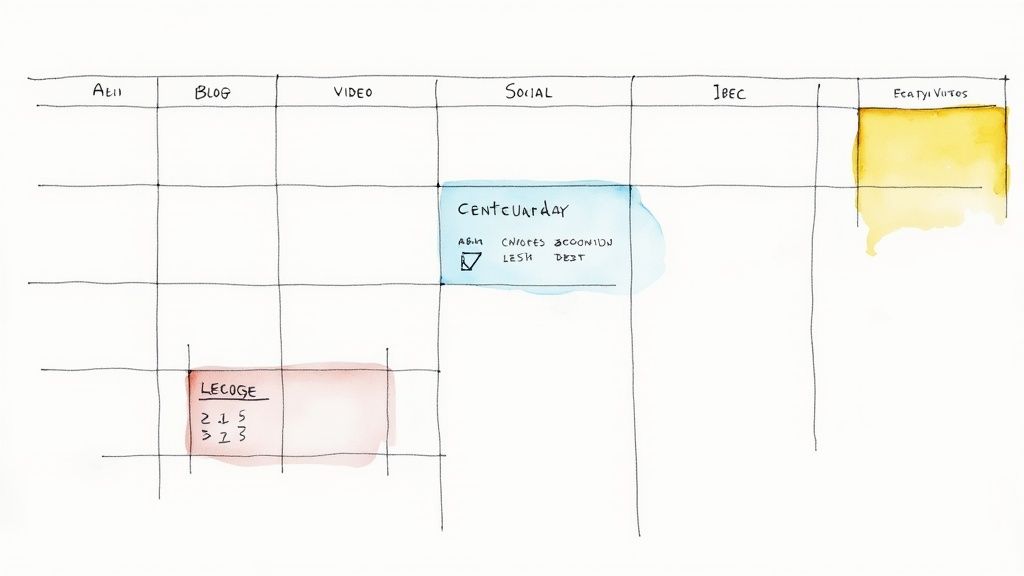
This system ensures a steady flow of valuable content across all your channels. It provides a single source of truth for your entire team, outlining what is being published, when, and by whom. This level of organization is crucial for coordinating campaigns, maintaining a consistent brand voice, and ensuring no opportunities are missed.
Why It's Foundational
A content calendar provides structure and accountability, turning abstract strategy into a tangible action plan. It prevents the frantic scramble for ideas and allows your team to work ahead, focusing on quality rather than just meeting deadlines. This foresight is critical for building momentum and achieving long-term growth.
Companies like Buffer and Hootsuite have built their reputations on organized content planning, often sharing their methodologies publicly. They demonstrate how a well-maintained calendar allows for thematic consistency, supports multi-channel campaigns, and allocates resources effectively. This strategic approach ensures every piece of content serves a purpose within the larger marketing ecosystem.
Actionable Implementation Steps
To implement a robust content planning system, focus on creating a sustainable and flexible workflow that your team can stick to.
Plan in Advance: Schedule evergreen content at least 4-6 weeks out. This provides a stable foundation and frees up resources for more timely pieces.
Leave Room for Flexibility: Keep around 20-30% of your calendar open. This buffer allows you to react to trending topics, industry news, or unexpected opportunities without derailing your entire strategy.
Organize and Color-Code: Use a system to categorize your content. Color-code entries by content pillar, format (blog, video, social), target platform, or campaign to get an at-a-glance overview of your content mix. This is especially helpful when mapping out how a single topic can be supported by various related assets, a process you can learn more about by reading about long-tail keyword research strategies.
Incorporate Workflows: Your calendar shouldn't just list publish dates. Include key milestones like draft deadlines, review stages, and final approvals to ensure everyone knows their responsibilities and timelines.
3. Prioritize Quality Over Quantity
In a landscape saturated with content, the temptation is to publish as frequently as possible to stay visible. However, one of the most impactful content creation best practices is to shift focus from volume to value. This means creating fewer, higher-quality pieces that serve your audience deeply, rather than churning out mediocre content on a relentless schedule. This approach builds authority, improves audience trust, and ultimately generates better long-term results.
This strategic pivot ensures that every piece you publish is a significant asset. It answers your audience's questions so comprehensively that they have no need to look elsewhere. This is how you create content that not only ranks but also earns loyalty and becomes a go-to resource in your industry.
Why It's Foundational
Prioritizing quality over quantity transforms your content from a disposable commodity into a durable, evergreen asset. It builds a stronger brand reputation, fosters deeper audience engagement, and leads to superior SEO performance. A single, comprehensive guide can attract more high-quality backlinks, social shares, and organic traffic over its lifetime than dozens of superficial blog posts combined. It's about making every piece count.
For example, Brian Dean of Backlinko built an entire SEO empire by publishing in-depth, "definitive guides" on a very infrequent schedule. Similarly, Seth Godin's blog entries, while often brief, are so insightful and thought-provoking that each one carries significant weight. These creators understand that their authority is built on the substance of their work, not the frequency of their posts.
Actionable Implementation Steps
To shift your focus from quantity to quality, you must invest more time and resources into each content piece.
Create Pillar Content: Develop comprehensive guides, tutorials, or resource hubs that cover a broad topic in immense detail. These "pillar pages" act as central assets that you can link to from smaller, related articles.
Invest in Original Research: Conduct your own surveys, analyze proprietary data, or compile unique industry statistics. Original data is highly linkable and positions you as an authority.
Refine Your Pre-Publication Process: Allocate significant time for outlining, drafting, and editing. Employ professional copyediting and design services to ensure every article is polished, professional, and visually appealing.
Focus on Evergreen Value: Create content that will remain relevant and useful for years, not just weeks. Solve timeless problems for your audience rather than chasing fleeting trends.
4. Optimize for Search Engines (SEO)
Creating exceptional content is only half the battle; ensuring it gets discovered is the other. This is where search engine optimization (SEO) becomes a non-negotiable component of any effective content creation best practices checklist. SEO is the process of structuring and enhancing your content so that search engines like Google can easily find, understand, and rank it for relevant user queries.
This practice involves a strategic blend of keyword research, on-page optimization, and technical considerations. By aligning your content with what both users and search engine algorithms are looking for, you create a powerful engine for attracting sustainable, high-intent organic traffic to your website.
Why It's Foundational
SEO directly connects your content with an audience actively seeking solutions you provide. Unlike paid ads that interrupt, organic search results provide answers at the exact moment of need, building authority and trust. It transforms your content from a temporary campaign into a long-term asset that can generate leads and traffic for months or even years.
For instance, Backlinko, founded by Brian Dean, built its entire brand on creating comprehensive, SEO-driven guides that dominate search results for highly competitive marketing terms. Similarly, Ahrefs uses its own blog to demonstrate best-in-class SEO, ranking for thousands of keywords related to its toolset and attracting a massive, relevant audience of potential customers.
Actionable Implementation Steps
To effectively integrate SEO into your content workflow, focus on both foundational research and on-page execution.
Conduct Strategic Keyword Research: Target long-tail keywords (phrases of 3+ words) that have clear user intent and manageable competition. These often convert better as they capture users further along in their search journey.
Master On-Page Elements: Include your primary keyword in the page title, meta description, URL, and at least one subheading (H2). Naturally weave it into the first 100 words of your introduction.
Prioritize User Intent: Create comprehensive content that fully answers the user's query. For competitive topics, this often means writing in-depth articles that serve as a one-stop resource. For guidance on keyword density, explore a deep dive into how many keywords per page is optimal for ranking.
Build Authority with Links: Use internal links to connect related articles, establishing a clear site hierarchy for search engines. Earn external backlinks from reputable sites through outreach and creating link-worthy content.
Optimize for Technical SEO: Ensure your page loads quickly and provides a good user experience on all devices by paying attention to Google's Core Web Vitals.
5. Create Data-Driven Content with Original Research
In a landscape saturated with repurposed information, one of the most powerful content creation best practices is to generate your own data. Conducting original surveys, studies, or internal data analyses allows you to create truly unique content that establishes authority, earns valuable backlinks, and provides insights your competitors simply cannot replicate. This practice transforms your brand from a commentator into a primary source.
This approach moves beyond curating existing statistics to creating new ones. By publishing proprietary research, you provide your industry with fresh, credible information that journalists, bloggers, and other creators will reference and link back to, significantly boosting your SEO and brand credibility.
Why It's Foundational
Original research is a long-term content asset that positions your brand as a thought leader. It’s inherently valuable because it’s exclusive. Instead of competing on the same keywords with the same talking points, you create a new conversation that you own. This not only attracts high-quality backlinks but also builds immense trust with your audience, as you become their go-to source for reliable industry data.
For example, Buffer's annual State of Social Media report is a cornerstone of their content strategy. By surveying thousands of marketers, they generate unique insights that become a benchmark for the entire industry. Similarly, HubSpot's State of Inbound report is widely cited, reinforcing their authority in the marketing space and driving massive organic traffic and leads year after year.
Actionable Implementation Steps
To integrate this practice, focus on creating credible, relevant research and promoting it effectively.
Define a Compelling Topic: Identify a key question or knowledge gap within your industry. What data does your audience wish they had? What trends are emerging but lack hard numbers?
Ensure Statistical Significance: Aim to survey a large and relevant sample size, ideally 500+ respondents, to ensure your findings are credible and statistically sound. Clearly document and share your methodology to build trust.
Create Multiple Content Formats: Don’t just publish a PDF report. Repurpose your findings into a comprehensive blog post, an infographic, a webinar, social media graphics, and even a press release to maximize reach and appeal to different audience segments.
Partner for Greater Reach: Collaborate with another respected brand in a complementary niche to co-author the research. This expands your promotional reach, splits the workload, and lends additional credibility to the findings.
6. Develop Multi-Format Content Strategy
Relying on a single content format, such as blog posts, significantly limits your reach. An essential component of modern content creation best practices is developing a multi-format strategy that caters to diverse audience preferences. This approach involves creating and adapting your core ideas into various formats like videos, podcasts, infographics, and interactive tools to maximize distribution potential and accessibility.
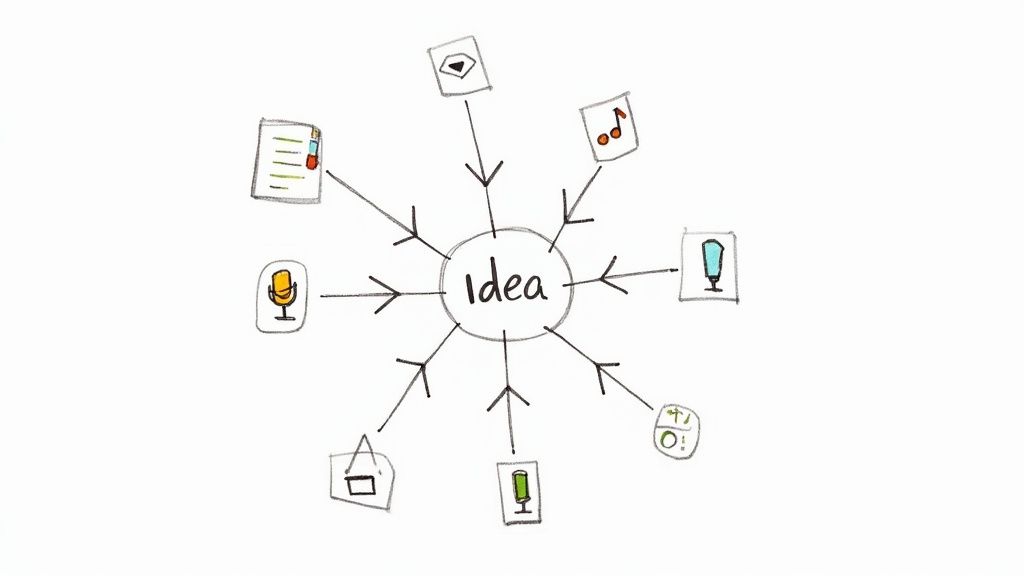
This strategy ensures your message connects with different segments of your audience. Some people prefer watching a video tutorial, others enjoy listening to a podcast during their commute, and many still value a detailed, scannable article. By diversifying, you meet your audience where they are most comfortable.
Why It's Foundational
A multi-format strategy transforms a single content idea into a comprehensive campaign, extending its lifespan and return on investment. It allows you to dominate a topic across multiple platforms, increasing brand authority and capturing traffic from different channels. When executed well, this method amplifies your message without requiring a constant stream of brand-new ideas.
For example, Neil Patel is a master of this, frequently turning his in-depth blog posts into engaging YouTube videos and shareable infographics. Similarly, TED takes its iconic talks and converts them into articles, transcripts, and social media clips, ensuring the core message reaches a global audience through every conceivable medium. This modular approach makes content more resilient and far-reaching.
Actionable Implementation Steps
To build an effective multi-format strategy, focus on systematically repurposing core concepts rather than starting from scratch for each format.
Start with a Pillar Piece: Create a comprehensive, in-depth piece of content like a detailed guide or research report. This will serve as the source material for all other formats.
Repurpose Strategically: A key element is understanding how to repurpose content for maximum impact, extending its reach and value. Break down your pillar piece into smaller, format-specific assets like a series of social media posts, a short video summary, an infographic, and a podcast episode.
Optimize for Each Platform: Don't just copy and paste. Tailor each piece of content to its native platform. A YouTube video needs a compelling thumbnail and description, while an Instagram post requires a strong visual and concise caption.
Use Tools to Boost Efficiency: Leverage transcription services to turn video or audio into text for blog posts. Use design templates and AI-powered tools to quickly create infographics and social media graphics from key data points.
7. Master Copywriting and Storytelling Techniques
Excellent content goes beyond just providing information; it connects with the reader on an emotional level. Mastering copywriting and storytelling techniques involves using compelling narrative structures, psychological triggers, and persuasive language to create content that captivates your audience. This practice transforms dry facts into memorable stories that resonate long after the reader has left the page.
This foundational skill is what separates content that merely exists from content that converts. It’s the art of framing your message within a narrative that addresses a reader's problems, presents a solution, and guides them toward a desired action, making it one of the most crucial content creation best practices.

Why It's Foundational
Storytelling is hardwired into human psychology. A good story makes abstract concepts concrete and builds an emotional bridge between a brand and its audience, fostering trust and loyalty. By focusing on narrative, you can differentiate your brand in a crowded market and make your value proposition far more impactful than a simple list of features.
For example, TOMS Shoes built an empire not just on footwear, but on its "One for One" story, making every purchase feel like a contribution to a greater cause. Similarly, Donald Miller's StoryBrand framework has helped thousands of businesses clarify their message by positioning the customer as the hero of the story, with the brand as their trusted guide. This narrative-driven approach makes the brand’s value proposition instantly understandable and compelling.
Actionable Implementation Steps
To weave powerful storytelling and copywriting into your content, focus on structure, emotion, and clarity.
Lead with a Compelling Hook: Grab your reader's attention within the first two sentences. Start with a surprising statistic, a relatable problem, or an intriguing question to make them want to read more.
Focus on Benefits Over Features: Instead of listing what your product does, explain how it solves your customer’s problem and improves their life. Frame the narrative around the transformation or outcome they will experience.
Use a Clear Narrative Arc: Structure your content with a beginning (the problem), a middle (the solution), and an end (the successful outcome or call to action). This familiar structure makes information easier to process and remember.
Develop a Consistent Brand Voice: Whether it’s witty, authoritative, or empathetic, maintain a consistent voice across all content to build a recognizable brand personality.
Leverage Customer Stories: Incorporate testimonials and case studies as mini-stories. These provide social proof and demonstrate your value in a relatable, human-centered way.
8. Implement Consistent Measurement and Analytics
Creating content without measuring its performance is like driving with your eyes closed. A core tenet of modern content creation best practices is to establish a robust system for tracking and analyzing key metrics. This data-driven approach moves content from a subjective art to a measurable science, allowing you to understand what works, what doesn't, and where to invest your resources for maximum impact.
This practice involves setting up analytics tools, defining key performance indicators (KPIs), and regularly reviewing data to refine your strategy. It’s the feedback loop that fuels continuous improvement and proves the value of your content efforts to stakeholders.
Why It's Foundational
Consistent measurement turns content into a predictable growth engine rather than a gamble. By tracking metrics, you can identify high-performing topics, optimize underperforming pages, and understand how content contributes to business objectives like lead generation and sales. It provides the evidence needed to justify budgets and scale your content operations effectively.
For example, Buffer meticulously tracks the performance of its social media and blog content, using the data to double down on formats and topics that resonate most with its audience. Similarly, Ahrefs uses its own powerful tools to analyze which of their blog posts drive the most organic traffic and sign-ups, directly informing their future content calendar.
Actionable Implementation Steps
To integrate data into your workflow, focus on setting up a consistent tracking and review process from day one.
Establish Baseline Metrics: Before launching a new campaign, document your current performance. This baseline is crucial for accurately measuring the impact of your new content initiatives.
Track Key Performance Indicators (KPIs): Define what success looks like. Track both leading indicators (e.g., organic traffic, keyword rankings) and lagging indicators (e.g., leads generated, conversion rate).
Create Custom Dashboards: Use tools like Google Analytics or Looker Studio to build dashboards tailored to different stakeholders. Your CEO might care about MQLs from the blog, while your content team focuses on on-page engagement metrics.
Review Analytics Regularly: Don’t wait for the end of the quarter. Schedule weekly or bi-weekly check-ins to spot trends, identify quick wins, and address issues before they become significant problems. This also helps you understand how factors like tracking your site's authority over time correlate with traffic and ranking improvements.
9. Build Distribution and Promotion Strategy
Great content is only effective if people see it. One of the most overlooked content creation best practices is having a systematic plan to promote your work across multiple channels. Strategic distribution ensures your content reaches its intended audience beyond initial organic discovery, maximizing its visibility, impact, and lifespan. This involves a deliberate mix of owned, earned, and paid media to create multiple touchpoints for engagement.
Publishing content is only the starting point. A robust distribution strategy transforms a static asset into a dynamic marketing tool that actively seeks out and engages potential customers. Without it, even the highest-quality content risks being lost in the digital noise.
Why It's Foundational
A well-planned distribution strategy amplifies your content's reach exponentially, accelerating results and maximizing your return on investment. It prevents the "publish and pray" approach, where creators hope for organic traffic without a plan to generate it. By actively pushing content to relevant platforms, you drive immediate traffic, gather valuable feedback, and build momentum that can significantly boost long-term organic performance.
For instance, HubSpot's multi-channel launch strategy for its annual "State of Marketing" report includes email blasts to its subscriber list, social media campaigns, paid ads targeting specific professional segments, and outreach to industry partners. This comprehensive approach ensures the report becomes a cornerstone industry resource year after year. Similarly, BuzzFeed’s entire model is built on creating content engineered for distribution, optimized for social sharing to achieve viral reach.
Actionable Implementation Steps
To build an effective distribution engine, move beyond simply hitting "publish" and create a repeatable promotional checklist for every piece of content.
Plan for a Multi-Channel Push: Create a distribution plan before you publish. Identify key channels like your email newsletter, social media profiles (LinkedIn, Twitter, etc.), relevant online communities (Reddit, Slack groups), and potential paid advertising platforms.
Customize Messaging for Each Platform: Don't just share a link. Tailor your promotional copy to fit the context and audience of each channel. A LinkedIn post should sound different from a tweet or a community forum comment.
Leverage Your Owned Audience First: Your email list and social media followers are your most engaged audience. Make them the first to know about new content to spark initial traction and social proof.
Use Paid Ads to Boost Winners: Identify your top-performing organic content using analytics. Invest a small paid budget to amplify these proven assets, driving them to a wider, yet still targeted, audience.
10. Foster Audience Engagement and Community Building
Great content doesn't end when you hit "publish." A core element of modern content creation best practices is transforming passive readers into an active, engaged community. This involves creating interactive experiences, actively participating in conversations, and building a space where your audience feels connected to your brand and each other.
This practice moves beyond one-way communication to foster a two-way dialogue. By actively engaging, you build loyalty, gather invaluable feedback, and turn consumers into advocates who willingly share and champion your content.
Why It's Foundational
Building a community around your content creates a powerful, defensible moat for your brand. It reduces reliance on volatile platform algorithms by establishing a direct line to your most loyal followers. When an audience feels heard and valued, they become a source of user-generated content, product feedback, and authentic testimonials that are far more persuasive than traditional marketing.
Peloton excels at this by building an entire ecosystem around its classes, where users share achievements and encourage one another. Similarly, Duolingo fosters a highly engaged user base through forums and leaderboards, turning a solo learning activity into a shared community experience that boosts user retention and advocacy.
Actionable Implementation Steps
To shift from content broadcasting to community building, you must be intentional and consistent in your engagement efforts.
Be Responsive and Proactive: Aim to respond to comments and questions across all platforms within 24 hours. Don't just answer; ask follow-up questions to spark deeper conversations.
Create Exclusive Spaces: Establish a dedicated community hub like a Slack channel, a Discord server, or a private Facebook group. Offer exclusive content, early access, or direct interaction with your team in these spaces.
Encourage User-Generated Content (UGC): Run contests, create unique hashtags, or feature customer stories and testimonials in your content. This not only provides social proof but also makes your audience feel like co-creators.
Host Live, Interactive Events: Regularly schedule Q&As, AMAs (Ask Me Anything), or live workshops. These events create a sense of urgency and provide a forum for real-time interaction that strengthens community bonds.
10-Point Comparison of Content Creation Best Practices
Strategy | Complexity 🔄 | Resource Requirements ⚡ | Expected Outcomes 📊⭐ | Ideal Use Cases 💡 | Key Advantages ⭐ |
|---|---|---|---|---|---|
Define Clear Goals and Target Audience | Medium — upfront research & mapping 🔄 | Low–Medium — analytics, interviews, time ⚡ | Better targeting, higher conversions, clearer ROI 📊⭐ | New strategies, product launches, audience refinement 💡 | Focused strategy, reduced wasted effort ⭐ |
Develop a Content Calendar and Planning System | Medium — workflow & scheduling setup 🔄 | Low–Medium — tools, coordination, time ⚡ | Consistent publishing, smoother operations 📊⭐ | Multi-channel teams, campaign coordination 💡 | Predictability, improved resource allocation ⭐ |
Prioritize Quality Over Quantity | Medium–High — deep research & editing 🔄 | High — expert writers, designers, time ⚡ | Stronger SEO, sustained engagement, higher ROI per piece 📊⭐ | Thought leadership, competitive/complex topics 💡 | Authority building, longer content lifespan ⭐ |
Optimize for Search Engines (SEO) | High — technical + content optimizations 🔄 | Medium–High — SEO tools, specialists, ongoing work ⚡ | Long-term organic traffic growth and visibility 📊⭐ | Evergreen content, discoverability and lead gen goals 💡 | Sustainable traffic, cost-effective over time ⭐ |
Create Data-Driven Content with Original Research | High — study design & analysis 🔄 | Very High — surveys, analysts, distribution budget ⚡ | High shareability, backlinks, media coverage 📊⭐ | Industry reports, B2B thought leadership, PR plays 💡 | Unique, defensible insights and thought leadership ⭐ |
Develop Multi-Format Content Strategy | High — format coordination & repurposing 🔄 | High — varied skillsets, production tools, budget ⚡ | Broader reach, repurposing efficiencies, accessibility 📊⭐ | Brands targeting diverse preferences, omni-channel plans 💡 | Maximize ROI via repurposing, reach multiple audiences ⭐ |
Master Copywriting and Storytelling Techniques | Medium — skill development & testing 🔄 | Medium — training, editors, A/B testing ⚡ | Higher engagement, conversion lift, memorability 📊⭐ | Brand messaging, conversion pages, campaigns needing emotion 💡 | Stronger emotional connection and differentiation ⭐ |
Implement Consistent Measurement and Analytics | High — tracking setup & data interpretation 🔄 | Medium–High — analytics tools, analysts, dashboards ⚡ | Data-driven optimization, clear ROI, actionable insights 📊⭐ | Scaling programs, performance marketing, executive reporting 💡 | Informed decisions, measurable improvements ⭐ |
Build Distribution and Promotion Strategy | High — multi-channel coordination 🔄 | High — ad spend, partnerships, PR resources ⚡ | Accelerated reach and visibility, diversified traffic 📊⭐ | Product launches, time-sensitive campaigns, growth pushes 💡 | Amplified reach, reduced reliance on organic alone ⭐ |
Foster Audience Engagement and Community Building | Medium–High — moderation & ongoing engagement 🔄 | Medium — community managers, platforms, content ⚡ | Increased loyalty, UGC, improved retention and feedback 📊⭐ | Subscription services, SaaS, consumer brands seeking advocacy 💡 | Stronger retention, authentic advocacy, feedback loop ⭐ |
Putting Your Content Creation Framework into Action
You have now explored the comprehensive ecosystem of modern content creation. We’ve moved beyond simplistic tips and delved into a strategic framework designed for sustainable growth. The journey from defining your audience and goals to measuring performance and fostering a community is not a linear path but a continuous, dynamic cycle. Mastering these content creation best practices transforms your approach from a series of disconnected tasks into a cohesive, high-performance system that consistently delivers results.
The true power of this framework lies not in executing each of the ten practices in isolation, but in their integration. Your audience research directly informs your SEO keyword strategy. Your commitment to quality guides your multi-format production, ensuring every video, podcast, or blog post meets a high standard. Your robust analytics and measurement then close the loop, providing concrete data that fuels your next great idea, making your content strategy smarter with every piece you publish.
From Theory to Tangible Results
It's easy to look at a comprehensive list and feel overwhelmed. The key is to avoid trying to perfect everything at once. Instead, adopt a mindset of incremental improvement.
Start with an Audit: Where is your current process weakest? Are you creating content without a clear distribution plan? Are you publishing without analyzing performance data? Identify the single biggest bottleneck holding you back.
Focus on One Area: Dedicate the next month to mastering that one weak point. If it’s SEO, focus on improving your on-page optimization for every new article. If it’s engagement, commit to responding to every comment and starting conversations.
Build Your System: Once you've improved one area, move to the next. Gradually, these individual best practices will connect to form a powerful, repeatable workflow. This systematic approach is what separates fleeting content success from building a durable, long-term asset.
Ultimately, adopting these content creation best practices is about shifting your perspective. Content is not just a marketing expense; it is a strategic, revenue-generating asset that builds brand equity, nurtures customer relationships, and drives predictable organic growth. It's the engine that powers your customer acquisition and retention efforts in an increasingly competitive digital landscape.
By consistently applying these principles, you move from just adding noise to the internet to creating genuine value. You build a library of resources that serves your audience, establishes your authority, and works for your business 24/7. This is the path to turning your content into your most powerful growth lever. The framework is here, the tools are available, and the opportunity is yours to seize. Now, it's time to get to work.
Ready to eliminate the guesswork and accelerate your growth? The tools from Viral SEO are designed to help you implement these content creation best practices with precision, from identifying high-traffic content gaps to ensuring every article is perfectly optimized for search engines. Start building your content engine today at Viral SEO and turn your strategy into measurable results.
Blogs
More Blogs
From keyword goldmines to AI-driven content hacks—expert insights to help your blog posts dominate the first page.